


 |
市場調查報告書
商品編碼
2116328
零售第三方物流:市場佔有率分析、產業趨勢與統計、成長預測(2026-2031)Retail 3PL - Market Share Analysis, Industry Trends & Statistics, Growth Forecasts (2026 - 2031) |
||||||

※ 本網頁內容可能與最新版本有所差異。詳細情況請與我們聯繫。
據 Mordor Intelligence 稱,2025 年零售 3PL 市值為 1830.8 億美元,預計將從 2026 年的 1933.8 億美元成長到 2031 年的 2542.4 億美元,預測期(2026-2031 年)的複合年成長率為 5.63%。
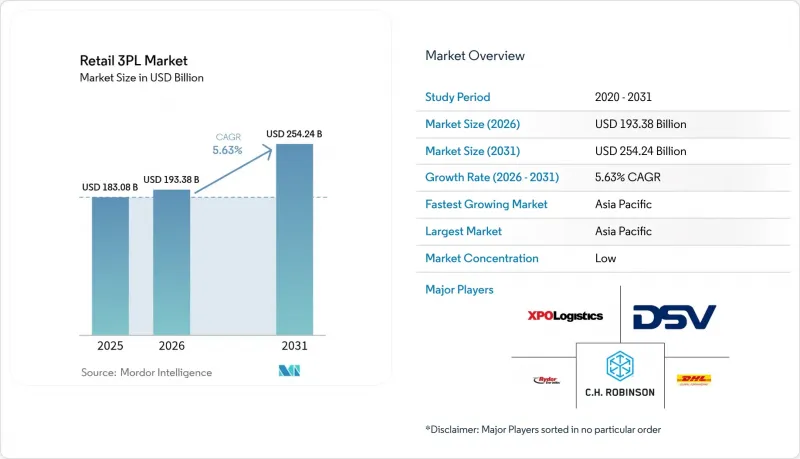
本報告按服務(例如,國內運輸管理)、產品(例如,食品飲料、時尚生活)、分銷管道(例如,超市、大型超市、便利商店、百貨公司、線上通路)、物流模式(例如,輕資產、重資產)和地區(例如,北美、亞太地區)進行分類。市場預測以美元計價。
全球零售第三方物流市場趨勢與洞察
網路快時尚退貨激增。
線上時尚零售業「回頭客」的存在以及寬鬆的退貨政策正在改變倉庫的工作流程和庫存估值方式。根據美國零售聯合會 (NRF) 預測,到 2024 年,零售退貨總額預計將達到 8,900 億美元,其中時尚產業受到的影響最大。目前,退貨成本佔原售價的 50% 以上,零售商也擴大將這項流程外包給專門從事回收和轉售的第三方物流(3PL) 公司。創業投資持續流入技術驅動的逆向物流平台,DHL 供應鏈於 2025 年 1 月收購 Immer 供應鏈解決方案公司,鞏固了其作為北美最大退貨處理公司的地位。資產規模較小的 3PL 公司可以部署基於雲端的平台,而無需受傳統網路的限制,從而能夠在這一細分市場快速擴張,並提高回收率和縮短週期。
微型履約中心的引入
連鎖超市和電商企業正在透過在其都市區門市內部或附近安裝5000至10000平方英尺的自動化模組來縮短「最後一公里」配送。 Hy-Vee已與Takeoff Technologies公司合作,亞馬遜也在部分Whole Foods門市試行使用Fulfil公司的機器人技術。微型倉配模式透過減少揀貨距離、配送距離和提高貨架庫存率來降低單位成本。對於第三方物流(3PL)供應商而言,微型倉配代表著一項全新的服務,它融合了自動化工程、維護和快速補貨運輸。早期採用者報告稱,週期時間縮短了30%以上,生產效率提高了兩位數,這使得該模式成為推動網路重新設計的催化劑。
人手不足和工資上漲
預計到2030年,勞動力缺口將達到8,500萬人,這將推高營運成本並擠壓利潤空間。倉儲業者報告稱,可用勞動力短缺高達73%。為了維持處理能力,第三方物流公司正在部署自主機器人、勞動力管理軟體和交叉培訓計劃,以提高每小時的生產效率。然而,薪資的快速上漲仍在侵蝕低利潤服務業的盈利,迫使供應商重新談判合約並將額外費用轉嫁給客戶。
細分市場分析
隨著零售商採購管道多元化和市場覆蓋範圍擴大,國際貨運管理正以6.84%的複合年成長率成長,超過了零售第三方物流市場的整體成長率。該服務業依賴最佳化的空運、海關監管和多模態路線,幫助品牌縮短時尚產品的前置作業時間,並在促銷期間電子產品需求激增時及時補充庫存。 UPS正尋求收購Estafeta,以增強其在墨西哥和美國之間的跨境快遞能力。日益成長的準時交貨需求正迫使第三方物流公司整合數位貨運市場、智慧路線規劃,並轉向更節能的運輸方式。
憑藉其成熟的實體網點和高吞吐量的小包裹物流,國內物流管理預計在2025年將佔總收入的47.40%。亞馬遜在2024年樹立了新的服務標桿,當日達或隔天達小包裹量達90億件,覆蓋美國140個大都會區。持續的網路最佳化、基於預測的庫存佈局以及區域分類中心的建立,正在縮短最後一公里配送距離,降低小包裹成本。儘管國內零售第三方物流市場預計將繼續擴張,但隨著國際物流流動加速以及全通路模式對端到端覆蓋的需求,其市場佔有率可能會有所下降。
到2025年,食品和飲料將佔總銷售額的33.55%。該領域穩定性強,韌性高,因為專業的運輸和倉儲管理對於低溫運輸規、嚴格的保存期限以及多溫區處理至關重要。區塊鏈先導計畫正在確保「從農場到餐桌」的可追溯性,縮短召回時間,並減少廢棄物。食品零售商正推動第三方物流供應商取得設施認證、整合物聯網感測器並實施預測性劣化分析,從而進一步將技術融入日常營運。
時尚生活產業成長最快,複合年成長率達6.35%,這主要得益於線上銷售的快速成長和退貨率的上升。隨著品牌擴大將印花、刺繡或小批量生產環節納入內部生產,以應對快速的潮流更迭,垂直整合的趨勢正在加速發展。專注於時尚退貨的第三方物流(3PL)服務市場正在擴張,GXO處理的退貨商品中有96%被重新入庫,從而維持了利潤率。包括二手服裝交易平台在內的二手經濟模式需要精細的分級、消毒和重新上架流程,領先的3PL公司正在將這些流程整合到其履約系統中。
區域分析
預計到2025年,亞太地區將以37.60%的市佔率佔據全球領先地位,複合年成長率(CAGR)為7.34%。在中國,165個電子商務試點區的清關延誤已顯著減少;在印度,隨著行動網路流量佔總訪問量的60%以上,全通路應用正在加速發展。東南亞物流走廊對智慧分類中心和保稅/免稅園區的投資正在蓬勃發展。政府激勵措施和不斷擴大的中產階級消費推動了小包裹量的持續兩位數成長,使該地區成為全球第三方物流(3PL)供應商的戰略要地。受電子產品出口和亞洲跨境電商成長的推動,亞太零售3PL市場持續擴張。
北美仍然是技術密集和創新主導市場。儘管亞馬遜在市場上佔據領先地位,但隨著主要競爭對手退出市場,XPO正在擴大其小包裹(零擔運輸)能力。人事費用的上升推動了自動化技術的普及,Symbotic公司透過在沃爾瑪網路中部署其「商品到人(GTP)」系統,已累積了50億美元的訂單。加州的環境法規正在加速電動短程運輸車輛的普及,第三方物流公司正在投資建造充電站和可再生能源驅動的物流中心。
在歐洲,碳中和法規正大力推動,脫歐後小包裹運輸的合規性也不斷完善。普洛斯(Prologis)已大規模部署屋頂太陽能發電系統,各大運輸公司也在高貨運量路線上進行氫燃料卡車的試運轉。都市區不斷上漲的房地產租金推動了多層倉庫和機器人系統的應用,從而最大限度地提高每立方公尺空間的利用率。南美、中東和非洲的電子商務發展迅速,儘管規模較小,但這促使全球第三方物流公司在最後一公里配送領域尋求輕資產合資企業、本地夥伴關係關係和有針對性的收購。
其他好處:
- Excel格式的市場預測(ME)表
- 3個月的分析師支持
目錄
第1章:引言
- 研究假設和市場定義
- 調查範圍
第2章:調查方法
第3章執行摘要
第4章 市場狀況
- 市場概覽
- 市場促進因素
- 線上快時尚零售商退貨量的激增推高了對逆向物流的需求。
- 超市連鎖店引進微型倉配中心
- 跨境電商平台正在推動保稅倉庫的需求。
- 已開發國家鼓勵倉庫使用可再生能源的獎勵(例如,歐盟綠色交易)
- 大型零售商的全通路策略
- 在墨西哥引進近岸倉儲業務,以調整庫存水準以應對通貨膨脹。
- 市場限制因素
- 勞動力短缺和工資上漲
- API整合零售與第三方物流網路所帶來的網路安全風險
- 分散的貨運能力正在影響服務水準協議的可靠性。
- 倉庫租金飆升
- 價值供應鏈分析
- 政府法規和政策
- 波特五力模型
- 價格分析
- 行業政策和法規
- 倉儲市場的整體趨勢
- 來自 CEP、最後一公里、低溫運輸等方面的需求。
- 物流業的技術進步
- 地緣政治事件對市場的影響
第5章 市場規模與成長預測
- 按服務
- 國內運輸管理
- 路
- 鐵路
- 空中航線
- 水路
- 國際運輸管理
- 路
- 鐵路
- 空中航線
- 水路
- 加值倉儲與物流 (VAWD)
- 國內運輸管理
- 依產品
- 食品/飲料
- 個人護理和居家護理
- 時尚與生活方式(配件、服裝、鞋類)
- 家具
- 電子設備及家用電器
- 其他產品
- 透過分銷管道
- 超市/大賣場/便利商店和百貨公司
- 專賣店
- 線上
- 其他頻道
- 透過物流模型
- 輕資產(託管)
- 資產密集型(公司車輛和倉庫)
- 混合
- 按地區
- 北美洲
- 美國
- 加拿大
- 墨西哥
- 南美洲
- 巴西
- 阿根廷
- 智利
- 其他南美國家
- 歐洲
- 德國
- 英國
- 法國
- 西班牙
- 義大利
- 荷蘭
- 俄羅斯
- 其他歐洲國家
- 亞太地區
- 中國
- 印度
- 日本
- 韓國
- 新加坡
- 越南
- 印尼
- 澳洲
- 其他亞太國家
- 中東
- 阿拉伯聯合大公國
- 沙烏地阿拉伯
- 土耳其
- 以色列
- 其他中東國家
- 非洲
- 南非
- 埃及
- 奈及利亞
- 肯亞
- 其他非洲國家
- 北美洲
第6章 競爭情勢
- 市場集中度
- 策略趨勢
- 市佔率分析
- 公司簡介
- DHL Supply Chain and Global Forwarding
- XPO Inc.
- DSV A/S
- CH Robinson Worldwide
- Ryder Supply Chain Solutions
- GXO Logistics
- Ceva Logistics
- Hellmann Worldwide Logistics
- Kuehne+Nagel
- UPS Supply Chain Solutions
- JB Hunt Transport Services
- Hub Group
- Nippon Express
- Kerry Logistics Network
- CJ Logistics
- Expeditors International
- Knight-Swift Transportation
- Geodis
- Agility Logistics
- Penske Logistics
- Aramex
- Dachser Group
- Kintetsu World Express
- SF Express
- Sinotrans
第7章 市場機會與未來展望
According to Mordor Intelligence, the retail 3PL market size was valued at USD 183.08 billion in 2025 and estimated to grow from USD 193.38 billion in 2026 to reach USD 254.24 billion by 2031, at a CAGR of 5.63% during the forecast period (2026-2031).
This report is Segmented by Service (Domestic Transportation Management, and More), by Product (Foods and Beverages, Fashion and Lifestyle and More), by Distribution Channel (Super/Hyper/Convenience and Department Stores, Online, and More), by Logistics Model (Asset-Light, Asset Heavy and More) and by Geography (North America, Asia-Pacific and More). The Market Forecasts are Provided in Terms of Value (USD).
Global Retail 3PL Market Trends and Insights
Surge in Online Fast-Fashion Returns
Serial returners and generous return policies in online fashion retail create flux in warehouse workflows and inventory valuation. The National Retail Federation states that total retail returns hit USD 890 billion in 2024, with fashion the most affected segment. Returns now cost more than 50% of the original sales price, prompting retailers to shift the task to 3PLs that specialise in reclamation and refurbishment. Venture capital keeps flowing into technology-enabled reverse-logistics platforms, and DHL Supply Chain's January 2025 acquisition of Inmar Supply Chain Solutions positions it as North America's largest returns processor. Asset-light 3PLs scale swiftly in this niche because they can deploy cloud-based platforms without legacy network constraints, improving recovery rates and cycle time.
Adoption of Micro-Fulfilment Centers
Grocery chains and quick-commerce specialists compress last-mile distances by embedding 5,000-10,000 sq ft automated modules inside or beside urban stores. Hy-Vee partners with Takeoff Technologies, while Amazon pilots Fulfil's robotics at select Whole Foods sites. The micro-fulfilment model trims unit economics: shorter picks, lower delivery miles, and higher on-shelf availability. For 3PLs, micro-fulfilment adds a new service line that blends automation engineering, maintenance, and rapid-replenishment transport. Early adopters report cycle-time reductions exceeding 30% and double-digit productivity gains, making the model a catalyst for wider network redesign.
Labour Shortages & Wage Inflation
A projected 85 million-worker gap by 2030 raises operating costs and compresses margins. Warehouse operators report a 73% labour-availability shortfall. To maintain throughput, 3PLs deploy autonomous mobile robots, labour-management software, and cross-training programs that raise productivity per hour. However, rapid wage escalation still erodes profitability in low-margin service lines, forcing providers to renegotiate contracts and pass through surcharges.
Other drivers and restraints analyzed in the detailed report include:
- Cross-Border E-commerce Platforms Fueling Bonded Warehousing
- Renewable-Energy-Powered Warehouses
- Cyber-security Risk From API-Integrated Networks
For complete list of drivers and restraints, kindly check the Table Of Contents.
Segment Analysis
International Transportation Management accelerates at a 6.84% CAGR, outstripping overall retail 3PL market growth as retailers diversify sourcing and expand marketplace reach. This service line relies on optimised airfreight, duty management, and multimodal routing, helping brands shorten fashion lead times and replenish electronics during promotional spikes. UPS moves to acquire Estafeta to bolster cross-border express capacity between Mexico and the United States. The heightened demand for time-definite delivery pushes 3PLs to integrate digital freight marketplaces, intelligent routing, and carbon-efficient modal shifts.
Domestic Transportation Management still accounts for 47.40% of 2025 revenue, thanks to entrenched brick-and-mortar networks and high-volume parcel flows. Amazon shipped 9 billion same- or next-day packages in 2024, covering 140 US metro areas and setting new service benchmarks. Continuous network densification, predictive inventory placement, and regional sort centres shorten final-mile distance and lower per-parcel cost. The retail 3PL market size for domestic services will continue growing, yet its share may erode as international flows accelerate and omnichannel models demand end-to-end coverage.
Food & Beverages holds 33.55% of the 2025 revenue. Cold-chain compliance, stringent expiry windows, and multi-temperature handling warrant specialised transport and warehousing, making this segment sticky and resilient. Blockchain pilots trace farm-to-fork provenance, cutting recall time and limiting waste. Grocery retailers push 3PLs to certify facilities, integrate IoT sensors, and deploy predictive spoilage analytics, embedding technology deeper into daily operations.
Fashion & Lifestyle grows fastest at 6.35% CAGR, riding booming online sales and high return volumes. Vertical integration gains traction as brands internalise printing, embroidery, or micro-batch manufacturing to meet rapid trend cycles. The retail 3PL market size dedicated to fashion returns processing widens because 96% of returned items handled by GXO re-enter inventory, preserving margin. Circular-economy models, including second-hand apparel marketplaces, demand meticulous grading, sanitising, and re-listing workflows that sophisticated 3PLs now embed into fulfilment logic.
Complete Report Scope:
- By Service
- Domestic Transportation Management
- Roadways
- Railways
- Airways
- Waterways
- International Transportation Management
- Roadways
- Railways
- Airways
- Waterways
- Value-Added Warehousing and Distribution (VAWD)
- Domestic Transportation Management
- By Product
- Foods and Beverages
- Personal and Household Care
- Fashion and Lifestyle (accessories, apparel, footwear)
- Furniture
- Electronics and Household Appliances
- Other Products
- By Distribution Channel
- Super/Hyper/Convenience and Department Stores
- Specialty Stores
- Online
- Other Channels
- By Logistics Model
- Asset-Light (Management-Based)
- Asset-Heavy (Own Fleet and Warehouses)
- Hybrid
- By Region
- North America
- United States
- Canada
- Mexico
- South America
- Brazil
- Argentina
- Chile
- Rest of South America
- Europe
- Germany
- United Kingdom
- France
- Spain
- Italy
- Netherlands
- Russia
- Rest of Europe
- Asia-Pacific
- China
- India
- Japan
- South Korea
- Singapore
- Vietnam
- Indonesia
- Australia
- Rest of Asia-Pacific
- Middle East
- United Arab Emirates
- Saudi Arabia
- Turkey
- Israel
- Rest of Middle East
- Africa
- South Africa
- Egypt
- Nigeria
- Kenya
- Rest of Africa
- North America
Geography Analysis
Asia-Pacific leads with a 37.60% share in 2025 and posts a 7.34% CAGR. China's 165 e-commerce pilot zones slash customs delays, and India's omnichannel adoption gains speed as mobile web traffic tops 60% of total sessions. Southeast Asian logistics corridors attract investment in smart sortation hubs and bonded, duty-free parks. Government incentives and booming middle-class consumption underpin sustained double-digit parcel growth, making the region a strategic imperative for global 3PLs. The retail 3PL market size in Asia-Pacific expands in tandem with electronic-goods exports and intra-Asia cross-border commerce.
North America remains technology-intensive and innovation-driven. Amazon leads the marketplace, while XPO expands less-than-truckload capacity after a major rival exited the market. High labour costs propel automation roll-outs, with Symbotic installing goods-to-person systems across Walmart's network, adding a USD 5 billion backlog. Environmental regulations in California spur electrified drayage fleets, prompting 3PLs to invest in charging depots and renewable-powered distribution centres.
Europe features a regulatory push for carbon neutrality and continues to refine cross-border parcel compliance after Brexit. Prologis deploys rooftop solar at scale, and leading carriers trial hydrogen trucks along dense freight corridors. Escalating property rents in urban zones encourage multi-storey warehousing and robotic systems that maximise cubic utilisation. South America, the Middle East, and Africa remain smaller but show rapid e-commerce uptake, encouraging global 3PLs to pursue asset-light joint ventures, local partnerships, and targeted last-mile acquisitions.
- DHL Supply Chain and Global Forwarding
- XPO Inc.
- DSV A/S
- C.H. Robinson Worldwide
- Ryder Supply Chain Solutions
- GXO Logistics
- Ceva Logistics
- Hellmann Worldwide Logistics
- Kuehne + Nagel
- UPS Supply Chain Solutions
- J.B. Hunt Transport Services
- Hub Group
- Nippon Express
- Kerry Logistics Network
- CJ Logistics
- Expeditors International
- Knight-Swift Transportation
- Geodis
- Agility Logistics
- Penske Logistics
- Aramex
- Dachser Group
- Kintetsu World Express
- SF Express
- Sinotrans
Additional Benefits:
- The market estimate (ME) sheet in Excel format
- 3 months of analyst support
TABLE OF CONTENTS
1 Introduction
- 1.1 Study Assumptions and Market Definition
- 1.2 Scope of the Study
2 Research Methodology
3 Executive Summary
4 Market Landscape
- 4.1 Market Overview
- 4.2 Market Drivers
- 4.2.1 Surge in Online Fast-Fashion Returns Driving Reverse Logistics Demand
- 4.2.2 Adoption of Micro-Fulfilment Centers by Grocery Chains
- 4.2.3 Cross-Border E-commerce Platforms Fueling Bonded Warehousing Needs
- 4.2.4 Renewable-Energy-Powered Warehouses Incentivized in Developed Countries (For e.g. EU Green Deal)
- 4.2.5 Omni-channel Transformation of Big-Box Retailers
- 4.2.6 Near-shoring Warehousing to Mexico for Inflation-led Inventory Rebalancing
- 4.3 Market Restraints
- 4.3.1 Labor Shortages and Wage Inflation
- 4.3.2 Cyber-security Risk From API-integrated Retail-3PL Networks
- 4.3.3 Fragmented Trucking Capacity Impacting SLA Reliability
- 4.3.4 Escalating Warehouse Rents
- 4.4 Value / Supply-Chain Analysis
- 4.5 Government Regulations and Policies
- 4.6 Porter's Five Forces
- 4.6.1 Threat of New Entrants
- 4.6.2 Bargaining Power of Buyers
- 4.6.3 Bargaining Power of Suppliers
- 4.6.4 Threat of Substitutes
- 4.6.5 Intensity of Competitive Rivalry
- 4.7 Pricing Analysis
- 4.8 Industry Policies and Regulations
- 4.9 General Trends in the Warehousing Market
- 4.10 Demand From CEP, Last-Mile, Cold-Chain, etc.
- 4.11 Technological Developments in Logistics industry
- 4.12 Impact of Geopolitical Events on the Market
5 Market Size and Growth Forecasts
- 5.1 By Service
- 5.1.1 Domestic Transportation Management
- 5.1.1.1 Roadways
- 5.1.1.2 Railways
- 5.1.1.3 Airways
- 5.1.1.4 Waterways
- 5.1.2 International Transportation Management
- 5.1.2.1 Roadways
- 5.1.2.2 Railways
- 5.1.2.3 Airways
- 5.1.2.4 Waterways
- 5.1.3 Value-Added Warehousing and Distribution (VAWD)
- 5.1.1 Domestic Transportation Management
- 5.2 By Product
- 5.2.1 Foods and Beverages
- 5.2.2 Personal and Household Care
- 5.2.3 Fashion and Lifestyle (accessories, apparel, footwear)
- 5.2.4 Furniture
- 5.2.5 Electronics and Household Appliances
- 5.2.6 Other Products
- 5.3 By Distribution Channel
- 5.3.1 Super/Hyper/Convenience and Department Stores
- 5.3.2 Specialty Stores
- 5.3.3 Online
- 5.3.4 Other Channels
- 5.4 By Logistics Model
- 5.4.1 Asset-Light (Management-Based)
- 5.4.2 Asset-Heavy (Own Fleet and Warehouses)
- 5.4.3 Hybrid
- 5.5 By Region
- 5.5.1 North America
- 5.5.1.1 United States
- 5.5.1.2 Canada
- 5.5.1.3 Mexico
- 5.5.2 South America
- 5.5.2.1 Brazil
- 5.5.2.2 Argentina
- 5.5.2.3 Chile
- 5.5.2.4 Rest of South America
- 5.5.3 Europe
- 5.5.3.1 Germany
- 5.5.3.2 United Kingdom
- 5.5.3.3 France
- 5.5.3.4 Spain
- 5.5.3.5 Italy
- 5.5.3.6 Netherlands
- 5.5.3.7 Russia
- 5.5.3.8 Rest of Europe
- 5.5.4 Asia-Pacific
- 5.5.4.1 China
- 5.5.4.2 India
- 5.5.4.3 Japan
- 5.5.4.4 South Korea
- 5.5.4.5 Singapore
- 5.5.4.6 Vietnam
- 5.5.4.7 Indonesia
- 5.5.4.8 Australia
- 5.5.4.9 Rest of Asia-Pacific
- 5.5.5 Middle East
- 5.5.5.1 United Arab Emirates
- 5.5.5.2 Saudi Arabia
- 5.5.5.3 Turkey
- 5.5.5.4 Israel
- 5.5.5.5 Rest of Middle East
- 5.5.6 Africa
- 5.5.6.1 South Africa
- 5.5.6.2 Egypt
- 5.5.6.3 Nigeria
- 5.5.6.4 Kenya
- 5.5.6.5 Rest of Africa
- 5.5.1 North America
6 Competitive Landscape
- 6.1 Market Concentration
- 6.2 Strategic Moves
- 6.3 Market Share Analysis
- 6.4 Company Profiles {(includes Global level Overview, Market level Overview, Core Segments, Financials as available, Strategic Information, Market Rank/Share for key companies, Products and Services, and Recent Developments)}
- 6.4.1 DHL Supply Chain and Global Forwarding
- 6.4.2 XPO Inc.
- 6.4.3 DSV A/S
- 6.4.4 C.H. Robinson Worldwide
- 6.4.5 Ryder Supply Chain Solutions
- 6.4.6 GXO Logistics
- 6.4.7 Ceva Logistics
- 6.4.8 Hellmann Worldwide Logistics
- 6.4.9 Kuehne + Nagel
- 6.4.10 UPS Supply Chain Solutions
- 6.4.11 J.B. Hunt Transport Services
- 6.4.12 Hub Group
- 6.4.13 Nippon Express
- 6.4.14 Kerry Logistics Network
- 6.4.15 CJ Logistics
- 6.4.16 Expeditors International
- 6.4.17 Knight-Swift Transportation
- 6.4.18 Geodis
- 6.4.19 Agility Logistics
- 6.4.20 Penske Logistics
- 6.4.21 Aramex
- 6.4.22 Dachser Group
- 6.4.23 Kintetsu World Express
- 6.4.24 SF Express
- 6.4.25 Sinotrans
7 Market Opportunities and Future Outlook

 第三方物流(3PL) 市場:依服務類型、運輸方式、最終用戶和地區分類
 美國零售第三方物流:市場佔有率分析、行業趨勢和統計數據、成長預測(2026-2031 年)英國第三方物流(3PL):市場佔有率分析、產業趨勢與統計數據以及成長預測 (2026-2031)印度第三方物流:市場佔有率分析、產業趨勢與統計及成長預測(2026-2031)德國第三方物流(3PL):市場佔有率分析、產業趨勢與統計及成長預測 (2026-2031)法國第三方物流(3PL):市場佔有率分析、產業趨勢與統計及成長預測 (2026-2031)
 LLM精細化服務市場規模、佔有率、成長及全球產業分析、區域趨勢及2026年至2034年預測
 第三方化學品分銷市場:全球市場預測,2026-2032年第三方物流軟體市場:全球市場預測,2026-2032年第三方物流市場-2026-2032年全球市場預測