


 |
市場調查報告書
商品編碼
2124313
東南亞可再生能源:市場佔有率分析、產業趨勢與統計及成長預測(2026-2031年)Southeast Asia Renewable Energy - Market Share Analysis, Industry Trends & Statistics, Growth Forecasts (2026 - 2031) |
||||||

※ 本網頁內容可能與最新版本有所差異。詳細情況請與我們聯繫。
根據 Mordor Intelligence 估計,東南亞可再生能源市場在 2025 年的價值為 125.10 吉瓦,從 2026 年的 142.01 吉瓦成長到 2031 年的 267.84 吉瓦,預計在預測期(2026-2031 年的 267.84 吉瓦,預計在預測期(2026-2031 年)內複合年成長率為 3.5 年。
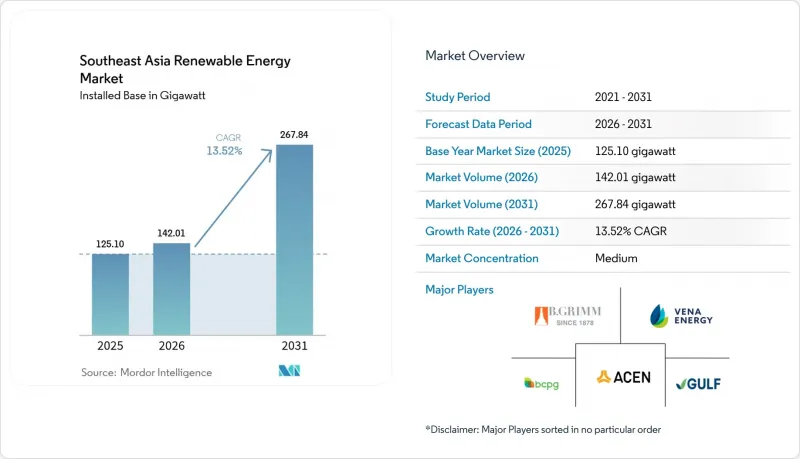
本報告按技術(太陽能、風能、水力發電、生質能源能、地熱能、海洋能)、最終用戶(公共產業、商業和工業、住宅)以及地區(越南、印尼、菲律賓、泰國、馬來西亞、新加坡和其他東南亞國家)進行細分。市場規模和預測以裝置容量(吉瓦)為單位。
東南亞可再生能源市場趨勢與洞察
新加坡基金推動綠色能源融資快速成長
新加坡的綠色債券框架旨在2030年發行350億新元的永續債券,以促進跨境資本流入東協各地的可再生能源項目。淡馬錫等政府投資機構正與貝萊德旗下規模達14億美元的氣候應變基金合作,引導私人資本流向分散式太陽能發電開發商,從而釋放先前未充分利用的商業和工業設施屋頂空間。挪威氣候投資基金向印尼Xurya公司投資5,500萬美元,顯示外國投資者傾向選擇符合工業用電需求特徵的小規模、可擴展的太陽能發電系統。本地銀行也紛紛效仿,星展銀行宣布加入RE100,顯示金融機構正在將綠色採購條款納入企業貸款,一個可再生能源採購為基本要求的生態系統正在形成。
越南和泰國出口主導產業的公司迅速承諾遵守 RE100 標準
在越南,從中國遷出的跨國公司對太陽能的需求超過了先前的預期,促使該國將2030年的太陽能發電目標提高到73吉瓦。泰國也呈現類似的趨勢,其5吉瓦的上網電價補貼(FIT)計畫明確針對汽車和電子產品製造商需要經過檢驗的綠能的工業園區。亞洲開發銀行(亞銀)為泰國12個太陽能儲能項目提供的8.2億美元貸款,凸顯了太陽能發電從試點階段向全天候供電必需階段的轉變。長期購電協議(PPA)的期限通常為15至20年,其價格低於波動較大的液化天然氣(LNG)價格,既能為出口商提供成本保障,也能確保其遵守供應商行為準則。
越南南部走廊電網擁塞與限電風險
越南可再生能源部署速度超過了500千伏主輸電網的建設速度,寧順省和平順省的太陽能發電廠由於電力需求位於數百公里以北,被迫減產。第八個電力發展規劃中已明確指出這一瓶頸問題,但新建輸電線路的進度仍不明朗。開發商已將5%至10%的減產納入現金流計算,這提高了所需的電價和利潤率。作為臨時措施,政府提議與當地企業提案直接購電協議(PPA),但這只能轉移問題,而無法解決擁塞問題。在輸電網發展跟上之前,投資者可能會優先考慮輸電能力過剩的地區。
細分市場分析
到2025年,水力發電將佔越南裝置容量的51.35%。這主要得益於寮國和馬來西亞沙撈越的大型水壩,這些水壩將剩餘電力出口到鄰國。 2019-2020年,太陽能發電經歷了快速成長,約佔越南能源供應的35%。這主要得益於組件供應過剩,導致價格降至每瓦0.15美元以下。陸域風電佔越南能源供應的8-10%,主要集中在越南中部高原地區。儘管已批准數吉瓦的專案權益,但離岸風電仍處於前期建設階段。海洋能源預計將迎來顯著成長,菲律賓和印尼的潮汐能和波浪能試點計畫預計到2031年將達到134.85%的複合年成長率。
目前海洋能源技術的總發電容量不足10兆瓦,因此即使小幅成長也能帶來三位數的成長。每兆瓦的資本投資仍然是離岸風電的3到4倍,缺乏區域性的海底電纜供應鏈限制了其短期商業化。生質能源佔4%到5%,主要來源是印尼棕櫚油廠的廢水和泰國的稻殼燃燒。地熱能被歸類為“其他”,其發電量約為2吉瓦,主要分佈在印尼和菲律賓。
其他好處
- Excel格式的市場預測(ME)表
- 3個月的分析師支持
目錄
第1章:引言
- 研究假設和市場定義
- 調查範圍
第2章:調查方法
第3章執行摘要
第4章 市場狀況
- 市場概覽
- 市場促進因素
- 在一家總部位於新加坡的基金的推動下,東協綠色能源融資迅速成長。
- 越南和泰國出口主導產業迅速承諾採用RE100
- 液化天然氣價格的加速波動提高了太陽能發電+儲能系統在生命週期成本(LCOE)的競爭力。
- 透過跨境電力交易計畫擴大區域需求(寮國、泰國、馬來西亞、新加坡)
- 印尼和菲律賓雄心勃勃的淨零排放目標促成了大規模競標。
- 一項併網浮體式太陽能發電試點項目,旨在為印尼缺水地區開闢商機。
- 市場限制因素
- 越南南部走廊電網擁塞與限電風險
- 印尼從固定價格採購系統過渡到競標系統的過程充滿不確定性,導致獨立發電專案規劃延誤。
- 菲律賓商業規模專案土地徵用和採購面臨的挑戰
- 區域性風力發電機製造地的限制增加了資本投資和前置作業時間。
- 供應鏈分析
- 監理展望
- 技術展望
- 波特五力模型
第5章 市場規模與成長預測
- 透過技術
- 太陽能(光伏發電和聚光型太陽熱能發電)
- 風力發電(陸上和海上)
- 水力發電(小規模、大型、抽水蓄能)
- 生質能源
- 地熱
- 海洋能源(潮汐能和波浪能)
- 最終用戶
- 公共產業
- 商業和工業
- 住宅
- 按地區
- 越南
- 印尼
- 菲律賓
- 泰國
- 馬來西亞
- 新加坡
- 其他東南亞國家
第6章 競爭情勢
- 市場集中度
- 策略趨勢(併購、聯盟、購電協議)
- 市場佔有率分析(主要公司的市場排名和佔有率)
- 公司簡介
- ACEN Corp(Ayala Group)
- B.Grimm Power PCL
- Gulf Energy Development PCL
- BCPG PCL
- Trung Nam Group
- JinkoSolar Holding Co. Ltd
- Canadian Solar Inc.
- Trina Solar Co. Ltd
- Sindicatum Renewable Energy Co.
- Sunseap Group Pte Ltd(EDP Renewables)
- Sembcorp Industries Ltd
- Nexif Energy
- Orsted A/S
- Vena Energy
- Citicore Renewable Energy Corp
- Siemens Gamesa Renewable Energy SA
- Vestas Wind Systems A/S
- First Gen Corporation
- Sarawak Energy Berhad
- PT Pertamina Geothermal Energy Tbk
- Masdar
第7章 市場機會與未來展望
According to Mordor Intelligence, the Southeast Asia renewable energy market size was valued at 125.10 gigawatt in 2025 and estimated to grow from 142.01 gigawatt in 2026 to reach 267.84 gigawatt by 2031, at a CAGR of 13.52% during the forecast period (2026-2031).
This report is Segmented by Technology (Solar Energy, Wind Energy, Hydropower, Bioenergy, Geothermal, and Ocean Energy), End-User (Utilities, Commercial and Industrial, and Residential), and Geography (Vietnam, Indonesia, Philippines, Thailand, Malaysia, Singapore, and Rest of Southeast Asia). The Market Sizes and Forecasts are Provided in Terms of Installed Capacity (GW).
Southeast Asia Renewable Energy Market Trends and Insights
Green-energy financing booms led by Singapore-based funds
Singapore's Green Bond Framework aims to target SGD 35 billion of sustainable issuance by 2030, catalyzing cross-border capital flows into renewable projects across ASEAN. Sovereign investment vehicles, such as Temasek, partnering with BlackRock's USD 1.4 billion climate fund, are steering private capital toward distributed solar developers, unlocking commercial and industrial (C&I) rooftops that were previously underserved. The Norwegian Climate Investment Fund's USD 55 million equity investment in Indonesia's Xurya demonstrates that foreign investors favor smaller, scalable arrays that match industrial electricity profiles. Local banks follow suit, DBS's RE100 pledge signals that financiers are embedding green-sourcing clauses in corporate loans, creating an ecosystem where renewable procurement becomes a baseline requirement.
Rapid corporate RE100 procurement across export-led industries in Vietnam & Thailand
Vietnam has lifted its 2030 solar target to 73 GW after multinationals relocating from China indicated demand that outstrips earlier forecasts. Thailand mirrors this push: its 5 GW feed-in-tariff round explicitly earmarks industrial zones where auto and electronics producers need verified clean electricity. The Asian Development Bank's USD 820 million loan for 12 Thai solar-plus-storage projects underscores storage moving from pilot to prerequisite for round-the-clock supply. Long-term corporate PPAs, often spanning 15 to 20 years, now price below volatile LNG-indexed tariffs, providing exporters with both cost certainty and compliance with supplier codes of conduct.
Grid congestion & curtailment risks in Vietnam's southern corridor
Vietnam's renewable energy rollout has outpaced its 500 kV backbone, forcing solar farms in Ninh Thuan and Binh Thuan to curtail output as demand lies hundreds of kilometers to the north. The eighth Power Development Plan acknowledges this bottleneck, but timelines for new lines remain vague. Developers are incorporating 5 to 10% curtailment assumptions into their cash flows, which increases the required tariffs or returns. The government has floated direct-wire PPAs to local industry as an interim relief, yet that would shift rather than solve congestion. Until transmission catches up, financiers may favor regions with excess evacuation capacity.
Other drivers and restraints analyzed in the detailed report include:
- Accelerating LNG price volatility improving LCOE competitiveness of solar-plus-storage
- Cross-border power-trade initiatives (Lao-PDR-Thailand-Malaysia-Singapore) scaling regional demand
- Land-banking & right-of-way challenges for utility-scale projects in the Philippines
For complete list of drivers and restraints, kindly check the Table Of Contents.
Segment Analysis
Hydropower accounted for 51.35% of installed capacity in 2025, underpinned by large dams in Laos and Malaysia's Sarawak region that export surplus electricity to neighbors. Solar photovoltaics supplied roughly 35% of Vietnam's energy after its 2019-2020 boom, benefiting from a module oversupply that pushed prices below USD 0.15 per watt. Onshore wind contributed 8-10%, concentrated in Vietnam's central highlands, while offshore wind remained in pre-construction despite multi-gigawatt concessions. Ocean energy is poised for significant growth, with a projected 134.85% CAGR through 2031 for tidal and wave pilots in the Philippines and Indonesia.
Ocean technologies currently total less than 10 MW, so even modest additions will result in triple-digit growth. Capital expenditure per megawatt remains 3-4 times that of offshore wind, and regional supply chains for subsea cables are lacking, which temper near-term commercialization. Bioenergy supplied 4-5%, mainly from palm oil mill effluent in Indonesia and rice husk combustion in Thailand, whereas geothermal, classified under "Other", delivered roughly 2 GW, mostly in Indonesia and the Philippines.
Complete Report Scope:
- By Technology
- Solar Energy (PV and CSP)
- Wind Energy (Onshore and Offshore)
- Hydropower (Small, Large, PSH)
- Bioenergy
- Geothermal
- Ocean Energy (Tidal and Wave)
- By End-User
- Utilities
- Commercial and Industrial
- Residential
- By Geography
- Vietnam
- Indonesia
- Philippines
- Thailand
- Malaysia
- Singapore
- Rest of Southeast Asia
List of Companies Covered in this Report:
- ACEN Corp (Ayala Group)
- B.Grimm Power PCL
- Gulf Energy Development PCL
- BCPG PCL
- Trung Nam Group
- JinkoSolar Holding Co. Ltd
- Canadian Solar Inc.
- Trina Solar Co. Ltd
- Sindicatum Renewable Energy Co.
- Sunseap Group Pte Ltd (EDP Renewables)
- Sembcorp Industries Ltd
- Nexif Energy
- Orsted A/S
- Vena Energy
- Citicore Renewable Energy Corp
- Siemens Gamesa Renewable Energy SA
- Vestas Wind Systems A/S
- First Gen Corporation
- Sarawak Energy Berhad
- PT Pertamina Geothermal Energy Tbk
- Masdar
Additional Benefits:
- The market estimate (ME) sheet in Excel format
- 3 months of analyst support
TABLE OF CONTENTS
1 Introduction
- 1.1 Study Assumptions & Market Definition
- 1.2 Scope of the Study
2 Research Methodology
3 Executive Summary
4 Market Landscape
- 4.1 Market Overview
- 4.2 Market Drivers
- 4.2.1 ASEAN Green-Energy Financing Booms Led by Singapore-Based Funds
- 4.2.2 Rapid Corporate RE100 Procurement Across Export-Led Industries in Vietnam & Thailand
- 4.2.3 Accelerating LNG Price Volatility Improving LCOE Competitiveness of Solar-Plus-Storage
- 4.2.4 Cross-Border Power-Trade Initiatives (Lao-PDR-Thailand-Malaysia-Singapore) Scaling Regional Demand
- 4.2.5 Aggressive Net-Zero Targets from Indonesia & Philippines Unlocking Gigawatt-Scale Auctions
- 4.2.6 Grid-Connected Floating Solar Pilots Unlocking Water-Constrained Opportunities in Indonesia
- 4.3 Market Restraints
- 4.3.1 Grid Congestion & Curtailment Risks in Vietnam's Southern Corridor
- 4.3.2 Uncertain Feed-in-Tariff Transition to Auction in Indonesia Delaying IPP Pipelines
- 4.3.3 Land-Banking & Right-of-Way Challenges for Utility-Scale Projects in the Philippines
- 4.3.4 Limited Regional Wind-Turbine Manufacturing Base Elevating Cap-Ex & Lead-Times
- 4.4 Supply-Chain Analysis
- 4.5 Regulatory Outlook
- 4.6 Technological Outlook
- 4.7 Porters Five Forces
- 4.7.1 Bargaining Power of Suppliers
- 4.7.2 Bargaining Power of Consumers
- 4.7.3 Threat of New Entrants
- 4.7.4 Threat of Substitutes
- 4.7.5 Competitive Rivalry
5 Market Size & Growth Forecasts
- 5.1 By Technology
- 5.1.1 Solar Energy (PV and CSP)
- 5.1.2 Wind Energy (Onshore and Offshore)
- 5.1.3 Hydropower (Small, Large, PSH)
- 5.1.4 Bioenergy
- 5.1.5 Geothermal
- 5.1.6 Ocean Energy (Tidal and Wave)
- 5.2 By End-User
- 5.2.1 Utilities
- 5.2.2 Commercial and Industrial
- 5.2.3 Residential
- 5.3 By Geography
- 5.3.1 Vietnam
- 5.3.2 Indonesia
- 5.3.3 Philippines
- 5.3.4 Thailand
- 5.3.5 Malaysia
- 5.3.6 Singapore
- 5.3.7 Rest of Southeast Asia
6 Competitive Landscape
- 6.1 Market Concentration
- 6.2 Strategic Moves (M&A, Partnerships, PPAs)
- 6.3 Market Share Analysis (Market Rank/Share for key companies)
- 6.4 Company Profiles (includes Global level Overview, Market level overview, Core Segments, Financials as available, Strategic Information, Products & Services, and Recent Developments)
- 6.4.1 ACEN Corp (Ayala Group)
- 6.4.2 B.Grimm Power PCL
- 6.4.3 Gulf Energy Development PCL
- 6.4.4 BCPG PCL
- 6.4.5 Trung Nam Group
- 6.4.6 JinkoSolar Holding Co. Ltd
- 6.4.7 Canadian Solar Inc.
- 6.4.8 Trina Solar Co. Ltd
- 6.4.9 Sindicatum Renewable Energy Co.
- 6.4.10 Sunseap Group Pte Ltd (EDP Renewables)
- 6.4.11 Sembcorp Industries Ltd
- 6.4.12 Nexif Energy
- 6.4.13 Orsted A/S
- 6.4.14 Vena Energy
- 6.4.15 Citicore Renewable Energy Corp
- 6.4.16 Siemens Gamesa Renewable Energy SA
- 6.4.17 Vestas Wind Systems A/S
- 6.4.18 First Gen Corporation
- 6.4.19 Sarawak Energy Berhad
- 6.4.20 PT Pertamina Geothermal Energy Tbk
- 6.4.21 Masdar
7 Market Opportunities & Future Outlook
- 7.1 White-Space & Unmet-Need Assessment

 全球可再生能源市場規模、佔有率、趨勢和成長分析報告(2026-2034年)
 可再生能源市場預測至2034年—按能源來源、裝置容量、部署狀況、應用、最終用戶和地區分類的全球分析全球太陽能上吸式塔市場規模、佔有率、趨勢和成長分析報告(2026-2034年)
 歐洲可再生能源:市場佔有率分析、產業趨勢與統計及成長預測(2026-2031 年)非洲可再生能源:市場佔有率分析、產業趨勢與統計及成長預測(2026-2031 年)中東可再生能源:市場佔有率分析、產業趨勢與統計及成長預測(2026-2031 年)南美洲可再生能源:市場佔有率分析、產業趨勢與統計及成長預測(2026-2031 年)南部非洲可再生能源:市場佔有率分析、產業趨勢與統計及成長預測(2026-2031 年)
 人機介面(HMI)汽輪機控制系統市場規模、佔有率和成長分析:按組件、汽輪機類型、應用、最終用戶和地區分類-2026-2033年產業預測可再生能源併網:市場規模、佔有率、成長、全球產業分析、區域趨勢及2026-2034年預測