


 |
市場調查報告書
商品編碼
2124312
中東可再生能源:市場佔有率分析、產業趨勢與統計及成長預測(2026-2031 年)Middle East Renewable Energy - Market Share Analysis, Industry Trends & Statistics, Growth Forecasts (2026 - 2031) |
||||||

※ 本網頁內容可能與最新版本有所差異。詳細情況請與我們聯繫。
根據 Mordor Intelligence 預測,中東可再生能源市場規模(以裝置容量計算)預計將從 2025 年的 49.26 吉瓦和 2026 年的 54.85 吉瓦成長到 2031 年的 102.40 吉瓦,2026 年吉瓦成長到 2031 年的 102.40 吉瓦,2026 年至 2031 年的複合年成長率為 3.30%。
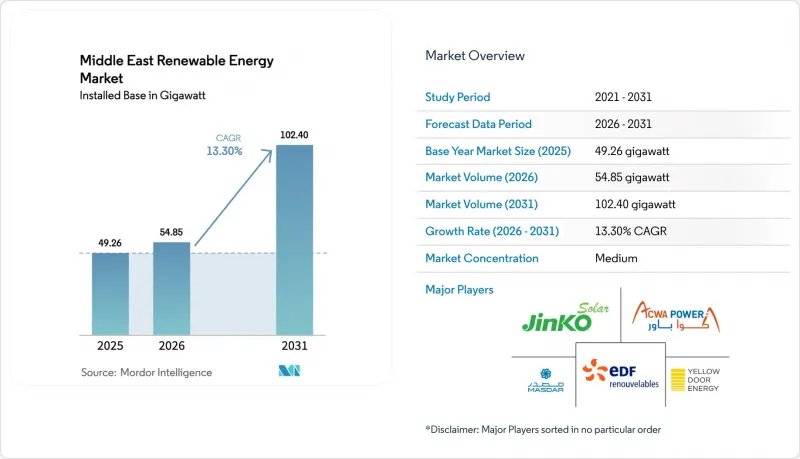
本報告按技術(太陽能、風能、水力、生質能源和海洋能)、最終用戶(公用事業、商業和工業以及住宅)和地區(阿拉伯聯合大公國、沙烏地阿拉伯、阿曼、伊朗、以色列、約旦、卡達、科威特、巴林和其他中東國家)進行細分。市場規模和預測以裝置容量(吉瓦,GW)為單位。
中東可再生能源市場趨勢與洞察
2030-2050年雄心勃勃的國家可再生能源目標
具有法律約束力的清潔能源目標正在改變公共支出的方向,加快競標,並減少新增火力發電裝置容量。沙烏地阿拉伯需要每年新增18吉瓦的裝置容量才能實現其2030年130吉瓦的目標,這一速度遠遠超過其2024年的基準水準。阿拉伯聯合大公國要求其50%的電力來自清潔能源,促使政府資金投入官民合作關係(PPP)項目,並降低早期開發階段的風險。卡達和科威特設定了規模較小但具有像徵意義的分配目標,並擴大了區域採購管道。雖然這些目標確保了專案的可見性,但電網升級或土地徵用的延誤可能會減緩對氫能和海水淡化等專案的額外投資,從而對專案進度造成連鎖風險。
太陽能和風能的平準化度電成本快速下降
由於太陽能和陸上風電的發電價格低於燃氣發電廠,可再生能源已成為新建發電設施的首選。該地區太陽能發電的平準化電成本(LCOE)在2025年平均為37美元/兆瓦時,預計到2060年將降至17美元/兆瓦時。沙烏地阿拉伯達瓦德米風發電工程的競標價格為1.34美分/度數時,使得新建火電廠在經濟上不再具有合理性。自2024年以來,組件供應過剩、雙面組件效率提高以及追蹤器最佳化等因素已使系統外成本降低了22%。儘管電力公司能夠以低於2美分/千瓦時的價格簽訂25年期購電協議(PPA),但設備製造商卻面臨利潤率下降的困境,並被迫轉向下一代技術和服務收入。
對持續石化燃料發電的補貼
海灣國家的零售太陽能發電價格極低,僅每千瓦時0.048美元,削弱了住宅太陽能發電的獲利能力,並減緩了分散式太陽能發電的普及進程。研究發現,補貼減少1%會導致可再生能源發電量增加10.61%,但由於政治因素,科威特和卡達的改革已被推遲到2027年後。由此形成了一個兩極分化的市場:享受補貼的家庭仍然依賴電網供電,而大型太陽能發電計畫則在競爭性競標下蓬勃發展。這種差距限制了住宅安裝商能夠滿足的需求,並減緩了電池儲能技術在大眾市場的普及。
細分市場分析
到2025年,太陽能發電將佔中東可再生能源市場的54.51%,預計到2031年將以18.56%的複合年成長率持續成長。這一主導地位反映了沙烏地阿拉伯和阿拉伯聯合大公國超過2200千瓦時/平方米的太陽輻射量、組件價格的快速下降以及有利的競標機制。像杜拜950兆瓦的努爾能源1號電站聚光型太陽光電發電廠,增加了5907兆瓦時的熔鹽儲能容量,從而實現了僅靠太陽能無法實現的夜間供電。風力發電設施集中在沙烏地阿拉伯北部的高地和阿曼的沿海地區,裝置容量佔比超過40%。由於資源限制,水力發電和生質能源的規模仍然有限,而地熱能和海洋能技術目前仍處於示範階段。
積極的採購策略優先考慮高性能硬體。 First Solar公司交付了1.8吉瓦的碲化鎘太陽能板,這種電池板以其耐高溫性能而聞名;晶科能源則交付了3.1吉瓦的雙面「Tiger Neo」組件,這些組件利用了地球表面的反照率效應。西門子歌美颯和維斯塔斯正在競標為沙烏地阿拉伯的達瓦德米計畫供應1.5吉瓦的風力發電機渦輪機。如果未來紅海近海的勘測證實產能利用率超過45%,中東風能可再生能源市場的規模可能會擴大,但太陽能發電很可能在2031年之前仍將是核心技術。
其他好處:
- Excel格式的市場預測(ME)表
- 3個月的分析師支持
目錄
第1章:引言
- 研究假設和市場定義
- 調查範圍
第2章:調查方法
第3章執行摘要
第4章 市場狀況
- 市場概覽
- 市場促進因素
- 2030-2050年雄心勃勃的國家可再生能源目標
- 太陽能和風能的平準化度電成本快速下降
- 一個陽光充足、適合風力發電的地區。
- 綠氫能出口大型企劃清單
- 用於沙漠旅遊和採礦的離網混合微電網
- 市場限制因素
- 石化燃料發電的補貼仍在繼續。
- 有限的併網容量和儲能容量
- 沙漠地區太陽能發電面臨的土壤污染與水資源利用挑戰
- 供應鏈分析
- 監理展望
- 技術展望
- 波特五力分析
第5章 市場規模與成長預測
- 透過技術
- 太陽能(光伏發電和聚光型太陽熱能發電)
- 風力發電(陸上和海上)
- 水力發電(小規模、大型、抽水蓄能)
- 生質能源
- 地熱
- 海洋能源(潮汐能和波浪能)
- 最終用戶
- 公用事業
- 商業和工業用途
- 住宅
- 按地區
- 阿拉伯聯合大公國
- 沙烏地阿拉伯
- 阿曼
- 伊朗
- 以色列
- 約旦
- 卡達
- 科威特
- 巴林
- 其他中東國家
第6章 競爭情勢
- 市場集中度
- 策略性措施(併購、合資、資金籌措、購電協議)
- 市場佔有率分析(主要公司的市場排名和佔有率)
- 公司簡介
- ACWA Power
- Masdar(Abu Dhabi Future Energy Co.)
- EDF Renewables
- Yellow Door Energy
- JinkoSolar
- First Solar
- Siemens Gamesa
- GE Renewable Energy
- Vestas
- Engie
- TotalEnergies Renewables
- Enel Green Power
- Scatec Solar
- Abengoa
- Canadian Solar
- Siraj Power
- MASE
- Enerwhere Sustainable Energy
- Akuo Energy
- ACWA Power Barka SAOG
- Solarwind ME
第7章 市場機會與未來展望
According to Mordor Intelligence, the Middle East renewable energy market size in terms of installed base is projected to expand from 49.26 gigawatt in 2025 and 54.85 gigawatt in 2026 to 102.40 gigawatt by 2031, registering a CAGR of 13.30% between 2026 to 2031.
This report is Segmented by Technology (Solar Energy, Wind Energy, Hydropower, Bioenergy, Geothermal, and Ocean Energy), End-User (Utilities, Commercial and Industrial, and Residential), and Geography (United Arab Emirates, Saudi Arabia, Oman, Iran, Israel, Jordan, Qatar, Kuwait, Bahrain, and Rest of Middle East). The Market Sizes and Forecasts are Provided in Terms of Installed Capacity (GW).
Middle East Renewable Energy Market Trends and Insights
Ambitious 2030-2050 National Renewable-Energy Targets
Binding clean-energy objectives are redirecting public spending, fast-tracking tenders, and crowding out new thermal capacity. Saudi Arabia must add 18 GW annually to hit its 130 GW 2030 goal, a pace that dwarfs its 2024 base. The UAE's 50% clean-power mandate funnels sovereign capital into public-private partnerships that de-risk early-stage development. Qatar and Kuwait have set smaller but symbolic quotas that broaden the regional procurement funnel. Targets anchor pipeline visibility, yet slippage in grid upgrades or land acquisition can delay follow-on investments in hydrogen and desalination, exposing financiers to cascading project-timeline risk.
Rapid Solar-PV and Wind LCOE Decline
Photovoltaic and onshore-wind tariffs now undercut gas-fired generation, making renewables the default choice for greenfield capacity. Regional solar LCOE averaged USD 37 per MWh in 2025 and is on track to hit USD 17 by 2060. Saudi Arabia's Dawadmi wind bid at 1.34 cents per kWh erased the economic rationale for new thermal plants. Module oversupply, bifacial-panel efficiency gains, and tracker optimization have sliced balance-of-system costs by 22% since 2024. While utilities secure 25-year PPAs at sub-2-cent tariffs, equipment makers face thinner margins, forcing a pivot toward next-generation technologies and service revenues.
Persistent Fossil-Fuel Power Subsidies
Gulf retail tariffs as low as USD 0.048 / kWh undercut rooftop-solar economics and slow distributed adoption. A 1% subsidy rollback correlates with a 10.61% jump in renewable generation, yet political sensitivities push reforms to 2027 and beyond in Kuwait and Qatar. Two-tier markets emerge where subsidized households stick with grid power while utility-scale solar flourishes under competitive tenders. The gap limits addressable demand for residential installers and defers mass-market battery uptake.
Other drivers and restraints analyzed in the detailed report include:
- Green-Hydrogen Export Mega-Projects Pipeline
- Off-Grid Hybrid Microgrids for Desert Tourism & Mining
- Limited Grid Interconnection & Storage Capacity
For complete list of drivers and restraints, kindly check the Table Of Contents.
Segment Analysis
Solar Energy held 54.51% of the Middle East renewable energy market in 2025 and is advancing at an 18.56% CAGR through 2031. This outsized share reflects irradiance levels above 2,200 kWh/m2 in Saudi Arabia and the UAE, rapid module cost declines, and supportive tender frameworks. Concentrated-solar-power plants such as Dubai's 950 MW Noor Energy 1 add 5,907 MWh of molten-salt storage, providing evening dispatch that photovoltaics alone cannot match. Wind installations cluster along Saudi Arabia's northern highlands and Oman's coasts, where capacity factors top 40%. Hydropower and bioenergy remain marginal due to resource limitations, while geothermal and ocean technologies sit at the pilot stage.
Aggressive procurement favors high-performance hardware. First Solar shipped 1.8 GW of cadmium-telluride panels prized for high-temperature resilience, whereas JinkoSolar delivered 3.1 GW of bifacial Tiger Neo modules that capitalize on ground-albedo gains. Siemens Gamesa and Vestas are vying to supply 1.5 GW of turbines for Saudi Arabia's Dawadmi project. The Middle East renewable energy market size for wind could swell if forthcoming Red Sea offshore studies confirm 45%-plus capacity factors, yet solar will remain the anchor technology through 2031.
Complete Report Scope:
- By Technology
- Solar Energy (PV and CSP)
- Wind Energy (Onshore and Offshore)
- Hydropower (Small, Large, PSH)
- Bioenergy
- Geothermal
- Ocean Energy (Tidal and Wave)
- By End-User
- Utilities
- Commercial and Industrial
- Residential
- By Geography
- United Arab Emirates
- Saudi Arabia
- Oman
- Iran
- Israel
- Jordan
- Qatar
- Kuwait
- Bahrain
- Rest of Middle East
List of Companies Covered in this Report:
- ACWA Power
- Masdar (Abu Dhabi Future Energy Co.)
- EDF Renewables
- Yellow Door Energy
- JinkoSolar
- First Solar
- Siemens Gamesa
- GE Renewable Energy
- Vestas
- Engie
- TotalEnergies Renewables
- Enel Green Power
- Scatec Solar
- Abengoa
- Canadian Solar
- Siraj Power
- MASE
- Enerwhere Sustainable Energy
- Akuo Energy
- ACWA Power Barka SAOG
- Solarwind ME
Additional Benefits:
- The market estimate (ME) sheet in Excel format
- 3 months of analyst support
TABLE OF CONTENTS
1 Introduction
- 1.1 Study Assumptions & Market Definition
- 1.2 Scope of the Study
2 Research Methodology
3 Executive Summary
4 Market Landscape
- 4.1 Market Overview
- 4.2 Market Drivers
- 4.2.1 Ambitious 2030-2050 national renewable-energy targets
- 4.2.2 Rapid solar-PV and wind LCOE decline
- 4.2.3 Abundant solar irradiance & wind corridors
- 4.2.4 Green-hydrogen export mega-projects pipeline
- 4.2.5 Off-grid hybrid micro-grids for desert tourism & mining
- 4.3 Market Restraints
- 4.3.1 Persistent fossil-fuel power subsidies
- 4.3.2 Limited grid interconnection & storage capacity
- 4.3.3 Desert soiling & water-usage challenges for PV
- 4.4 Supply-Chain Analysis
- 4.5 Regulatory Outlook
- 4.6 Technological Outlook
- 4.7 Porter's Five Forces Analysis
- 4.7.1 Bargaining Power of Suppliers
- 4.7.2 Bargaining Power of Buyers
- 4.7.3 Threat of New Entrants
- 4.7.4 Threat of Substitutes
- 4.7.5 Intensity of Competitive Rivalry
5 Market Size & Growth Forecasts
- 5.1 By Technology
- 5.1.1 Solar Energy (PV and CSP)
- 5.1.2 Wind Energy (Onshore and Offshore)
- 5.1.3 Hydropower (Small, Large, PSH)
- 5.1.4 Bioenergy
- 5.1.5 Geothermal
- 5.1.6 Ocean Energy (Tidal and Wave)
- 5.2 By End-User
- 5.2.1 Utilities
- 5.2.2 Commercial and Industrial
- 5.2.3 Residential
- 5.3 By Geography
- 5.3.1 United Arab Emirates
- 5.3.2 Saudi Arabia
- 5.3.3 Oman
- 5.3.4 Iran
- 5.3.5 Israel
- 5.3.6 Jordan
- 5.3.7 Qatar
- 5.3.8 Kuwait
- 5.3.9 Bahrain
- 5.3.10 Rest of Middle East
6 Competitive Landscape
- 6.1 Market Concentration
- 6.2 Strategic Moves (M&A, JVs, Funding, PPAs)
- 6.3 Market Share Analysis (Market Rank/Share for key companies)
- 6.4 Company Profiles (includes Global-level Overview, Market-level Overview, Core Segments, Financials, Strategic Information, Products & Services, Recent Developments)
- 6.4.1 ACWA Power
- 6.4.2 Masdar (Abu Dhabi Future Energy Co.)
- 6.4.3 EDF Renewables
- 6.4.4 Yellow Door Energy
- 6.4.5 JinkoSolar
- 6.4.6 First Solar
- 6.4.7 Siemens Gamesa
- 6.4.8 GE Renewable Energy
- 6.4.9 Vestas
- 6.4.10 Engie
- 6.4.11 TotalEnergies Renewables
- 6.4.12 Enel Green Power
- 6.4.13 Scatec Solar
- 6.4.14 Abengoa
- 6.4.15 Canadian Solar
- 6.4.16 Siraj Power
- 6.4.17 MASE
- 6.4.18 Enerwhere Sustainable Energy
- 6.4.19 Akuo Energy
- 6.4.20 ACWA Power Barka SAOG
- 6.4.21 Solarwind ME
7 Market Opportunities & Future Outlook
- 7.1 White-space & Unmet-need Assessment

 全球可再生能源市場規模、佔有率、趨勢和成長分析報告(2026-2034年)
 可再生能源市場預測至2034年—按能源來源、裝置容量、部署狀況、應用、最終用戶和地區分類的全球分析全球太陽能上吸式塔市場規模、佔有率、趨勢和成長分析報告(2026-2034年)
 歐洲可再生能源:市場佔有率分析、產業趨勢與統計及成長預測(2026-2031 年)非洲可再生能源:市場佔有率分析、產業趨勢與統計及成長預測(2026-2031 年)南美洲可再生能源:市場佔有率分析、產業趨勢與統計及成長預測(2026-2031 年)南部非洲可再生能源:市場佔有率分析、產業趨勢與統計及成長預測(2026-2031 年)東南亞可再生能源:市場佔有率分析、產業趨勢與統計及成長預測(2026-2031年)
 人機介面(HMI)汽輪機控制系統市場規模、佔有率和成長分析:按組件、汽輪機類型、應用、最終用戶和地區分類-2026-2033年產業預測可再生能源併網:市場規模、佔有率、成長、全球產業分析、區域趨勢及2026-2034年預測