


 |
市場調查報告書
商品編碼
2124286
合約包裝和履約服務:市場佔有率分析、行業趨勢和統計數據以及成長預測(2026-2031 年)Contract Packaging And Fulfillment Service - Market Share Analysis, Industry Trends & Statistics, Growth Forecasts (2026 - 2031) |
||||||

※ 本網頁內容可能與最新版本有所差異。詳細情況請與我們聯繫。
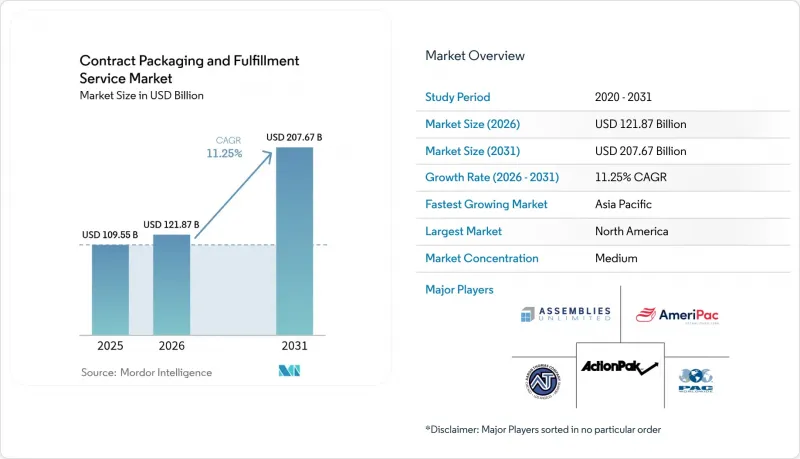
據 Mordor Intelligence 稱,2025 年合約包裝和履約服務市場價值為 1095.5 億美元,預計到 2031 年將達到 2076.7 億美元,而 2026 年為 1218.7 億美元,預測期(2026-2031 年)的複合年成長率為 11.25%。
本報告按包裝材料(紙/紙板、塑膠、其他)、服務類型(包裝設計/原型製作、合約包裝、包裝檢驗、其他)、最終用戶(食品、飲料、藥品、其他)、履約通路(B2C 電子商務、B2B 分銷、零售庫存補貨)和地區進行細分。市場預測以美元計價。
全球合約包裝及履約服務市場趨勢及洞察
將非核心業務外包以最佳化成本
製造商將有限的資金投入產品創新,同時將包裝生產線外包給承包商,將固定成本分攤到多個客戶身上。目前,一些知名品牌透過將傳統的內部生產線轉向全天候運作的自動化多客戶工廠,實現了15%至25%的成本節約。製藥公司就是這種轉變的典型例子,像Catalent這樣的供應商正在擴大其泡殼包裝序列化、冷鏈組裝和GMP認證標籤的生產能力。除了降低成本之外,決策者還將責任轉移放在首位。專業的合作夥伴承擔召回風險,維護ISO文件,並根據檢驗的方案校準測試設備。預計2024年通貨膨脹導致的工資上漲將進一步加速這些計算,使得外包的額外成本與內部工廠必須承擔的人事費用、水電和合規相關費用相比顯得微不足道。先進的成本建模軟體與 ERP(企業資源計劃)平台整合,現在可以即時比較總交付成本方案,結果表明,對於大多數中等規模的 SKU 而言,包裝外包是財務上合理的選擇。
對即食食品和飲料的需求不斷成長。
都市區消費者青睞即食餐、食材自煮包和單份零食,這些產品需要控制份量、進行氣體排放並確保保存期限。 2024年,即食食品市場成長了18%,但隨著銷售量的成長,對密封包裝、氣體排放或殺菌袋的需求也隨之增加——然而,能夠自行處理這些工序的品牌商卻越來越少。為了滿足食品安全監管機構的要求,代工包裝公司紛紛擴建無塵室,引進高速成型、灌裝和封口生產線,並進行即時微生物監測。從曼谷到胡志明市,亞太地區正經歷著最為顯著的成長,這主要得益於雙薪家庭和小型都市區家庭對外帶產品的青睞。同時,西方零售商要求產品標籤清楚標示過敏原和營養訊息,促使專業印刷商採用能夠將序列化可變數據直接印刷到包裝上的數位印刷機。機能飲料和營養軟糖的需求不斷成長,同時對阻隔薄膜和分量合適的泡殼包裝的需求也進一步推動外包需求。
嚴格的生產者延伸責任制(EPR)法規
修訂後的歐洲法律要求品牌所有者承擔收集、分類和資源回收計畫的成本,導致合規成本增加至包裝成本的3%至5%。合約包裝公司必須逐托盤追蹤樹脂識別碼、廢舊產品材料百分比以及地理目的地數據,違規者將面臨處罰。實施RFID標籤和區塊鏈帳本等追蹤技術需要資金和專業的合規人員,但小規模供應商難以獲得資金籌措,市場佔有率正被全球性公司蠶食。美國四個州的類似法規以及日本的試驗計畫進一步加重了行政負擔。因此,跨境合約現在包含審計條款、生命週期評估(LCA)交付物和回收檢驗,增加了談判成本並延誤了專案推出。對於成本敏感的客戶而言,高額的生產者責任延伸(EPR)費用促使他們重新考慮包裝密集型設計理念,在出現降低附加稅門檻的新材料之前,外包總量將受到限制。
細分市場分析
憑藉低成本、易加工性和多樣化的阻隔性,塑膠樹脂在2025年仍佔據合約包裝和履約服務市場54.63%的佔有率。然而,其在該領域的主導地位正引發監管方面的關注,例如禁止使用一次性塑膠和對再生材料含量設定配額。合約包裝公司正透過認證符合即將實施的分級生產者責任延伸(EPR)收費結構的生物基聚乙烯和可堆肥聚乳酸薄膜來規避風險。玻璃和金屬容器在高階飲料和藥妝品領域重新流行起來,它們既符合傳統,又具有可回收性,但其重量卻增加了實現減排目標的難度。紙板,尤其是在電商紙盒和模塑纖維郵件容器的推動下,正處於可再生資源獲取和生活垃圾收集的交匯點。 2024年樹脂價格的上漲迫使品牌所有者最佳化包裝,從而增加了對能夠預測減重後抗穿刺性能的模擬軟體的需求。
儘管預計到2031年,可生物分解和可堆肥材料將以13.22%的複合年成長率成長,但供應鏈的限制仍然存在。發酵槽容量不足、原料價格波動、廢棄物處理基礎設施不完善,都可能削弱其理論上的永續性優勢。因此,合約包裝公司正在建立內部實驗室,測試各種生物聚合物等級的密封強度、遷移性和保存期限,以確保食品安全不受影響。成功的測試使供應商能夠根據客戶對碳中和產品的需求設定溢價。同時,標準塑膠等級在製藥領域仍然至關重要,因為該領域需要生質塑膠目前無法提供的防潮泡殼包裝。因此,未來的發展路徑將是逐步減薄、混合結構和循環回收流程的整合,而不是突然的材料替代方案。
到2025年,合約包裝將佔據最大的銷售佔有率,達到44.78%,但由於價格敏感度和自動化程度的提高,利潤率正受到擠壓。客戶越來越重視設計思維,供應商被迫培養精通消費者心理、商店效果和再利用技巧的創新工作室。包裝設計和原型製作預計將以12.6%的複合年成長率成長,這標誌著從簡單的人工操作轉向智慧財產權和快速迭代開發。混合實境(MR)技術中的數位孿生將加速決策週期,使行銷人員能夠在模切印刷前,在店內燈光下預覽品牌元素。
在下游流程中,實驗室檢驗正變得越來越普遍。振動、跌落和壓縮測試設備模擬了多管道配送路線,而環境檢查室則將包裝暴露於熱帶潮濕和北極嚴寒的環境中。隨著電子商務的普及,法律責任日益增加,包裝測試的收入也不斷成長。雖然與物流履約相關的倉儲仍然至關重要,但隨著第三方物流公司將聯合包裝模組內部化,聯合包裝供應商租賃相鄰的儲存空間,倉儲與物流之間的界限正在變得模糊。成功的關鍵在於將概念草圖、材料採購、流程測試和多承運商運輸整合到全面的服務合約中。這種廣泛的服務範圍可以有效阻止轉換,促使客戶簽署多年期的工作協議,並穩定供應商的現金流。
區域分析
預計2025年,北美仍將維持39.05%的市佔率。這主要得益於該地區成熟的線上零售基礎設施和嚴格的環境法規,這些法規優先考慮專業包裝公司而非企業內部員工。每小時超過25美元的人事費用推動了自動化技術的普及,而當地稅法中寬鬆的折舊免稅額政策則促進了設備的持續升級。在美國,需求主要集中在藥品、高階零食和暢銷消費性電子產品領域,這些領域需要快速的製程轉換和零缺陷標準。在加拿大,向全球出口產品的自然資源加工商的需求不斷成長,需要加固的出口包裝箱和防潮生產線板。
預計到2031年,亞太地區將以13.28%的複合年成長率實現最高成長速度,這主要得益於中國製造業的規模、印度龐大的消費群以及東南亞數位平台的快速發展。地方政府正鼓勵工廠升級設備,以滿足新的食品安全和減少廢棄物的指南,從而促進非正規代工生產向認證代工生產過渡。儘管機器人技術的應用落後於西方標準,但政府補貼和跨國公司對可追溯性的審計要求正在加速其推廣應用。日本和韓國在遊戲機和高階化妝品套裝的自動化組裝方面處於領先地位,這些產品在上市後數小時內即可運往世界各地。
歐洲已成為永續性的試驗場,在「綠色交易」框架下率先推行了從搖籃到搖籃的認證和碳標籤計畫。德國汽車零件供應商依賴耐用、可重複使用的緩衝材料,而法國化妝品製造商則指定使用可堆肥的纖維素薄膜窗。斯堪地那維亞國家正在開發纖維基瓶子,這要求服務供應商掌握多種材料的使用技術。東歐以其成本效益高的勞動力和毗鄰中歐消費市場的地理優勢,成功吸引了許多西歐跨國公司待開發區生產基地,這些公司希望避免英國脫歐引發的邊境摩擦。
其他好處
- Excel格式的市場預測(ME)表
- 3個月的分析師支持
目錄
第1章:引言
- 研究假設和市場定義
- 調查範圍
第2章:調查方法
第3章執行摘要
第4章 市場狀況
- 市場概覽
- 市場促進因素
- 將非核心業務外包以最佳化成本
- 對即食食品和飲料的需求不斷成長。
- 進入第三方物流倉儲產業的新興參與企業正在推動包裝創新。
- 訂閱盒式 D2C 模式的蓬勃發展推動了對敏捷履約的需求。
- 將ESG(環境、社會和治理)因素與外包結合,以減少範圍3排放
- 人工智慧驅動的貨架位置選擇和個性化包裝
- 市場限制因素
- 嚴格的生產者延伸責任制(EPR)法規
- 來自我們自身包裝線的競爭
- 專業履約中心熟練勞力短缺
- 再生材料成本波動給利潤率帶來壓力。
- 產業價值鏈分析
- 監管情勢和標準
- 技術展望
- 波特五力分析
- 宏觀經濟因素對市場的影響
第5章 市場規模與成長預測
- 透過包裝材料
- 紙張和紙板
- 塑膠
- 玻璃
- 金屬
- 可生物分解和可堆肥材料
- 按服務類型
- 包裝設計與原型製作
- 合約包裝
- 包裝檢驗
- 倉儲和履約
- 其他服務類型
- 最終用戶
- 食物
- 飲料
- 製藥
- 居家及個人護理
- 其他最終用戶
- 透過履約管道
- B2C電子商務
- B2B分銷
- 零售庫存補貨
- 按地區
- 北美洲
- 美國
- 加拿大
- 墨西哥
- 南美洲
- 巴西
- 阿根廷
- 智利
- 其他南美國家
- 歐洲
- 德國
- 英國
- 法國
- 義大利
- 西班牙
- 其他歐洲國家
- 亞太地區
- 中國
- 日本
- 印度
- 韓國
- 澳洲
- 其他亞太國家
- 中東和非洲
- 中東
- 沙烏地阿拉伯
- 阿拉伯聯合大公國
- 土耳其
- 其他中東國家
- 非洲
- 南非
- 奈及利亞
- 肯亞
- 其他非洲國家
- 中東
- 北美洲
第6章 競爭情勢
- 市場集中度
- 策略趨勢
- 市佔率分析
- 公司簡介
- Aaron Thomas Company Inc.
- ActionPak Inc.
- Assemblies Unlimited Inc.
- PAC Worldwide Corp.
- AmeriPac LLC
- KANE Logistics LLC
- FW Logistics LLC
- Warren Industries Inc.
- Swan Packaging Fulfillment Inc.
- Multi-Pac Solutions LLC
- Sharp Packaging Services(UDG Healthcare plc)
- Boughey Distribution Ltd
- Budelpack Poortvliet BV
- Wasdell Packaging Group Ltd
- Sonoco Products Company
- Deutsche Post DHL Group(DHL Supply Chain)
- Catalent Inc.
- CCL Industries Inc.
- GXO Logistics Inc.
- FedEx Supply Chain Services Inc.
第7章 市場機會與未來展望
According to Mordor Intelligence, the contract packaging and fulfillment services market size was valued at USD 109.55 billion in 2025 and estimated to grow from USD 121.87 billion in 2026 to reach USD 207.67 billion by 2031, at a CAGR of 11.25% during the forecast period (2026-2031).
This report is Segmented by Packaging Material (Paper and Paperboard, Plastic and More), Service Type (Packaging Design and Prototyping, Contract Packing, Package Testing and More), End-User (Food, Beverage, Pharmaceutical and More), Fulfilment Channel (E-Commerce B2C, B2B Distribution, Retail Replenishment), and Geography. The Market Forecasts are Provided in Terms of Value (USD).
Global Contract Packaging And Fulfillment Service Market Trends and Insights
Outsourcing Non-Core Operations for Cost Optimisation
Manufacturers allocate scarce capital toward product innovation while redirecting packaging lines to contractors that spread fixed costs across multiple clients. A typical brand now realizes 15-25% cost reductions by moving from legacy in-house lines to automated multi-client facilities that operate around the clock. Pharmaceutical companies illustrate the shift, with providers such as Catalent adding capacity for blister serialization, cold-chain assembly, and GMP-certified labeling. Beyond savings, decision makers value liability transfer: specialized partners shoulder recall risks, maintain ISO documentation, and calibrate inspection equipment under validated protocols. Inflation-linked wage spikes in 2024 merely accelerated the calculation, making the outsourcing premium look modest versus the staffing, utilities, and compliance overhead internal plants must carry. Sophisticated cost-modeling software, plugged into enterprise resource planning platforms, now compares total landed cost scenarios in real time and surfaces packaging outsourcing as the financially superior option across most mid-sized SKUs.
Growing F and B Demand for Ready-to-Eat Formats
Urban consumers gravitate toward convenience meals, meal kits, and single-serve snacks that call for portion control, protective atmospheres, and shelf-life assurance. Ready-to-eat categories expanded 18% in 2024, and every incremental unit required hermetic sealing, modified-atmosphere flushing, or retort pouches that few brand owners can support internally. Contract packagers stepped in with clean-room extensions, high-speed form-fill-seal lines, and real-time microbial monitoring to satisfy food-safety regulators. Asia-Pacific hubs from Bangkok to Ho Chi Minh City show the starkest spike, pulled by dual-income households and tight city kitchens that favor grab-and-go offerings. Meanwhile, Western retailers press for clear labeling on allergens and nutrition, prompting specialist printers to add digital presses that deliver serialized, variable data directly on pack. As functional beverages and nutraceutical gummies rise, barrier films and dose-specific blistering drive another layer of outsourcing demand.
Stringent Extended-Producer-Responsibility Rules
Revised European legislation obliges brand owners to finance collection, sorting, and material recovery schemes, pushing compliance costs up by 3-5% of packaging spend. Contract packagers must now capture resin identification codes, post-consumer content ratios, and geographic destination data at pallet level, or risk fines. Tracking technology RFID tags and blockchain registers requires capital and skilled compliance staff that small providers struggle to fund, tilting share toward global players. Similar statutes in four U.S. states and pilot programs in Japan widen the administrative footprint. Cross-border contracts therefore bundle audit clauses, life-cycle-assessment deliverables, and recycling verification, adding negotiation overhead that slows project onboarding. For cost-sensitive clients, high EPR fees can tempt reconsideration of packaging-intensive design concepts, suppressing overall outsourced volume until new materials emerge that lower levy brackets.
Other drivers and restraints analyzed in the detailed report include:
- 3PL Warehousing Entrants Fostering Packaging Innovation
- Subscription-Box D2C Boom Requiring Agile Fulfilment
- Competition from In-House Packaging Lines
For complete list of drivers and restraints, kindly check the Table Of Contents.
Segment Analysis
Plastic resins retained a 54.63% contract packaging and fulfillment services market share in 2025, buoyed by low cost, machinability, and barrier versatility. The segment's commanding position nonetheless invites regulatory scrutiny under single-use-plastics bans and recycled-content quotas. Contract packagers hedge exposure by qualifying bio-based polyethylene and compostable polylactic acid films that align with forthcoming EPR fee tiers. Glass and metal containers resurge in premium beverages and cosmeceuticals that market heritage and recyclability, although their heavier weight complicates emissions targets. Paperboard, boosted by e-commerce cartons and molded-fiber mailers, sits at the nexus of renewable sourcing and curbside recovery. Rising resin prices in 2024 nudged brand owners to right-size packaging, intensifying demand for simulation software that predicts puncture resistance at lower gram weights.
Biodegradable and compostable categories forecast a 13.22% CAGR to 2031, yet supply chain constraints persist. Limited fermenter capacity, feedstock price swings, and inconsistent end-of-life infrastructure can erode theoretical sustainability gains. Contract packagers therefore add in-house laboratories to test seal integrity, migration, and shelf-life across myriad biopolymer grades, ensuring they do not jeopardize food safety. Successful trials position providers to command premium rates as clients chase carbon-neutral claims. Meanwhile, standard plastic grades remain indispensable for pharmaceuticals requiring moisture-barrier blister packs that bioplastics cannot yet match. The evolutionary path thus blends incremental downgauging, hybrid structures, and circular recycling streams rather than an abrupt material substitution.
Contract packing generated the largest 44.78% revenue slice in 2025, but price sensitivity and automation parity compress margins. Customers increasingly reward design thinking, prompting suppliers to cultivate creative studios fluent in consumer psychology, shelf impact, and reuse cues. Packaging design and prototyping is projected to clock a 12.6% CAGR, illustrating the pivot from commodity labor toward intellectual property and rapid iteration. Digital twins, rendered in mixed reality, allow marketers to preview branding elements under store lighting before a single die-cut hits the press, accelerating decision cycles.
Downstream, lab-based validation gains traction. Vibration, drop, and compression rigs mimic multichannel shipping pathways, while environmental chambers expose packs to tropical humidity or arctic freeze. Package-testing revenue thus swells as e-commerce exposure magnifies liability. Fulfillment-linked warehousing remains essential, yet borderlines blur as 3PLs internalize co-pack modules and co-packers lease adjacent storage bays. The winning formula bundles concept sketches, material sourcing, inline inspection, and multicarrier dispatch under one master service agreement. Such breadth erects switching barriers, encouraging clients to sign multi-year statements of work that smooth provider cash flow.
Complete Report Scope:
- By Packaging Material
- Paper and Paperboard
- Plastic
- Glass
- Metal
- Biodegradable / Compostable Materials
- By Service Type
- Packaging Design and Prototyping
- Contract Packing
- Package Testing
- Warehousing and Fulfilment
- Other Service Types
- By End-User
- Food
- Beverage
- Pharmaceutical
- Household and Personal Care
- Other End-Users
- By Fulfilment Channel
- E-commerce B2C
- B2B Distribution
- Retail Replenishment
- By Geography
- North America
- United States
- Canada
- Mexico
- South America
- Brazil
- Argentina
- Chile
- Rest of South America
- Europe
- Germany
- United Kingdom
- France
- Italy
- Spain
- Rest of Europe
- Asia-Pacific
- China
- Japan
- India
- South Korea
- Australia
- Rest of Asia-Pacific
- Middle East and Africa
- Middle East
- Saudi Arabia
- United Arab Emirates
- Turkey
- Rest of Middle East
- Africa
- South Africa
- Nigeria
- Kenya
- Rest of Africa
- Middle East
- North America
Geography Analysis
North America retained a 39.05% share in 2025 as the region couples mature online retail infrastructure with strict environmental regulations that privilege professional packaging specialists over in-house crews. Labor rates above USD 25 per hour spur automation adoption, and generous depreciation schedules under local tax codes encourage continuous capital refresh. U.S. demand centers on pharmaceuticals, premium snacks, and high-velocity consumer electronics requiring fast changeovers and zero-defect standards. Canada supplements volume with natural-resource processors shipping globally, necessitating reinforced export crates and humidity-resilient line boards.
Asia-Pacific records the fastest 13.28% CAGR to 2031, buoyed by China's manufacturing heft, India's consumer base, and Southeast Asia's digital-platform surge. Local authorities incentivize plant upgrades to meet emerging food-safety and waste-reduction directives, fostering a transition from informal to certified co-pack hubs. Robotics adoption lags Western benchmarks but accelerates due to government grants and multinational client audits demanding traceability. Japan and South Korea push the frontier with automated kitting for gaming consoles and luxury beauty sets shipped globally within hours of release.
Europe positions itself as the sustainability test bed, pioneering cradle-to-cradle certifications and carbon-labeling schemes under the Green Deal umbrella. German automotive suppliers rely on durable, reusable dunnage, while French cosmetics houses specify compostable cellulose film windows. Scandinavia pilots fiber-based bottle prototypes, pushing service providers to build multi-material expertise. Eastern Europe offers cost-effective labor pools and proximity to Central European consumption, attracting greenfield capacity from Western multinationals keen to sidestep Brexit border friction.
- Aaron Thomas Company Inc.
- ActionPak Inc.
- Assemblies Unlimited Inc.
- PAC Worldwide Corp.
- AmeriPac LLC
- KANE Logistics LLC
- FW Logistics LLC
- Warren Industries Inc.
- Swan Packaging Fulfillment Inc.
- Multi-Pac Solutions LLC
- Sharp Packaging Services (UDG Healthcare plc)
- Boughey Distribution Ltd
- Budelpack Poortvliet B.V.
- Wasdell Packaging Group Ltd
- Sonoco Products Company
- Deutsche Post DHL Group (DHL Supply Chain)
- Catalent Inc.
- CCL Industries Inc.
- GXO Logistics Inc.
- FedEx Supply Chain Services Inc.
Additional Benefits:
- The market estimate (ME) sheet in Excel format
- 3 months of analyst support
TABLE OF CONTENTS
1 INTRODUCTION
- 1.1 Study Assumptions and Market Definition
- 1.2 Scope of the Study
2 RESEARCH METHODOLOGY
3 EXECUTIVE SUMMARY
4 MARKET LANDSCAPE
- 4.1 Market Overview
- 4.2 Market Drivers
- 4.2.1 Outsourcing non-core operations for cost optimisation
- 4.2.2 Growing FandB demand for ready-to-eat formats
- 4.2.3 3PL warehousing entrants fostering packaging innovation
- 4.2.4 Subscription-box D2C boom requiring agile fulfilment
- 4.2.5 ESG-linked outsourcing to lower Scope-3 emissions
- 4.2.6 AI-driven slotting and personalised packs
- 4.3 Market Restraints
- 4.3.1 Stringent extended-producer-responsibility (EPR) rules
- 4.3.2 Competition from in-house packaging lines
- 4.3.3 Skilled labour shortages in specialised fulfilment centres
- 4.3.4 Recycled-material cost volatility compressing margins
- 4.4 Industry Value Chain Analysis
- 4.5 Regulatory Landscape and Standards
- 4.6 Technological Outlook
- 4.7 Porters Five Forces Analysis
- 4.7.1 Bargaining Power of Suppliers
- 4.7.2 Threat of New Entrants
- 4.7.3 Bargaining Power of Buyers/Consumers
- 4.7.4 Threat of Substitute Products
- 4.7.5 Intensity of Competitive Rivalry
- 4.8 The Impact of Macroeconomic Factors on the Market
5 MARKET SIZE AND GROWTH FORECASTS (VALUE)
- 5.1 By Packaging Material
- 5.1.1 Paper and Paperboard
- 5.1.2 Plastic
- 5.1.3 Glass
- 5.1.4 Metal
- 5.1.5 Biodegradable / Compostable Materials
- 5.2 By Service Type
- 5.2.1 Packaging Design and Prototyping
- 5.2.2 Contract Packing
- 5.2.3 Package Testing
- 5.2.4 Warehousing and Fulfilment
- 5.2.5 Other Service Types
- 5.3 By End-User
- 5.3.1 Food
- 5.3.2 Beverage
- 5.3.3 Pharmaceutical
- 5.3.4 Household and Personal Care
- 5.3.5 Other End-Users
- 5.4 By Fulfilment Channel
- 5.4.1 E-commerce B2C
- 5.4.2 B2B Distribution
- 5.4.3 Retail Replenishment
- 5.5 By Geography
- 5.5.1 North America
- 5.5.1.1 United States
- 5.5.1.2 Canada
- 5.5.1.3 Mexico
- 5.5.2 South America
- 5.5.2.1 Brazil
- 5.5.2.2 Argentina
- 5.5.2.3 Chile
- 5.5.2.4 Rest of South America
- 5.5.3 Europe
- 5.5.3.1 Germany
- 5.5.3.2 United Kingdom
- 5.5.3.3 France
- 5.5.3.4 Italy
- 5.5.3.5 Spain
- 5.5.3.6 Rest of Europe
- 5.5.4 Asia-Pacific
- 5.5.4.1 China
- 5.5.4.2 Japan
- 5.5.4.3 India
- 5.5.4.4 South Korea
- 5.5.4.5 Australia
- 5.5.4.6 Rest of Asia-Pacific
- 5.5.5 Middle East and Africa
- 5.5.5.1 Middle East
- 5.5.5.1.1 Saudi Arabia
- 5.5.5.1.2 United Arab Emirates
- 5.5.5.1.3 Turkey
- 5.5.5.1.4 Rest of Middle East
- 5.5.5.2 Africa
- 5.5.5.2.1 South Africa
- 5.5.5.2.2 Nigeria
- 5.5.5.2.3 Kenya
- 5.5.5.2.4 Rest of Africa
- 5.5.5.1 Middle East
- 5.5.1 North America
6 COMPETITIVE LANDSCAPE
- 6.1 Market Concentration
- 6.2 Strategic Moves
- 6.3 Market Share Analysis
- 6.4 Company Profiles (includes Global level Overview, Market level overview, Core Segments, Financials as available, Strategic Information, Market Rank/Share for key companies, Products and Services, and Recent Developments)
- 6.4.1 Aaron Thomas Company Inc.
- 6.4.2 ActionPak Inc.
- 6.4.3 Assemblies Unlimited Inc.
- 6.4.4 PAC Worldwide Corp.
- 6.4.5 AmeriPac LLC
- 6.4.6 KANE Logistics LLC
- 6.4.7 FW Logistics LLC
- 6.4.8 Warren Industries Inc.
- 6.4.9 Swan Packaging Fulfillment Inc.
- 6.4.10 Multi-Pac Solutions LLC
- 6.4.11 Sharp Packaging Services (UDG Healthcare plc)
- 6.4.12 Boughey Distribution Ltd
- 6.4.13 Budelpack Poortvliet B.V.
- 6.4.14 Wasdell Packaging Group Ltd
- 6.4.15 Sonoco Products Company
- 6.4.16 Deutsche Post DHL Group (DHL Supply Chain)
- 6.4.17 Catalent Inc.
- 6.4.18 CCL Industries Inc.
- 6.4.19 GXO Logistics Inc.
- 6.4.20 FedEx Supply Chain Services Inc.
7 MARKET OPPORTUNITIES AND FUTURE OUTLOOK
- 7.1 White-space and Unmet-Need Assessment

 合約包裝:市場佔有率分析、產業趨勢與統計、成長預測(2026-2031)美國合約套裝:市場佔有率分析、行業趨勢和統計數據、成長預測(2026-2031 年)藥品和醫療設備無菌包裝服務:市場佔有率分析、產業趨勢和統計數據以及成長預測(2025-2030 年)歐洲合約包裝:市場佔有率分析、產業趨勢與統計及成長預測(2026-2031 年)
 合約包裝市場:2026-2032年全球市場預測(按包裝類型、服務類型、包裝材料、合約類型和最終用途行業分類)電子商務包裝準備與合規包裝服務:市場佔有率分析、產業趨勢與統計、成長預測(2026-2031)
 2026-2030年全球合約包裝市場
 合約包裝市場規模、佔有率、趨勢和預測:按包裝類型、材料、服務、最終用途行業和地區分類,2026-2034 年
 合約包裝和履約服務市場-全球產業規模、佔有率、趨勢、機會、預測:按服務類型、最終用戶、地區和競爭格局分類,2021-2031年
 合約包裝市場規模、佔有率和趨勢分析報告:按材料、包裝類型、最終用途、地區和細分市場預測(2026-2033 年)