


 |
市場調查報告書
商品編碼
2117471
藥品和醫療設備無菌包裝服務:市場佔有率分析、產業趨勢和統計數據以及成長預測(2025-2030 年)Pharma and Medical Device Sterile Packaging Services - Market Share Analysis, Industry Trends & Statistics, Growth Forecasts (2025 - 2030) |
||||||

※ 本網頁內容可能與最新版本有所差異。詳細情況請與我們聯繫。
預計到 2025 年,藥品和醫療設備無菌包裝服務市場規模將達到 92.8 億美元,到 2030 年將擴大到 145.1 億美元,年複合成長率為 9.35%。
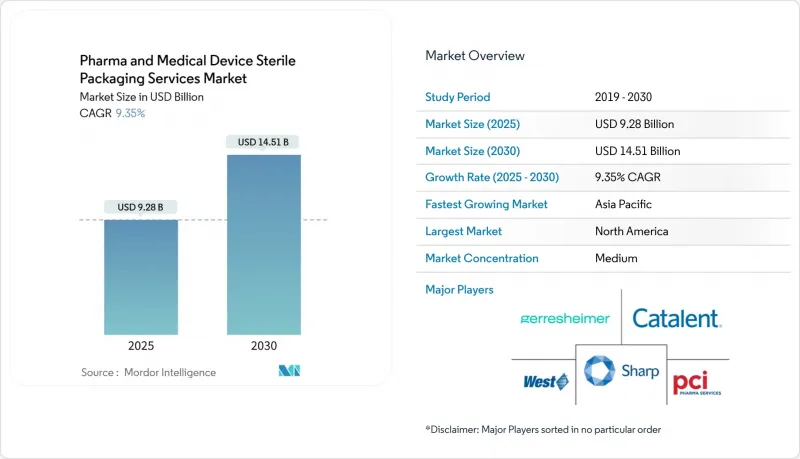
本報告按服務類型(初級包裝、二級包裝、無塵室合約包裝等)、包裝形式(袋裝/包裝袋、托盤/翻蓋盒等)、滅菌方法(環氧乙烷等)、最終用戶行業(製藥公司等)和地區進行細分。市場預測以價值(美元)表示。
全球醫藥醫療設備無菌包裝服務市場趨勢及洞察
生物製藥和細胞/基因療法的快速成長
生物製藥研發管線的爆炸性成長以及監管政策對先進治療藥物的支持力度,正在重新定義無菌包裝的要求。由於細胞和基因療法通常在低於-80 度C的溫度下運輸,供應商必須檢驗低溫管瓶、包裝袋和重疊包裝,以確保在整個超低溫冷鏈中保持無菌狀態。個體化劑量需要小批量填充、序列化標籤和可追溯性,並將這些功能整合到包裝流程中。一次性使用、耐γ射線輻照的聚合物組件有助於降低小批量生產中的交叉污染風險。因此,經費正集中投入藥品和醫療設備的無菌包裝服務市場,用於研發高可靠性的瓶塞、雙腔注射器和防篡改包裝。雖然最初的需求主導來自北美和歐洲,但亞太地區對本地生物製藥工廠的投資正在加速技術轉移。
中型製藥公司合約包裝外包業務的擴張
隨著生物製藥產品日益複雜,以及多個司法管轄區的標籤法規日益嚴格,中型製藥公司被迫將合約包裝和無菌包裝業務外包給合約研發生產機構(CDMO)。維護符合GMP標準的無塵室、進行環境監測以及提供可用的組件都會對內部預算造成壓力,因此基於服務的模式更具吸引力。近期的一些收購案,例如諾和銳以165億美元收購Catarent,顯示投資人對端到端包裝能力的高度重視。為此,CDMO正在部署模組化填充和包裝設備、線上視覺檢測以及全廠序列化系統,使委託公司能夠更快地將區域客製化的包裝推向市場。因此,隨著創新公司將資金集中在研發而非工廠維護,藥品和醫療設備的無菌包裝服務市場正受益於可預測的外包專案儲備。
環氧乙烷(EtO)加工能力不足以及日益嚴格的環境法規
美國目前僅有88家環氧乙烷(EtO)生產設施在運作,運轉率超過90%。美國環保署(EPA)一項將於2024年生效的法規要求將EtO排放量減少90%,這迫使企業投入數百萬美元進行設備升級,而那些被認為維修成本過高的設施則面臨停產風險。約56%的關鍵醫療設備仍依賴EtO,這意味著即使少數設施停產,也幾乎沒有運作空間。包裝公司正透過檢驗電子束和X光方法來規避風險,但他們面臨耗時數年的材料相容性測試。在成熟的替代方案已廣泛應用之前,EtO瓶頸可能會延遲產品上市,並延長整個藥品和醫療設備無菌包裝服務市場的前置作業時間。
細分市場分析
到2024年,初級包裝將佔藥品和醫療設備無菌包裝服務市場佔有率的46.78%,這反映出製藥公司將劑量單位層面的容器和密封系統完整性放在首位。一體化供應商提供符合附件1視覺品質標準的可填充注射器、嵌套式管瓶和阻隔塗層瓶塞。贊助公司依靠經過驗證的培養基灌裝和氦氣洩漏測試來確保全球批次放行,從而獲得長期契約,穩定其收入來源。隨著生物製藥產品線的擴展以及個人化醫療對靈活批次規模的需求,預計無塵室合約包裝將以11.86%的複合年成長率推動該行業成長。 CDMO(合約研發生產機構)將填充和包裝、無菌組裝以及無菌後貼標整合到模組化隔離器中,從而縮短了中型公司的技術轉移時間。
數位孿生技術透過在物理驗證之前模擬氣流、設備循環和停留時間,進一步擴大了生產力差距。服務套件整合了冷凍乾燥、目視檢查和序列化等環節,為企業進入全球市場提供了一站式解決方案。驗證和測試能夠帶來額外收入,因為贊助公司將顆粒計數測試和使用Tyvek重疊材料的加速老化測試外包出去。雖然從防篡改和聚合碼的角度來看,二級包裝仍然至關重要,但由於瓦楞紙箱組裝的商品化,毛利率較低。因此,醫藥和醫療設備無菌包裝服務市場正在轉向能夠實現「端到端」合規性的整合合作夥伴。
2024年,袋裝和袋式包裝佔了38.41%的市場。這主要得益於Tyvek重疊層,它能夠承受環氧乙烷(EtO)處理循環,同時確保微生物阻隔性。這些包裝仍然是手術包、藥品和醫療設備組合產品以及散裝導管套裝的標準選擇。預計到2030年,隨著口服抗癌藥物和高劑量藥片轉變為單劑量給藥方案以提高用藥依從性,泡殼包裝和帶狀包裝將以10.95%的複合年成長率(CAGR)實現最高成長。嚴格的口袋公差確保了劑量完整性,而整合的QR碼有助於追溯。
硬質托盤用於支撐即用型包裝,但在運輸過程中減輕重量具有挑戰性的情況下,它們正擴大被泡沫填充密封(FFS)卷材所取代。瓶子仍然被用作散裝液體和懸浮液的容器,但為了實現永續性,人們正逐漸轉向使用可回收的環烯烴共聚物樹脂。在一些特殊的高壓釜應用中,多孔醫用級紙張即可滿足需求,此時則使用包裝膜和捲材。諸如獲得「可再生」認證的Tyvek等創新材料,正在滿足相關人員對檢驗的低碳足跡的需求。因此,材料科學在滿足環境標準的同時又不影響無菌性,仍是藥品和醫療設備無菌包裝服務市場的核心所在。
區域分析
2024年,北美佔全球銷售額的37.56%。這主要得益於美國在生物製藥研發領域的主導地位,以及美國食品藥物管理局(FDA)對容器和密封系統完整性的嚴格監管。環氧乙烷(EtO)的使用率超過90%,即將推出的排放法規使得尋找替代生產能力變得特別迫切。 《藥品供應鏈安全法案》(DSSA)規定的序列化截止日期,也持續推動對資料豐富的標籤檢視和資訊總結的需求。加拿大和墨西哥透過將非專利藥注射劑的生產和包裝流程外包,進一步促進了市場成長。
亞太地區預計將實現11.31%的複合年成長率,反映出該地區積極的產能建設和國家GMP標準的修訂。中國2025年版《無菌藥品管理條例》提高了無塵室標準,而印度修訂後的M類藥品包裝標準迫使當地灌裝企業升級其暖通空調(HVAC)和監控系統。包括馬來西亞在內的東南亞國家現在要求提供外國GMP檢驗證書,這提高了進入門檻,但也促進了品質標準的統一。區域工資優勢吸引了跨國公司前來生產,但贊助公司在進行初步人體試驗時仍依賴西方的合約研發生產機構(CDMO)。隨著與ICH指南的日益協調,該地區藥品和醫療設備無菌包裝服務市場預計將保持兩位數的成長。
在歐洲,歐盟的《反仿冒藥品指令》已將序列化和防篡改功能標準化,並維持強勁的發展動能。德國和英國正積極推動永續材料的創新,例如引進可再生杜邦特衛強(Tyvek) 。全氟烷基和多氟烷基物質(PFAS)法規正在影響樹脂的選擇,即將實施的《包裝和包裝廢棄物法規》將強化使用再生材料的義務。英國脫歐持續擾亂物流流通,但GMP檢查的相互認可正在緩解摩擦。環氧乙烷(EtO)排放法規反映了美國的發展趨勢,推動了對X光和過氧化氫處理生產線的投資,特別是在愛爾蘭和比利時。這些因素共同確保了歐洲大陸在藥品和醫療設備無菌包裝服務市場中保持成熟且技術先進的地位。
其他好處:
- Excel格式的市場預測(ME)表
- 3個月的分析師支持
目錄
第1章:引言
- 研究假設和市場定義
- 調查範圍
第2章:調查方法
第3章執行摘要
第4章 市場狀況
- 市場概覽
- 市場促進因素
- 生技藥品和細胞/基因療法的快速發展
- 中型製藥公司合約包裝外包業務的擴張
- 加強全球滅菌和序列化法規
- 小批量生產:個人化醫療領域對靈活無菌填充的需求
- 自動化和工業4.0提高了無塵室的生產效率。
- 過渡到環保無菌屏障材料
- 市場限制因素
- 環氧乙烷產能有限且環境監測受限
- 中小企業面臨高昂的檢驗和合規成本
- 高揮發性聚合物和Tyvek原料價格
- 伽瑪射線輻照設備供應鏈中的脆弱性
- 產業價值鏈分析
- 監理情勢
- 技術展望
- 宏觀經濟因素的影響
- 波特五力分析
第5章 市場規模與成長預測
- 按服務類型
- 初級包裝
- 二級包裝
- 潔淨室中的合約包裝
- 無菌
- 檢驗和測試服務
- 按包裝類型
- 小袋和袋子
- 托盤和翻蓋
- 泡殼包裝和帶狀包裝
- 瓶子和容器
- 包裹和捲起
- 透過滅菌方法
- 環氧乙烷(EtO)
- 伽瑪射線照射
- 電子束
- 蒸氣和高壓釜
- 過氧化氫蒸氣
- 按最終用途行業分類
- 製藥公司
- 生技公司
- CDMO/CMO/CRO
- 醫院和專科診所
- 其他終端用戶產業
- 按地區
- 北美洲
- 美國
- 加拿大
- 墨西哥
- 南美洲
- 巴西
- 阿根廷
- 智利
- 其他南美國家
- 歐洲
- 英國
- 德國
- 法國
- 義大利
- 西班牙
- 俄羅斯
- 其他歐洲國家
- 亞太地區
- 中國
- 印度
- 日本
- 韓國
- 澳洲
- 其他亞太國家
- 中東和非洲
- 中東
- 沙烏地阿拉伯
- 阿拉伯聯合大公國
- 土耳其
- 其他中東國家
- 非洲
- 南非
- 奈及利亞
- 其他非洲國家
- 中東
- 北美洲
第6章 競爭情勢
- 市場集中度
- 策略趨勢
- 市佔率分析
- 公司簡介
- Catalent Pharma Solutions, Inc.
- West Pharmaceutical Services, Inc.
- Gerresheimer AG
- Packaging Coordinators, Inc.
- Sharp Services, LLC
- SCHOTT Pharma AG & Co. KGaA
- Vetter Pharma International GmbH
- Baxter BioPharma Solutions
- Syntegon Technology GmbH
- Jubilant HollisterStier LLC
- Curia Global, Inc.
- Grand River Aseptic Manufacturing, Inc.
- WuXi STA Pharmaceutical Co., Ltd.
- Samsung Biologics Co., Ltd.
- Ajinomoto Bio-Pharma Services
- Thermo Fisher Scientific Inc.
- Nipro PharmaPackaging International NV
- Unicep Packaging LLC
- Sanner GmbH
第7章 市場機會與未來展望
According to Mordor Intelligence, the pharma and Medical Device Sterile Packaging Services market size reached USD 9.28 billion in 2025 and is projected to climb to USD 14.51 billion by 2030, advancing at a 9.35% CAGR.
This report is Segmented by Service Type (Primary Packaging, Secondary Packaging, Clean-Room Contract Packaging, and More), Packaging Format (Pouches and Bags, Trays and Clamshells, and More), Sterilization Method (Ethylene Oxide, and More), End-Use Industry (Pharmaceutical Companies, and More), and Geography. The Market Forecasts are Provided in Terms of Value (USD).
Global Pharma and Medical Device Sterile Packaging Services Market Trends and Insights
Rapid Growth of Biologics and Cell-Gene Therapies
Explosive biologics pipelines and regulatory momentum behind advanced therapy medicinal products are reshaping the requirements for sterile packaging. Cell and gene therapies often ship at temperatures below -80 °C, compelling providers to validate cryogenic vials, bags, and overwraps that guard sterility throughout ultra-cold chains. Personalized doses require mini-batch fills, serialized labels, and chain-of-identity safeguards integrated into packaging workflows. Single-use, gamma-compatible polymer assemblies help producers cut cross-contamination risk during small runs. The Pharma and Medical Device Sterile Packaging Services Market, therefore, channels capital toward high-integrity stoppers, dual-chamber syringes, and tamper-evident formats. North America and Europe dominate early demand, but funding for local biologics plants in the Asia-Pacific is accelerating capability transfer.
Expansion of Contract Packaging Outsourcing Among Mid-Tier Pharma
Rising biologic complexity and multi-jurisdictional labeling rules are pushing mid-sized drug makers to outsource pharmaceutical contract packaging and sterile packaging operations to CDMOs. Maintaining GMP-compliant cleanrooms, conducting environmental monitoring, and providing ready-to-use components can strain internal budgets, making fee-for-service models more attractive. Recent acquisitions, including Novo Holdings' USD 16.5 billion Catalent deal, show how investors prize end-to-end packaging depth. CDMOs respond with modular fill-finish suites, online vision inspection, and site-wide serialization, enabling sponsors to launch regionally tailored packs more quickly. The Pharma and Medical Device Sterile Packaging Services Market thus benefits from predictable outsourcing pipelines as innovators focus capital on R&D rather than plant upkeep.
Limited EtO Capacity and Environmental Scrutiny
Only 88 EtO facilities operate in the United States, and utilization exceeds 90%. The Environmental Protection Agency's 2024 rule mandating 90% emission reductions forces multimillion-dollar upgrades, threatening shutdowns where retrofits prove uneconomic. Approximately 56% of critical medical devices still rely on EtO, leaving little room for error if even a handful of plants go offline. Packaging firms hedge by validating electron-beam and X-ray methods, but face multi-year material compatibility studies. Until proven alternatives scale, EtO bottlenecks can delay launches and inflate lead times across the Pharma and Medical Device Sterile Packaging Services Market.
Other drivers and restraints analyzed in the detailed report include:
- Stricter Global Sterility and Serialization Mandates
- Automation and Industry 4.0 Boosting Clean-Room Productivity
- High Validation and Compliance Costs for SMEs
For complete list of drivers and restraints, kindly check the Table Of Contents.
Segment Analysis
Primary packaging captured 46.78% of the Pharma and Medical Device Sterile Packaging Services market share in 2024, reflecting drug makers' priority on container closure integrity at the dose level. Integrated suppliers deliver ready-to-fill syringes, nested vials, and barrier-coated stoppers that pass Annex 1 visual quality thresholds. Sponsors rely on validated media fill runs and helium leak tests to secure global batch release, locking in long-term contracts that stabilize revenue streams. Clean-room contract packaging is poised to lead the field with an 11.86% CAGR as biologic pipelines expand and personalized therapies require agile batch sizes. CDMOs that combine fill-finish, sterile assembly, and post-sterilization labeling within modular isolators shorten technology transfer timelines for mid-tier companies.
Digital twins widen the productivity gap by simulating airflow, equipment cycles, and dwell times before physical validation. Service suites bundle lyophilization, visual inspection, and serialization, offering a one-stop path to global launch. Validation and testing add incremental revenue because sponsors outsource particulate count studies and accelerated aging on Tyvek overwraps. Secondary packaging remains vital for tamper-evidence and aggregation codes, albeit at lower gross margins, given the commoditization of carton erecting. The Pharma and Medical Device Sterile Packaging Services Market thus gravitates toward integrated partners that can deliver cradle-to-gate compliance.
Pouches and bags commanded a 38.41% share in 2024, anchored by Tyvek-based overwraps that withstand EtO cycles while ensuring microbial barrier. They remain go-to choices for surgical kits, drug-device combinations, and bulk catheter sets. Blister and strip packs are projected to post the fastest 10.95% CAGR to 2030 as oral oncology and highly potent tablets migrate to unit-dose regimens that aid adherence. Tight pocket tolerances guard dose integrity, and integrated QR codes promote traceability.
Rigid trays support procedure-ready bundles, but they face substitution from form-fill-seal rolls where transportation weight savings are a concern. Bottles still house bulk liquids and suspensions, yet are migrating toward recyclable cyclic olefin copolymer resins to fulfill sustainability pledges. Wraps and rolls serve niche autoclave applications where porous, medical-grade paper is sufficient. Innovations such as Tyvek with Renewable Attribution underscore the stakeholder push for verified, lower-carbon footprints. Material science, therefore, remains central as the Pharma and Medical Device Sterile Packaging Services Market meets eco standards without compromising sterility.
Complete Report Scope:
- By Service Type
- Primary Packaging
- Secondary Packaging
- Clean-room Contract Packaging
- Sterilization
- Validation and Testing Services
- By Packaging Format
- Pouches and Bags
- Trays and Clamshells
- Blister and Strip Packs
- Bottles and Containers
- Wraps and Rolls
- By Sterilization Method
- Ethylene Oxide (EtO)
- Gamma Irradiation
- Electron-Beam
- Steam and Autoclave
- Hydrogen Peroxide Vapor
- By End-use Industry
- Pharmaceutical Companies
- Biotechnology Companies
- CDMOs/CMOs/CROs
- Hospitals and Specialty Clinics
- Other End-use Industries
- By Geography
- North America
- United States
- Canada
- Mexico
- South America
- Brazil
- Argentina
- Chile
- Rest of South America
- Europe
- United Kingdom
- Germany
- France
- Italy
- Spain
- Russia
- Rest of Europe
- Asia-Pacific
- China
- India
- Japan
- South Korea
- Australia
- Rest of Asia-Pacific
- Middle East and Africa
- Middle East
- Saudi Arabia
- United Arab Emirates
- Turkey
- Rest of Middle East
- Africa
- South Africa
- Nigeria
- Rest of Africa
- Middle East
- North America
Geography Analysis
North America accounted for 37.56% of global revenue in 2024, driven by the United States' leadership in biologics R&D and stringent FDA oversight of container closure integrity. EtO utilization levels surpass 90%, and impending emission controls heighten the urgency for alternative capacity. Serialization deadlines under the Drug Supply Chain Security Act sustain demand for data-rich labeling and aggregation. Canada and Mexico contribute incremental growth through the production of generic injectables and the near-shoring of packaging runs.
Asia-Pacific is forecast to register an 11.31% CAGR, reflecting aggressive capacity additions and updated national GMP codes. China's 2025 sterile medicine rules elevate cleanroom standards, while India's revised Schedule M pushes local fillers to upgrade HVAC and monitoring. Southeast Asian members, including Malaysia, now require foreign GMP inspection certificates, which raises entry thresholds but harmonizes quality. Regional wage advantages attract multinational production; yet, sponsors still rely on Western CDMOs for first-in-human studies. Progressive harmonization with ICH guidelines is expected to sustain double-digit gains for the Pharma and Medical Device Sterile Packaging Services Market in the region.
Europe maintains steady momentum as the EU Falsified Medicines Directive standardizes serialization and tamper evidence. Germany and the United Kingdom innovate in sustainable materials, exemplified by the rollout of Tyvek with Renewable Attribution. PFAS restrictions shape resin choices, and the forthcoming Packaging and Packaging Waste Regulation tightens recycled-content mandates. Brexit continues to alter logistics flows, though mutual recognition of GMP inspections reduces friction. EtO emission rules mirror U.S. trends, prompting investments in X-ray and hydrogen peroxide lines, particularly in Ireland and Belgium. Together, these factors keep the continent a mature yet technologically progressive node within the Pharma and Medical Device Sterile Packaging Services Market.
- Catalent Pharma Solutions, Inc.
- West Pharmaceutical Services, Inc.
- Gerresheimer AG
- Packaging Coordinators, Inc.
- Sharp Services, LLC
- SCHOTT Pharma AG & Co. KGaA
- Vetter Pharma International GmbH
- Baxter BioPharma Solutions
- Syntegon Technology GmbH
- Jubilant HollisterStier LLC
- Curia Global, Inc.
- Grand River Aseptic Manufacturing, Inc.
- WuXi STA Pharmaceutical Co., Ltd.
- Samsung Biologics Co., Ltd.
- Ajinomoto Bio-Pharma Services
- Thermo Fisher Scientific Inc.
- Nipro PharmaPackaging International NV
- Unicep Packaging LLC
- Sanner GmbH
Additional Benefits:
- The market estimate (ME) sheet in Excel format
- 3 months of analyst support
TABLE OF CONTENTS
1 INTRODUCTION
- 1.1 Study Assumptions and Market Definition
- 1.2 Scope of the Study
2 RESEARCH METHODOLOGY
3 EXECUTIVE SUMMARY
4 MARKET LANDSCAPE
- 4.1 Market Overview
- 4.2 Market Drivers
- 4.2.1 Rapid Growth of Biologics and Cell-Gene Therapies
- 4.2.2 Expansion Of Contract Packaging Outsourcing Among Mid-Tier Pharma
- 4.2.3 Stricter Global Sterility and Serialization Mandates
- 4.2.4 Mini-Batch, Personalized-Medicine Demand for Flexible Sterile Fills
- 4.2.5 Automation And Industry 4.0 Boosting Clean-Room Productivity
- 4.2.6 Shift to Eco-Friendly Sterile Barrier Materials
- 4.3 Market Restraints
- 4.3.1 Limited Eto Capacity and Environmental Scrutiny
- 4.3.2 High Validation and Compliance Costs for SMEs
- 4.3.3 Volatile Polymer and Tyvek Input Prices
- 4.3.4 Supply-Chain Fragility for Gamma Irradiators
- 4.4 Industry Value Chain Analysis
- 4.5 Regulatory Landscape
- 4.6 Technological Outlook
- 4.7 Impact of Macroeconomic Factors
- 4.8 Porter's Five Forces Analysis
- 4.8.1 Threat of New Entrants
- 4.8.2 Bargaining Power of Suppliers
- 4.8.3 Bargaining Power of Buyers
- 4.8.4 Threat of Substitutes
- 4.8.5 Industry Rivalry
5 MARKET SIZE AND GROWTH FORECASTS (VALUE)
- 5.1 By Service Type
- 5.1.1 Primary Packaging
- 5.1.2 Secondary Packaging
- 5.1.3 Clean-room Contract Packaging
- 5.1.4 Sterilization
- 5.1.5 Validation and Testing Services
- 5.2 By Packaging Format
- 5.2.1 Pouches and Bags
- 5.2.2 Trays and Clamshells
- 5.2.3 Blister and Strip Packs
- 5.2.4 Bottles and Containers
- 5.2.5 Wraps and Rolls
- 5.3 By Sterilization Method
- 5.3.1 Ethylene Oxide (EtO)
- 5.3.2 Gamma Irradiation
- 5.3.3 Electron-Beam
- 5.3.4 Steam and Autoclave
- 5.3.5 Hydrogen Peroxide Vapor
- 5.4 By End-use Industry
- 5.4.1 Pharmaceutical Companies
- 5.4.2 Biotechnology Companies
- 5.4.3 CDMOs/CMOs/CROs
- 5.4.4 Hospitals and Specialty Clinics
- 5.4.5 Other End-use Industries
- 5.5 By Geography
- 5.5.1 North America
- 5.5.1.1 United States
- 5.5.1.2 Canada
- 5.5.1.3 Mexico
- 5.5.2 South America
- 5.5.2.1 Brazil
- 5.5.2.2 Argentina
- 5.5.2.3 Chile
- 5.5.2.4 Rest of South America
- 5.5.3 Europe
- 5.5.3.1 United Kingdom
- 5.5.3.2 Germany
- 5.5.3.3 France
- 5.5.3.4 Italy
- 5.5.3.5 Spain
- 5.5.3.6 Russia
- 5.5.3.7 Rest of Europe
- 5.5.4 Asia-Pacific
- 5.5.4.1 China
- 5.5.4.2 India
- 5.5.4.3 Japan
- 5.5.4.4 South Korea
- 5.5.4.5 Australia
- 5.5.4.6 Rest of Asia-Pacific
- 5.5.5 Middle East and Africa
- 5.5.5.1 Middle East
- 5.5.5.1.1 Saudi Arabia
- 5.5.5.1.2 United Arab Emirates
- 5.5.5.1.3 Turkey
- 5.5.5.1.4 Rest of Middle East
- 5.5.5.2 Africa
- 5.5.5.2.1 South Africa
- 5.5.5.2.2 Nigeria
- 5.5.5.2.3 Rest of Africa
- 5.5.5.1 Middle East
- 5.5.1 North America
6 COMPETITIVE LANDSCAPE
- 6.1 Market Concentration
- 6.2 Strategic Moves
- 6.3 Market Share Analysis
- 6.4 Company Profiles (includes Global level Overview, Market level overview, Core Segments, Financials as available, Strategic Information, Market Rank/Share for key companies, Products and Services, and Recent Developments)
- 6.4.1 Catalent Pharma Solutions, Inc.
- 6.4.2 West Pharmaceutical Services, Inc.
- 6.4.3 Gerresheimer AG
- 6.4.4 Packaging Coordinators, Inc.
- 6.4.5 Sharp Services, LLC
- 6.4.6 SCHOTT Pharma AG & Co. KGaA
- 6.4.7 Vetter Pharma International GmbH
- 6.4.8 Baxter BioPharma Solutions
- 6.4.9 Syntegon Technology GmbH
- 6.4.10 Jubilant HollisterStier LLC
- 6.4.11 Curia Global, Inc.
- 6.4.12 Grand River Aseptic Manufacturing, Inc.
- 6.4.13 WuXi STA Pharmaceutical Co., Ltd.
- 6.4.14 Samsung Biologics Co., Ltd.
- 6.4.15 Ajinomoto Bio-Pharma Services
- 6.4.16 Thermo Fisher Scientific Inc.
- 6.4.17 Nipro PharmaPackaging International NV
- 6.4.18 Unicep Packaging LLC
- 6.4.19 Sanner GmbH
7 MARKET OPPORTUNITIES AND FUTURE OUTLOOK
- 7.1 White-space and Unmet-need Assessment

 合約包裝和履約服務:市場佔有率分析、行業趨勢和統計數據以及成長預測(2026-2031 年)合約包裝:市場佔有率分析、產業趨勢與統計、成長預測(2026-2031)美國合約套裝:市場佔有率分析、行業趨勢和統計數據、成長預測(2026-2031 年)歐洲合約包裝:市場佔有率分析、產業趨勢與統計及成長預測(2026-2031 年)
 合約包裝市場:2026-2032年全球市場預測(按包裝類型、服務類型、包裝材料、合約類型和最終用途行業分類)電子商務包裝準備與合規包裝服務:市場佔有率分析、產業趨勢與統計、成長預測(2026-2031)
 2026-2030年全球合約包裝市場
 合約包裝市場規模、佔有率、趨勢和預測:按包裝類型、材料、服務、最終用途行業和地區分類,2026-2034 年
 合約包裝和履約服務市場-全球產業規模、佔有率、趨勢、機會、預測:按服務類型、最終用戶、地區和競爭格局分類,2021-2031年
 合約包裝市場規模、佔有率和趨勢分析報告:按材料、包裝類型、最終用途、地區和細分市場預測(2026-2033 年)