


 |
市場調查報告書
商品編碼
2124150
美國合約套裝:市場佔有率分析、行業趨勢和統計數據、成長預測(2026-2031 年)United States Contract Packaging - Market Share Analysis, Industry Trends & Statistics, Growth Forecasts (2026 - 2031) |
||||||

※ 本網頁內容可能與最新版本有所差異。詳細情況請與我們聯繫。
據 Mordor Intelligence 稱,2025 年美國合約套裝市場價值 255 億美元,預計到 2031 年將達到 426.4 億美元,而 2026 年為 277.8 億美元,預測期(2026-2031 年)複合年成長率為 8.96%。
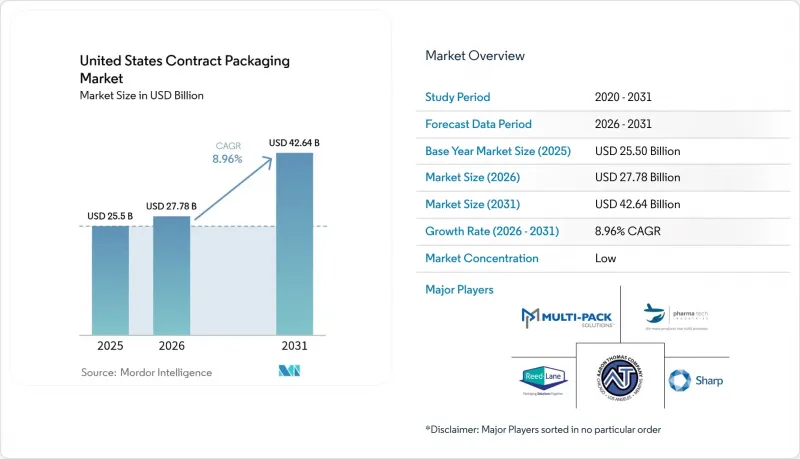
本報告按包裝類型(初級包裝、二級包裝和三級包裝)、終端用戶行業(食品、飲料、藥品等)、提供的服務(配方/混合、填充/組裝等)、材料(紙/紙板、塑膠、金屬等)和自動化程度(手動、半自動等)進行分類。市場預測以美元計價。
美國合約包裝市場的趨勢和洞察
電子商務的快速成長正在推動對靈活聯合包裝的需求。
線上零售的快速擴張持續重塑品牌所有者的包裝經濟格局。基於體積重量的運輸政策傾向於採用空間利用率高的包裝形式,迫使代工包裝商重新設計初級和二級包裝,使其更輕、更緊湊。即飲咖啡(RTD)的激增-預計到2032年市場規模將達到647.8億美元-表明,特定品類的成長正在推動產品線的擴張,而這些產品線需要靈活的填充和貼標能力。能夠將人工智慧驅動的需求預測與快速切換相結合的代工包裝商,在電子商務項目中佔據越來越大的佔有率,這進一步提升了美國代工包裝市場對全通路品牌的戰略重要性。
醫藥和營養保健品產業的業務外包正在迅速成長。
監管審查的加強和複雜生物製藥開發平臺的擴展,迫使製藥公司拓展外部夥伴關係。虛擬製藥公司透過與專業的包裝公司合作,將研發成本降低高達50%。這些包裝公司能夠在單一工作流程中完成製劑配製、無菌填充和包裝以及序列化等環節。 GLP-1療法對精準給藥系統的需求進一步提高了污染控制的標準,而像諾和諾德在北卡羅來納州投資41億美元的工廠這樣的產能擴張,為美國合約包裝市場帶來了巨大的商機。因此,擁有Annex 1專業知識和疫苗級無塵室認證的合約包裝公司,正在從單純的供應商轉型為策略供應鏈合作夥伴。
物流和冷鏈成本不斷上漲
紅海和運河走廊的地緣政治動盪導致現貨運費遠高於長期平均水平,加劇了國內庫存計畫的波動性。在對溫度敏感的產業,冷藏貨櫃供應有限,並推高了生物製藥和高階食品的收貨成本,使其面臨更大的風險。品牌所有者正將這些成本向上游轉嫁,迫使合約包裝公司增加營運資金儲備或重新談判交貨條款。人工智慧驅動的需求預測(例如Americold公司實施的預測)有助於降低不確定性,但無法完全消除成本波動,從而限制了美國合約套件市場的利潤率成長。
細分市場分析
到2025年,初級包裝將占美國合約包裝市場佔有率的55.88%,其11.25%的複合年成長率表明,到2031年,該細分市場將貢獻大部分收入成長。市場需求集中在注射劑組、兒童安全管瓶和用於監測用藥依從性的智慧泡殼包裝。隨著癌症和糖尿病治療個人化程度的提高,灌裝量正在減少,而SKU數量卻在增加,因此,能夠快速更換模具的柔軟性填充生產線更受青睞。二級包裝持續滿足會員制倉儲式商店和零售多包裝的展示需求,但由於品牌方加大了對智慧初級包裝的投資,二級包裝的創新動能仍較為緩慢。
智慧包裝技術也正在這一領域廣泛應用。QR碼包裝可提供產品來源訊息,而NFC標籤則可收集患者回饋,用於真實世界證據(RWE)計畫。例如,Geresheimer在喬治亞投資1.8億美元進行擴張,凸顯了市場對醫用級塑膠和射出成型成型吸入器的巨大資金需求。因此,美國合約包裝市場的初級包裝正從單純的被動容器轉向數位化互聯介面。
到2025年,食品業仍將佔總收入的35.06%,繼續維持最大收入來源的地位;而製藥業則以13.74%的複合年成長率快速擴張,是整體市場成長率的兩倍。這種分化反映了製藥公司將高度專業化的填充、包裝和貼標流程外包的趨勢,這些流程需要C級潔淨室和即時環境監測。附錄1中修訂的滅菌指南透過提高污染控制要求,進一步加速了這個趨勢。
即食食品和機能飲料產品線繼續將生產分配給美國合約包裝市場,但隨著品牌商的直接面對消費者(DTC)供應鏈日趨成熟,其成長速度正在放緩。相較之下,禮來公司和諾和諾德在北卡羅來納州的數十億美元資本投資,正推動注射劑需求向區域性聯合包裝合作夥伴轉移,形成新一輪需求。因此,在整個預測期內,醫藥外包有望縮小其與食品外包在對美國合約包裝市場整體貢獻方面的傳統差距。
其他好處:
- Excel格式的市場預測(ME)表
- 3個月的分析師支持
目錄
第1章:引言
- 研究假設和市場定義
- 調查範圍
第2章:調查方法
第3章執行摘要
第4章 市場狀況
- 市場概覽
- 市場促進因素
- 電子商務的快速發展正在推動對靈活聯合包裝的需求。
- 醫藥和營養補充劑行業的外包業務正在迅速成長。
- 人手不足正在加速機器人技術的應用。
- 根據美國食品藥物管理局 (FDA) 的藥品標籤規定,該標籤需要重新貼標。
- 回流政策激勵措施將提振國內需求。
- 環保包裝的相關法規與需求趨勢
- 市場限制因素
- 物流成本和冷鏈成本不斷上漲
- 自動化需要高資本投入
- 分段式補充/FOP合規的負擔
- 在通貨膨脹的背景下,品牌所有者正在將核心 SKU 生產轉移到公司內部。
- 供應鏈分析
- 監理情勢
- 技術展望
- 波特五力分析
第5章 市場規模與成長預測
- 按包裝類型
- 初級包裝
- 二級包裝
- 三級包裝
- 按最終用戶行業分類
- 食物
- 飲料
- 製藥
- 居家及個人護理
- 車
- 電子與高科技
- 寵物食品
- 其他終端用戶產業
- 透過提供服務
- 配方和混合物
- 填充和組裝
- 包裝和標籤
- 物流履約
- 按材料基板
- 紙張和紙板
- 塑膠
- 金屬
- 玻璃
- 可生物分解/生物基
- 按自動化級別
- 手動的
- 半自動
- 全自動
- 機器人整合
第6章 競爭情勢
- 市場集中度
- 策略趨勢
- 市佔率分析
- 公司簡介
- Aaron Thomas Company
- Sharp Packaging Services
- Multipack Solutions
- Pharma Tech Industries
- Reed-Lane Inc.
- UNICEP Packaging
- Bell-Carter Packaging
- Jones Packaging Inc.
- Stamar Packaging
- FedEx Supply Chain(GENCO)
- GreenSeed Contract Packaging
- Honeyville Inc.
- Ryder Contract Packaging
- Motion Controls Robotics
- Nulogy Corp.
- Custom Pak Illinois
- Buske Logistics
- Very Good Mfg.
- SMT Packaging
- Thermo Fisher CDMO Services
- Catalent Inc.
第7章 市場機會與未來展望
According to Mordor Intelligence, the United States contract packaging market size was valued at USD 25.50 billion in 2025 and estimated to grow from USD 27.78 billion in 2026 to reach USD 42.64 billion by 2031, at a CAGR of 8.96% during the forecast period (2026-2031).
This report is Segmented by Packaging Type (Primary, Secondary, Tertiary), End-User Industry (Food, Beverage, Pharmaceutical, and More), Service Offering (Formulation and Blending, Filling and Assembly, and More), Material Substrate (Paper and Paperboard, Plastics, Metals, and More), Automation Level (Manual, Semi-Automated, and More). The Market Forecasts are Provided in Terms of Value (USD).
United States Contract Packaging Market Trends and Insights
E-commerce Boom Drives Agile Co-packing Demand
The rapid expansion of online retail continues to rewrite packaging economics for brand owners. Dimensional-weight shipping policies reward formats that minimize wasted air, pushing co-packers to redesign primary and secondary packs for lighter, tighter footprints. A surge in ready-to-drink coffee, projected to be worth USD 64.78 billion by 2032, illustrates how category-specific growth fuels line extensions that require flexible filling and labeling capability. Contract packagers able to combine AI-driven demand forecasting with rapid changeovers capture a larger share of e-commerce programs, reinforcing the strategic relevance of the United States contract packaging market for omnichannel brands.
Pharma and Nutraceutical Outsourcing Surge
Heightened regulatory scrutiny and a pipeline of complex biologics are driving drug makers to expand external partnerships. Virtual pharmaceutical firms have cut development costs by up to 50% by leaning on specialized packagers that can manage formulation, sterile fill-finish, and serialization in one workflow The need for precise dosing systems for GLP-1 therapies further raises the bar for contamination control, turning capacity expansions such as Novo Nordisk's USD 4.1 billion North Carolina facility into anchor opportunities for the United States contract packaging market. As a result, co-packers that hold Annex 1 expertise and vaccine-grade cleanroom certifications are transitioning from transactional vendors to strategic supply-chain partners.
Rising Logistics and Cold-Chain Costs
Geopolitical disruptions in the Red Sea and canal corridors have pushed spot freight rates well above long-term averages, adding volatility to domestic inventory planning. Temperature-controlled segments carry even higher risk, as limited reefer container availability inflates landed costs for biologics and premium food products. Brand owners are passing those expenses upstream, pressuring contract packagers to widen working-capital buffers or renegotiate delivery terms. AI-derived demand forecasts, like those deployed by Americold, help mitigate uncertainty but cannot fully erase cost swings, constraining profit margin expansion within the United States contract packaging market.
Other drivers and restraints analyzed in the detailed report include:
- Labor Shortages Accelerate Robotics Adoption
- FDA FOP Labeling Rule Spurs Relabeling Needs
- High Cap-ex for Automation
For complete list of drivers and restraints, kindly check the Table Of Contents.
Segment Analysis
Primary packaging accounts for 55.88% of United States contract packaging market share in 2025, and its 11.25% CAGR signals that the segment will capture most incremental revenue through 2031. Demand concentrates in injectable kits, child-resistant vials, and smart blister packs that monitor adherence. Increased personalization in oncology and diabetes therapies pushes fill volumes lower and SKU counts higher, favoring agile filling lines with quick-change tooling. Secondary packaging continues to service club-store displays and retail multipacks, yet innovation intensity remains lower as brands channel capital toward intelligent primary containers.
The segment is also where smart packaging technologies take root. QR-enabled packs provide provenance data, while NFC tags collect patient feedback for real-world evidence programs. Investments such as Gerresheimer's USD 180 million expansion in Georgia underline the capital requirements for medical-grade plastics and injection-molded inhalers. As a result, the United States contract packaging market sees primary packaging evolve from a passive enclosure to a digitally connected interface.
The food segment remains the largest revenue contributor at 35.06% in 2025, yet pharmaceuticals are advancing at a 13.74% CAGR, twice the overall market rate. This divergence mirrors drug makers' willingness to outsource highly specialized fill-finish and labeling steps that demand Grade C cleanrooms and real-time environmental monitoring. Updated Annex 1 sterilization guidance adds further impetus by ratcheting up contamination control requirements.
Ready-to-eat and functional beverage lines continue to allocate volume to the United States contract packaging market, but growth moderates as brands mature their direct-to-consumer supply chains. In contrast, Eli Lilly's and Novo Nordisk's multi-billion-dollar North Carolina builds are channeling a fresh wave of injectable demand toward regional co-pack partners. Over the forecast horizon, pharmaceutical outsourcing is therefore expected to narrow the historical gap with food in overall contribution to the United States contract packaging market.
Complete Report Scope:
- By Packaging Type
- Primary
- Secondary
- Tertiary
- By End-user Industry
- Food
- Beverage
- Pharmaceutical
- Home and Personal Care
- Automotive
- Electronics and High-tech
- Pet Food
- Other End-user Industry
- By Service Offering
- Formulation and Blending
- Filling and Assembly
- Packaging and Labeling
- Fulfillment and Logistics
- By Material Substrate
- Paper and Paperboard
- Plastics
- Metals
- Glass
- Biodegradable/Bio-based
- By Automation Level
- Manual
- Semi-automated
- Fully Automated
- Robotics-integrated
List of Companies Covered in this Report:
- Aaron Thomas Company
- Sharp Packaging Services
- Multipack Solutions
- Pharma Tech Industries
- Reed-Lane Inc.
- UNICEP Packaging
- Bell-Carter Packaging
- Jones Packaging Inc.
- Stamar Packaging
- FedEx Supply Chain (GENCO)
- GreenSeed Contract Packaging
- Honeyville Inc.
- Ryder Contract Packaging
- Motion Controls Robotics
- Nulogy Corp.
- Custom Pak Illinois
- Buske Logistics
- Very Good Mfg.
- SMT Packaging
- Thermo Fisher CDMO Services
- Catalent Inc.
Additional Benefits:
- The market estimate (ME) sheet in Excel format
- 3 months of analyst support
TABLE OF CONTENTS
1 INTRODUCTION
- 1.1 Study Assumptions and Market Definition
- 1.2 Scope of the Study
2 RESEARCH METHODOLOGY
3 EXECUTIVE SUMMARY
4 MARKET LANDSCAPE
- 4.1 Market Overview
- 4.2 Market Drivers
- 4.2.1 E-commerce boom drives agile co-packing demand
- 4.2.2 Pharma and nutraceutical outsourcing surge
- 4.2.3 Labor shortages accelerate robotics adoption
- 4.2.4 FDA FOP labeling rule spurs relabeling needs
- 4.2.5 Reshoring incentives lift domestic demand
- 4.2.6 Eco-friendly packaging mandates and preferences
- 4.3 Market Restraints
- 4.3.1 Rising logistics and cold-chain costs
- 4.3.2 High cap-ex for automation
- 4.3.3 Fragmented supplement/FOP compliance burden
- 4.3.4 Brand owners insource core SKUs under inflation
- 4.4 Supply-Chain Analysis
- 4.5 Regulatory Landscape
- 4.6 Technological Outlook
- 4.7 Porter's Five Forces Analysis
- 4.7.1 Bargaining Power of Suppliers
- 4.7.2 Bargaining Power of Buyers
- 4.7.3 Threat of New Entrants
- 4.7.4 Threat of Substitutes
- 4.7.5 Intensity of Rivalry
5 MARKET SIZE AND GROWTH FORECASTS (VALUE)
- 5.1 By Packaging Type
- 5.1.1 Primary
- 5.1.2 Secondary
- 5.1.3 Tertiary
- 5.2 By End-user Industry
- 5.2.1 Food
- 5.2.2 Beverage
- 5.2.3 Pharmaceutical
- 5.2.4 Home and Personal Care
- 5.2.5 Automotive
- 5.2.6 Electronics and High-tech
- 5.2.7 Pet Food
- 5.2.8 Other End-user Industry
- 5.3 By Service Offering
- 5.3.1 Formulation and Blending
- 5.3.2 Filling and Assembly
- 5.3.3 Packaging and Labeling
- 5.3.4 Fulfillment and Logistics
- 5.4 By Material Substrate
- 5.4.1 Paper and Paperboard
- 5.4.2 Plastics
- 5.4.3 Metals
- 5.4.4 Glass
- 5.4.5 Biodegradable/Bio-based
- 5.5 By Automation Level
- 5.5.1 Manual
- 5.5.2 Semi-automated
- 5.5.3 Fully Automated
- 5.5.4 Robotics-integrated
6 COMPETITIVE LANDSCAPE
- 6.1 Market Concentration
- 6.2 Strategic Moves
- 6.3 Market Share Analysis
- 6.4 Company Profiles (includes Global level Overview, Market level overview, Core Segments, Financials as available, Strategic Information, Market Rank/Share for key companies, Products and Services, Recent Developments)
- 6.4.1 Aaron Thomas Company
- 6.4.2 Sharp Packaging Services
- 6.4.3 Multipack Solutions
- 6.4.4 Pharma Tech Industries
- 6.4.5 Reed-Lane Inc.
- 6.4.6 UNICEP Packaging
- 6.4.7 Bell-Carter Packaging
- 6.4.8 Jones Packaging Inc.
- 6.4.9 Stamar Packaging
- 6.4.10 FedEx Supply Chain (GENCO)
- 6.4.11 GreenSeed Contract Packaging
- 6.4.12 Honeyville Inc.
- 6.4.13 Ryder Contract Packaging
- 6.4.14 Motion Controls Robotics
- 6.4.15 Nulogy Corp.
- 6.4.16 Custom Pak Illinois
- 6.4.17 Buske Logistics
- 6.4.18 Very Good Mfg.
- 6.4.19 SMT Packaging
- 6.4.20 Thermo Fisher CDMO Services
- 6.4.21 Catalent Inc.
7 MARKET OPPORTUNITIES AND FUTURE OUTLOOK
- 7.1 White-space and Unmet-Need Assessment

 合約包裝和履約服務:市場佔有率分析、行業趨勢和統計數據以及成長預測(2026-2031 年)合約包裝:市場佔有率分析、產業趨勢與統計、成長預測(2026-2031)藥品和醫療設備無菌包裝服務:市場佔有率分析、產業趨勢和統計數據以及成長預測(2025-2030 年)歐洲合約包裝:市場佔有率分析、產業趨勢與統計及成長預測(2026-2031 年)
 合約包裝市場:2026-2032年全球市場預測(按包裝類型、服務類型、包裝材料、合約類型和最終用途行業分類)電子商務包裝準備與合規包裝服務:市場佔有率分析、產業趨勢與統計、成長預測(2026-2031)
 2026-2030年全球合約包裝市場
 合約包裝市場規模、佔有率、趨勢和預測:按包裝類型、材料、服務、最終用途行業和地區分類,2026-2034 年
 合約包裝和履約服務市場-全球產業規模、佔有率、趨勢、機會、預測:按服務類型、最終用戶、地區和競爭格局分類,2021-2031年
 合約包裝市場規模、佔有率和趨勢分析報告:按材料、包裝類型、最終用途、地區和細分市場預測(2026-2033 年)