


 |
市場調查報告書
商品編碼
2097353
電子商務包裝準備與合規包裝服務:市場佔有率分析、產業趨勢與統計、成長預測(2026-2031)E-commerce Prep And Compliance Packaging Services - Market Share Analysis, Industry Trends & Statistics, Growth Forecasts (2026 - 2031) |
||||||

※ 本網頁內容可能與最新版本有所差異。詳細情況請與我們聯繫。
據 Mordor Intelligence 稱,電子商務包裝準備和合規包裝服務的市場規模預計將從 2025 年的 63.7 億美元成長到 2026 年的 68.7 億美元,預計到 2031 年將達到 100.5 億美元。
預計從 2026 年到 2031 年,其複合年成長率將達到 7.9%。
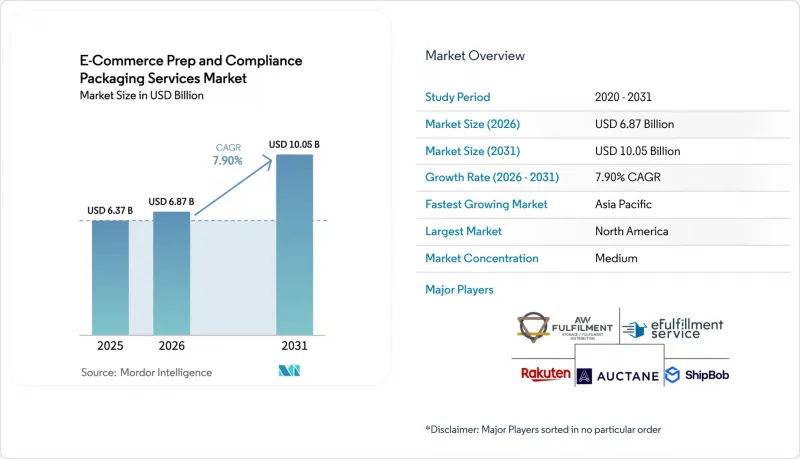
本報告按服務類型(全方位包裝準備和合規性服務、包裝設計和原型製作、ISTA 6 測試限制、其他)、包裝類型(瓦楞紙箱、其他)、終端用戶行業(家用電子電器、其他)、材料類型(紙基、其他)和地區(北美、其他)進行細分。市場預測以美元計價。
全球電子商務包裝準備與合規包裝服務市場趨勢與分析
亞馬遜FBA和賣家自配送Prime交易量快速成長。
亞馬遜在2024年處理了59億個小包裹,比2023年增加了12%。其中約60%的包裹透過亞馬遜物流(FBA)處理。隨著小包裹數量的增加,合規寬限期縮短,導致賣家越來越依賴能夠保證符合SIOC標準的包裝、組裝和即時追蹤的合作夥伴。 2024年,賣家自送Prime(SFP)將其Prime認證計畫擴展至新增的10萬個經銷商,同時仍需履行所有SIOC和ISTA-6義務。這促使小規模品牌選擇外包包裝業務,而不是徹底維修倉庫。亞馬遜國際物流在印度、巴西和東南亞的擴張意味著,亞馬遜的全球法規,加上當地的標籤檢視和海關文件要求,使得在沒有專家協助的情況下,幾乎不可能實現多國合規。能夠整合 Prime 服務、多通路履約和 D2C(直接面對消費者)流程的備貨中心現在正在獲得豐厚的固定費用和長期合約。
對亞馬遜不遵守 SIOC/ISTA-6 的規定,將處以更嚴格的處罰和扣回爭議帳款。
2024年,亞馬遜收緊了扣回爭議帳款標準,對每件不合規商品收取1.50美元至5美元的收費,並暫停屢次違反標準的賣家帳戶。自動化的損壞偵測引擎會檢查每個小包裹的50多個屬性,並在幾分鐘內將錯誤回報給財務部門。重複收到警告的賣家將失去「購買按鈕」資格,導致銷售速度放緩。由此產生的連鎖反應是,保證SIOC合規性的第三方物流供應商現在可以收取更高的服務費用。 2024年中期,SIOC類別擴展至汽車零件和家居用品,使合規範圍增加了約200萬個SKU,導致測試實驗室的預約量立即激增。在旺季實現零扣回爭議帳款的包裝準備服務公司正利用這項成功作為行銷差異化優勢,吸引新的企業客戶。
ISTA-6 實驗室的高資本密集度限制了服務的擴充性。
建造一個符合ISTA-6標準的實驗室需要200萬至500萬美元的設備購置費用,例如旋轉滾筒、壓縮測試設備和環境測試室,此外每年還需要約30萬美元的維護成本。認證過程可能需要長達18個月,在此期間,實驗室設施將處於閒置狀態。小規模樣品製備公司通常會將檢測外包給第三方實驗室,而這些實驗室的運作往往已達極限,導致4至6週的等待時間,並延誤了經銷商的產品上市。區域差異依然存在,拉丁美洲獲得認證的實驗室數量極少,迫使經銷商將樣本空運至美國。這種經濟負擔阻礙了新進入者,並促使現有的獨立營運商與資金雄厚的第三方物流公司合併或建立策略聯盟。
基於細分市場的分析
全方位包裝準備和合規服務細分市場佔據電商包裝準備和合規服務市場的最大佔有率,預計到2025年將佔總收入的45.62%。認證諮詢細分市場雖然規模較小,但成長動能最強勁,年複合成長率達9.12%,主要得益於賣家對亞馬遜、沃爾瑪平台和當地法規的詳細指導需求。這一趨勢正將市場重點從勞動力轉向專業知識,使得顧問公司能夠透過提供專注於解讀法規更新的服務來收取高額諮詢費。在其子細分市場中,包裝設計和原型製作預計到2025年將佔總支出的22.10%,這反映了品牌對符合ISTA-6模擬標準、能夠保護高價值商品並儘可能減少運輸體積的包裝的需求。僅針對ISTA-6的測試服務佔15.18%的市場佔有率,服務對像是那些擁有內部準備站但仍需要中立實驗室出具的證書以維持有效保險的企業品牌。
在電子商務包裝準備和合規包裝服務市場,那些將諮詢、設計、測試和包裝準備整合到訂閱式服務包中的公司仍然備受青睞。隨著法規日益複雜,企業更傾向於單一聯絡人,並尋求減少可能導致交接錯誤的供應商障礙。諮詢專業人士利用每日更新的合規儀表板,涵蓋SIOC修訂、歐盟PPWR閾值以及中國快遞包裝清單等資訊。他們的利潤率通常高於瓦楞紙板封口服務,因為其價值創造的是知識而非勞動力。從2026年到2031年,儘管全方位服務仍將是主要的收入來源,但預計市場將進一步轉向訂閱式顧問合約。
預計到2025年,瓦楞紙箱仍將因其堅固耐用和便於運輸商堆疊而備受青睞,佔據電商包裝準備和合規包裝服務市場61.20%的佔有率。同時,折疊式紙盒的複合年成長率(CAGR)持續成長,達到8.41%。這是因為包裝中心的自動化尺寸最佳化生產線能夠提供尺寸精準的紙盒坯料,從而將基於尺寸和重量的額外費用降低高達20%。聚乙烯郵寄袋(Polymail)佔銷售額的18.10%,主要用於服裝業,該行業對防護性能的要求相對較低。氣泡信封(Bidded mail)佔12.00%,用於包裝小型電子設備和珠寶飾品無需完整包裝盒、只需氣泡信封即可保護的物品。
在電商包裝準備和合規包裝服務市場,永續性評估的重要性日益凸顯,尺寸合適的瓦楞紙箱有助於賣家在平台上獲得環保認證並減少廢棄物。折疊式結構能夠適應不同深度的穿孔,使機器人可以根據貨物的厚度自動切割。一體化瓦楞紙箱製造商正透過採用可變深度結構和黏合劑快速拉環來解決這個問題,從而確保與自動化系統的兼容性。對於向多個國家/地區出貨的經銷商,在折疊式瓦楞紙箱上印刷多樣化的圖案可以加快清關流程並進一步擴大市場佔有率。因此,一個包裝生態系統已經形成,在這個生態系統中,保護性、運輸效率和永續性是同等重要的設計支柱。
區域分析
預計到2031年,亞太地區的複合年成長率將達到8.92%,超過其他所有地區。這主要得益於中國、印度和東南亞國家零售業的數位轉型以及包裝方法法規的不斷改進。中國的新標準GB/T 16606-3-2024採用了與ISTA-6不同的跌落測試規程,迫使出口商進行雙重測試,否則可能面臨海關拒收的風險。印度於2024年推出了電子商務包裝申報系統,要求在小包裹上揭露材料成分比例。熟悉印度標準局(BIS)標準的包裝代理商正在幫助企業減輕這項行政負擔。越南和菲律賓等新興樞紐正在考慮根據再生材料含量徵收附加附加稅,這表明合規要求將持續收緊,預計這將支撐諮詢服務的需求。
北美地區預計到2025年將佔亞馬遜銷售額的41.30%,這得益於其最密集的亞馬遜物流中心網路和成熟的第三方物流基礎設施。由於關鍵品類市場趨於飽和,北美地區的成長速度已放緩至個位數中段,但亞馬遜透過定期擴張自有物流中心(SIOC)維持了需求的基準成長。歐洲市場佔有率佔28.05%,監管政策的調整仍在繼續,《包裝和包裝廢棄物法規》逐步引入了可回收性和可重複使用容器的目標,導致包裝盒的審核和重新設計工作日益增多。拉丁美洲和中東及非洲地區的市場規模仍然較小,但隨著電商平台營運商開發出以亞馬遜全球包裝標準為藍本的在地化「Prime」計劃,這些地區的市場採用率已達到兩位數。
其他好處:
- Excel格式的市場預測(ME)表
- 3個月的分析師支持
目錄
第1章:引言
- 市場分析與定義的前提條件
- 分析範圍
第2章 分析方法
第3章執行摘要
第4章 市場狀況
- 市場概覽
- 市場促進因素
- 亞馬遜FBA和賣家自配送Prime交易量快速成長。
- 由於對不遵守亞馬遜 SIOC/ISTA-6 的處罰更加嚴格,因此出現了扣回爭議帳款。
- 在備考中心擴大自動化(視覺測試、協作機器人)的應用
- 跨境電子商務的發展需要專門的合規包裝。
- 為了減少體積重量費用,零售商正在轉向永續的、尺寸合適的包裝。
- 保險公司要求使用經過認證的包裝材料,以減少索賠。
- 市場限制因素
- ISTA-6 測試實驗室的高資本密集度限制了該服務的擴充性。
- 再生紙板價格的波動給預加工利潤帶來了壓力。
- 除了亞馬遜以外,其他行業監管標準的不一致導致投資回報率的不確定性。
- 知名品牌正在加強內部履約能力,減少外包。
- 產業價值鏈分析
- 監理情勢
- 技術展望
- 宏觀經濟因素的影響
- 波特五力分析
第5章:預測市場規模與成長率
- 按服務類型
- 全方位包裝準備及合規服務
- 包裝設計與原型製作
- ISTA 6 測試限量版
- 認證諮詢
- 其他服務類型
- 按包裝類型
- 瓦楞紙箱
- 塑膠郵寄袋
- 附襯墊信封
- 折疊式紙箱
- 其他類型的包裝
- 按最終用戶行業分類
- 家用電子電器
- 健康與美容
- 居家與廚房
- 服裝和鞋類
- 其他終端用戶產業
- 依材料類型
- 紙張類型
- 塑膠
- 可生物分解/可堆肥
- 多材料混合
- 按地區
- 北美洲
- 美國
- 加拿大
- 墨西哥
- 南美洲
- 巴西
- 阿根廷
- 其他南美國家
- 歐洲
- 德國
- 英國
- 法國
- 義大利
- 西班牙
- 俄羅斯
- 其他歐洲國家
- 亞太地區
- 中國
- 日本
- 印度
- 韓國
- 東南亞
- 其他亞太國家
- 中東和非洲
- 中東
- 沙烏地阿拉伯
- 阿拉伯聯合大公國
- 土耳其
- 其他中東國家
- 非洲
- 南非
- 奈及利亞
- 其他非洲國家
- 中東
- 北美洲
第6章 競爭情勢
- 市場集中度
- 策略趨勢
- 市佔率分析
- 公司簡介
- Auctane ShipStation
- AW Fulfilment
- eFulfillment Service Inc.
- Rakuten Super Logistics
- ShipBob Inc.
- FBA Prep and Ship
- Deliverr by Shopify
- James and James Fulfilment Ltd
- PrepItPackItShipIt Inc.
- Shapiro Packaging Solutions
- SPS Commerce Packaging Services
- Quiet Logistics(American Eagle)
- Hexa Packaging LLC
- ShipMonk Inc.
- Red Stag Fulfillment
- Whiplash(Port Logistics Group)
- Stord Inc.
- Flexport Certified Packaging
- Shipfusion Inc.
- MyFBAPrep
- Fulfillmentcrowd Ltd
- Printful Inc.(Packaging Solutions)
- Boxprep Services Ltd
- Innovate Packaging Solutions Pty Ltd
- 3Linx Fulfillment
第7章 市場機會與未來展望
According to Mordor Intelligence, the e-commerce prep and compliance packaging services market size in 2026 is estimated at USD 6.87 billion, growing from 2025 value of USD 6.37 billion with 2031 projections showing USD 10.05 billion, growing at 7.9% CAGR over 2026-2031.
This report is Segmented by Service Type (Full-Service Prep and Compliance, Packaging Design and Prototyping, ISTA 6 Testing Only, and More), Packaging Type (Corrugated Boxes, and More), End-User Industry (Consumer Electronics, and More), Material Type (Paper-Based, and More), and Geography (North America, and More). The Market Forecasts are Provided in Terms of Value (USD).
Global E-commerce Prep And Compliance Packaging Services Market Trends and Insights
Rapid Expansion of Amazon FBA and Seller Fulfilled Prime Volumes
Amazon processed 5.9 billion parcels in 2024, 12% more than in 2023, with approximately 60% of them routed through FBA. Each additional parcel tightens compliance windows, pushing sellers toward partners that guarantee SIOC-ready units, kitting, and live tracking. Seller Fulfilled Prime opened the Prime badge to 100,000 additional merchants in 2024, while maintaining all SIOC and ISTA-6 obligations, prompting small brands to outsource preparation rather than overhaul their own warehouses. International FBA rollouts in India, Brazil, and Southeast Asia have layered local labeling and customs forms on top of Amazon's global rules, making multi-country compliance practically unattainable without specialist help. Prep centers that can bridge Prime, Multi-Channel Fulfillment, and direct-to-consumer flows now secure premium retainers and long-term contracts.
Stricter Penalties for Non-Compliance with Amazon SIOC/ISTA-6 Resulting in Chargebacks
In 2024, Amazon tightened its chargeback matrix, levying a charge of USD 1.50 to USD 5.00 per non-compliant unit and suspending repeat offenders. Automated damage-detection engines query more than 50 attributes per parcel, escalating errors to finance within minutes. Sellers who repeatedly receive flags lose Buy-Box eligibility, resulting in a decline in sales velocity. The knock-on effect is that 3PLs offering guaranteed SIOC adherence can justify higher service fees. The category expansion of SIOC to automotive parts and home goods in mid-2024 increased the compliance perimeter by approximately 2 million SKUs, resulting in an immediate surge in inbound test-lab bookings. Prep services reporting zero chargebacks during peak season use that metric as a marketing differentiator to lock in new enterprise accounts.
High Capital Intensity of ISTA-6 Test Labs Limiting Service Scalability
Building a single ISTA-6 lab requires USD 2 million to USD 5 million for rotary drums, compression rigs, and environmental chambers, followed by annual maintenance of nearly USD 300,000. Accreditation can last up to 18 months, during which the equipment remains idle. Smaller prep shops often outsource to third-party labs that are already running at capacity, adding four- to six-week queues that slow down seller launches. Regional gaps persist: Latin America hosts only a handful of accredited centers, obliging merchants to air-freight samples to the United States. The cash burden dissuades new entrants and prompts existing independents to merge or form strategic alliances with capital-rich 3PLs.
Other drivers and restraints analyzed in the detailed report include:
- Rising Adoption of Automation (Vision Inspection, Cobots) in Prep Centers
- Growth of Cross-Border E-Commerce Requiring Specialized Compliance Packaging
- Volatility in Recycled Corrugate Prices Squeezing Prep Margins
For complete list of drivers and restraints, kindly check the Table Of Contents.
Segment Analysis
Full-service preparation and compliance generated the largest slice of the e-commerce preparation and compliance packaging services market, with 45.62% revenue in 2025. Certification Advisory, while smaller, is on the fastest 9.12% CAGR track as sellers seek granular guidance on Amazon, Walmart Marketplace, and regional rulebooks. That dynamic elevates expertise over labor, allowing consultative players to secure premium retainers solely to interpret rule updates. Underneath, Packaging Design and Prototyping commands 22.10% of 2025 spend, reflecting brand demand for packaging that satisfies ISTA-6 simulation, protects high-value goods, and ships in the smallest possible cube. ISTA-6-only testing services hold a 15.18% share, serving enterprise brands that have internal preparation stations but still require unbiased lab certificates to maintain valid insurance coverage.
The E-commerce Prep And Compliance Packaging Services Market continues to reward firms that unify advisory, design, test, and prep into subscription bundles. As rules grow more complex, merchants prefer a single point of control, reducing vendor silos that can introduce handoff errors. Advisory specialists leverage proprietary compliance dashboards updated daily with SIOC amendments, EU PPWR thresholds, and China's express-pack list. Their margin profile often eclipses that of carton-sealing services because knowledge, not labor, drives value. Over the 2026-2031 period, the market is expected to tilt further toward advisory retainers, even as full-service volumes remain the backbone of revenue.
Corrugated Boxes still represent 61.20% of the e-commerce preparation and compliance packaging services market share in 2025, favored for robustness and carrier stackability. Foldable Cartons, however, are on an 8.41% CAGR run as automated right-sizing lines at prep centers feed exact-fit blanks that reduce dimensional weight surcharges by as much as 20%. Poly Mailers account for 18.10% of revenue, primarily in the apparel sector, where protection needs are lower. Padded Mailers account for another 12.00%, shielding small electronics and jewelry that require cushioned envelopes without full boxes.
As the e-commerce preparation and compliance packaging services market prioritizes sustainability scoring, right-sized cartons help sellers hit platform eco-badges and cut waste. Foldable constructs support multi-depth perforations, allowing robots to auto-snip to match product depth. Corrugated integrators respond with variable-depth and glue-free quick tabs to maintain automation compatibility. For sellers shipping to multiple countries, universal-print graphics on foldable cartons speed up customs clearance, further increasing market share. The net result is a packaging ecosystem where protection, freight efficiency, and sustainability are co-equal design pillars.
Complete Report Scope:
- By Service Type
- Full-service Prep and Compliance
- Packaging Design and Prototyping
- ISTA 6 Testing Only
- Certification Advisory
- Other Service Types
- By Packaging Type
- Corrugated Boxes
- Poly Mailers
- Padded Mailers
- Foldable Cartons
- Other Packaging Types
- By End-User Industry
- Consumer Electronics
- Health and Beauty
- Home and Kitchen
- Apparel and Footwear
- Other End-User Industries
- By Material Type
- Paper-based
- Plastic-based
- Biodegradable / Compostable
- Multi-material Hybrids
- By Geography
- North America
- United States
- Canada
- Mexico
- South America
- Brazil
- Argentina
- Rest of South America
- Europe
- Germany
- United Kingdom
- France
- Italy
- Spain
- Russia
- Rest of Europe
- Asia-Pacific
- China
- Japan
- India
- South Korea
- South-East Asia
- Rest of Asia-Pacific
- Middle East and Africa
- Middle East
- Saudi Arabia
- United Arab Emirates
- Turkey
- Rest of Middle East
- Africa
- South Africa
- Nigeria
- Rest of Africa
- Middle East
- North America
Geography Analysis
The Asia-Pacific region is expected to post a 8.92% CAGR through 2031, outpacing every other territory as China, India, and Southeast Asian economies continue to digitize retail and codify packaging laws. China's new GB/T 16606-3-2024 spec mandates drop-test protocols that differ from ISTA-6, compelling exporters to double-test or risk customs rejections. India introduced e-commerce packaging declarations in 2024, requiring material composition percentages on parcels, an administrative burden alleviated by prep houses versed in Bureau of Indian Standards norms. Emerging hubs like Vietnam and the Philippines are considering recycled-content levies, signaling a steady escalation of compliance that will sustain advisory demand.
North America accounted for 41.30% of 2025 revenue, driven by the densest network of FBA nodes and a mature third-party logistics infrastructure. Growth moderates to mid-single digits as core categories saturate, yet Amazon's periodic SIOC expansions keep a baseline of incremental demand. Europe, with a 28.05% share, is in legislative flux as the Packaging and Packaging Waste Regulation phases in recyclability and refillable targets, driving audits and redesigns of packaging boxes. Latin America, and Middle East and Africa remain small but show double-digit adoption as marketplace operators roll out local Prime-type programs that reference Amazon's global packaging rubric.
- Auctane ShipStation
- AW Fulfilment
- eFulfillment Service Inc.
- Rakuten Super Logistics
- ShipBob Inc.
- FBA Prep and Ship
- Deliverr by Shopify
- James and James Fulfilment Ltd
- PrepItPackItShipIt Inc.
- Shapiro Packaging Solutions
- SPS Commerce Packaging Services
- Quiet Logistics (American Eagle)
- Hexa Packaging LLC
- ShipMonk Inc.
- Red Stag Fulfillment
- Whiplash (Port Logistics Group)
- Stord Inc.
- Flexport Certified Packaging
- Shipfusion Inc.
- MyFBAPrep
- Fulfillmentcrowd Ltd
- Printful Inc. (Packaging Solutions)
- Boxprep Services Ltd
- Innovate Packaging Solutions Pty Ltd
- 3Linx Fulfillment
Additional Benefits:
- The market estimate (ME) sheet in Excel format
- 3 months of analyst support
TABLE OF CONTENTS
1 INTRODUCTION
- 1.1 Study Assumptions and Market Definition
- 1.2 Scope of the Study
2 RESEARCH METHODOLOGY
3 EXECUTIVE SUMMARY
4 MARKET LANDSCAPE
- 4.1 Market Overview
- 4.2 Market Drivers
- 4.2.1 Rapid Expansion of Amazon FBA and Seller Fulfilled Prime Volumes
- 4.2.2 Stricter Penalties for Non-Compliance with Amazon SIOC/ISTA-6 Resulting in Chargebacks
- 4.2.3 Rising Adoption of Automation (Vision Inspection, Cobots) in Prep Centers
- 4.2.4 Growth of Cross-Border E-Commerce Requiring Specialized Compliance Packaging
- 4.2.5 Retailer Shift Toward Sustainable Right-Sized Packaging to Cut DIM-Weight Fees
- 4.2.6 Insurance Carriers Mandating Certified Packaging to Reduce Damage Claims
- 4.3 Market Restraints
- 4.3.1 High Capital Intensity of ISTA-6 Test Labs Limiting Service Scalability
- 4.3.2 Volatility in Recycled Corrugate Prices Squeezing Prep Margins
- 4.3.3 Fragmented Regulatory Standards Outside Amazon Leading to Uncertain ROI
- 4.3.4 Increasing In-House Fulfillment Capabilities by Large Brands Reducing Outsourcing
- 4.4 Industry Value Chain Analysis
- 4.5 Regulatory Landscape
- 4.6 Technological Outlook
- 4.7 Porter's Five Forces Analysis
- 4.7.1 Threat of New Entrants
- 4.7.2 Bargaining Power of Buyers
- 4.7.3 Bargaining Power of Suppliers
- 4.7.4 Threat of Substitutes
- 4.7.5 Competitive Rivalry
- 4.8 Impact of Macroeconomic Factors
5 MARKET SIZE AND GROWTH FORECASTS (VALUE)
- 5.1 By Service Type
- 5.1.1 Full-service Prep and Compliance
- 5.1.2 Packaging Design and Prototyping
- 5.1.3 ISTA 6 Testing Only
- 5.1.4 Certification Advisory
- 5.1.5 Other Service Types
- 5.2 By Packaging Type
- 5.2.1 Corrugated Boxes
- 5.2.2 Poly Mailers
- 5.2.3 Padded Mailers
- 5.2.4 Foldable Cartons
- 5.2.5 Other Packaging Types
- 5.3 By End-User Industry
- 5.3.1 Consumer Electronics
- 5.3.2 Health and Beauty
- 5.3.3 Home and Kitchen
- 5.3.4 Apparel and Footwear
- 5.3.5 Other End-User Industries
- 5.4 By Material Type
- 5.4.1 Paper-based
- 5.4.2 Plastic-based
- 5.4.3 Biodegradable / Compostable
- 5.4.4 Multi-material Hybrids
- 5.5 By Geography
- 5.5.1 North America
- 5.5.1.1 United States
- 5.5.1.2 Canada
- 5.5.1.3 Mexico
- 5.5.2 South America
- 5.5.2.1 Brazil
- 5.5.2.2 Argentina
- 5.5.2.3 Rest of South America
- 5.5.3 Europe
- 5.5.3.1 Germany
- 5.5.3.2 United Kingdom
- 5.5.3.3 France
- 5.5.3.4 Italy
- 5.5.3.5 Spain
- 5.5.3.6 Russia
- 5.5.3.7 Rest of Europe
- 5.5.4 Asia-Pacific
- 5.5.4.1 China
- 5.5.4.2 Japan
- 5.5.4.3 India
- 5.5.4.4 South Korea
- 5.5.4.5 South-East Asia
- 5.5.4.6 Rest of Asia-Pacific
- 5.5.5 Middle East and Africa
- 5.5.5.1 Middle East
- 5.5.5.1.1 Saudi Arabia
- 5.5.5.1.2 United Arab Emirates
- 5.5.5.1.3 Turkey
- 5.5.5.1.4 Rest of Middle East
- 5.5.5.2 Africa
- 5.5.5.2.1 South Africa
- 5.5.5.2.2 Nigeria
- 5.5.5.2.3 Rest of Africa
- 5.5.5.1 Middle East
- 5.5.1 North America
6 COMPETITIVE LANDSCAPE
- 6.1 Market Concentration
- 6.2 Strategic Moves
- 6.3 Market Share Analysis
- 6.4 Company Profiles (includes Global level Overview, Market level overview, Core Segments, Financials as available, Strategic Information, Market Rank/Share for key companies, Products and Services, and Recent Developments)
- 6.4.1 Auctane ShipStation
- 6.4.2 AW Fulfilment
- 6.4.3 eFulfillment Service Inc.
- 6.4.4 Rakuten Super Logistics
- 6.4.5 ShipBob Inc.
- 6.4.6 FBA Prep and Ship
- 6.4.7 Deliverr by Shopify
- 6.4.8 James and James Fulfilment Ltd
- 6.4.9 PrepItPackItShipIt Inc.
- 6.4.10 Shapiro Packaging Solutions
- 6.4.11 SPS Commerce Packaging Services
- 6.4.12 Quiet Logistics (American Eagle)
- 6.4.13 Hexa Packaging LLC
- 6.4.14 ShipMonk Inc.
- 6.4.15 Red Stag Fulfillment
- 6.4.16 Whiplash (Port Logistics Group)
- 6.4.17 Stord Inc.
- 6.4.18 Flexport Certified Packaging
- 6.4.19 Shipfusion Inc.
- 6.4.20 MyFBAPrep
- 6.4.21 Fulfillmentcrowd Ltd
- 6.4.22 Printful Inc. (Packaging Solutions)
- 6.4.23 Boxprep Services Ltd
- 6.4.24 Innovate Packaging Solutions Pty Ltd
- 6.4.25 3Linx Fulfillment
7 MARKET OPPORTUNITIES AND FUTURE OUTLOOK
- 7.1 White-space and Unmet-Need Assessment

 合約包裝和履約服務:市場佔有率分析、行業趨勢和統計數據以及成長預測(2026-2031 年)合約包裝:市場佔有率分析、產業趨勢與統計、成長預測(2026-2031)美國合約套裝:市場佔有率分析、行業趨勢和統計數據、成長預測(2026-2031 年)藥品和醫療設備無菌包裝服務:市場佔有率分析、產業趨勢和統計數據以及成長預測(2025-2030 年)歐洲合約包裝:市場佔有率分析、產業趨勢與統計及成長預測(2026-2031 年)
 合約包裝市場:2026-2032年全球市場預測(按包裝類型、服務類型、包裝材料、合約類型和最終用途行業分類)
 2026-2030年全球合約包裝市場
 合約包裝市場規模、佔有率、趨勢和預測:按包裝類型、材料、服務、最終用途行業和地區分類,2026-2034 年
 合約包裝和履約服務市場-全球產業規模、佔有率、趨勢、機會、預測:按服務類型、最終用戶、地區和競爭格局分類,2021-2031年
 合約包裝市場規模、佔有率和趨勢分析報告:按材料、包裝類型、最終用途、地區和細分市場預測(2026-2033 年)