


 |
市場調查報告書
商品編碼
2123566
動物飼料微量元素:市場佔有率分析、產業趨勢與統計、成長預測(2026-2031)Animal Feed Trace Minerals - Market Share Analysis, Industry Trends & Statistics, Growth Forecasts (2026 - 2031) |
||||||

※ 本網頁內容可能與最新版本有所差異。詳細情況請與我們聯繫。
根據 Mordor Intelligence 預測,動物飼料微量元素市場規模預計在 2026 年達到 53.3 億美元,到 2031 年將達到約 73 億美元,預測期內複合年成長率為 6.5%。
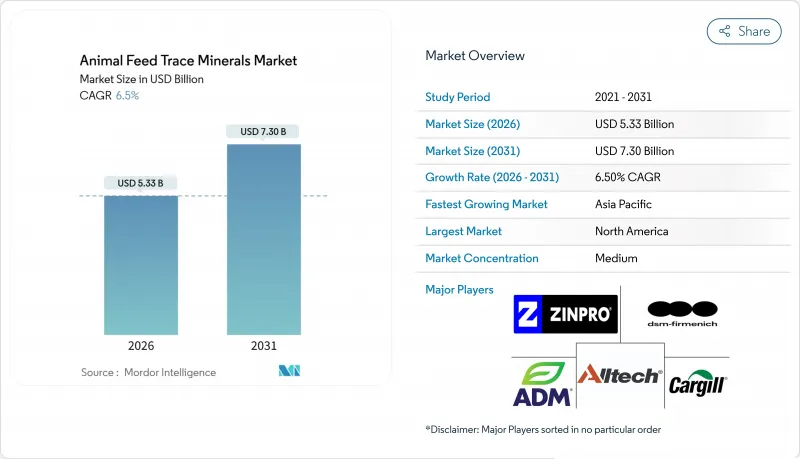
本報告按礦物類型(鋅、銅、鐵及其他)、牲畜(家禽、反芻動物及其他)、原料類型(無機、有機及其他)、形態(乾粉、液體)和地區(北美、歐洲、亞太及其他)進行細分。市場預測以美元計價。
全球動物飼料微量元素市場趨勢與洞察。
全球對動物性蛋白質的需求正在成長。
預計到2024年,全球肉類產量將成長1.3%,達到3.65億噸。這一成長主要由禽肉生產推動,牛肉產量的增加也起到了一定作用,而豬肉和羊肉產量則保持平穩。澳洲、巴西、歐盟和美國的肉類產量均顯著成長。此外,根據經合組織和聯合國糧農組織的預測,到2031年,肉類消費量預計將達到4,790萬噸,這凸顯了在不擴大耕地面積的情況下,需要營養豐富、富含礦物質的飼料來維持肉類生產。根據中國農業農村部統計,到2025年,中國豬隻存欄量將恢復到3,900萬頭,將導致複合飼料產量激增22%。這種複合飼料將添加濃度為80-120 ppm的鋅、銅和錳。在印度,由於政府支持建造配備生物安全設施並相應補充礦物質,肉雞引進數量在同一年增加了8%。沙烏地阿拉伯和阿拉伯聯合大公國的家禽公司進行大規模投資,加速了出口飼料中螯合硒和鋅的需求。在撒哈拉以南非洲,人均每日蛋白質攝取量仍比世界衛生組織(世衛組織)的基準值低約15克,因此,需要添加礦物質的捐助者資助的幼畜飼料飼料計畫正在推廣。在全部區域,每消費一公斤肉類,就會補充約14克微量元素,這比例有助於肉類消費量的長期成長。都市區收入的成長、飲食習慣的改變以及超級市場的擴張也推動了人們對更高品質動物性蛋白質的需求,進而增加了對富含礦物質飼料的需求。全球糧食安全努力也促使各國政府為飼料原料提供補貼,間接提高了礦物質的使用率。這些因素共同推動了動物飼料微量元素市場在預測期內實現強勁的、以銷售主導的成長。
有機礦物質具有極佳的生物利用度
與無機硫酸鹽和氧化物相比,胺基酸螯合物和蛋白質鹽的吸收效率高出20%至40%,這使得營養師能夠在維持最佳組織濃度的同時降低其用量,從而在大規模養殖中每噸飼料節省0.50至1.20美元的成本。在巴西,Zinpro公司的「Availa」計畫旨在在2025年飼養120萬隻肉雞,該計畫將飼料轉換率提高了12%,使養殖戶能夠提前3.5天達到目標體重。歐洲食品安全局(EFSA)於2024年採用了修訂後的生物利用度係數,該係數在計算最大允許值時有效考慮了有機礦物質,從而有助於飼料配方的調整。在東南亞,混合策略正日益普及,一體化生產商將30%的有機螯合物與70%的無機鹽混合,並計劃在2027年將有機礦物質的比例提高到25%。飼餵螯合劑的雞群免疫功能增強,氧化壓力降低,從而降低了疾病成本,進一步強化了價格差異的合理性。隨著精準飼餵工具的出現,生產性能得以即時量化,有機礦物質的經濟效益也更容易體現,加速了其應用。此外,與永續發展掛鉤的融資機制(獎勵減少礦物質排泄)也促使買家轉向螯合劑。綜上所述,這些趨勢表明,有機礦物質將在動物飼料微量元素市場中持續削弱無機鹽的主導地位。
有機微量元素的高溢價
螯合鋅和螯合銅的價格比硫酸鹽飼料高出30-50%,在典型的家禽和生豬養殖系統中,每噸成品飼料的成本將增加2.50-4.00美元,而這些養殖系統的平均淨利潤為每噸15-25美元。在印度,70%的飼料廠為融資拮据的小規模農戶供貨,預計到2025年,有機微量元素的市場滲透率僅12%。在撒哈拉以南非洲,15-25%的進口關稅和8-12%的物流利潤使得80%的生產商難以負擔螯合劑。在巴西,預計到2025年雷亞爾對美元貶值12%,這將增加螯合劑的成本,導致BRF SA和JBS SA等大型企業將有機礦物質含量限制在20%。由60%無機鹽和40%螯合劑組成的混合配方,在維持約66.67%生物利用度優勢的同時,將溢價降低了一半,並在有機飼料市場保持了6%的年成長率,儘管受到價格飆升的影響。飼料添加劑生產商正在投資本地螯合劑生產以降低運輸成本,但擴大生產規模仍需要大量資金。在實現規模經濟或原物料價格恢復正常之前,成本壁壘可能會繼續阻礙其推廣應用並減緩市場成長。
細分市場分析
至2025年,鋅將佔動物飼料微量元素市場銷售額的43%。由於鋅在免疫調節和骨骼生長中發揮重要作用,因此它是家禽、豬和反芻動物飼料中不可或缺的成分。銅緊隨其後,主要原因是其被用於仔豬飼料中,藥理劑量的銅有助於在斷奶壓力下穩定腸道環境。錳主要用於種雞和蛋雞的複合飼料中,以維持高產蛋周轉率雞群的蛋殼強度。鐵的生長主要得益於其在仔豬補飼飼料中的應用,以預防仔豬貧血。隨著熱帶地區畜牧業對緩解熱應激的需求日益成長,硒的市場需求也迅速成長。
關於硒,有機酵母和甲硫胺酸等形式的硒預計到2031年將實現9.5%的複合年成長率,因為它們在代謝率高的牲畜中表現出較高的組織保留率和抗氧化能力。有機鋅和奈米包封產品可將腸道吸收率提高高達90%,從而降低飼料中硒的比例,減少糞便中的硒排泄,並更容易符合歐洲新的土壤負荷法規。在沒有嚴格環境法規的地區,對銅的需求仍然強勁,但在歐盟,飼料中銅的平均含量正在下降,因為螯合形式的銅可以在保持生長的同時,將比例降低30%。隨著胺基酸螯合和奈米遞送技術的積極研發,預計效率將進一步提高,動物飼料微量元素市場預計將保持技術主導的成長軌跡。
至2025年,家禽將佔動物飼料微量元素市場的43%,成為該市場最大的單一佔有率。這反映了該產業預計全球家禽數量將達到1,300億隻,以及其快速的生產週期,需要持續的礦物質攝取才能實現屠體產量的一致性。反芻動物產業也在擴張,高產量乳牛和育肥牛需要鋅和錳來維持蹄部強度和繁殖效率。養豬業也做出了顯著貢獻,儘管面臨日益嚴格的監管壓力,銅和鋅在亞洲和南美洲的許多仔豬養殖場仍然發揮著促進生長的作用。水產養殖業的成長速度最快,年複合成長率達10.2%,這主要得益於蝦、吳郭魚和鮭魚養殖場需要高濃度的硒和鋅來減輕循環系統中的氧化壓力。
水產養殖業的快速發展得益於預計到2025年養殖魚類產量將達到8,800萬噸,首次超過野生漁獲量,促使人們開發針對不同魚類滲透調節需求的專用微量元素組合藥物。一體化家禽生產商正轉向使用微膠囊鋅,這種鋅可以減少粉塵損失,提高運作飼料廠的混合均勻性,並有助於履行與加工商簽訂的性能契約,因為加工商會因重量差異而受到處罰。中國和越南的養豬戶仍在給豬飼料中添加150-250ppm的銅來控制斷奶後腹瀉。然而,隨著土壤負荷法規的日益嚴格,預計未來幾年高生物利用度螯合化合物的使用量將會增加。高階寵物食品品牌也在增加螯合礦物質的含量,以支持老年寵物的關節健康和免疫功能,這雖然是動物飼料微量元素市場中小規模但盈利的收入來源。
區域分析
到2025年,北美將佔全球銷售額的35%,這主要得益於美國肉雞和牛養殖規模的擴大,預計這些養殖戶將消耗120萬噸礦物質添加劑。預計該地區將保持穩定的成長勢頭直至2031年。在加拿大,採用精準飼餵技術的酪農中,液態螯合劑的使用率已達到42%;而在墨西哥,哈利斯科州和韋拉克魯斯州的家禽養殖場增加了有機硒的添加,以應對熱應激問題。感測器分析技術在商業農場的普及率已達到18%,為數據驅動的礦物質調整提供了支持,從而在玉米和大豆價格波動的情況下保障利潤率。
預計到2031年,亞太地區將以8.2%的複合年成長率成長,成為各地區中成長最快的地區。這主要得益於中國生豬養殖業的復甦和印度家禽業的擴張,這兩個產業正逐年擴大該地區動物飼料微量元素市場的規模。中國政府對現代化飼料廠提供150億元人民幣(約21億美元)的補貼,有利於螯合礦物質的使用,預計有機礦物質的滲透率將從2023年的14%上升到2025年的22%。印度的「國家畜牧業發展計畫」強制要求小規模乳品加工業使用礦物質飼料,為經濟實惠的無機鹽創造了穩定的需求基礎,而大型酪農對優質螯合劑的需求仍然存在。東南亞水產養殖業的蓬勃發展,使得水生動物體內的硒和鋅含量比陸生牲畜高出 20-30%,為越南和印尼兩位數的成長奠定了基礎。
在歐洲,由於畜牧業數量成長趨於平穩,但永續性法規要求減少廢棄物產生,預計市場將以較高的複合年成長率 (CAGR) 擴張。 2023/915 號法規強制飼料生產商要么採用螯合鋅和螯合銅,要么承擔每噸 30-50 歐元(32-53 美元)的糞便處理成本,導致市場需求轉向價格更高的有機解決方案。在英國,脫歐後添加劑核准流程加快,使 Balchem 的螯合錳產品上市時間縮短了 14 個月。這顯示創新企業的法規環境正在改變。
其他好處
- Excel格式的市場預測(ME)表
- 3個月的分析師支持
目錄
第1章:引言
- 研究假設和市場定義
- 調查範圍
第2章:調查方法
第3章執行摘要
第4章 市場狀況
- 市場概覽
- 市場促進因素
- 全球對動物性蛋白質的需求正在成長。
- 有機礦物質具有極佳的生物利用度
- 對抗生素生長促進劑的監管限制
- 減少礦物質排泄帶來的環境效益
- 精密送料和感測器分析技術的介紹
- 透過循環經濟採購微量元素
- 市場限制因素
- 有機礦物質價格溢價高昂
- 多個地區均實施嚴格的報名手續
- 引入土壤重金屬含量上限
- 特種螯合劑供應鏈中的脆弱性
- 監理情勢
- 技術展望
- 波特五力分析
第5章 市場規模與成長預測
- 礦物類型
- 鋅
- 銅
- 錳
- 鐵
- 碳粉匣
- 其他
- 畜牧業
- 家禽
- 反芻動物
- 豬
- 水產養殖
- 寵物和其他
- 依原料類型
- 無機鹽
- 有機螯合
- 奈米封裝
- 按形式
- 乾燥
- 液體
- 按地區
- 北美洲
- 美國
- 加拿大
- 墨西哥
- 其他北美國家
- 南美洲
- 巴西
- 阿根廷
- 其他南美國家
- 歐洲
- 德國
- 英國
- 法國
- 義大利
- 西班牙
- 俄羅斯
- 其他歐洲國家
- 亞太地區
- 中國
- 印度
- 日本
- 韓國
- 澳洲
- 其他亞太國家
- 中東
- 沙烏地阿拉伯
- 阿拉伯聯合大公國
- 其他中東國家
- 非洲
- 南非
- 埃及
- 其他非洲地區
- 北美洲
第6章 競爭情勢
- 市場集中度
- 策略趨勢
- 市佔率分析
- 公司簡介
- Cargill Incorporated
- Archer Daniels Midland Company
- DSM-Firmenich AG
- Zinpro Corporation
- Alltech, Inc
- BASF SE
- Nutreco NV(SHV Holdings)
- Kemin Industries, Inc.
- Phibro Animal Health Corporation
- Adisseo(China National Bluestar(Group)Co., Ltd.)
- Novus International, Inc.
- Balchem Corp.
- Biochem Zusatzstoffe Handels-und Produktionsgesellschaft mbH
- Orffa(Marubeni Corporation)
- Animine
第7章 市場機會與未來展望
According to Mordor Intelligence, the animal feed trace minerals market size is USD 5.33 billion in 2026 and is projected to reach approximately USD 7.3 billion by 2031, growing at a 6.5% CAGR over the forecast period.
This report is Segmented by Mineral Type (Zinc, Copper, Iron, and More), by Livestock (Poultry, Ruminants, and More), by Source Type (Inorganic, Organic, and More), by Form (Dry and Liquid), and by Geography (North America, Europe, Asia-Pacific, and More). The Market Forecasts are Provided in Terms of Value (USD).
Global Animal Feed Trace Minerals Market Trends and Insights
Rising Global Demand for Animal Protein
In 2024, global meat production is estimated to have risen by 1.3%, reaching 365 million metric tons. This growth was largely driven by poultry meat, with increases in beef output also contributing, while pig and sheep meat production remained stable. Significant growth in meat production occurred in Australia, Brazil, the European Union, and the United States. Moreover, the OECD and FAO outlook pegs consumption to reach 47.9 million metric tons by 2031, emphasizing the need for denser, mineral-fortified rations that sustain output without expanding farmland. According to the Ministry of Agriculture and Rural Affairs of China, China's hog inventory rebounded to 39 million heads in 2025, driving a 22% jump in compound-feed production that pulls zinc, copper, and manganese at inclusion rates of 80-120 parts per million. India's poultry industry increased broiler placements by 8% in the same year, aided by government support for biosecure housing and aligned mineral supplementation. Both Saudi Arabia and the United Arab Emirates are witnessing significant investments by poultry companies, which is accelerating the demand for chelated selenium and zinc in export-quality feed. Sub-Saharan Africa still lags behind the World Health Organization's protein benchmark by approximately 15 grams per person per day, prompting donor-funded starter-feed programs that require mineral fortification. Across these regions, each additional kilogram of meat consumed translates into roughly 14 grams of supplemental trace minerals, a ratio that supports long-term volume growth. Rising urban incomes, changing dietary preferences, and supermarket expansion also stimulate the purchase of higher-quality animal protein, which favors mineral-dense feed. The global push for food security further encourages governments to subsidize feed inputs, indirectly lifting mineral utilization. Combined, these factors provide the animal feed trace minerals market with a durable, volume-driven growth that remains intact throughout the forecast horizon.
Superior Bioavailability of Organic Minerals
Amino-acid chelates and proteinates demonstrate 20-40% higher absorption efficiency than inorganic sulfates or oxides, allowing nutritionists to reduce inclusion rates while maintaining optimal tissue concentrations and trimming feed costs by USD 0.50-1.20 per metric ton in large operations. In Brazil, Zinpro's Availa program, which involved 1.2 million broilers in 2025, improved feed conversion ratios by 12%, enabling producers to reach target weights 3.5 days sooner. The European Food Safety Authority adopted updated bioavailability coefficients in 2024, which effectively account for organic minerals in maximum-limit calculations, encouraging reformulation. Hybrid strategies are gaining ground in Southeast Asia, where integrators blend 30% organic chelates with 70% inorganics and increase organic penetration to 25% by 2027. Improved immune competence and lower oxidative stress observed in chelate-fed flocks reduce morbidity costs, further justifying the premium. As precision-feeding tools quantify performance in real-time, the economic benefits of organic minerals become easier to prove, driving faster adoption. Sustainability-linked loans that reward lower mineral excretion also steer buyers toward chelates. Taken together, these dynamics ensure organic minerals will keep chipping away at the dominance of inorganic salts inside the animal feed trace minerals market.
High Cost Premium of Organic Trace Minerals
Chelated zinc and copper command a 30-50% premium over sulfate forms, increasing finished-feed costs by USD 2.50-4.00 per metric ton in commodity poultry and swine systems, where net margins average USD 15-25 per metric ton. In India, 70% of mills serve smallholders with tight cash flow, limiting organic-mineral penetration to 12% by 2025. Sub-Saharan African import tariffs of 15-25% and logistics markups of 8-12% keep chelates out of reach for 80% of producers. Brazil's real depreciated 12% against the dollar in 2025, inflating chelate costs and prompting integrators such as BRF S.A. and JBS S.A. to cap organic inclusion at 20%. Hybrid blends, which utilize 60% inorganic salts and 40% chelates, capture approximately 66.67% of the bioavailability benefit while halving the premium, sustaining 6% annual organic segment growth even amid sticker shock. Feed additive makers are investing in local chelate production to reduce freight costs, but scaling remains a capital-intensive process. Until economies of scale emerge or ingredient prices normalize, the cost hurdle will continue to dampen adoption and slow the market's growth.
Other drivers and restraints analyzed in the detailed report include:
- Regulatory Curbs on Antibiotic Growth Promoters
- Environmental Benefits of Reduced Mineral Excretion
- Stringent Multi-Region Registration Processes
For complete list of drivers and restraints, kindly check the Table Of Contents.
Segment Analysis
In 2025, Zinc accounted for 43% of the animal feed trace minerals market revenue. Its critical role in immune modulation and skeletal growth made it essential in diets for poultry, swine, and ruminants. Copper followed, primarily due to its use in nursery swine rations, where pharmacological dosing helps stabilize gut health during weaning stress. Manganese usage is driven by its inclusion in breeder and layer formulations to maintain eggshell integrity in high-turnover flocks. Iron's growth is supported by its use in creep-feed supplements to prevent anemia in piglets. Selenium is experiencing rapid growth as heat-stress mitigation becomes increasingly important in tropical livestock operations.
Selenium is projected to post a 9.5% CAGR through 2031 as organic yeast and selenomethionine forms deliver higher tissue retention and antioxidant capacity in high-metabolic livestock. Organic zinc and nano-encapsulated variants that achieve up to 90% intestinal absorption are reducing inclusion rates, thereby lowering fecal output and facilitating compliance with new soil-load rules in Europe. Copper demand remains steady in regions without stringent environmental regulations, but average dietary levels are declining in the European Union as chelated forms enable a 30% reduction while sustaining growth. Intensifying R&D in amino-acid chelation and nano-delivery promises further efficiency gains that will keep the animal feed trace minerals market on a technology-driven upgrade path.
Poultry commanded 43% in 2025 and represented the largest single share of the animal feed trace minerals market share, reflecting the sector's 130 billion-bird global population and fast production cycles that demand consistent mineral intake for uniform carcass yields. Ruminants are growing as high-producing dairy cows and feedlot cattle rely on zinc and manganese for hoof strength and reproductive efficiency. Swine contributes significantly, as copper and zinc still function as growth promoters in many Asian and South American nurseries, despite mounting regulatory pressure. Aquaculture is experiencing the fastest growth trajectory, with a 10.2% CAGR, driven by shrimp, tilapia, and salmon farms that require elevated levels of selenium and zinc to mitigate oxidative stress in recirculating systems.
Aquaculture's rapid ascent is underpinned by farmed-fish output that hit 88 million metric tons in 2025, surpassing wild catch for the first time and triggering specialized trace-mineral formulations matched to species-specific osmoregulatory needs. Poultry integrators are shifting toward micro-encapsulated zinc, which reduces dust loss and improves mixing uniformity in high-speed mills, thereby supporting performance contracts with processors that penalize weight variance. Swine producers in China and Vietnam continue to dose copper at 150-250 parts per million to offset post-weaning diarrhea. However, rising soil-load caps will likely push them toward more bioavailable chelates over the outlook period. Premium pet food brands are also lifting chelated mineral levels to support joint health and immune function in aging companion animals, adding a small but profitable revenue stream for the animal feed trace minerals market.
Complete Report Scope:
- By Mineral Type
- Zinc
- Copper
- Manganese
- Iron
- Selenium
- Others
- By Livestock
- Poultry
- Ruminant
- Swine
- Aquaculture
- Pets and Other
- By Source Type
- Inorganic Salts
- Organic/Chelated
- Nano/Encapsulated
- By Form
- Dry
- Liquid
- By Geography
- North America
- United States
- Canada
- Mexico
- Rest of North America
- South America
- Brazil
- Argentina
- Rest of South America
- Europe
- Germany
- United Kingdom
- France
- Italy
- Spain
- Russia
- Rest of Europe
- Asia-Pacific
- China
- India
- Japan
- South Korea
- Australia
- Rest of Asia-Pacific
- Middle East
- Saudi Arabia
- United Arab Emirates
- Rest of Middle East
- Africa
- South Africa
- Egypt
- Rest of Africa
- North America
Geography Analysis
North America generated 35% of global revenue in 2025, primarily driven by the United States' broiler and cattle herds, which consumed 1.2 million metric tons of mineral additives. The region is projected to expand at a steady growth rate through 2031. Adoption of liquid chelates in precision-fed dairies rose to 42% of herds in Canada, while Mexico's heat-stress challenges lifted organic selenium inclusion across Jalisco and Veracruz flocks. Sensor analytics penetration reached 18% of commercial operations, supporting data-driven mineral adjustments that protect margins as corn and soybean prices fluctuate.
The Asia Pacific is advancing at an 8.2% CAGR through 2031, the fastest regional pace, driven by China's recovery of its hog herd and India's poultry expansion, which together increase the region's animal feed trace minerals market size each year. Subsidies worth CNY 15 billion (USD 2.1 billion) for modernized feed mills in China favor chelated minerals, raising organic penetration from 14% in 2023 to 22% in 2025. India's National Livestock Mission mandates mineralized rations for smallholder dairies, creating a captive base for cost-effective inorganic salts while leaving headroom for premium chelates in organized dairies. Southeast Asia's aquaculture boom absorbs selenium and zinc at inclusion rates 20-30% higher than those of terrestrial livestock, underpinning double-digit growth in Vietnam and Indonesia.
Europe is estimated to grow at a high CAGR, as static animal numbers are offset by sustainability mandates that require lower excretion profiles. Regulation 2023/915 prompted feed mills to adopt chelated zinc and copper or incur manure export costs of EUR 30-50 (USD 32-53) per metric ton, thereby steering demand toward higher-priced organic solutions. The United Kingdom accelerated additive approvals post-Brexit, shortening market entry for Balchem's chelated manganese by fourteen months and signaling a regulatory change for innovators.
- Cargill Incorporated
- Archer Daniels Midland Company
- DSM-Firmenich AG
- Zinpro Corporation
- Alltech, Inc
- BASF SE
- Nutreco N.V. (SHV Holdings)
- Kemin Industries, Inc.
- Phibro Animal Health Corporation
- Adisseo (China National Bluestar (Group) Co., Ltd.)
- Novus International, Inc.
- Balchem Corp.
- Biochem Zusatzstoffe Handels- und Produktionsgesellschaft mbH
- Orffa (Marubeni Corporation)
- Animine
Additional Benefits:
- The market estimate (ME) sheet in Excel format
- 3 months of analyst support
TABLE OF CONTENTS
1 Introduction
- 1.1 Study Assumptions and Market Definition
- 1.2 Scope of the Study
2 Research Methodology
3 Executive Summary
4 Market Landscape
- 4.1 Market Overview
- 4.2 Market Drivers
- 4.2.1 Rising global demand for animal protein
- 4.2.2 Superior bioavailability of organic minerals
- 4.2.3 Regulatory curbs on antibiotic growth promoters
- 4.2.4 Environmental benefits of reduced mineral excretion
- 4.2.5 Precision feeding and sensor analytics adoption
- 4.2.6 Circular-economy sourcing of trace minerals
- 4.3 Market Restraints
- 4.3.1 High cost premium of organic minerals
- 4.3.2 Stringent multi-region registration processes
- 4.3.3 Emerging soil-load caps on heavy metals
- 4.3.4 Specialty-chelate supply-chain fragility
- 4.4 Regulatory Landscape
- 4.5 Technological Outlook
- 4.6 Porter's Five Forces Analysis
- 4.6.1 Threat of New Entrants
- 4.6.2 Bargaining Power of Buyers
- 4.6.3 Bargaining Power of Suppliers
- 4.6.4 Threat of Substitutes
- 4.6.5 Intensity of Competitive Rivalry
5 Market Size and Growth Forecasts (Value)
- 5.1 By Mineral Type
- 5.1.1 Zinc
- 5.1.2 Copper
- 5.1.3 Manganese
- 5.1.4 Iron
- 5.1.5 Selenium
- 5.1.6 Others
- 5.2 By Livestock
- 5.2.1 Poultry
- 5.2.2 Ruminant
- 5.2.3 Swine
- 5.2.4 Aquaculture
- 5.2.5 Pets and Other
- 5.3 By Source Type
- 5.3.1 Inorganic Salts
- 5.3.2 Organic/Chelated
- 5.3.3 Nano/Encapsulated
- 5.4 By Form
- 5.4.1 Dry
- 5.4.2 Liquid
- 5.5 By Geography
- 5.5.1 North America
- 5.5.1.1 United States
- 5.5.1.2 Canada
- 5.5.1.3 Mexico
- 5.5.1.4 Rest of North America
- 5.5.2 South America
- 5.5.2.1 Brazil
- 5.5.2.2 Argentina
- 5.5.2.3 Rest of South America
- 5.5.3 Europe
- 5.5.3.1 Germany
- 5.5.3.2 United Kingdom
- 5.5.3.3 France
- 5.5.3.4 Italy
- 5.5.3.5 Spain
- 5.5.3.6 Russia
- 5.5.3.7 Rest of Europe
- 5.5.4 Asia-Pacific
- 5.5.4.1 China
- 5.5.4.2 India
- 5.5.4.3 Japan
- 5.5.4.4 South Korea
- 5.5.4.5 Australia
- 5.5.4.6 Rest of Asia-Pacific
- 5.5.5 Middle East
- 5.5.5.1 Saudi Arabia
- 5.5.5.2 United Arab Emirates
- 5.5.5.3 Rest of Middle East
- 5.5.6 Africa
- 5.5.6.1 South Africa
- 5.5.6.2 Egypt
- 5.5.6.3 Rest of Africa
- 5.5.1 North America
6 Competitive Landscape
- 6.1 Market Concentration
- 6.2 Strategic Moves
- 6.3 Market Share Analysis
- 6.4 Company Profiles (includes Global Level Overview, Market Level Overview, Core Segments, Financials as Available, Strategic Information, Market Rank/Share for Key Companies, Products and Services, and Recent Developments)
- 6.4.1 Cargill Incorporated
- 6.4.2 Archer Daniels Midland Company
- 6.4.3 DSM-Firmenich AG
- 6.4.4 Zinpro Corporation
- 6.4.5 Alltech, Inc
- 6.4.6 BASF SE
- 6.4.7 Nutreco N.V. (SHV Holdings)
- 6.4.8 Kemin Industries, Inc.
- 6.4.9 Phibro Animal Health Corporation
- 6.4.10 Adisseo (China National Bluestar (Group) Co., Ltd.)
- 6.4.11 Novus International, Inc.
- 6.4.12 Balchem Corp.
- 6.4.13 Biochem Zusatzstoffe Handels- und Produktionsgesellschaft mbH
- 6.4.14 Orffa (Marubeni Corporation)
- 6.4.15 Animine
7 Market Opportunities and Future Outlook

 動物飼料用有機微量元素:市場佔有率分析、產業趨勢與統計及成長預測(2026-2031)
 飼料飼料用有機微量元素市場:依礦物種類、螯合物、形態、動物種類、應用及通路分類-2026-2032年全球市場預測美國動物飼料用有機微量元素:市佔率分析、產業趨勢與統計及成長預測(2026-2031 年)北美動物飼料中有機微量元素:市場佔有率分析、行業趨勢和統計數據以及成長預測(2026-2031 年)南美洲動物飼料中的有機微量元素:市場佔有率分析、行業趨勢和統計數據以及成長預測(2026-2031 年)歐洲動物飼料用有機微量元素:市場佔有率分析、產業趨勢與統計及成長預測(2026-2031)
 飼料中微量元素的市場機會、成長要素、產業趨勢和預測(2025-2035 年)。
 飼料飼料有機微量元素市場報告:按微量元素類型、動物類型和地區分類(2026-2034 年)
 2026-2034年全球動物飼料中有機微量元素市場規模、佔有率、趨勢和成長分析報告動物飼料用有機微量元素市場機會、成長要素、產業趨勢分析及預測(2026年至2035年)