


 |
市場調查報告書
商品編碼
2027573
飼料中微量元素的市場機會、成長要素、產業趨勢和預測(2025-2035 年)。Animal Feed Trace Mineral Market Opportunity, Growth Drivers, Industry Trend Analysis, and Forecast 2025 - 2035 |
||||||

2025 年全球動物飼料中微量元素市場規模預計為 6.415 億美元,預計到 2035 年將達到 12 億美元,年複合成長率為 6.4%。
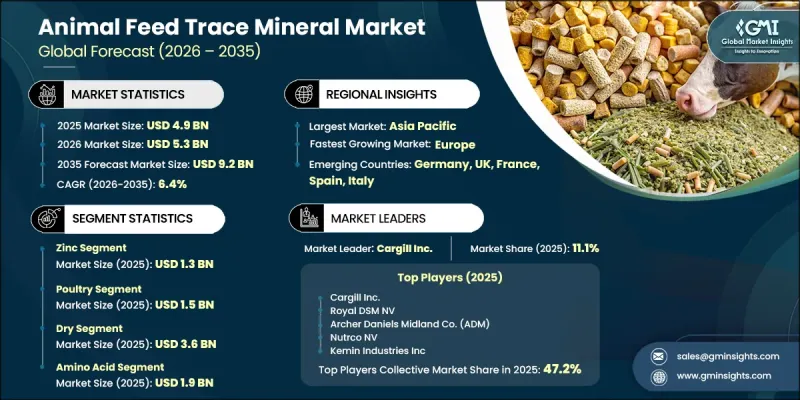
隨著畜牧養殖戶日益認知到微量元素補充劑對動物健康和生產力的重要性,市場正在穩步擴張。鋅、銅、鐵、錳、硒和碘等微量元素在維持牲畜的代謝功能、免疫反應、繁殖能力和整體生長方面發揮著至關重要的作用。這些營養素的需求量雖小,但對飼料轉換率和動物健康有顯著的影響。飼料生產商正在添加微量元素,以彌補傳統飼料原料中的營養不足,並確保動物在各個生長階段都能獲得均衡的營養。隨著精準營養實踐的日益普及,礦物質的配方和供應方式也不斷改進,從而提高了動物的吸收和利用效率。礦物質螯合和有機礦物質形式的技術進步進一步增強了生物利用度和生產性能。隨著畜牧業系統日益集約化和以生產力為導向,對最佳化礦物質補充的需求持續成長,這有助於全球農業生產保持穩定的生產力並改善畜群健康狀況。
由於鋅在支持牲畜免疫功能、腸道功能和皮膚健康方面應用廣泛,預計到2025年,鋅市場規模將達到1.7億美元。鐵的需求與其在氧氣運輸和動物早期發育中的作用密切相關。同時,隨著生產商專注於可控的補充策略以支持生長效率並遵守環境法規,銅的使用量持續成長。
預計到2025年,家禽業市場規模將達到1.989億美元。這一主導地位得益於該行業的集約化生產模式、快速的生長週期以及對礦物質缺乏的高度敏感性。尤其值得一提的是,隨著生產系統向減少抗生素使用和更均衡的營養方式轉變,家禽飼料配方正不斷最佳化,以提高免疫力、骨骼強度、產蛋量和飼料轉換率。
預計北美動物飼料微量元素市場規模將從2025年的2.085億美元成長到2035年的3.942億美元。這一成長主要得益於集約化畜牧養殖方式的廣泛應用,以及對精準營養和永續生產體係日益成長的重視。對有機和螯合礦物質配方的需求不斷成長,正在重塑家禽、生豬、乳牛和肉牛養殖的飼料策略。監管壓力,包括更嚴格的環境標準和減少畜牧業抗生素的使用,進一步加速了先進礦物質解決方案的推廣應用。飼料配方方面的技術創新也有助於提高該地區的生產效率和生產力。
目錄
第1章:調查方法和範圍
第2章執行摘要
第3章業界考察
- 生態系分析
- 供應商情況
- 利潤率
- 每個階段增加的價值
- 影響價值鏈的因素
- 中斷
- 影響產業的因素
- 促進因素
- 全球對動物性蛋白質的需求不斷成長,以及效率的提高
- 過渡到有機且生物可利用的微量元素
- 集約化畜牧養殖和水產養殖的擴張
- 陷阱與挑戰
- 原物料價格波動會影響生產成本。
- 嚴格的礦物質含量監管標準
- 機會
- 精準營養和數位營養系統的廣泛應用
- 對永續、無殘留動物產品的需求日益成長
- 促進因素
- 成長潛力分析
- 監理情勢
- 北美洲
- 歐洲
- 亞太地區
- 拉丁美洲
- 中東和非洲
- 波特的分析
- PESTEL 分析
- 科技與創新趨勢
- 當前技術趨勢
- 新興技術
- 價格趨勢
- 按地區
- 按類型
- 未來市場趨勢
- 科技與創新趨勢
- 當前技術趨勢
- 新興技術
- 專利趨勢
- 貿易統計(HS編碼)
- 主要進口國
- 主要出口國
- 永續性和環境方面
- 永續計劃
- 減少廢棄物策略
- 生產中的能源效率
- 環保意識的舉措
- 考慮碳足跡
第4章 競爭情勢
- 介紹
- 企業市佔率分析
- 按地區
- 北美洲
- 歐洲
- 亞太地區
- 拉丁美洲
- 中東和非洲
- 按地區
- 企業矩陣分析
- 主要市場公司的競爭分析
- 競爭定位矩陣
- 主要進展
- 併購
- 夥伴關係與合作
- 新產品發布
- 業務拓展計劃
第5章 市場估計與預測:依類型分類,2022-2035年
- 鋅
- 鐵
- 銅
- 碳粉匣
- 鈷
- 鉻
- 其他元素(錳、碘等)
第6章 市場估計與預測:依畜牧業分類,2022-2035年
- 家禽
- 豬
- 反芻動物
- 水產養殖
- 馬
- 其他(寵物、小動物)
第7章 市場估計與預測:依類型分類,2022-2035年
- 乾型
- 液體
第8章 市場估計與預測:依螯合劑類型分類,2022-2035年
- 胺基酸
- 蛋白質攝取
- 多醣
- 其他
第9章 市場估計與預測:依地區分類,2022-2035年
- 北美洲
- 美國
- 加拿大
- 歐洲
- 德國
- 英國
- 法國
- 西班牙
- 義大利
- 其他歐洲地區
- 亞太地區
- 中國
- 印度
- 日本
- 澳洲
- 韓國
- 亞太其他地區
- 拉丁美洲
- 巴西
- 墨西哥
- 阿根廷
- 其他拉丁美洲地區
- 中東和非洲
- 沙烏地阿拉伯
- 南非
- 阿拉伯聯合大公國
- 其他中東和非洲地區
第10章:公司簡介
- Archer Daniels Midland Co.
- Biochem
- Tanke International Group
- Cargill Inc.
- Kemin Industries Inc.
- Mercer Milling Co. Inc.
- Novus International Inc.
- Nutrco NV
- Pancosma SA
- DSM-Firmenich
- Zinpro Corp.
The Global Animal Feed Trace Mineral Market was valued at USD 641.5 million in 2025 and is estimated to grow at a CAGR of 6.4% to reach USD 1.2 billion by 2035.
The market is steadily advancing as livestock producers increasingly recognize the importance of micronutrient supplementation in animal health and productivity. Trace minerals such as zinc, copper, iron, manganese, selenium, and iodine play a vital role in supporting metabolic functions, immune response, reproductive performance, and overall growth in livestock. These nutrients are required in very small quantities, yet they significantly influence feed efficiency and animal well-being. Feed manufacturers incorporate trace minerals to compensate for nutrient gaps in conventional feed sources and to ensure balanced nutrition across different stages of animal development. Growing adoption of precision nutrition practices is improving how minerals are formulated and delivered, leading to better absorption and utilization in animals. Technological advancements in mineral chelation and organic mineral forms are further enhancing bioavailability and performance outcomes. As livestock production systems become more intensive and performance-driven, demand for optimized mineral supplementation continues to rise, supporting consistent productivity and improved herd health across global agricultural operations.
The zinc segment reached USD 170 million in 2025 owing to its widespread use in supporting immune health, gut function, and skin integrity in livestock. Demand for iron is closely linked to its role in oxygen transport and early-stage animal development, while copper usage continues to expand as producers focus on controlled supplementation strategies that support growth efficiency and environmental compliance.
The poultry segment captured USD 198.9 million in 2025. This dominance is driven by the sector's intensive production systems, rapid growth cycles, and higher sensitivity to mineral deficiencies. Feed formulations for poultry are increasingly optimized to improve immunity, bone strength, egg production, and feed conversion efficiency, particularly as production systems move toward reduced antibiotic usage and more balanced nutritional approaches.
North America Animal Feed Trace Mineral Market is projected to grow from USD 208.5 million in 2025 to USD 394.2 million in 2035. Growth in the region is supported by widespread adoption of intensive livestock farming practices and increasing emphasis on precision nutrition and sustainable production systems. Rising demand for organic and chelated mineral formulations is reshaping feed strategies across poultry, swine, dairy, and beef production. Regulatory pressures, including stricter environmental standards and reduced antibiotic use in livestock, are further encouraging the use of advanced mineral solutions. Technological innovation in feed formulation is also supporting improved efficiency and productivity in the region.
Major companies operating in the Global Animal Feed Trace Mineral Market include Cargill Inc., Archer Daniels Midland Co., DSM Firmenich, Novus International Inc., Kemin Industries Inc., Zinpro Corp., Biochem, Tanke International Group, Mercer Milling Co. Inc., Nutreco NV, and Pancosma SA. Companies operating in the Animal Feed Trace Mineral Market are focusing on expanding their product portfolios with advanced organic and chelated mineral solutions that improve bioavailability and animal performance. Strategic investments in research and development are supporting the creation of precision nutrition products tailored to specific livestock needs. Many players are strengthening their global distribution networks through partnerships with feed manufacturers and agricultural suppliers. Capacity expansion initiatives are being implemented to meet rising demand from intensive livestock production systems. Companies are also prioritizing sustainability-driven innovation to align with stricter environmental regulations and evolving industry standards.
Table of Contents
Chapter 1 Methodology & Scope
- 1.1 Market scope and definition
- 1.2 Research design
- 1.2.1 Research approach
- 1.2.2 Data collection methods
- 1.3 Data mining sources
- 1.3.1 Global
- 1.3.2 Regional/Country
- 1.4 Base estimates and calculations
- 1.4.1 Base year calculation
- 1.4.2 Key trends for market estimation
- 1.5 Primary research and validation
- 1.5.1 Primary sources
- 1.6 Forecast model
- 1.7 Research assumptions and limitations
Chapter 2 Executive Summary
- 2.1 Industry 360° synopsis
- 2.2 Key market trends
- 2.2.1 Type
- 2.2.2 Livestock
- 2.2.3 Form
- 2.2.4 Chelate Type
- 2.2.5 Regional
- 2.3 TAM Analysis, 2026-2035
- 2.4 CXO perspectives: Strategic imperatives
- 2.5 Future outlook and strategic recommendations
Chapter 3 Industry Insights
- 3.1 Industry ecosystem analysis
- 3.1.1 Supplier landscape
- 3.1.2 Profit margin
- 3.1.3 Value addition at each stage
- 3.1.4 Factor affecting the value chain
- 3.1.5 Disruptions
- 3.2 Industry impact forces
- 3.2.1 Growth drivers
- 3.2.1.1 Rising global demand for animal protein and efficiency
- 3.2.1.2 Shift toward organic and bioavailable trace minerals
- 3.2.1.3 Expansion of intensive livestock and aquaculture production
- 3.2.2 Pitfalls/challenge
- 3.2.2.1 Volatile raw material prices impacting production costs
- 3.2.2.2 Stringent regulatory limits on mineral inclusion levels
- 3.2.3 Opportunities
- 3.2.3.1 Growing adoption of precision and digital nutrition systems
- 3.2.3.2 Rising demand for sustainable and residue-free animal products
- 3.2.1 Growth drivers
- 3.3 Growth potential analysis
- 3.4 Regulatory landscape
- 3.4.1 North America
- 3.4.2 Europe
- 3.4.3 Asia Pacific
- 3.4.4 Latin America
- 3.4.5 Middle East & Africa
- 3.5 Porter’s analysis
- 3.6 PESTEL analysis
- 3.7 Technology and innovation landscape
- 3.7.1 Current technological trends
- 3.7.2 Emerging technologies
- 3.8 Price trends
- 3.8.1 By region
- 3.8.2 By type
- 3.9 Future market trends
- 3.10 Technology and innovation landscape
- 3.10.1 Current technological trends
- 3.10.2 Emerging technologies
- 3.11 Patent landscape
- 3.12 Trade statistics (HS code)
- 3.12.1 Major importing countries
- 3.12.2 Major exporting countries
- 3.13 Sustainability and environmental aspects
- 3.13.1 Sustainable practices
- 3.13.2 Waste reduction strategies
- 3.13.3 Energy efficiency in production
- 3.13.4 Eco-friendly initiatives
- 3.14 Carbon footprint consideration
Chapter 4 Competitive Landscape, 2025
- 4.1 Introduction
- 4.2 Company market share analysis
- 4.2.1 By region
- 4.2.1.1 North America
- 4.2.1.2 Europe
- 4.2.1.3 Asia Pacific
- 4.2.1.4 LATAM
- 4.2.1.5 MEA
- 4.2.1 By region
- 4.3 Company matrix analysis
- 4.4 Competitive analysis of major market players
- 4.5 Competitive positioning matrix
- 4.6 Key developments
- 4.6.1 Mergers & acquisitions
- 4.6.2 Partnerships & collaborations
- 4.6.3 New product launches
- 4.6.4 Expansion plans
Chapter 5 Market Estimates and Forecast, By Type, 2022-2035 (USD Million) (Kilo Tons)
- 5.1 Key trends
- 5.2 Zinc
- 5.3 Iron
- 5.4 Copper
- 5.5 Selenium
- 5.6 Cobalt
- 5.7 Chromium
- 5.8 Others (manganese, iodine, etc.)
Chapter 6 Market Estimates and Forecast, By Livestock, 2022-2035 (USD Million) (Kilo Tons)
- 6.1 Key trends
- 6.2 Poultry
- 6.3 Swine
- 6.4 Ruminants
- 6.5 Aquaculture
- 6.6 Equine
- 6.7 Others (pets, small animals)
Chapter 7 Market Estimates and Forecast, By Form, 2022-2035 (USD Million) (Kilo Tons)
- 7.1 Key trends
- 7.2 Dry
- 7.3 Liquid
Chapter 8 Market Estimates and Forecast, By Chelate Type, 2022-2035 (USD Million) (Kilo Tons)
- 8.1 Key trends
- 8.2 Amino acids
- 8.3 Proteinates
- 8.4 Polysaccharides
- 8.5 Others
Chapter 9 Market Estimates and Forecast, By Region, 2022-2035 (USD Million) (Kilo Tons)
- 9.1 Key trends
- 9.2 North America
- 9.2.1 U.S.
- 9.2.2 Canada
- 9.3 Europe
- 9.3.1 Germany
- 9.3.2 UK
- 9.3.3 France
- 9.3.4 Spain
- 9.3.5 Italy
- 9.3.6 Rest of Europe
- 9.4 Asia Pacific
- 9.4.1 China
- 9.4.2 India
- 9.4.3 Japan
- 9.4.4 Australia
- 9.4.5 South Korea
- 9.4.6 Rest of Asia Pacific
- 9.5 Latin America
- 9.5.1 Brazil
- 9.5.2 Mexico
- 9.5.3 Argentina
- 9.5.4 Rest of Latin America
- 9.6 Middle East and Africa
- 9.6.1 Saudi Arabia
- 9.6.2 South Africa
- 9.6.3 UAE
- 9.6.4 Rest of Middle East and Africa
Chapter 10 Company Profiles
- 10.1 Archer Daniels Midland Co.
- 10.2 Biochem
- 10.3 Tanke International Group
- 10.4 Cargill Inc.
- 10.5 Kemin Industries Inc.
- 10.6 Mercer Milling Co. Inc.
- 10.7 Novus International Inc.
- 10.8 Nutrco NV
- 10.9 Pancosma SA
- 10.10 DSM-Firmenich
- 10.11 Zinpro Corp.

 動物飼料微量元素:市場佔有率分析、產業趨勢與統計、成長預測(2026-2031)動物飼料用有機微量元素:市場佔有率分析、產業趨勢與統計及成長預測(2026-2031)
 飼料飼料用有機微量元素市場:依礦物種類、螯合物、形態、動物種類、應用及通路分類-2026-2032年全球市場預測美國動物飼料用有機微量元素:市佔率分析、產業趨勢與統計及成長預測(2026-2031 年)北美動物飼料中有機微量元素:市場佔有率分析、行業趨勢和統計數據以及成長預測(2026-2031 年)南美洲動物飼料中的有機微量元素:市場佔有率分析、行業趨勢和統計數據以及成長預測(2026-2031 年)歐洲動物飼料用有機微量元素:市場佔有率分析、產業趨勢與統計及成長預測(2026-2031)
 飼料飼料有機微量元素市場報告:按微量元素類型、動物類型和地區分類(2026-2034 年)
 2026-2034年全球動物飼料中有機微量元素市場規模、佔有率、趨勢和成長分析報告
 動物飼料用有機微量元素市場機會、成長要素、產業趨勢分析及預測(2026年至2035年)