


 |
市場調查報告書
商品編碼
2073304
美國動物飼料用有機微量元素:市佔率分析、產業趨勢與統計及成長預測(2026-2031 年)United States Animal Feed Organic Trace Minerals - Market Share Analysis, Industry Trends & Statistics, Growth Forecasts (2026 - 2031) |
||||||

※ 本網頁內容可能與最新版本有所差異。詳細情況請與我們聯繫。
據 Mordor Intelligence 稱,2025 年美國動物飼料中有機微量元素的市場價值為 1.527 億美元,預計在預測期(2026-2031 年)內將以 7.70% 的複合年成長率 (CAGR) 成長,從 2026 年的 1.644 億美元成長到 2031 年的 20313 億美元。
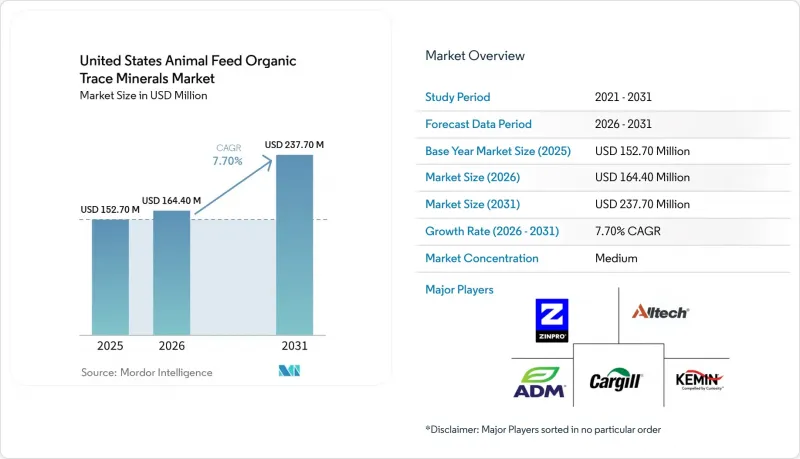
本報告按微量元素類型(鋅、鐵、銅、錳、硒等)、牲畜類型(乳牛、牛、家禽等)、螯合類型(胺基酸螯合物、蛋白質鹽等)和形態(乾燥預混合料和粉末等)進行分類。市場預測以美元計價。
美國動物飼料中有機微量元素市場的趨勢與見解。
對有機肉類、牛奶和雞蛋的需求不斷成長
美國動物飼料中有機微量元素市場持續受益於消費者對認證有機畜產品日益成長的需求。農業市場服務局 (AMS) 發布了 2026 年 3 月液體產品的預估銷售量。美國有機乳製品總銷售量達 2.72 億英鎊,年增 5.6%。由於認證有機飼料必須符合經批准的投入清單和有機採購法規,與傳統系統相比,不斷成長的消費者需求為飼料添加劑市場帶來了更穩定的市場需求。因此,美國動物飼料中有機微量元素市場不僅受益於產量增加,也受益於其與合規性、畜牧生產力和更嚴格的飼料配方之間更緊密的關聯。
礦物質吸收改善,排泄減少
美國動物飼料中有機微量元素市場的需求也得到了相關證據的支持,這些證據表明有機微量元素可以提高礦物質的利用效率。提高吸收率對飼料採購者至關重要,因為這增強了在不影響牲畜反應的前提下降低混合比例的合理性。此外,在畜禽糞便營養成分管理日益嚴格的環境法規下,減少糞便量也是一個關鍵因素,尤其是在必須嚴格監控鋅和銅含量的情況下。美國動物飼料中有機微量元素市場正受益於此趨勢,因為提高消化率和吸收率能夠在一個價值提案中同時支持成本效益和合訊息。
高成本與無機鹽相比
在美國,有機微量元素飼料市場在買家比較有機微量元素與傳統無機鹽時,仍面臨成本障礙。這種成本差異在有機認證系統中很容易得到認可,因為飼料項目旨在支持高價牛奶、雞蛋和肉類的銷售;但對於專注於短期盈利的企業而言,這仍然是一個難題。當胺基酸和螯合劑的成本在整個飼料原料鏈中波動不定時,這項挑戰會進一步加劇。雖然大規模養殖場通常可以根據可衡量的績效和合規性來證明高價的合理性,但小規模農場可能難以同樣精確地證明類似的投資回報。這種成本矛盾使得美國有機微量元素飼料市場既有吸引力,也有選擇性。
細分市場分析
在2025年美國有機動物飼料微量元素市場中,鋅將佔35.6%的最大佔有率,成為本報告中最大的微量元素類別。這一領先地位反映了乳牛、肉牛、豬和家禽養殖計畫的日常需求,在這些養殖計畫中,蹄部健康、皮膚狀況、免疫力維持和繁殖能力在日常畜群管理中都至關重要。此外,使用者評估表明,鋅在以牧場為基礎的有機養殖系統中仍然商業性,因為僅靠飼料無法持續滿足這些需求。
硒是成長最快的硒類產品,預計2026年至2031年將以7.7%的複合年成長率成長。這主要歸功於有機硒的日益普及,與無機硒相比,有機硒在組織中的保留率更高,同時符合美國食品食品藥物管理局( FDA)的基準值。鉻、鈷和碘的市場佔有率仍然小規模,但隨著凱敏公司(Kemin)的丙酸鉻獲得FDA批准在美國廣泛使用,鉻的市場也受到了關注。在美國動物飼料用有機微量元素產業,這個細分市場持續受到日常營養需求和嚴格監管的影響。
2025年,家禽在美國動物飼料用有機微量元素市場中佔最大佔有率,達32.5%。家禽之所以能成為最大的動物品種,是因為其商業飼料需求廣泛、配方控制嚴格,以及大規模飼料廠網路能夠實現礦物質添加的標準化。此外,蛋雞和肉雞養殖系統對鋅和錳的需求不斷成長,也使家禽受益,因為這些礦物質對禽類健康、蛋殼品質和生產穩定性至關重要。因此,美國飼料用有機微量元素產業呈現出兩極分化的格局:一方面是像家禽這樣的大型成熟用戶,另一方面是快速成長的應用領域,在這些領域,可追溯性和飼料轉換率至關重要。
水產養殖是成長速度最快的動物養殖業,預計2026年至2031年間將以8.9%的複合年成長率(CAGR)高速成長。這一快速成長主要得益於買家日益重視可追溯的礦物質來源和低廢棄物的飼餵策略。這一趨勢與有機礦物質形式相契合,有機礦物質能夠以更低的劑量提供更清潔的營養。 2025年發表在《生物學》(Biology)雜誌上的一項研究表明,施用相當於標準無機礦物質劑量50%的有機微量礦物質預混合料,可以改善白蝦的礦物質生物積累、抗氧化能力和腸道菌群,從而支持水產養殖飼料負責人提高飼料劑量的有效性。
其他好處:
- Excel格式的市場預測(ME)表
- 3個月的分析師支持
目錄
第1章:引言
- 研究假設和市場定義
- 調查範圍
第2章:調查方法
第3章執行摘要
第4章 市場狀況
- 市場概覽
- 市場促進因素
- 對有機肉類、牛奶和雞蛋的需求增加
- 礦物質吸收增加,排泄減少
- 無抗生素牛管理的必要性
- 飼料廠精準營養的引進
- 牧草對有機反芻動物飼料的拮抗作用
- 預混合料維生素穩定性優勢
- 市場限制因素
- 高成本鹽與無機鹽的比較
- 對經過認證的有機產品的需求量很小。
- 有機載體和認證機構的複雜性
- 礦物含量和安全限值較為嚴格
- 監理情勢
- 技術展望
- 波特五力分析
第5章 市場規模與成長預測
- 依微量元素類型
- 鋅
- 銅
- 錳
- 鐵
- 碳粉匣
- 鉻
- 鈷
- 碘
- 依牲畜種類分類
- 家禽
- 牛
- 牛
- 豬
- 水產養殖
- 馬
- 伴侶動物
- 按螯合類型
- 胺基酸螯合物
- 胺基酸錯合
- 蛋白質攝取
- 多醣複合物
- 硒酵母
- 丙酸酯
- 按形式
- 乾粉預混合料和粉末
- 液體補充劑
- 礦物和方塊自由選擇
- 水溶性飼料添加劑
第6章 競爭情勢
- 市場集中度
- 策略趨勢
- 市佔率分析
- 公司簡介
- Zinpro Corporation
- Alltech, Inc.
- ADM
- Kemin Industries, Inc.
- Cargill, Incorporated
- Novus International, Inc.
- dsm-firmenich
- Nutreco NV
- Trouw Nutrition USA, LLC
- Selko USA, Inc.
- Micronutrients USA LLC
- Phibro Animal Health Corporation
- Balchem Corporation
- QualiTech, Inc.
- BioZyme, Inc.
- Adisseo Group(A Bluestar Company)
- Orffa USA Inc.
- Biochem Zusatzstoffe Handels-und Produktionsgesellschaft mbH
- Pancosma SA
- Prince Agri Products, Inc.
第7章 市場機會與未來展望
According to Mordor Intelligence, the united states animal feed organic trace minerals market size was valued at USD 152.70 million in 2025 and estimated to grow from USD 164.40 million in 2026 to reach USD 237.70 million by 2031, at a CAGR of 7.70% during the forecast period (2026-2031).
This report is Segmented by Trace Mineral Type (Zinc, Iron, Copper, Manganese, Selenium, and More), by Animal Type (Dairy Cattle, Beef Cattle, Poultry, and More), by Chelation Type (Amino-Acid Chelates, Proteinates, and More), and by Form (Dry Premixes and Powders, and More). The Market Forecasts are Provided in Terms of Value (USD).
United States Animal Feed Organic Trace Minerals Market Trends and Insights
Rising Organic Meat, Milk, and Egg Demand
The United States organic trace minerals market for animal feed continues to benefit from stronger demand for certified organic animal products. The Agricultural Marketing Service (AMS) reported estimated fluid product sales for March 2026. Total organic milk product sales in the United States reached 272 million pounds, a 5.6% increase from the previous year. Because certified-organic feed must comply with approved input lists and organic sourcing rules, rising consumer demand translates into a more captive feed additive market than in conventional systems. The United States organic trace minerals market for animal feed therefore gains not only from larger output volumes but also from a tighter link between compliance, animal productivity, and feed formulation discipline.
Higher Mineral Uptake and Lower Excretion
The United States organic trace minerals market for animal feed is also supported by evidence that organic forms can improve mineral use efficiency. The absorption gains matter for feed buyers because they improve the case for lower inclusion rates without sacrificing animal response. Lower excretion also matters in operations managing manure nutrients under tighter environmental scrutiny, especially where zinc and copper loading must be watched closely. The United States animal feed organic trace minerals market benefits from this dynamic because better digestibility supports both cost justification and compliance messaging in a single value proposition.
High Cost Versus Inorganic Salts
The United States organic trace mineral market for animal feed still faces a cost barrier when buyers compare organic forms with conventional inorganic salts. That gap is easier to defend in certified-organic systems where feed programs support premium milk, egg, and meat pricing, but it remains difficult in operations focused on tight short-cycle returns. The challenge becomes sharper when amino acid or chelating input costs move unpredictably through the feed ingredient chain. Larger operations can often justify the premium through measured performance and compliance logic, while smaller farms may struggle to document the same payback with the same precision. This cost tension keeps the United States organic trace minerals market for animal feed attractive but still selective.
Other drivers and restraints analyzed in the detailed report include:
- Antibiotic-Free Herd Management Needs
- Precision Nutrition Adoption in Feed Mills
- Small Certified-Organic Demand Base
For complete list of drivers and restraints, kindly check the Table Of Contents.
Segment Analysis
Trace mineral type zinc accounted for the largest share, 35.6%, of the United States animal feed organic trace minerals market in 2025, which made it the largest trace mineral category in the report. Its lead position reflects routine demand across dairy, beef, swine, and poultry programs where hoof integrity, skin condition, immune support, and reproductive performance all matter in day-to-day herd management. The user-supplied review also shows that zinc remains commercially favored because pasture-based organic systems do not consistently cover these needs through forage alone.
Selenium is the fastest-growing type, forecast to expand at a 7.7% CAGR through 2026 to 2031, supported by organic selenium forms that improve tissue retention relative to inorganic alternatives while remaining within Food and Drug Administration (FDA) limits. Chromium, cobalt, and iodine remained smaller categories, although chromium gained visibility after Kemin completed broader Food and Drug Administration (FDA) species approvals for chromium propionate use cases in the United States. Within the United States animal feed organic trace minerals industry, this segment remains shaped by everyday nutritional need on one end and regulatory precision on the other.
Poultry accounted for the largest share of the United States animal organic trace minerals market for animal feed in 2025, at 32.5%. Poultry remained the largest animal type because commercial feed demand is broad, ration control is high, and mineral supplementation can be standardized across large feed mill networks. The segment also benefits from the wider need for zinc and manganese in bird health, shell quality, and production consistency across layer and broiler systems. The United States organic animal feed trace minerals industry, therefore, shows a split between large, established users, such as poultry, and faster-growing applications where traceability and feed efficiency are gaining ground.
Aquaculture is the fastest-growing animal type, projected to record the highest CAGR at 8.9% through 2026 to 2031. Aquaculture has grown rapidly because buyers are placing greater value on traceable mineral inputs and lower-waste feeding strategies. That trend aligns well with organic mineral forms that support cleaner nutrient delivery at lower dosages. A 2025 study published in Biology found that an organic trace mineral premix at 50% of the standard inorganic dose improved mineral bioaccumulation, antioxidant capacity, and gut microbiota in white shrimp, reinforcing the dose-efficiency case for aquafeed formulators.
Complete Report Scope:
- By Trace Mineral Type
- Zinc
- Copper
- Manganese
- Iron
- Selenium
- Chromium
- Cobalt
- Iodine
- By Animal Type
- Poultry
- Dairy Cattle
- Beef Cattle
- Swine
- Aquaculture
- Equine
- Companion Animals
- By Chelation Type
- Amino Acid Chelates
- Amino Acid Complexes
- Proteinates
- Polysaccharide Complexes
- Selenium Yeast
- Propionates
- By Form
- Dry Premixes and Powders
- Liquid Supplements
- Free-choice Minerals and Blocks
- Water-soluble Feed Additives
List of Companies Covered in this Report:
- Zinpro Corporation
- Alltech, Inc.
- ADM
- Kemin Industries, Inc.
- Cargill, Incorporated
- Novus International, Inc.
- dsm-firmenich
- Nutreco N.V.
- Trouw Nutrition USA, LLC
- Selko USA, Inc.
- Micronutrients USA LLC
- Phibro Animal Health Corporation
- Balchem Corporation
- QualITech, Inc.
- BioZyme, Inc.
- Adisseo Group (A Bluestar Company)
- Orffa USA Inc.
- Biochem Zusatzstoffe Handels- und Produktionsgesellschaft mbH
- Pancosma S.A.
- Prince Agri Products, Inc.
Additional Benefits:
- The market estimate (ME) sheet in Excel format
- 3 months of analyst support
TABLE OF CONTENTS
1 Introduction
- 1.1 Study Assumption and Market Definition
- 1.2 Scope of the Study
2 Research Methodology
3 Executive Summary
4 Market Landscape
- 4.1 Market Overview
- 4.2 Market Drivers
- 4.2.1 Rising Organic Meat, Milk, and Egg Demand
- 4.2.2 Higher Mineral Uptake and Lower Excretion
- 4.2.3 Antibiotic-Free Herd Management Needs
- 4.2.4 Precision Nutrition Adoption in Feed Mills
- 4.2.5 Pasture Antagonism in Organic Ruminant Diets
- 4.2.6 Premix Vitamin Stability Benefits
- 4.3 Market Restraints
- 4.3.1 High Cost Versus Inorganic Salts
- 4.3.2 Small Certified-Organic Demand Base
- 4.3.3 Organic Carrier and Certifier Complexity
- 4.3.4 Narrow Mineral Safety and Inclusion Limits
- 4.4 Regulatory Landscape
- 4.5 Technological Outlook
- 4.6 Porter's Five Forces Analysis
- 4.6.1 Bargaining Power of Suppliers
- 4.6.2 Bargaining Power of Buyers
- 4.6.3 Threat of New Entrants
- 4.6.4 Threat of Substitute Products
- 4.6.5 Intensity of Competitive Rivalry
5 Market Size and Growth Forecasts (Value)
- 5.1 By Trace Mineral Type
- 5.1.1 Zinc
- 5.1.2 Copper
- 5.1.3 Manganese
- 5.1.4 Iron
- 5.1.5 Selenium
- 5.1.6 Chromium
- 5.1.7 Cobalt
- 5.1.8 Iodine
- 5.2 By Animal Type
- 5.2.1 Poultry
- 5.2.2 Dairy Cattle
- 5.2.3 Beef Cattle
- 5.2.4 Swine
- 5.2.5 Aquaculture
- 5.2.6 Equine
- 5.2.7 Companion Animals
- 5.3 By Chelation Type
- 5.3.1 Amino Acid Chelates
- 5.3.2 Amino Acid Complexes
- 5.3.3 Proteinates
- 5.3.4 Polysaccharide Complexes
- 5.3.5 Selenium Yeast
- 5.3.6 Propionates
- 5.4 By Form
- 5.4.1 Dry Premixes and Powders
- 5.4.2 Liquid Supplements
- 5.4.3 Free-choice Minerals and Blocks
- 5.4.4 Water-soluble Feed Additives
6 Competitive Landscape
- 6.1 Market Concentration
- 6.2 Strategic Moves
- 6.3 Market Share Analysis
- 6.4 Company Profiles (Includes Global Level Overview, Market-Level Overview, Core Segments, Financials as Available, Strategic Information, Market Rank/Share for Key Companies, Products and Services, and Recent Developments)
- 6.4.1 Zinpro Corporation
- 6.4.2 Alltech, Inc.
- 6.4.3 ADM
- 6.4.4 Kemin Industries, Inc.
- 6.4.5 Cargill, Incorporated
- 6.4.6 Novus International, Inc.
- 6.4.7 dsm-firmenich
- 6.4.8 Nutreco N.V.
- 6.4.9 Trouw Nutrition USA, LLC
- 6.4.10 Selko USA, Inc.
- 6.4.11 Micronutrients USA LLC
- 6.4.12 Phibro Animal Health Corporation
- 6.4.13 Balchem Corporation
- 6.4.14 QualiTech, Inc.
- 6.4.15 BioZyme, Inc.
- 6.4.16 Adisseo Group (A Bluestar Company)
- 6.4.17 Orffa USA Inc.
- 6.4.18 Biochem Zusatzstoffe Handels- und Produktionsgesellschaft mbH
- 6.4.19 Pancosma S.A.
- 6.4.20 Prince Agri Products, Inc.
7 Market Opportunities and Future Outlook

 動物飼料微量元素:市場佔有率分析、產業趨勢與統計、成長預測(2026-2031)動物飼料用有機微量元素:市場佔有率分析、產業趨勢與統計及成長預測(2026-2031)
 飼料飼料用有機微量元素市場:依礦物種類、螯合物、形態、動物種類、應用及通路分類-2026-2032年全球市場預測北美動物飼料中有機微量元素:市場佔有率分析、行業趨勢和統計數據以及成長預測(2026-2031 年)南美洲動物飼料中的有機微量元素:市場佔有率分析、行業趨勢和統計數據以及成長預測(2026-2031 年)歐洲動物飼料用有機微量元素:市場佔有率分析、產業趨勢與統計及成長預測(2026-2031)
 飼料中微量元素的市場機會、成長要素、產業趨勢和預測(2025-2035 年)。
 飼料飼料有機微量元素市場報告:按微量元素類型、動物類型和地區分類(2026-2034 年)
 2026-2034年全球動物飼料中有機微量元素市場規模、佔有率、趨勢和成長分析報告動物飼料用有機微量元素市場機會、成長要素、產業趨勢分析及預測(2026年至2035年)