


 |
市場調查報告書
商品編碼
2073021
南美洲動物飼料中的有機微量元素:市場佔有率分析、行業趨勢和統計數據以及成長預測(2026-2031 年)South America Animal Feed Organic Trace Minerals - Market Share Analysis, Industry Trends & Statistics, Growth Forecasts (2026 - 2031) |
||||||

※ 本網頁內容可能與最新版本有所差異。詳細情況請與我們聯繫。
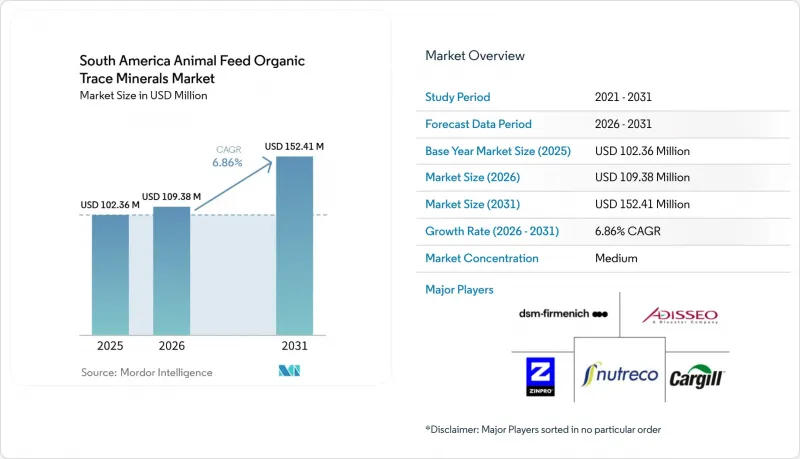
根據 Mordor Intelligence 預測,南美動物飼料有機微量元素市場將從 2026 年的 1.024 億美元成長到 2021 年的 1.094 億美元,然後成長到 2031 年的 1.524 億美元,2026 年至 2031 年的複合年成長率為 6.86%。
本報告按微量元素類型(鋅、銅、鐵等)、螯合類型(胺基酸螯合物、蛋白質鹽等)、動物種類(家禽、反芻動物等)、應用領域(促進生長、預防疾病、增強免疫力等)和地區(巴西、阿根廷等)進行細分。市場預測以美元計價。
南美動物飼料有機微量元素市場趨勢與洞察。
與家禽和生豬出口相關的飼料強化需求
巴西2024年的出口表現正迫使南美動物飼料有機微量元素市場的飼料生產商採用更嚴格的礦物質標準。根據巴西動物蛋白協會(ABPA)的數據顯示,2024年巴西雞肉出口量達530萬噸,豬肉出口量達140萬噸,分別比去年增加3%和10%。主要出口目的地對飼料原料可追溯性的要求日益提高,導致南美動物飼料有機微量元素市場更傾向於選擇有機認證的礦物質原料而非普通的無機原料。 2025年9月的一項小型綜述顯示,在禽類和豬飼料中添加有機錯合的鋅、銅、錳和鐵可以減少糞便中礦物質的排泄,從而幫助出口相關供應鏈中的商業性系統應對環境合規壓力。這表明,即使在國內飼料成本波動的情況下,南美動物飼料有機微量元素市場也正從貿易合規需求中獲得支持。
肉牛牛的整合與牧場的礦物質平衡
南美肉牛牛集約化為飼料中添加有機微量元素創造了穩定的需求基礎,使其不易受短期價格波動的影響。 2024年,巴西商業牛存欄量達到1.94億頭,同年育肥場飼養的牛隻數量創歷史新高,達880萬頭。根據巴西肉類出口委員會(ABIEC)的同一份報告,育肥場屠宰量佔總屠宰量的19.2%,巴西肉牛養殖業的飼料成本達45.04億美元。 2025年在巴西育肥場進行的一項試驗表明,有機微量元素即使在低添加量下也能提高Nerol育肥牛的平均日增重和飼料轉換率,同時保持牲畜生產力。這些結果凸顯了有機微量元素的價值,與無機微量元素相比,有機微量元素具有更高的生物利用度和營養吸收率。這導致南美牛肉生產商進一步增加對有機微量元素的採用,他們的目標是提高生產效率、最佳化飼料成本,並更有效地解決塞拉多和潘帕斯等地區常見的硒、銅和鋅缺乏症。
與無機微量元素相比的價格差異
在南美洲動物飼料用有機微量元素市場,高昂的價格仍是最大的進入門檻。有機產品與硫酸鹽和氧化物相比,成本差異仍然很大,而在放牧系統中,由於飼餵週期短,獲利前景不明朗,這種成本差異更難體現。阿根廷的情況尤其如此,該國採用以價值為導向的牛肉生產系統;小規模養豬場也同樣如此,它們優先考慮的是短期複合飼料成本,而非後續的胴體品質。這種情況也會產生一種次要效應,即有利於Zinpro、Novus International, Inc.和Alltech等老牌供應商,因為轉向有機飼料的生產商傾向於選擇那些劑量-反應關係數據公開的品牌。因此,南美洲動物飼料用有機微量元素市場呈現兩極化的格局:一方是已全面轉型使用有機飼料的大型商業用戶,另一方則是繼續使用無機產品的小規模企業。
細分市場分析
到2025年,鋅將佔據南美動物飼料有機微量元素市場35.6%的最大佔有率,成為家禽、豬、牛和水產養殖營養方案的關鍵微量元素。鋅的作用涵蓋免疫支持、維持蹄部強度、修復腸道上皮和提高繁殖能力,因此在各個物種中都有廣泛的需求。巴西肉牛育肥業向室內養殖的轉變也推動了鋅的使用,因為更嚴格的飼養體系需要更穩定的生產結果。一項2024年針對肉雞的研究——《鹽酸鋅和有機鋅對肉雞生產性能、胴體特性以及肝臟和脛骨礦物質成分的協同作用》——表明,在添加量相同的情況下,鹽酸鋅和有機鋅的組合比硫酸鋅更能提高飼料轉化率並減少腹部脂肪。
硒是成長最快的微量元素,預計在預測期(2026-2031年)內將以7.8%的複合年成長率成長。這主要歸功於肉雞、蛋雞、育種和水產養殖計畫中對生物利用度和食品安全保障的日益重視。 2025年發表在《營養學雜誌》上的一篇綜述指出,有機硒甲硫胺酸和硒酵母在市售劑量下比亞硒酸鈉具有25%至45%的生物利用度優勢。銅、錳、鐵和鈷也很重要,它們通常與繁殖計劃、骨骼健康或糾正特定人群的營養缺乏症有關,儘管它們的功能較為有限。鉻目前仍是小規模的類別,但因其在乳牛和水產養殖壓力管理方面的應用而日益受到關注。南美動物飼料有機微量元素產業的廣泛產品系列包括用於飼料匱乏地區(如塞拉多草原和潘帕斯草原)的特色元素,這些地區由於礦物質平衡的根本失衡,需要直接補充這些元素。
蛋白鹽在南美洲動物飼料有機微量元素市場佔最大佔有率,預計到2025年將達到39.4%。其主導地位源自於蛋白鹽在牛、乳牛、家禽和豬飼料配方中的廣泛商業性應用。蛋白鹽在以提高生產力為導向的畜牧營養方案中發揮著重要作用,加之其已被證實具有良好的生物利用度、礦物質穩定性以及與市售預混合料系統的兼容性,這些因素共同支撐了其在全部區域強大的市場滲透。蛋白鹽在集約化生產系統中尤其普遍,因為提高飼料轉換率、繁殖效率、免疫功能和整體畜牧生產力是商業飼料生產商和綜合畜牧企業關注的關鍵因素。
羥基微量元素正成為南美動物飼料有機微量元素市場中成長最快的螯合形式,預計2026年至2031年將以9.7%的複合年成長率成長。這一成長主要得益於產業對提高集約化畜牧系統中礦物質穩定性、飼料轉換率和營養利用率的日益關注。其他螯合形式,例如氨基酸螯合物、硒酵母複合物和特殊礦物質配方,也因其在高階動物營養應用方面的潛力而備受關注。同時,新興的奈米礦物技術在南美洲動物飼料有機微量元素產業仍處於商業化初期階段。
其他好處:
- Excel格式的市場預測(ME)表
- 3個月的分析師支持
目錄
第1章:引言
- 研究假設和市場定義
- 調查範圍
第2章:調查方法
第3章執行摘要
第4章 市場狀況
- 市場概覽
- 市場促進因素
- 與家禽和生豬出口相關的飼料強化需求
- 整合肉牛牛資源並調整牧場礦物質平衡
- 螯合礦物質因其高生物利用度而被廣泛應用
- 巴西擴大預混合料和補充劑的生產能力。
- 巴西對飼料添加劑和預混合料的稅收優惠
- 智利在地採購有機鮭魚飼料以及對原料可追溯性的需求。
- 市場限制因素
- 優質產品價格與無機微量元素的比較
- 註冊和準備飼料添加劑文件所帶來的負擔。
- 偏遠農場(位於主要飼料運輸走廊以外)的物流
- 小規模生產商對產品配方的控制與其標籤的可靠性之間存在差距。
- 監理情勢
- 技術展望
- 波特五力分析
第5章 市場規模與成長預測
- 微量元素類型
- 鋅
- 銅
- 鐵
- 錳
- 碳粉匣
- 鈷
- 鉻
- 其他
- 螯合型
- 胺基酸螯合物
- 蛋白質攝取
- 多醣複合物
- 羥基化微量元素
- 酵母來源的錯合
- 其他
- 依動物類型
- 家禽
- 肉雞
- 產蛋母雞
- 其他家禽
- 反芻動物
- 牛
- 牛
- 其他反芻動物
- 豬
- 水產養殖
- 魚
- 蝦
- 其他水產養殖
- 其他動物
- 家禽
- 透過使用
- 促進生長
- 疾病預防
- 生育能力和生殖能力
- 飼料轉換率和增重
- 蹄部和骨骼健康
- 免疫支持
- 其他用途
- 按地區
- 巴西
- 阿根廷
- 智利
- 其他南美國家
第6章 競爭情勢
- 市場集中度
- 策略趨勢
- 市佔率分析
- 公司簡介
- Alltech
- ADM
- Balchem Corp.
- Biochem Zusatzstoffe Handels
- dsm-firmenich
- Adisseo(A Bluestar Company)
- Cargill, Incorporated
- Kemin Industries, Inc.
- Novus International, Inc.
- SHV(Nutreco NV)
- Orffa
- BASF SE
- Phibro Animal Health Corporation
- Zinpro
第7章 市場機會與未來展望
According to Mordor Intelligence, the south america animal feed organic trace minerals market size is projected to grow from USD 102.4 million to USD 109.4 million in 2026 to USD 152.4 million by 2031, registering a CAGR of 6.86% during 2026 to 2031.
This report is Segmented by Trace Element Type (Zinc, Copper, Iron, and More), by Chelation Type (Amino-Acid Chelates, Proteinates, and More), by Animal Type (Poultry, Ruminants, and More), by Application (Growth Promotion, Disease Prevention, Immune Support, and More), and by Geography (Brazil, Argentina, and More). The Market Forecasts are Provided in Terms of Value (USD).
South America Animal Feed Organic Trace Minerals Market Trends and Insights
Poultry and Swine Export-Linked Feed Fortification Demand
Brazil's 2024 export performance is pushing feed mills toward tighter mineral specifications in the South America animal feed organic trace minerals market. Chicken exports reached 5.3 million metric tons in 2024, and pork exports reached 1.4 million metric tons, with year-on-year growth of 3% and 10%, respectively, according to the Brazilian Animal Protein Association (ABPA). Large export destinations increasingly expect feed ingredient traceability, which favors labeled organic mineral sources over generic inorganic inputs in the South America animal feed organic trace minerals market. A September 2025 mini-review found that organically complexed zinc, copper, manganese, and iron in poultry and swine can reduce fecal mineral excretion, helping commercial systems respond to environmental compliance pressures in export-linked supply chains. This means the South America animal feed organic trace minerals market is gaining support from trade compliance needs, even when domestic feed costs remain volatile.
Beef Herd Intensification and Pasture Mineral Balancing
Beef herd intensification provides the South American organic trace minerals market for animal feed with a steady demand base that is less dependent on short-cycle price swings. Brazil's commercial cattle herd reached 194 million head in 2024, and feedlot confinement hit a record 8.8 million head in the same year. The same ABIEC report showed that confinement finishing accounted for 19.2% of total slaughters, while nutrition spending in Brazil's beef agro-industrial system reached USD 4,504 million. A 2025 Brazilian feedlot trial showed that organic trace minerals maintained animal performance even at lower inclusion rates, while improving average daily gain and feed efficiency in Nellore finishing bulls. The results reinforce the value of organic trace minerals through superior bioavailability and nutrient utilization compared with inorganic sources. This is supporting wider adoption among South American beef producers seeking greater production efficiency, optimized feed costs, and more effective correction of selenium, copper, and zinc deficiencies common in regions such as the Cerrado and Pampas.
Premium Pricing Versus Inorganic Trace Minerals
Premium pricing remains the clearest adoption barrier in the South America animal feed organic trace minerals market. Organic formats still carry a visible cost gap against sulfates and oxides, and that gap is harder to defend in pasture systems where returns are less visible over short feeding cycles. The pressure is strongest in Argentina's value-led beef systems and in smaller swine operations that focus on immediate ration cost rather than downstream carcass quality. This has the side effect of favoring research-backed suppliers such as Zinpro, Novus International, Inc., and Alltech because producers who do upgrade tend to choose brands with published dose-response support. The South America animal feed organic trace minerals market consequently splits between advanced commercial users who convert fully and smaller operators who remain on inorganic programs.
Other drivers and restraints analyzed in the detailed report include:
- Shift to Higher-Bioavailability Chelated Minerals
- Brazil Premix and Supplement Capacity Expansion
- Registration and Documentation Burden for Feed Additives
For complete list of drivers and restraints, kindly check the Table Of Contents.
Segment Analysis
Zinc accounted for the largest South America animal feed organic trace minerals market share, 35.6%, in 2025, making it the baseline trace element across poultry, swine, cattle, and aquaculture nutrition programs. Its role spans immune support, hoof strength, gut epithelial repair, and reproductive performance, so demand is broad rather than species-specific. Brazil's move toward more confined beef finishing also supports the use of zinc because tighter feeding systems require more consistent performance outcomes. A 2024 broiler study, "Synergistic Effects of Hydroxychloride and Organic Zinc on Performance, Carcass Characteristics, Liver and Tibia Mineral Profiles of Broiler Chickens," found that combinations of hydroxychloride and organic zinc improved feed conversion and reduced abdominal fat compared with zinc sulfate at equivalent inclusion levels.
Selenium is the fastest-growing trace element, projected to grow at a CAGR of 7.8% during the forecast period (2026-2031) because broiler, layer, breeder, and aquaculture programs increasingly value both bioavailability and support for food safety. A 2025 review in the Journal of Nutrition reported a 25% to 45% bioavailability advantage for organic selenomethionine and selenium yeast over sodium selenite at commercial dose levels. Copper, manganese, iron, and cobalt serve important but narrower functions, often tied to reproductive programs, skeletal health, or herd-specific correction of deficiencies. Chromium is still a small category, but it is gaining interest for stress-management applications in dairy cattle and aquaculture. The broader mix in the South America animal feed organic trace minerals industry also includes niche elements used in forage-deficient areas of the Cerrado and Pampas, where baseline mineral imbalance creates a direct supplementation need.
Proteinates held the largest share of the South America animal feed organic trace minerals market and accounted for 39.4% of the market in 2025. This dominance is attributed to their widespread commercial acceptance in feed formulations for beef, dairy, poultry, and swine. Their established role in performance-focused livestock nutrition programs, combined with proven bioavailability, mineral stability, and compatibility with commercial premix systems, supports their strong market penetration across the region. Proteinates are particularly prevalent in intensive production systems, where improvements in feed conversion, reproductive efficiency, immune performance, and overall animal productivity are critical factors for commercial feed manufacturers and integrated livestock operations.
Hydroxy trace minerals emerged as the fastest-growing chelation format in the South America animal feed organic trace minerals market, with a projected CAGR of 9.7% from 2026 to 2031. This growth is driven by the industry's increasing emphasis on mineral stability, feed efficiency, and enhanced nutrient utilization in intensive livestock production systems. Other chelation formats, such as amino acid chelates, selenium yeast complexes, and specialty mineral formulations, are gaining traction in premium animal nutrition applications. Meanwhile, emerging nano-mineral technologies remain in the early stages of commercialization within the South America animal feed organic trace minerals industry.
Complete Report Scope:
- By Trace Element Type
- Zinc
- Copper
- Iron
- Manganese
- Selenium
- Cobalt
- Chromium
- Others
- By Chelation Type
- Amino-Acid Chelates
- Proteinates
- Polysaccharide Complexes
- Hydroxy-Trace Minerals
- Yeast-Based Complexes
- Others
- By Animal Type
- Poultry
- Broilers
- Layers
- Other Poultry Birds
- Ruminants
- Beef Cattle
- Dairy Cattle
- Other Ruminants
- Swine
- Aquaculture
- Fish
- Shrimp
- Other Aquaculture
- Other Animals
- Poultry
- By Application
- Growth Promotion
- Disease Prevention
- Fertility and Reproductive Performance
- Feed Efficiency and Weight Gain
- Hoof and Skeletal Health
- Immune Support
- Other Applications
- By Geography
- Brazil
- Argentina
- Chile
- Rest of South America
List of Companies Covered in this Report:
- Alltech
- ADM
- Balchem Corp.
- Biochem Zusatzstoffe Handels
- dsm-firmenich
- Adisseo (A Bluestar Company)
- Cargill, Incorporated
- Kemin Industries, Inc.
- Novus International, Inc.
- SHV (Nutreco NV)
- Orffa
- BASF SE
- Phibro Animal Health Corporation
- Zinpro
Additional Benefits:
- The market estimate (ME) sheet in Excel format
- 3 months of analyst support
TABLE OF CONTENTS
1 Introduction
- 1.1 Study Assumptions and Market Definition
- 1.2 Scope of the Study
2 Research Methodology
3 Executive Summary
4 Market Landscape
- 4.1 Market Overview
- 4.2 Market Drivers
- 4.2.1 Poultry and swine export-linked feed fortification demand
- 4.2.2 Beef herd intensification and pasture mineral balancing
- 4.2.3 Shift to higher-bioavailability chelated minerals
- 4.2.4 Brazil premix and supplement capacity expansion
- 4.2.5 Brazil tax relief on feed additives and premixes
- 4.2.6 Chile organic salmon feed localization and traceable-input pull
- 4.3 Market Restraints
- 4.3.1 Premium pricing versus inorganic trace minerals
- 4.3.2 Registration and documentation burden for feed additives
- 4.3.3 Remote ranch logistics beyond core feed corridors
- 4.3.4 Smallholder formulation discipline and label-trust gaps
- 4.4 Regulatory Landscape
- 4.5 Technological Outlook
- 4.6 Porter's Five Forces Analysis
- 4.6.1 Bargaining Power of Suppliers
- 4.6.2 Bargaining Power of Buyers
- 4.6.3 Threat of New Entrants
- 4.6.4 Threat of Substitutes
- 4.6.5 Intensity of Competitive Rivalry
5 Market Size and Growth Forecasts (Value)
- 5.1 By Trace Element Type
- 5.1.1 Zinc
- 5.1.2 Copper
- 5.1.3 Iron
- 5.1.4 Manganese
- 5.1.5 Selenium
- 5.1.6 Cobalt
- 5.1.7 Chromium
- 5.1.8 Others
- 5.2 By Chelation Type
- 5.2.1 Amino-Acid Chelates
- 5.2.2 Proteinates
- 5.2.3 Polysaccharide Complexes
- 5.2.4 Hydroxy-Trace Minerals
- 5.2.5 Yeast-Based Complexes
- 5.2.6 Others
- 5.3 By Animal Type
- 5.3.1 Poultry
- 5.3.1.1 Broilers
- 5.3.1.2 Layers
- 5.3.1.3 Other Poultry Birds
- 5.3.2 Ruminants
- 5.3.2.1 Beef Cattle
- 5.3.2.2 Dairy Cattle
- 5.3.2.3 Other Ruminants
- 5.3.3 Swine
- 5.3.4 Aquaculture
- 5.3.4.1 Fish
- 5.3.4.2 Shrimp
- 5.3.4.3 Other Aquaculture
- 5.3.5 Other Animals
- 5.3.1 Poultry
- 5.4 By Application
- 5.4.1 Growth Promotion
- 5.4.2 Disease Prevention
- 5.4.3 Fertility and Reproductive Performance
- 5.4.4 Feed Efficiency and Weight Gain
- 5.4.5 Hoof and Skeletal Health
- 5.4.6 Immune Support
- 5.4.7 Other Applications
- 5.5 By Geography
- 5.5.1 Brazil
- 5.5.2 Argentina
- 5.5.3 Chile
- 5.5.4 Rest of South America
6 Competitive Landscape
- 6.1 Market Concentration
- 6.2 Strategic Moves
- 6.3 Market Share Analysis
- 6.4 Company Profiles (Includes Global Level Overview, Market Level Overview, Core Segments, Financials as Available, Strategic Information, Market Rank/Share for Key Companies, Products and Services, and Recent Developments)
- 6.4.1 Alltech
- 6.4.2 ADM
- 6.4.3 Balchem Corp.
- 6.4.4 Biochem Zusatzstoffe Handels
- 6.4.5 dsm-firmenich
- 6.4.6 Adisseo (A Bluestar Company)
- 6.4.7 Cargill, Incorporated
- 6.4.8 Kemin Industries, Inc.
- 6.4.9 Novus International, Inc.
- 6.4.10 SHV (Nutreco NV)
- 6.4.11 Orffa
- 6.4.12 BASF SE
- 6.4.13 Phibro Animal Health Corporation
- 6.4.14 Zinpro
7 Market Opportunities and Future Outlook

 動物飼料微量元素:市場佔有率分析、產業趨勢與統計、成長預測(2026-2031)動物飼料用有機微量元素:市場佔有率分析、產業趨勢與統計及成長預測(2026-2031)
 飼料飼料用有機微量元素市場:依礦物種類、螯合物、形態、動物種類、應用及通路分類-2026-2032年全球市場預測美國動物飼料用有機微量元素:市佔率分析、產業趨勢與統計及成長預測(2026-2031 年)北美動物飼料中有機微量元素:市場佔有率分析、行業趨勢和統計數據以及成長預測(2026-2031 年)歐洲動物飼料用有機微量元素:市場佔有率分析、產業趨勢與統計及成長預測(2026-2031)
 飼料中微量元素的市場機會、成長要素、產業趨勢和預測(2025-2035 年)。
 飼料飼料有機微量元素市場報告:按微量元素類型、動物類型和地區分類(2026-2034 年)
 2026-2034年全球動物飼料中有機微量元素市場規模、佔有率、趨勢和成長分析報告動物飼料用有機微量元素市場機會、成長要素、產業趨勢分析及預測(2026年至2035年)