


 |
市場調查報告書
商品編碼
2123536
動物飼料用有機微量元素:市場佔有率分析、產業趨勢與統計及成長預測(2026-2031)Animal Feed Organic Trace Minerals - Market Share Analysis, Industry Trends & Statistics, Growth Forecasts (2026 - 2031) |
||||||

※ 本網頁內容可能與最新版本有所差異。詳細情況請與我們聯繫。
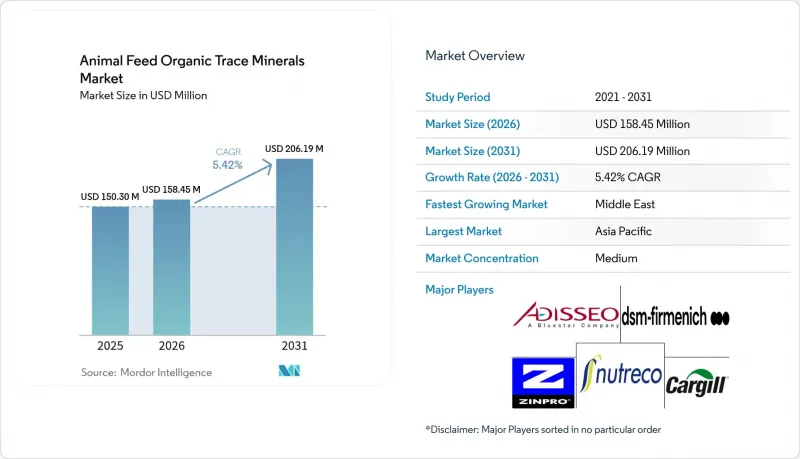
根據 Mordor Intelligence 預測,動物飼料中有機微量元素的市場規模預計將從 2025 年的 1.503 億美元成長到 2026 年的 1.5845 億美元,到 2031 年將達到 2.0619 億美元,2026 年至 2031 年的複合年成長率為 5.42%。
本報告按微量元素類型(鋅、鐵、銅、錳、硒等)、螯合類型(胺基酸螯合物、蛋白鹽等)、牲畜類型(乳牛、牛、家禽等)和地區(北美、歐洲、亞太、南美等)進行細分。市場預測以美元計價。
全球動物飼料用有機微量元素市場趨勢及洞察。
對優質動物性蛋白質的需求日益成長
隨著亞太地區和南美洲居民可支配收入的成長,高品質肉類、乳製品、魚類和蛋類的消費量不斷擴大,促使生產商將重心從大規模生產轉向提升營養價值。螯合硒和鋅的使用能夠增強產品的抗氧化性能,延長保存期限,並改善感官特性,進而提高零售價格。研究表明,與無機鹽相比,生物可利用礦物質能夠將飼料轉換率提高3%至5%,這不僅能抵消添加劑成本的增加,也能滿足消費者對瘦肉的需求。零售連鎖店正在將礦物質強化規範納入供應商契約,從而促進整個供應鏈的整合。此外,一些蛋白質缺乏地區的政府也積極推廣礦物質最佳化,將其視為保障糧食安全措施的一部分。
嚴格禁止使用抗生素生長促進劑(AGP)
北美和歐洲監管機構禁止在飼料中常規使用抗生素,加上亞太市場計劃逐步淘汰抗生素,為畜牧業的生產力帶來了挑戰。鋅和銅螯合物作為重要的替代品,因其有助於維持健康的腸道環境和增強免疫功能而備受關注。抗生素禁令實施後進行的田間試驗表明,有機礦物質補充方案可以達到傳統增重方案90%的效果,有助於集約化畜牧業保持盈利。飼料生產商目前正將螯合礦物質與植物來源化合物結合,開發高價無抗生素濃縮飼料。新興經濟體抗生素監管的推出,正在擴大動物飼料中有機微量元素的市場潛力。
高價產品與無機礦物的比較
有機微量元素的成本是氧化物和硫酸鹽的兩到四倍,這限制了它們在禽肉和生豬養殖業中的應用,而飼料在這兩個行業的生產成本中佔比超過70%。玉米和大豆粕價格的波動導致人們對飼料添加劑的審查日益嚴格。生產商在實施螯合礦物質方案之前,要求提供數據支援的投資報酬率 (ROI) 分析。營養品相關企業提供分級產品線、基於用量的折扣和固定配方,以將成本分攤到多種性能提升上。能夠將配方比例轉換為屠體產量的數位計算器,有助於展現飼料成本以外的價值。
細分市場分析
鋅在80多種影響免疫功能、上皮健康和生殖的金屬酶中發揮著至關重要的作用,預計到2025年,其在動物飼料有機微量元素市場中將佔據35.62%的佔有率。有機鋅的高生物利用度使生產商能夠在滿足環境排放標準的同時減少其在飼料中的添加量,從而降低環境成本並提高利潤率。硒的複合年成長率最高,達7.78%,儘管在飼料中的用量非常少。這主要是由於加工商尋求提高硒的抗氧化性能,以延長冷藏肉的保存期限,尤其是在海運過程中易發生氧化劣化的養殖魚片方面。銅、錳和鐵仍然是必需營養素,但其配方受到嚴格限制,因此對螯合態銅、錳和鐵的需求增加,因為螯合態銅、錳和鐵即使在低濃度下也能保持其功效。
微量元素的分佈既反映了生物需求,也反映了監管限制。鋅仍佔據市場主導地位,而硒價格較高,並憑藉「強化硒」產品標籤享有市場優勢。鈷和鉻在瘤胃代謝和葡萄糖利用中發揮特定作用,而碘和鉬則用於解決區域性微量元素缺乏問題。市場成長有利於那些既能提高產品品質又能幫助符合廢棄物管理法規的元素。這些因素共同構成了動物飼料用有機微量元素市場的基礎。
區域分析
受中國水產養殖業和印度肉雞及蝦類產業成長的推動,亞太地區預計到2025年將佔動物飼料用有機微量元素市場43.65%的銷售額。政府對國內飼料添加劑的補貼正在推動高吸收率礦物質形式的應用。該地區的市場規模受益於集中式生產群集,這降低了物流成本,並促進了供應商和整合商之間的直接聯繫。日本和韓國的技術專長和研發能力正在支持具有已證實環境效益的先進螯合劑的引入。
預計到2031年,中東市場將以7.82%的複合年成長率成長,這主要得益於各國政府對蛋白質生產能力的投資,其中包括沙烏地阿拉伯到2030年實現60萬噸魚類產量的目標。該地區水資源短缺,因此需要精準投餵礦物質以減少廢水排放。位置沿海養殖基地附近的飼料廠對耐熱微量元素配方的需求日益成長,這些配方能夠最大限度地減少運輸過程中的氧化。
北美和歐洲是成熟的市場,監管要求和永續性措施正推動市場穩定成長。美國食品藥物管理局(FDA)的食品藥物管理局飼料指令以及歐洲的抗生素使用法規,都在促進有機礦物質的補充,以維持牲畜的生產力。環境法規對礦物質排放的限制,也鼓勵使用高生物利用度的礦物質形式。在南美洲,豬禽一體化生產商正在加強其營養方案,以滿足出口市場的需求。隨著螯合礦物質的日益普及,成本考量與螯合礦物質的整合應用可望帶來成長機會。這些區域趨勢表明,動物飼料用有機微量元素市場蘊藏著多元化的成長機會。
其他好處:
- Excel格式的市場預測(ME)表
- 3個月的分析師支持
目錄
第1章:引言
- 研究假設和市場定義
- 調查範圍
第2章:調查方法
第3章執行摘要
第4章 市場狀況
- 市場概覽
- 市場促進因素
- 對優質動物性蛋白質的需求日益成長
- 嚴格禁止使用抗生素生長促進劑(AGP)
- 加強對畜禽糞便中磷和重金屬排放的監管。
- 精準螯合和微膠囊化技術的快速普及
- 測量牲畜的碳足跡和飼料的影響。
- 人工智慧驅動的數位飼料配方平台正在推動有機微量元素的標準化。
- 市場限制因素
- 溢價定價與非內部成長的比較
- 小規模農戶意識水平低
- 主要螯合化合物供應瓶頸
- 有機認證和畜牧業認證機構之間的監管規定分散
- 監理情勢
- 技術展望
- 波特五力分析
第5章 市場規模與成長預測
- 微量元素類型
- 鋅
- 銅
- 鐵
- 錳
- 碳粉匣
- 鈷
- 鉻
- 其他
- 螯合型
- 胺基酸螯合物
- 蛋白質鹽
- 多醣複合物
- 羥基微量元素
- 丙酸酯
- 酵母來源的螯合化合物
- 其他
- 依動物類型
- 乳牛
- 肉牛
- 家禽
- 豬
- 水產養殖
- 寵物
- 馬
- 其他
- 按地區
- 北美洲
- 美國
- 加拿大
- 墨西哥
- 其他北美國家
- 歐洲
- 德國
- 法國
- 英國
- 義大利
- 西班牙
- 荷蘭
- 俄羅斯
- 其他歐洲國家
- 亞太地區
- 中國
- 印度
- 日本
- 澳洲
- 韓國
- 其他亞太國家
- 南美洲
- 巴西
- 阿根廷
- 智利
- 其他南美國家
- 中東
- 沙烏地阿拉伯
- 土耳其
- UAE
- 其他中東國家
- 非洲
- 南非
- 埃及
- 肯亞
- 其他非洲國家
- 北美洲
第6章 競爭情勢
- 市場集中度
- 策略趨勢
- 市佔率分析
- 公司簡介
- Alltech
- ADM
- Balchem Corp.
- Biochem Zusatzstoffe Handels
- DSM-Firmenich
- Adisseo(A Bluestar Company)
- Cargill, Incorporated
- Kemin Industries, Inc.
- Novus International, Inc.
- SHV(Nutreco NV)
- Orffa
- BASF SE
- Phibro Animal Health
- Zinpro
- Vamso Biotec Pvt. Ltd.
第7章 市場機會與未來展望
According to Mordor Intelligence, the animal feed organic trace minerals market size is expected to grow from USD 150.3 million in 2025 to USD 158.45 million in 2026 and is forecast to reach USD 206.19 million by 2031 at 5.42% CAGR over 2026-2031.
This report is Segmented by Trace Element Type (Zinc, Iron, Copper, Manganese, Selenium, and More), by Chelation Type (Amino-Acid Chelates, Proteinates, and More), by Animal Type (Dairy Cattle, Beef Cattle, Poultry, and More), and by Geography (North America, Europe, Asia-Pacific, South America, and More). The Market Forecasts are Provided in Terms of Value (USD).
Global Animal Feed Organic Trace Minerals Market Trends and Insights
Escalating Demand for High-Quality Animal Protein
The increasing disposable income in Asia-Pacific and South America has elevated the consumption of premium meat, milk, fish, and eggs, prompting producers to focus on nutritional value enhancement rather than volume production. The use of chelated selenium and zinc improves antioxidant levels, extends product shelf-life, and enhances sensory characteristics, enabling higher retail prices. Research indicates that bioavailable minerals deliver 3-5% better feed conversion compared to inorganic salts, compensating for higher additive costs while meeting lean-meat requirements. Retail chains include mineral-enrichment specifications in supplier agreements, driving adoption throughout integrated supply chains. Additionally, governments in regions with protein deficiency promote mineral optimization as part of their food security initiatives.
Stringent Bans on Antibiotic Growth Promoters (AGPs)
The ban on routine in-feed antibiotics by North American and European regulators, along with upcoming phase-out policies in Asia-Pacific markets, has created a productivity challenge in animal farming. Zinc and copper chelates have emerged as crucial alternatives, as they help maintain gut health and enhance immune function. Field trials conducted after the antibiotic ban demonstrate that organic mineral supplementation programs can achieve up to 90% of previous weight-gain performance, helping maintain profitability in intensive farming operations. Feed manufacturers are now combining chelated minerals with phytogenic compounds to develop antibiotic-free feed concentrates at premium price points. The implementation of antibiotic restrictions across emerging economies is expanding the market potential for animal feed organic trace minerals.
Premium Pricing Versus Inorganic Counterparts
Organic trace minerals cost 2-4 times more than oxides or sulfates, which limits their adoption in the poultry and pig sectors, where feed represents over 70% of production costs. The volatility in corn and soybean meal prices increases scrutiny of feed additives. Producers require a return on investment analyses supported by data before implementing chelated mineral programs. Nutrition companies offer tiered product lines, volume rebates, and bundled formulations to distribute costs across multiple performance benefits. Digital calculators that convert inclusion rates into carcass-yield gains help demonstrate value beyond feed cost considerations.
Other drivers and restraints analyzed in the detailed report include:
- Tighter Manure-Phosphorus and Heavy-Metal Discharge Regulations
- Rapid Adoption of Precision-Chelation and Micro-Encapsulation Technology
- Limited Awareness Among Smallholder Farmers
For complete list of drivers and restraints, kindly check the Table Of Contents.
Segment Analysis
Zinc maintained 35.62% of the animal feed organic trace minerals market share in 2025, supported by its essential role in over 80 metalloenzymes that influence immune function, epithelial integrity, and reproduction. The higher bioavailability of organic zinc enables producers to reduce dietary inclusion rates while meeting environmental excretion limits, resulting in lower environmental fees and improved profit margins. Selenium, despite its minimal dietary requirement, achieved the highest growth rate at 7.78% CAGR, driven by processors seeking enhanced antioxidant properties to extend the shelf-life of chilled meat, particularly in aquaculture fillets susceptible to oxidative deterioration during maritime transport. Copper, manganese, and iron remain essential nutrients but face strict inclusion limits, increasing the demand for chelated forms that maintain performance at reduced concentrations.
The distribution of trace elements reflects both biological requirements and regulatory constraints. While zinc maintains market dominance, selenium commands higher prices and benefits from marketing advantages through "selenium-enriched" product labeling. Cobalt and chromium serve specific functions in rumen metabolism and glucose utilization, while iodine and molybdenum address regional deficiency issues. Market growth favors elements that improve product quality while helping meet waste management regulations. These factors create an interconnected foundation for the animal feed organic trace minerals market.
Complete Report Scope:
- By Trace Element Type
- Zinc
- Copper
- Iron
- Manganese
- Selenium
- Cobalt
- Chromium
- Others
- By Chelation Type
- Amino-Acid Chelates
- Proteinates
- Polysaccharide Complexes
- Hydroxy-Trace Minerals
- Propionates
- Yeast-Based Complexes
- Others
- By Animal Type
- Dairy cattle
- Beef cattle
- Poultry
- Swine
- Aquaculture
- Pets
- Equine
- Others
- By Geography
- North America
- United States
- Canada
- Mexico
- Rest of North America
- Europe
- Germany
- France
- United Kingdom
- Italy
- Spain
- Netherlands
- Russia
- Rest of Europe
- Asia-Pacific
- China
- India
- Japan
- Australia
- South Korea
- Rest of Asia-Pacific
- South America
- Brazil
- Argentina
- Chile
- Rest of South America
- Middle East
- Saudi Arabia
- Turkey
- UAE
- Rest of Middle East
- Africa
- South Africa
- Egypt
- Kenya
- Rest of Africa
- North America
Geography Analysis
Asia-Pacific holds 43.65% of the 2025 revenue in the animal feed organic trace minerals market, driven by China's aquaculture production and India's growing broiler and shrimp industries. Government subsidies for domestic feed additives increase the adoption of high-absorption mineral formats. The region's market size benefits from concentrated production clusters that reduce logistics costs and enable direct relationships between suppliers and integrators. Japan and South Korea's technical expertise and research capabilities support the implementation of advanced chelates with proven environmental benefits.
The Middle East market projects an 7.82% CAGR through 2031, supported by government investments in protein production capacity, including Saudi Arabia's target of 600,000 metric tons of fish by 2030. The region's water scarcity necessitates precise mineral feeding to reduce effluent discharge. Feed mills positioned near coastal farming centers minimize oxidation during transport, increasing demand for temperature-resistant trace mineral formats.
North America and Europe represent established markets where regulatory requirements and sustainability commitments generate steady growth. The FDA's Veterinary Feed Directive and European restrictions on antibiotic usage encourage organic mineral supplementation to maintain animal performance. Environmental regulations on mineral discharge promote the use of highly bioavailable forms. South America shows growth potential as swine and poultry integrators enhance nutrition programs to comply with export market requirements, balancing cost considerations with increased adoption of chelated minerals. These regional developments indicate diverse growth opportunities in the animal feed organic trace minerals market.
- Alltech
- ADM
- Balchem Corp.
- Biochem Zusatzstoffe Handels
- DSM-Firmenich
- Adisseo (A Bluestar Company)
- Cargill, Incorporated
- Kemin Industries, Inc.
- Novus International, Inc.
- SHV (Nutreco NV)
- Orffa
- BASF SE
- Phibro Animal Health
- Zinpro
- Vamso Biotec Pvt. Ltd.
Additional Benefits:
- The market estimate (ME) sheet in Excel format
- 3 months of analyst support
TABLE OF CONTENTS
1 Introduction
- 1.1 Study Assumptions and Market Definition
- 1.2 Scope of the Study
2 Research Methodology
3 Executive Summary
4 Market Landscape
- 4.1 Market Overview
- 4.2 Market Drivers
- 4.2.1 Escalating Demand for High-Quality Animal Protein
- 4.2.2 Stringent Bans on Antibiotic Growth Promoters (AGPs)
- 4.2.3 Tighter Manure-Phosphorus and Heavy-Metal Discharge Regulations
- 4.2.4 Rapid Adoption of Precision-Chelation and Micro-Encapsulation Technology
- 4.2.5 Livestock Carbon Footprint Measurement and Dietary Impact
- 4.2.6 AI-Driven Digital Feed-Formulation Platforms Standardizing Organic Trace Minerals
- 4.3 Market Restraints
- 4.3.1 Premium Pricing Versus Inorganic Counterparts
- 4.3.2 Limited Awareness Among Smallholder Farmers
- 4.3.3 Supply Bottlenecks for Key Chelating Ligands
- 4.3.4 Regulatory Fragmentation Across Organic-Livestock Certification Bodies
- 4.4 Regulatory Landscape
- 4.5 Technological Outlook
- 4.6 Porter's Five Forces Analysis
- 4.6.1 Bargaining Power of Buyers
- 4.6.2 Bargaining Power of Suppliers
- 4.6.3 Threat of New Entrants
- 4.6.4 Threat of Substitutes
- 4.6.5 Intensity of Competitive Rivalry
5 Market Size and Growth Forecasts (Value)
- 5.1 By Trace Element Type
- 5.1.1 Zinc
- 5.1.2 Copper
- 5.1.3 Iron
- 5.1.4 Manganese
- 5.1.5 Selenium
- 5.1.6 Cobalt
- 5.1.7 Chromium
- 5.1.8 Others
- 5.2 By Chelation Type
- 5.2.1 Amino-Acid Chelates
- 5.2.2 Proteinates
- 5.2.3 Polysaccharide Complexes
- 5.2.4 Hydroxy-Trace Minerals
- 5.2.5 Propionates
- 5.2.6 Yeast-Based Complexes
- 5.2.7 Others
- 5.3 By Animal Type
- 5.3.1 Dairy cattle
- 5.3.2 Beef cattle
- 5.3.3 Poultry
- 5.3.4 Swine
- 5.3.5 Aquaculture
- 5.3.6 Pets
- 5.3.7 Equine
- 5.3.8 Others
- 5.4 By Geography
- 5.4.1 North America
- 5.4.1.1 United States
- 5.4.1.2 Canada
- 5.4.1.3 Mexico
- 5.4.1.4 Rest of North America
- 5.4.2 Europe
- 5.4.2.1 Germany
- 5.4.2.2 France
- 5.4.2.3 United Kingdom
- 5.4.2.4 Italy
- 5.4.2.5 Spain
- 5.4.2.6 Netherlands
- 5.4.2.7 Russia
- 5.4.2.8 Rest of Europe
- 5.4.3 Asia-Pacific
- 5.4.3.1 China
- 5.4.3.2 India
- 5.4.3.3 Japan
- 5.4.3.4 Australia
- 5.4.3.5 South Korea
- 5.4.3.6 Rest of Asia-Pacific
- 5.4.4 South America
- 5.4.4.1 Brazil
- 5.4.4.2 Argentina
- 5.4.4.3 Chile
- 5.4.4.4 Rest of South America
- 5.4.5 Middle East
- 5.4.5.1 Saudi Arabia
- 5.4.5.2 Turkey
- 5.4.5.3 UAE
- 5.4.5.4 Rest of Middle East
- 5.4.6 Africa
- 5.4.6.1 South Africa
- 5.4.6.2 Egypt
- 5.4.6.3 Kenya
- 5.4.6.4 Rest of Africa
- 5.4.1 North America
6 Competitive Landscape
- 6.1 Market Concentration
- 6.2 Strategic Moves
- 6.3 Market Share Analysis
- 6.4 Company Profiles (includes Global-level Overview, Market-level Overview, Core Segments, Financials, Strategic Information, Market Rank/Share, Products and Services, Recent Developments)
- 6.4.1 Alltech
- 6.4.2 ADM
- 6.4.3 Balchem Corp.
- 6.4.4 Biochem Zusatzstoffe Handels
- 6.4.5 DSM-Firmenich
- 6.4.6 Adisseo (A Bluestar Company)
- 6.4.7 Cargill, Incorporated
- 6.4.8 Kemin Industries, Inc.
- 6.4.9 Novus International, Inc.
- 6.4.10 SHV (Nutreco NV)
- 6.4.11 Orffa
- 6.4.12 BASF SE
- 6.4.13 Phibro Animal Health
- 6.4.14 Zinpro
- 6.4.15 Vamso Biotec Pvt. Ltd.
7 Market Opportunities and Future Outlook

 動物飼料微量元素:市場佔有率分析、產業趨勢與統計、成長預測(2026-2031)
 飼料飼料用有機微量元素市場:依礦物種類、螯合物、形態、動物種類、應用及通路分類-2026-2032年全球市場預測美國動物飼料用有機微量元素:市佔率分析、產業趨勢與統計及成長預測(2026-2031 年)北美動物飼料中有機微量元素:市場佔有率分析、行業趨勢和統計數據以及成長預測(2026-2031 年)南美洲動物飼料中的有機微量元素:市場佔有率分析、行業趨勢和統計數據以及成長預測(2026-2031 年)歐洲動物飼料用有機微量元素:市場佔有率分析、產業趨勢與統計及成長預測(2026-2031)
 飼料中微量元素的市場機會、成長要素、產業趨勢和預測(2025-2035 年)。
 飼料飼料有機微量元素市場報告:按微量元素類型、動物類型和地區分類(2026-2034 年)
 2026-2034年全球動物飼料中有機微量元素市場規模、佔有率、趨勢和成長分析報告動物飼料用有機微量元素市場機會、成長要素、產業趨勢分析及預測(2026年至2035年)