


 |
市場調查報告書
商品編碼
2123161
印度容器用玻璃器皿:市場佔有率分析、產業趨勢與統計、成長預測(2026-2031)India Container Glass - Market Share Analysis, Industry Trends & Statistics, Growth Forecasts (2026 - 2031) |
||||||

※ 本網頁內容可能與最新版本有所差異。詳細情況請與我們聯繫。
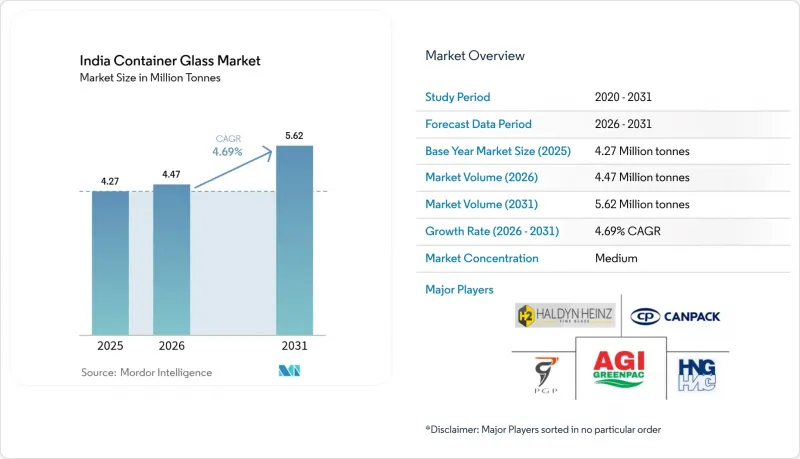
據 Mordor Intelligence 稱,印度玻璃容器市場規模預計將從 2025 年的 427 萬噸成長到 2026 年的 447 萬噸,到 2031 年達到 562 萬噸,2026 年至 2031 年的複合年成長率為 4.69%。
本報告按最終使用者(飲料(含酒精飲料(啤酒、葡萄酒、烈酒及其他含酒精飲料)、非酒精飲料(果汁、碳酸飲料、乳製品飲料及其他非酒精飲料))、食品、化妝品及個人護理用品、藥品(不包括管瓶和安瓿瓶)及其他)和顏色(綠色、琥珀色、燧石色及其他)進行細分。市場預測以噸為單位。
印度玻璃容器市場趨勢及洞察。
包裝食品和飲料的繁榮
預計到2025年,有組織的零售市場滲透率將達到15%左右,這將推動高階果汁、手工果醬和冷壓果汁品牌轉向使用玻璃容器,因為玻璃容器強調產品純度,無需添加化學防腐劑即可延長保存期限。使用200毫升至500毫升玻璃罐和玻璃瓶的產品線在零售價上高出近25%,以抵消不斷上漲的包裝成本。印度標準局(BIS)持續推進耐熱衝擊標準的標準化,提高了低成本進口產品的進入門檻,從而促進了國內熔爐的現代化。雖然目前大都會圈是玻璃容器普及的主要動力,但經銷商調查顯示,從2027年起,二線城市地區將貢獻大部分銷售量成長。預計這一趨勢將在中期內顯著推動印度玻璃容器市場的成長。
酒精消費量成長
2024年,印度酒精飲料出貨量超過11億箱,預計2025年高級啤酒、單一麥芽威士忌和進口葡萄酒的整體成長率將達到兩位數。這些品類正呈現出一種日益成長的趨勢,即採用客製化壓紋、加深底部凹槽以及琥珀色或綠色著色來保護風味成分——這些特徵在塑膠或罐裝容器中難以複製。各邦的酒類稅收改革允許小型釀酒廠直接向消費者銷售,這縮短了產品上市時間,並增加了對330毫升可回收玻璃瓶的訂單。這種玻璃瓶可重複使用約18次,之後才會被製成玻璃屑。由於模具前置作業時間不到四個月,玻璃供應商能夠滿足啤酒廠快速的SKU部署計劃,甚至超過了罐裝生產線的運作時間。標籤的快速普及也推動了印度玻璃容器市場的短期銷售量成長。
塑膠和軟包裝的替代品
由於單位成本降低40-50%、重量顯著減輕以及更易於與高速無菌灌裝機整合等優勢,帶吸嘴的硬質塑膠瓶和軟包裝袋在果汁、食用油和產品類型持續擴大市場佔有率。 2025年即將推出的監管政策將允許回收PET直接接觸食品,這進一步加速了價格敏感型農村地區對輕質瓶的採用。立式袋已佔番茄醬和調味醬市場五分之一以上的佔有率,銷售量了玻璃瓶的市場佔有率。將現有玻璃瓶填充線改造為軟包裝的投資回收期約為三年,這意味著中期內替代壓力將持續存在。此外,大都會圈以外地區玻璃屑回收率較低,導致回收材料的使用低於全球標準,減緩了玻璃製造商的成本節約效果。
細分市場分析
預計到2025年,飲料將佔總噸位的64.83%,鞏固其作為印度玻璃容器市場主要收入來源的地位。酒精飲料佔據該領域的絕大部分,僅啤酒就佔玻璃需求的一半以上,其次是烈酒和葡萄酒。非酒精飲料生產商正轉向使用PET瓶包裝果汁和風味乳製品,並持續最佳化其庫存單位(SKU),而碳酸飲料裝瓶商仍依賴可回收玻璃瓶來實現成本效益高的閉合迴路物流。食品應用(果醬、醬料、醃菜和嬰兒食品)的產量略低於五分之一,但由於有機和無添加劑產品在二線城市的銷售不斷成長,其複合年成長率(CAGR)也達到了4.3%。化妝品和個人保健產品僅佔總產量的 10%,但其複合年成長率 (CAGR) 為 4.82%,超過了所有其他終端用戶,這反映了護膚和阿育吠陀製劑領域高階優質化的浪潮。
消費者偏好的轉變在價格結構中得到了清楚的體現。客製化壓紋、厚底的精釀啤酒瓶比標準可回收容器的價格高出15-20%,從而提高了燧石玻璃和琥珀色玻璃供應合約的利潤率。由國內美妝零售商率先推出的可重複灌裝化妝品舉措,在第三次灌裝週期後降低了每次灌裝的包裝成本,從而促進了與客戶的長期關係。食品級燧石玻璃罐配有防篡改蓋,滿足了保存期限長達18個月或更長的手工調味品產品線的需求。食品和飲料包裝玻璃標準的日益嚴格,不斷提高技術標準,抑制了低成本進口,並鞏固了印度容器玻璃市場的佔有率成長。
其他好處:
- Excel格式的市場預測(ME)表
- 3個月的分析師支持
目錄
第1章:引言
- 市場分析與定義的前提條件
- 分析範圍
第2章 分析方法
第3章執行摘要
第4章 市場狀況
- 市場概覽
- 市場促進因素
- 加工食品和飲料產業的蓬勃發展
- 酒精消費量成長
- ESG措施與高階體驗
- 政府為減少一次性塑膠製品的使用所做的努力
- 消費稅差異對玻璃包裝有利。
- 冷鏈物流的擴張
- 市場限制因素
- 塑膠軟包裝的替代品
- 高能耗溶解製程相關的風險及相關成本
- 關於開採高純度矽砂的規定
- 過渡到輕質鋁罐
- 價值鏈分析
- 監理情勢
- 波特五力分析
- 價格分析
- 印度容器用玻璃熔爐的生產能力和位置
- 工廠位置及投產年份
- 生產能力
- 爐子的種類
- 玻璃的顏色
- 玻璃容器的進出口數據
- 進口量和進口額(2021-2024年)
- 出口量/出口額(2021-2024)
- 原料分析
- 玻璃包裝回收趨勢
- 需求與供給分析
第5章 市場規模與成長預測
- 最終用戶
- 飲料
- 酒精飲料
- 啤酒
- 葡萄酒
- 烈酒
- 其他酒精飲料
- 非酒精性
- 汁
- 碳酸飲料(CSD)
- 乳製品飲料
- 其他非酒精飲料
- 酒精飲料
- 食物
- 化妝品和個人護理
- 藥品(不包括管瓶和安瓿)
- 香水
- 飲料
- 按顏色
- 綠色的
- 琥珀色
- 燧石
- 其他顏色
第6章 競爭情勢
- 市場集中度
- 策略舉措和趨勢
- 市佔率分析:按公司分類
- 公司簡介
- AGI Greenpac Limited
- CANPACK India Private Limited
- Hindusthan National Glass and Industries Limited
- PGP Glass Private Limited
- Haldyn Heinz Fine Glass Private Limited
- Gerresheimer AG
- Sunrise Glass Industries Private Limited
- Pragati Glass Private Limited
- Empire Industries Limited
- Borosil Limited
- Kapoor Glass India Private Limited
- Khemka Glass Private Limited
- Jagdamba Glass Works Private Limited
- Mono Industries Limited
- Verallia India Limited
- Saver Glass India Private Limited
- Vitrum Glass Private Limited
- Hitesh Glass Works Private Limited
- SBG Glass Private Limited
- Kanchan Glass Industries
第7章 市場機會與未來展望
According to Mordor Intelligence, the India container glass market size is expected to increase from 4.27 million tonnes in 2025 to 4.47 million tonnes in 2026 and reach 5.62 million tonnes by 2031, growing at a 4.69% CAGR over 2026-2031.
This report is Segmented by End-User (Beverages [Alcoholic {Beer, Wine, Spirits, Other Alcoholic Beverages}, Non-Alcoholic {Juices, Carbonated Drinks, Dairy-Product-Based Drinks, Other Non-Alcoholic Beverages}], Food, Cosmetics and Personal Care, Pharmaceuticals [excl. Vials and Ampoules, and More), and Colour (Green, Amber, Flint, and More). The Market Forecasts are Provided in Terms of Volume (Tonnes).
India Container Glass Market Trends and Insights
Packaged Food and Beverage Boom
Organized retail penetration moved into the mid-teens by 2025, prompting premium juice, artisanal preserve, and cold-pressed-juice brands to migrate toward glass containers that signal purity and help extend shelf life without chemical preservatives. Product lines adopting 200-milliliter to 500-milliliter flint jars and bottles command retail premiums approaching 25%, cushioning higher packaging costs. Ongoing harmonization of Bureau of Indian Standards specifications for thermal-shock resistance is raising the entry bar for low-cost imports, reinforcing domestic furnace upgrades. Metro markets lead adoption today, yet distributor surveys indicate Tier-2 urban clusters will generate most incremental volume from 2027 onward. This trajectory supports a meaningful uplift to the India container glass market over the medium term.
Alcohol Consumption Growth
India shipped more than 1.1 billion alcoholic-beverage cases in 2024, and premium beer, single-malt whisky, and imported wine collectively grew at double-digit rates in 2025. These categories increasingly specify bespoke embossing, heavier punt depths, and amber or green tints to protect flavor compounds, features that plastics and cans struggle to replicate. State excise reforms permitting direct-to-consumer sales by microbreweries compressed route-to-market times and lifted orders for 330-milliliter returnable bottles that withstand roughly 18 trip cycles before cullet diversion. Tooling lead times of fewer than four months enable glass suppliers to match brewers' rapid SKU launches, outpacing can-line commissioning schedules. The quick cadence of label introductions underpins short-term volume tailwinds for the India container glass market.
Plastic and Flexible-Pack Substitution
Rigid plastic bottles and spouted pouches offer 40-50% lower unit costs, weigh far less, and integrate readily with high-speed aseptic fillers, attributes that continue to win share in juice, edible-oil, and dairy categories. A 2025 regulatory amendment allowing recycled PET for direct food contact further accelerated deployment of lightweight bottles in value-conscious rural regions. Stand-up pouches already claim more than one-fifth of the ketchup and sauce segment, drawing volume away from glass. The payback period for converting existing glass-fill lines to flexible formats is roughly three years, suggesting substitution pressure will persist through the medium term. Lower cullet-collection rates outside metropolitan areas also keep recycled-content penetration below global benchmarks, blunting cost-relief for glass producers.
Other drivers and restraints analyzed in the detailed report include:
- Government Push Against Single-Use Plastics
- ESG Commitments and Premium Perception
- Energy-Intensive Melting and CO2 Cost Risks
For complete list of drivers and restraints, kindly check the Table Of Contents.
Segment Analysis
Beverages supplied 64.83% of total tonnage in 2025, cementing the segment as the principal revenue engine for the India container glass market. Alcoholic drinks accounted for the bulk, with beer alone accounting for more than half of glass demand, followed by spirits and wine. Non-alcoholic fillers continue to rationalize stock-keeping units toward PET in juice and flavored-milk lines, but carbonated-soft-drink bottlers still rely on returnable glass for cost-effective closed-loop logistics. Food applications-jams, sauces, pickles, and baby nutrition-account for just below one-fifth of output yet exhibit solid 4.3% compound growth as organic and preservative-free labels expand distribution in Tier-2 cities. Cosmetics and personal care, although accounting for only 10% of volume, outpaced all other end users with a 4.82% CAGR, reflecting the premiumization wave sweeping skincare and Ayurvedic formulations.
Shifts in consumer preferences are reflected starkly in pricing structures. Craft beer bottles with bespoke embossing and heavier base weights fetch 15-20% price premiums over standard returnable formats, strengthening margins for flint and amber supply contracts. Refillable cosmetics initiatives pioneered by domestic beauty retailers lower per-use packaging costs beyond the third refill cycle, deepening long-run customer ties. Food-grade flint jars equipped with tamper-evident closures support a growing portfolio of artisanal condiments whose shelf life must exceed 18 months. Regulatory upgrades to glass specifications for food and beverage packaging continue to raise technical thresholds, deterring low-cost imports and consolidating share gains inside the India container glass market.
Complete Report Scope:
- By End-user
- Beverages
- Alcoholic
- Beer
- Wine
- Spirits
- Other alcoholic beverages
- Non-alcoholic
- Juices
- Carbonated drinks (CSDs)
- Dairy-product-based drinks
- Other non-alcoholic beverages
- Alcoholic
- Food
- Cosmetics and personal care
- Pharmaceuticals (excl. vials & ampoules)
- Perfumery
- Beverages
- By Colour
- Green
- Amber
- Flint
- Other colours
List of Companies Covered in this Report:
- AGI Greenpac Limited
- CANPACK India Private Limited
- Hindusthan National Glass and Industries Limited
- PGP Glass Private Limited
- Haldyn Heinz Fine Glass Private Limited
- Gerresheimer AG
- Sunrise Glass Industries Private Limited
- Pragati Glass Private Limited
- Empire Industries Limited
- Borosil Limited
- Kapoor Glass India Private Limited
- Khemka Glass Private Limited
- Jagdamba Glass Works Private Limited
- Mono Industries Limited
- Verallia India Limited
- Saver Glass India Private Limited
- Vitrum Glass Private Limited
- Hitesh Glass Works Private Limited
- SBG Glass Private Limited
- Kanchan Glass Industries
Additional Benefits:
- The market estimate (ME) sheet in Excel format
- 3 months of analyst support
TABLE OF CONTENTS
1 INTRODUCTION
- 1.1 Study Assumptions and Market Definition
- 1.2 Scope of the Study
2 RESEARCH METHODOLOGY
3 EXECUTIVE SUMMARY
4 MARKET LANDSCAPE
- 4.1 Market Overview
- 4.2 Market Drivers
- 4.2.1 Packaged Food And Beverage Boom
- 4.2.2 Alcohol Consumption Growth
- 4.2.3 ESG Commitments and Premium Perception
- 4.2.4 Government Push Against Single-Use Plastics
- 4.2.5 GST Differential Favouring Glass Packaging
- 4.2.6 Expansion Of Cold-Chain Logistics
- 4.3 Market Restraints
- 4.3.1 Plastic And Flexible-Pack Substitution
- 4.3.2 Energy-Intensive Melting and Co? Cost Risks
- 4.3.3 High-Purity Silica-Sand Mining Curbs
- 4.3.4 Shift To Lightweight Aluminium Cans
- 4.4 Value Chain Analysis
- 4.5 Regulatory Landscape
- 4.6 Porter's Five Forces
- 4.6.1 Threat of New Entrants
- 4.6.2 Bargaining Power of Suppliers
- 4.6.3 Bargaining Power of Buyers
- 4.6.4 Threat of Substitutes
- 4.6.5 Competitive Rivalry
- 4.7 Pricing Analysis
- 4.8 Container Glass Furnace Capacity and Locations in India
- 4.8.1 Plant Locations and Year of Commencement
- 4.8.2 Production Capacities
- 4.8.3 Types of Furnaces
- 4.8.4 Colour of Glass Produced
- 4.9 Export-Import Data of Container Glass
- 4.9.1 Import Volume and Value, 2021-2024
- 4.9.2 Export Volume and Value, 2021-2024
- 4.10 Raw-Material Analysis
- 4.11 Recycling Trends for Glass Packaging
- 4.12 Demand vs Supply Analysis
5 MARKET SIZE AND GROWTH FORECASTS
- 5.1 By End-user
- 5.1.1 Beverages
- 5.1.1.1 Alcoholic
- 5.1.1.1.1 Beer
- 5.1.1.1.2 Wine
- 5.1.1.1.3 Spirits
- 5.1.1.1.4 Other alcoholic beverages
- 5.1.1.2 Non-alcoholic
- 5.1.1.2.1 Juices
- 5.1.1.2.2 Carbonated drinks (CSDs)
- 5.1.1.2.3 Dairy-product-based drinks
- 5.1.1.2.4 Other non-alcoholic beverages
- 5.1.1.1 Alcoholic
- 5.1.2 Food
- 5.1.3 Cosmetics and personal care
- 5.1.4 Pharmaceuticals (excl. vials & ampoules)
- 5.1.5 Perfumery
- 5.1.1 Beverages
- 5.2 By Colour
- 5.2.1 Green
- 5.2.2 Amber
- 5.2.3 Flint
- 5.2.4 Other colours
6 COMPETITIVE LANDSCAPE
- 6.1 Market Concentration
- 6.2 Strategic Moves and Developments
- 6.3 Company Market-Share Analysis
- 6.4 Company Profiles (includes Global level Overview, Market level overview, Core Segments, Financials as available, Strategic Information, Market Rank/Share for key companies, Products and Services, and Recent Developments)
- 6.4.1 AGI Greenpac Limited
- 6.4.2 CANPACK India Private Limited
- 6.4.3 Hindusthan National Glass and Industries Limited
- 6.4.4 PGP Glass Private Limited
- 6.4.5 Haldyn Heinz Fine Glass Private Limited
- 6.4.6 Gerresheimer AG
- 6.4.7 Sunrise Glass Industries Private Limited
- 6.4.8 Pragati Glass Private Limited
- 6.4.9 Empire Industries Limited
- 6.4.10 Borosil Limited
- 6.4.11 Kapoor Glass India Private Limited
- 6.4.12 Khemka Glass Private Limited
- 6.4.13 Jagdamba Glass Works Private Limited
- 6.4.14 Mono Industries Limited
- 6.4.15 Verallia India Limited
- 6.4.16 Saver Glass India Private Limited
- 6.4.17 Vitrum Glass Private Limited
- 6.4.18 Hitesh Glass Works Private Limited
- 6.4.19 SBG Glass Private Limited
- 6.4.20 Kanchan Glass Industries
7 MARKET OPPORTUNITIES AND FUTURE OUTLOOK
- 7.1 White-space and Unmet-Need Assessment

 日本容器玻璃市場:市場佔有率分析、產業趨勢與統計及成長預測(2026-2031)法國玻璃容器:市場佔有率分析、行業趨勢和統計數據以及成長預測(2026-2031 年)泰國容器玻璃:市場佔有率分析、產業趨勢與統計、成長預測(2026-2031)義大利容器玻璃:市場佔有率分析、產業趨勢與統計、成長預測(2026-2031)西班牙容器玻璃:市場佔有率分析、產業趨勢與統計、成長預測(2026-2031)
 玻璃器皿市場-2026-2032年全球市場預測
 玻璃器皿市場規模、佔有率、成長和行業分析:按玻璃類型、成型方法、應用和地區分類,並預測至2034年
 玻璃器皿市場規模、佔有率和趨勢分析報告:按產品、應用、地區和細分市場分類(2026-2033 年)玻璃瓶市場:依材質、顏色、容量、應用及通路分類-2026-2032年全球市場預測
 酒精飲料瓶市場規模、佔有率和成長分析:按形狀、容量、材質、應用和地區分類-2026-2033年產業預測