


 |
市場調查報告書
商品編碼
2097127
印尼紡織品:市場佔有率分析、產業趨勢與統計、成長預測(2026-2031)Indonesia Textiles - Market Share Analysis, Industry Trends & Statistics, Growth Forecasts (2026 - 2031) |
||||||

※ 本網頁內容可能與最新版本有所差異。詳細情況請與我們聯繫。
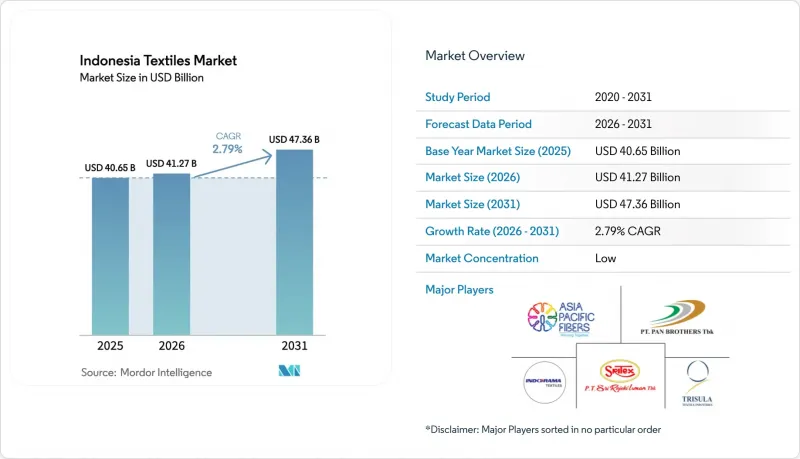
根據 Mordor Intelligence 預測,印尼紡織品市場規模將從 2025 年的 406.5 億美元和 2026 年的 412.7 億美元成長到 2031 年的 473.6 億美元,2026 年至 2031 年的年複合成長率(CAGR)為 2.79%。
本報告按應用領域(時尚服飾、工業科技、家居、醫療保健、汽車交通運輸及其他)、原料(天然纖維、合成纖維、再生纖維及其他)、製造程序(紡織品、針織品和不織布布)以及地區(爪哇島、蘇門答臘島、加里曼丹島、蘇拉威西島及印度尼西亞其他地區)進行細分。市場預測以美元計價。
印尼紡織品市場的趨勢與洞察
中產階級電子商務時尚的蓬勃發展帶動了國內紗線和布料訂單的成長。
2024年,印尼時尚品類引領了整個線上零售市場,其中直播影片商約佔商品總價值的四分之一。在印尼紡織業,能夠10天內交貨500-2000米批量布料的本土加工商,持續收到來自各大平台D2C(直接面對消費者)品牌的訂單。儘管付款週期縮短,現金流有所改善,但訂單分散化增加了計劃的複雜性。 2024年10月禁止未註冊的海外經銷商參與市場後,價格競爭有所緩解,但小包裹進口商品仍透過其他管道繼續流通。整體而言,隨著都市區可支配收入的穩定成長,線上時尚市場仍然是滌棉混紡印花布料和染色針織品的一大成長點。
加速基於「印尼製造4.0」的機器現代化補貼
雅加達政府實施了一項200億印尼幣的計劃,為符合條件的紡織機械購置成本提供高達25%的報銷,直接惠及57%已使用超過15年的織機和錠子。率先採用該計劃的企業,主要是西爪哇和中爪哇的中型紡織製造商,正利用這項報銷計劃結合銀行貸款,升級到噴氣織機和緊密紡紗生產線。國內機械製造商透過在地採購條款獲得了市場壟斷地位,但高精度齒輪(屬於報銷比例較低的10%)仍需要從德國和日本進口。工廠必須提供營業利潤證明和有效的環保許可證,這項條件將最需要設備升級的財務困難企業排除在外。中期來看,預計該計畫將提高運作效率,降低產品缺陷率,進而逐步提升出口競爭力。
印尼幣疲軟推高了棉花和合成纖維原料的進口成本。
預計到2025年3月,印尼幣兌美元匯率將跌破16,500印尼幣,而佔紡紗需求95%以上的進口棉花和聚酯原料的到貨價格卻有所上漲。紡紗企業目前僅以40-50%的運轉率運轉,缺乏足夠的營運資金進行避險或批量採購,進一步壓縮了他們本已微薄的利潤空間。雖然貨幣貶值理論上會促進出口,但同時6.5%的薪資成長抵銷了大部分收益。總而言之,這給本已面臨融資困境的紡紗企業帶來了直接壓力。
細分市場分析
到2025年,時尚服裝業將佔據印尼紡織品市場56.16%的主導地位,這反映了該國強大的服飾製造業基礎。然而,由於利潤率收窄和進口競爭,其成長速度已放緩至個位數。工業和技術紡織品雖然規模較小,但卻是成長最快的細分市場,年複合成長率達4.12%,這主要得益於對過濾材料、一次性醫療產品和汽車內部裝潢建材的需求。許多OEM製造商目前正積極尋求在地採購以滿足國內採購比例的規定,這為能夠獲得阻燃性、拉伸強度和可追溯性認證的紡紗企業創造了新的商機。同樣,政府對醫院建設的支持也增加了手術罩衣和手術鋪巾的訂單,從而促進了對紡粘和熔噴不織布生產線的投資。在整個預測期內,隨著買家尋求符合其規格的供應商,以及時尚產業的生產趨於穩定,工業和技術紡織品的市場佔有率預計將進一步擴大。
此外,應用領域的平衡性提升使印尼紡織市場能夠減輕時尚週期波動的影響。進入汽車和地工織物供應鏈的紡紗企業需要實施嚴格的品管體系,並且通常與擁有自主紗線和塗層技術的全球授權公司合作。目前,只有少數印尼工廠能夠滿足安全氣囊和安全帶的生產規格,但早期進入該領域的企業報告稱,其利潤率高於一般時尚產品,且合約期限也更長。這種轉型需要持續加大研發投入,並與終端用戶進行更緊密的合作,但它為抵消不斷上漲的工資和日益嚴格的環境標準提供了一條切實可行的途徑。
其他好處:
- Excel格式的市場預測(ME)表
- 3個月的分析師支持
目錄
第1章:引言
- 研究假設和市場定義
- 調查範圍
第2章:調查方法
第3章執行摘要
第4章 市場狀況
- 市場概覽
- 市場促進因素
- 根據「印尼製造4.0」計畫加快機器現代化補貼(2025-2027年)
- 針對中產階級的電子商務時尚蓬勃發展,帶動了日本紗線和布料的訂單成長。
- 由於 IA-CEPA 下的優惠關稅以及加入 CPTPP 的前景,出口利潤空間正在擴大。
- 品牌關於再生纖維含量的政策正在推動對PET轉化為紗線和黏膠回收的投資。
- 人工智慧驅動的線上品質檢測系統降低了中小針織品出口商的缺陷率。
- 可再生能源購電協議旨在降低印染廠的能源成本和範圍3排放。
- 市場限制因素
- 印尼幣疲軟推高了棉花和合成纖維原料的進口成本。
- 2025年各省最低工資的大幅上漲正在削弱它們相對於越南和孟加拉的競爭優勢。
- 國內市場充斥著價格極低的 Temu/Shein 產品進口商品,這些商品利用了美國第 321 條的漏洞。
- 受聖嬰現象引發的乾旱影響,中爪哇印染產業叢集的用水許可證管理正在收緊。
- 價值供應鏈分析
- 監理情勢
- 技術展望
- 產業吸引力—五力分析
- 新進入者的威脅
- 買方的議價能力
- 供應商的議價能力
- 替代品的威脅
- 競爭公司之間的競爭
第5章 市場規模與成長預測
- 透過使用
- 時尚與服裝
- 工業和技術纖維
- 家用及家用紡織品
- 用於醫療保健領域的紡織品
- 汽車和運輸紡織品
- 其他(防護和運動紡織品等)
- 按成分
- 天然纖維
- 棉布
- 羊毛
- 絲綢
- 合成纖維
- 聚酯纖維
- 尼龍
- 人造絲/粘膠纖維
- 丙烯酸纖維
- 聚丙烯
- 再生纖維
- 其他(特殊高性能纖維(芳香聚醯胺、碳纖維、超高分子量聚乙烯))
- 天然纖維
- 透過製造程序/透過技術
- 織物
- 針織
- 不織布
- 紡絲成網(紡粘/熔噴)
- 乾式突襲水力纏繞
- 濕法成網
- 針刺機
- 3D編織織物和間隔織物
- 按地區
- Java
- 蘇門答臘
- 加里曼丹
- 蘇拉威西
- 印尼其他地區
第6章 競爭情勢
- 市場集中度
- 策略趨勢
- 市佔率分析
- 公司簡介
- PT Sri Rejeki Isman Tbk
- PT Pan Brothers Tbk
- PT Asia Pacific Fibers Tbk
- PT Trisula Textile Industries Tbk
- PT Indo-Rama Synthetics Tbk
- PT Tifico Fiber Indonesia Tbk
- PT Ever Shine Tex Tbk
- PT Century Textile Industry Tbk
- PT Polychem Indonesia Tbk
- PT Panasia Group
- PT Tyfountex Indonesia
- PT Eratex Djaja Tbk
- PT Argo Pantes Tbk
- PT Indo Kordsa Tbk
- PT Sritex Green(new recycled fibre unit)
- PT Rayon Utama Makmur
- PT Kahatex
- PT Duniatex
- PT Dragon Sweater Indonesia
- PT Behaestex
第7章 市場機會與未來展望
According to Mordor Intelligence, the Indonesia textiles market size is projected to expand from USD 40.65 billion in 2025 and USD 41.27 billion in 2026 to USD 47.36 billion by 2031, registering a CAGR of 2.79% between 2026 to 2031.
This report is Segmented by Application (Fashion & Apparel, Industrial/Technical, Household & Home, Medical & Healthcare, Automotive & Transport, Others), by Raw Material (Natural Fibers, Synthetic Fibers, Recycled Fibers, Others), by Process (Woven, Knitted, Non-Woven), and by Geography (Java, Sumatra, Kalimantan, Sulawesi, Rest of Indonesia). Market Forecasts are Provided in Terms of Value (USD).
Indonesia Textiles Market Trends and Insights
Middle-Class Fashion E-Commerce Boom Lifting Domestic Yarn & Fabric Orders
Indonesia's fashion category led all online retail in 2024, and live-video commerce captured roughly one-quarter of gross merchandise value. Within the Indonesia textile industry, domestic converters that can deliver 500 to 2,000 meter lots within 10 days now receive rolling orders from direct-to-consumer labels on major platforms. Payment cycles shorten, improving cash flow, but order fragmentation raises planning complexity. The October 2024 removal of unregistered foreign sellers reduced price undercutting, yet parcel-level imports continue through other channels. On balance, steady urban disposable-income growth keeps online fashion a bright spot for polyester-cotton prints and dyed knits.
Acceleration of Machine-Modernization Subsidies Under Making Indonesia 4.0
Jakarta's IDR 20 billion program reimburses up to 25% of qualified textile equipment purchases, directly targeting the 57% of looms and spindles that are more than 15 years old. Early adopters, mainly mid-sized spinners in West and Central Java, pair the rebate with bank loans to upgrade to air-jet looms and compact-spinning lines. Domestic machine builders secure a captive market through the local-content clause, although high-precision gear still arrives from Germany and Japan on the lower 10% rebate tier. Mills must show operating profitability and valid environmental permits, conditions that exclude distressed firms most in need of upgrades. Over the medium term, the scheme is expected to lift run speeds and lower defect rates, modestly improving export competitiveness.
Weakening Rupiah Amplifying Cotton & Synthetic-Feedstock Import Costs
The rupiah fell beyond IDR 16,500 per USD by March 2025, intensifying the landed prices of imported cotton and polyester staple fiber that cover over 95% of spinning needs. Spinners operating at just 40-50% utilization lack the working capital to hedge or bulk-buy, eroding already thin margins. Although a cheaper currency theoretically aids exports, simultaneous 6.5% wage hikes nullify much of the benefit. The overall effect is a direct squeeze on cash-constrained mills.
Other drivers and restraints analyzed in the detailed report include:
- Preferential Tariffs From IA-CEPA and Prospective CPTPP Entry Expanding Export Margins
- Brand Mandates for Recycled-Fiber Content Sparking PET-to-Yarn & Viscose-Recycling Investments
- Sharp Hikes in 2025 Provincial Minimum Wages Narrowing Advantage Versus Vietnam & Bangladesh
For complete list of drivers and restraints, kindly check the Table Of Contents.
Segment Analysis
Fashion and apparel controlled a dominant 56.16% share of Indonesia textiles market size in 2025, reflecting the archipelago's deep garment-making base. Yet margin compression and import competition have slowed its growth to low single digits. Industrial and technical textiles, though smaller, are the fastest-growing niche at a 4.12% CAGR, propelled by demand for filtration media, medical disposables, and automotive upholstery. Several OEMs now insist on local sourcing to meet domestic-content rules, opening avenues for mills able to certify flame retardancy, tensile strength, and traceability. Government incentives for hospital construction similarly expand orders for gowns and drapes, supporting capacity investments in non-woven spunbond and meltblown lines. Over the forecast horizon, technical fabrics are expected to capture incremental share as buyers seek specification-driven suppliers and as fashion volumes plateau.
A more balanced application mix also cushions the Indonesian textiles market against fashion-cycle volatility. Mills entering automotive and geotextile supply chains must adopt rigorous quality systems and often partner with global licensors for proprietary yarns or coatings. While only a handful of domestic plants presently meet airbag or seat-belt specifications, early movers report higher margins and longer contracts than basic fashion programs. The shift requires sustained R&D spending and closer collaboration with end users, but it offers a viable path to offset rising wages and tougher environmental standards.
Complete Report Scope:
- By Application
- Fashion & Apparel
- Industrial/Technical Textiles
- Household & Home Textiles
- Medical & Healthcare Textiles
- Automotive & Transport Textiles
- Others (Protective, Sports Textiles, etc.)
- By Raw Material
- Natural Fibers
- Cotton
- Wool
- Silk
- Synthetic Fibers
- Polyester
- Nylon
- Rayon / Viscose
- Acrylic
- Polypropylene
- Recycled Fibers
- Others (Speciality High-Performance Fibers (Aramid, Carbon, UHMWPE))
- Natural Fibers
- By Process / Technology
- Woven
- Knitted
- Non-woven
- Spunlaid (Spunbond / Melt-blown)
- Dry-laid Hydro-entangled
- Wet-Laid
- Needle-punched
- 3-D Weaving & Spacer Fabrics
- By Region
- Java
- Sumatra
- Kalimantan
- Sulawesi
- Rest of Indonesia
List of Companies Covered in this Report:
- PT Sri Rejeki Isman Tbk
- PT Pan Brothers Tbk
- PT Asia Pacific Fibers Tbk
- PT Trisula Textile Industries Tbk
- PT Indo-Rama Synthetics Tbk
- PT Tifico Fiber Indonesia Tbk
- PT Ever Shine Tex Tbk
- PT Century Textile Industry Tbk
- PT Polychem Indonesia Tbk
- PT Panasia Group
- PT Tyfountex Indonesia
- PT Eratex Djaja Tbk
- PT Argo Pantes Tbk
- PT Indo Kordsa Tbk
- PT Sritex Green (new recycled fibre unit)
- PT Rayon Utama Makmur
- PT Kahatex
- PT Duniatex
- PT Dragon Sweater Indonesia
- PT Behaestex
Additional Benefits:
- The market estimate (ME) sheet in Excel format
- 3 months of analyst support
TABLE OF CONTENTS
1 Introduction
- 1.1 Study Assumptions & Market Definition
- 1.2 Scope of the Study
2 Research Methodology
3 Executive Summary
4 Market Landscape
- 4.1 Market Overview
- 4.2 Market Drivers
- 4.2.1 Acceleration of machine-modernization subsidies under Making Indonesia 4.0 (2025-2027)
- 4.2.2 Middle-class fashion e-commerce boom lifting domestic yarn & fabric orders
- 4.2.3 Preferential tariffs from IA-CEPA & prospective CPTPP entry expanding export margins
- 4.2.4 Brand mandates for recycled-fibre content sparking PET-to-yarn & viscose-recycling investments
- 4.2.5 AI-enabled inline quality-inspection systems cutting defect rates for SME knitwear exporters
- 4.2.6 Renewable-power PPAs reducing energy costs and Scope 3 emissions for dyehouses
- 4.3 Market Restraints
- 4.3.1 Weakening rupiah amplifying cotton & synthetic-feedstock import costs
- 4.3.2 Sharp hikes in 2025 provincial minimum wages narrowing advantage versus Vietnam & Bangladesh
- 4.3.3 Temu/Shein ultra-low-cost imports exploiting US Section 321 loophole flooding domestic market
- 4.3.4 Water-use permits tightening in Central-Java dyeing clusters amid El Nino droughts
- 4.4 Value / Supply-Chain Analysis
- 4.5 Regulatory Landscape
- 4.6 Technological Outlook
- 4.7 Industry Attractiveness - Porter's Five Forces
- 4.7.1 Threat of New Entrants
- 4.7.2 Bargaining Power of Buyers
- 4.7.3 Bargaining Power of Suppliers
- 4.7.4 Threat of Substitutes
- 4.7.5 Competitive Rivalry
5 Market Size & Growth Forecasts (Values, In USD Billion)
- 5.1 By Application
- 5.1.1 Fashion & Apparel
- 5.1.2 Industrial/Technical Textiles
- 5.1.3 Household & Home Textiles
- 5.1.4 Medical & Healthcare Textiles
- 5.1.5 Automotive & Transport Textiles
- 5.1.6 Others (Protective, Sports Textiles, etc.)
- 5.2 By Raw Material
- 5.2.1 Natural Fibers
- 5.2.1.1 Cotton
- 5.2.1.2 Wool
- 5.2.1.3 Silk
- 5.2.2 Synthetic Fibers
- 5.2.2.1 Polyester
- 5.2.2.2 Nylon
- 5.2.2.3 Rayon / Viscose
- 5.2.2.4 Acrylic
- 5.2.2.5 Polypropylene
- 5.2.3 Recycled Fibers
- 5.2.4 Others (Speciality High-Performance Fibers (Aramid, Carbon, UHMWPE))
- 5.2.1 Natural Fibers
- 5.3 By Process / Technology
- 5.3.1 Woven
- 5.3.2 Knitted
- 5.3.3 Non-woven
- 5.3.3.1 Spunlaid (Spunbond / Melt-blown)
- 5.3.3.2 Dry-laid Hydro-entangled
- 5.3.3.3 Wet-Laid
- 5.3.3.4 Needle-punched
- 5.3.4 3-D Weaving & Spacer Fabrics
- 5.4 By Region
- 5.4.1 Java
- 5.4.2 Sumatra
- 5.4.3 Kalimantan
- 5.4.4 Sulawesi
- 5.4.5 Rest of Indonesia
6 Competitive Landscape
- 6.1 Market Concentration
- 6.2 Strategic Moves
- 6.3 Market Share Analysis
- 6.4 Company Profiles (includes Global level Overview, Market level overview, Core Segments, Financials as available, Strategic Information, Products & Services, and Recent Developments)
- 6.4.1 PT Sri Rejeki Isman Tbk
- 6.4.2 PT Pan Brothers Tbk
- 6.4.3 PT Asia Pacific Fibers Tbk
- 6.4.4 PT Trisula Textile Industries Tbk
- 6.4.5 PT Indo-Rama Synthetics Tbk
- 6.4.6 PT Tifico Fiber Indonesia Tbk
- 6.4.7 PT Ever Shine Tex Tbk
- 6.4.8 PT Century Textile Industry Tbk
- 6.4.9 PT Polychem Indonesia Tbk
- 6.4.10 PT Panasia Group
- 6.4.11 PT Tyfountex Indonesia
- 6.4.12 PT Eratex Djaja Tbk
- 6.4.13 PT Argo Pantes Tbk
- 6.4.14 PT Indo Kordsa Tbk
- 6.4.15 PT Sritex Green (new recycled fibre unit)
- 6.4.16 PT Rayon Utama Makmur
- 6.4.17 PT Kahatex
- 6.4.18 PT Duniatex
- 6.4.19 PT Dragon Sweater Indonesia
- 6.4.20 PT Behaestex
7 Market Opportunities & Future Outlook
- 7.1 White-space & Unmet-Need Assessment

 技術紡織材料市場預測至2034年—按纖維類型、材料、功能、應用、產業和地區分類的全球分析
 防護紡織品市場:2026-2032年全球市場預測(按織物類型、產品、製造流程、最終用途和分銷管道分類)動物源纖維市場:2026-2032 年全球市場按形態、混合成分、表面處理、分銷管道和應用進行預測。紡織品市場:2026-2032年全球市場預測(按材料類型、結構類型、染色方法、價格範圍、織物克重、應用和分銷管道分類)
 綠色紡織品市場-全球產業規模、佔有率、趨勢、機會、預測:按類型、原料、應用、地區和競爭格局分類,2021-2031年
 紡織品:市場佔有率分析、產業趨勢與統計、成長預測(2026-2031)
 2026-2034年全球服飾市場規模、佔有率、趨勢和成長分析報告紗線、纖維和線材市場:按產品類型、原料、製造流程、撚度、應用、分銷通路和最終用途產業分類-全球預測,2026-2032年南美紡織品:市場佔有率分析、產業趨勢與統計、成長預測(2026-2031)
 紡織品市場分析及預測(至2035年):依類型、產品類型、技術、應用、材料類型、最終用戶、製程、組件及採用度分類