


 |
市場調查報告書
商品編碼
2113379
馬來西亞紡織製造業:市場佔有率分析、產業趨勢與統計及成長預測(2026-2031)Malaysia Textile Manufacturing - Market Share Analysis, Industry Trends & Statistics, Growth Forecasts (2026 - 2031) |
||||||

※ 本網頁內容可能與最新版本有所差異。詳細情況請與我們聯繫。
根據 Mordor Intelligence 預測,馬來西亞紡織品製造業市場規模預計將在 2025 年達到 35 億美元,2026 年達到 36.7 億美元,到 2031 年達到 47.1 億美元,2026 年至 2031 年的複合年成長率為 5.12%。
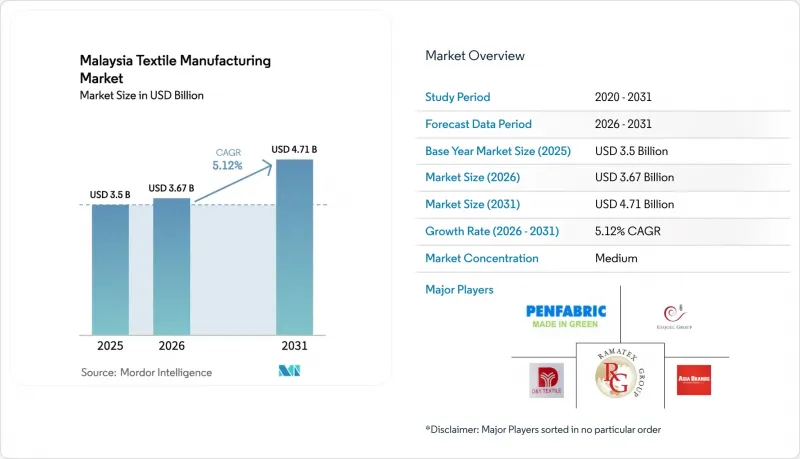
本報告按應用領域(時尚服飾、工業技術及其他)、原料(天然纖維、合成纖維及其他)、工藝/技術(紡織品、針織品、不織布、3D紡織品和間隔織物)以及地區(北部、中部、南部、東海岸和東馬)進行細分。市場預測以美元計價。
馬來西亞紡織製造業市場趨勢與洞察
RCEP下的關稅減讓將加速紗線出口。
RCEP下的優惠准入政策降低了馬來西亞紗線在中國、日本、韓國和澳洲的關稅,使符合資格的供應商的利潤率提高了5-8個百分點。生產商現在可以將澳洲羊毛和中國聚酯纖維片混合使用,而不會失去其原產地認證,檳城和吉打的中型紡紗廠已經開始利用這一優勢。 2024年,紡織工程的外商直接投資核准量將佔馬來西亞製造業總核准量的8%,顯示市場對馬來西亞這個紗線出口中心的信心日益增強。產能提升帶來的益處對於自行紡紗的綜合紡紗廠尤其顯著,但裁剪、縫紉和後整理承包商只有在合約允許價格上漲的情況下才能從中受益。隨著關稅分階段取消的持續到2026年,預計此利多因素將得以維持。
電子商務推動東協地區快時尚需求復甦。
2024年,東協地區線上市場商品總值達1,390億美元,服飾成為第二大品類。 Shopee和Lazada等平台目前正將小批量訂單集中到其馬來西亞樞紐進行處理,將交貨週期縮短至21天,這惠及了那些投資於自動化裁剪和數位化製版技術的靈活針織服裝製造商。 ZALORA平台上「端莊服飾」銷量激增33%,這對注重文化設計的本地蠟染和針織服裝製造商來說無疑是一大利好。然而,隨著越南和柬埔寨採購網路的擴張,馬來西亞企業需要確保在2027年前與平台簽訂多年協議。
2025年外籍勞工更嚴格的配額制度將導致技術工人短缺。
到2026年,外籍勞工配額將從15%逐步降至10%,這對那些超過40%的員工依賴外籍勞工的工廠構成了威脅。目前,已有35%的紡織廠面臨人手不足,預計到2025年,操作工的薪資將上漲26.7%,達到每月475美元。大型企業正在加速自動化進程(例如,Ramatex公司已經採用了可程式設計縫紉模組),而中小企業儘管有《工業發展法案》(ITA)的支持,卻仍然難以獲得資金籌措。除非技術培訓項目加快推進,否則即使訂單回升,勞動力短缺仍將阻礙生產成長。
細分市場分析
預計到2025年,時尚和服裝應用將佔總銷售額的54.1%,這鞏固了該公司在馬來西亞紡織品製造市場歷來佔據的核心地位。同時,受個人防護設備(PPE)庫存補充以及寶騰(Proton)和二國產車(Perodua)汽車內飾布料本地化生產的推動,工業和技術紡織品預計將以6.54%的最高複合年成長率成長。該細分市場的強勁成長勢頭預計將在2031年縮小與服裝的市場佔有率差距。
Ocean Cash Pacific計劃將其不織布年產量增加至1.6萬噸,這標誌著其產能正向用於生產外科口罩和罩衣的紡粘和熔噴織物轉移。汽車內裝件供應商Choli Trading Malaysia正在擴建其位於雪蘭莪州的紡織品生產線,以滿足電動車專案對阻燃輕質材料的需求。受馬來西亞住宅開工量的推動,家用紡織品市場正以4.8%的速度成長,但價格敏感的消費者使得來自中國和印度的進口產品保持競爭力。
其他好處:
- Excel格式的市場預測(ME)表
- 3個月的分析師支持
目錄
第1章:引言
- 研究假設和市場定義
- 調查範圍
第2章:調查方法
第3章執行摘要
第4章 市場狀況
- 市場概覽
- 市場促進因素
- RCEP取消關稅正在加速紗線出口。
- 電子商務推動東協地區快時尚需求復甦。
- 2025年,紡織業的投資稅額扣抵(ITA)政策恢復實施。
- 由於個人防護裝備庫存更新,醫用紡織品的訂單正在增加。
- 檳城循環經濟工業園區供應再生纖維。
- 歐盟「數位產品護照」早期採用基於區塊鏈的可追溯性
- 市場限制因素
- 因 ICPT 2025 審查而導致天然氣價格上漲
- 2025年起,對接收外籍勞工的更嚴格規定將導致技術工人短缺。
- 馬幣的波動導致進口紡織品和染料的成本增加。
- 柔佛港紡織相關設施維修延誤導致物流瓶頸。
- 價值供應鏈分析
- 監理情勢
- 技術展望
- 產業吸引力—五力分析
- 新進入者的威脅
- 買方的議價能力
- 供應商的議價能力
- 替代品的威脅
- 競爭公司之間的競爭
第5章 市場規模與成長預測
- 透過使用
- 時尚與服裝
- 工業和技術用紡織品
- 家用及家用紡織品
- 用於醫療保健領域的紡織品
- 汽車和運輸紡織品
- 其他(防護和運動紡織品等)
- 按成分
- 天然纖維
- 棉布
- 羊毛
- 絲綢
- 合成纖維
- 聚酯纖維
- 尼龍
- 人造絲/粘膠纖維
- 丙烯酸纖維
- 聚丙烯
- 再生纖維
- 其他(特殊高性能纖維(芳香聚醯胺、碳纖維、超高分子量聚乙烯))
- 天然纖維
- 按工藝/技術
- 織物
- 針織
- 不織布
- 紡絲成網(紡粘/熔噴)
- 乾式突襲水力纏繞
- 濕法成網法
- 針刺機
- 3D編織織物和間隔織物
- 按地區
- 北部地區(檳城、吉打、玻璃市、霹靂)
- 中環(雪蘭莪、吉隆坡、森美蘭、布城)
- 南部地區(柔佛、馬六甲)
- 東海岸(吉蘭丹、登嘉樓、彭亨、納閩)
- 東馬(沙巴、砂勞越)
第6章 競爭情勢
- 市場集中度
- 策略趨勢
- 市佔率分析
- 公司簡介
- Ramatex Textiles Industrial Sdn Bhd
- Penfabric Sdn Berhad
- D&Y Textile(Malaysia)Sdn Bhd
- Esquel Malaysia Sdn Berhad
- Asia Brands Berhad
- Kamunting Spinning Industries Sdn Bhd
- KIB Textiles Bhd
- Vicmark Fashion Sdn Bhd
- San Miguel Yamamura Woven Products Sdn Bhd
- Manwira Manufacturing Sdn Bhd
- Kima Sdn Bhd
- Oceanic Fabric Mill Sdn Bhd
- Maxim Textile Technology Sdn Bhd
- Hytex Integrated Bhd
- Padini Holdings Berhad
- Furniweb Holdings Ltd
- Batek Malaysia Berhad
- Usha Yarns(Malaysia)
- Titan Petrochemicals(M)Sdn Bhd
- Skreen Fabric(M)Sdn Bhd
- Choon Giap Knitting Ind. Sdn Bhd
第7章 市場機會與未來展望
According to Mordor Intelligence, the Malaysia textile manufacturing market size is projected to be USD 3.5 billion in 2025, USD 3.67 billion in 2026, and reach USD 4.71 billion by 2031, growing at a CAGR of 5.12% from 2026 to 2031.
This report is Segmented by Application (Fashion & Apparel, Industrial/Technical, Hand More), by Raw Material (Natural Fibers, Synthetic Fibers, and More), by Process (Woven, Knitted, Non-Woven, 3D Weaving & Spacer Fabrics), and by Geography (Northern, Central, Southern, East Coast, East Malaysia). Market Forecasts are Provided in Value (USD).
Malaysia Textile Manufacturing Market Trends and Insights
RCEP Tariff Eliminations Accelerating Yarn Exports
Preferential access under RCEP has lowered Malaysian yarn duties in China, Japan, South Korea, and Australia, lifting margins by 5-8 percentage points for compliant suppliers. Producers may combine Australian wool or Chinese polyester chips without losing origin status, a benefit already exploited by mid-scale spinners in Penang and Kedah. Foreign direct investment approvals for textile projects jumped 8% of Malaysia's 2024 manufacturing total, signaling confidence in a yarn-export hub. Capacity gains disproportionately reward integrated mills that spin in-house, though cut-make-trim contractors capture upside only if contracts allow pass-through pricing. Continued tariff phase-outs to 2026 keep this tailwind intact.
E-commerce-Driven Resurgence in ASEAN Fast-Fashion Demand
Regional gross merchandise value for online marketplaces touched USD 139 billion in 2024, with apparel as the second-largest category. Platforms such as Shopee and Lazada now aggregate small-lot orders in Malaysian hubs, cutting turnaround times to 21 days and rewarding agile knitters who invested in automated cutting and digital patterning. ZALORA's 33% jump in modest-wear sales benefits local batik and jersey makers that offer cultural design advantages. However, Vietnamese and Cambodian sourcing networks are expanding, so Malaysian firms must lock multi-year platform agreements before 2027.
Stricter 2025 Migrant-Worker Quota Causing Skilled-Labor Gaps
A phased cut from 15% to 10% foreign-labor allocation by 2026 threatens mills where migrant dependence exceeds 40%. Unfilled vacancies already affect 35% of textile plants, pushing operator wages up 26.7% to USD 475/month in 2025. Larger players accelerate automation - Ramatex has deployed programmable sewing modules - yet SMEs struggle with financing despite the ITA window. Without faster technical-training rollouts, labor scarcity will cap output growth even as orders rebound.
Other drivers and restraints analyzed in the detailed report include:
- Reinstated Textile Investment Tax Allowance (ITA) 2025
- PPE Stockpile Renewal Boosting Healthcare Textile Orders
- Escalating Natural-Gas Tariffs Under ICPT 2025 Review
For complete list of drivers and restraints, kindly check the Table Of Contents.
Segment Analysis
Fashion and apparel applications commanded 54.1% of 2025 revenue, underscoring the historical backbone of the Malaysia textile manufacturing market. Industrial and technical textiles, however, are set to grow at a 6.54% CAGR, the highest among applications, propelled by PPE restocking and automotive interior fabric localization for Proton and Perodua lines. The segment's robust trajectory positions it to narrow the share gap with apparel by 2031.
Oceancash Pacific's plan to double non-woven output to 16,000 tpa exemplifies capacity shifts toward spunbond and meltblown fabrics for surgical masks and gowns. Automotive interior supplier Chori Trading Malaysia is expanding its Selangor weaving lines to support electric-vehicle programs requiring flame-retardant, lightweight materials. Household textiles follow at a 4.8% pace, anchored by Malaysia's housing starts, yet price-sensitive consumers keep Chinese and Indian imports competitive.
Complete Report Scope:
- By Application
- Fashion & Apparel
- Industrial/Technical Textiles
- Household & Home Textiles
- Medical & Healthcare Textiles
- Automotive & Transport Textiles
- Others (Protective, Sports Textiles, etc.)
- By Raw Material
- Natural Fibers
- Cotton
- Wool
- Silk
- Synthetic Fibers
- Polyester
- Nylon
- Rayon / Viscose
- Acrylic
- Polypropylene
- Recycled Fibers
- Others (Speciality High-Performance Fibers (Aramid, Carbon, UHMWPE))
- Natural Fibers
- By Process / Technology
- Woven
- Knitted
- Non-woven
- Spunlaid (Spunbond / Melt-blown)
- Dry-laid Hydro-entangled
- Wet-Laid
- Needle-punched
- 3-D Weaving & Spacer Fabrics
- By Geography
- Northern (Penang, Kedah, Perlis, and Perak)
- Central (Selangor, Kuala Lumpur, Negeri Sembilan, and Putrajaya)
- Southern (Johor, Melaka)
- East Coast (Kelantan, Terengganu, Pahang, and Labuan)
- East Malaysia (Sabah, Sarawak)
List of Companies Covered in this Report:
- Ramatex Textiles Industrial Sdn Bhd
- Penfabric Sdn Berhad
- D&Y Textile (Malaysia) Sdn Bhd
- Esquel Malaysia Sdn Berhad
- Asia Brands Berhad
- Kamunting Spinning Industries Sdn Bhd
- KIB Textiles Bhd
- Vicmark Fashion Sdn Bhd
- San Miguel Yamamura Woven Products Sdn Bhd
- Manwira Manufacturing Sdn Bhd
- Kima Sdn Bhd
- Oceanic Fabric Mill Sdn Bhd
- Maxim Textile Technology Sdn Bhd
- Hytex Integrated Bhd
- Padini Holdings Berhad
- Furniweb Holdings Ltd
- Batek Malaysia Berhad
- Usha Yarns (Malaysia)
- Titan Petrochemicals (M) Sdn Bhd
- Skreen Fabric (M) Sdn Bhd
- Choon Giap Knitting Ind. Sdn Bhd
Additional Benefits:
- The market estimate (ME) sheet in Excel format
- 3 months of analyst support
TABLE OF CONTENTS
1 Introduction
- 1.1 Study Assumptions & Market Definition
- 1.2 Scope of the Study
2 Research Methodology
3 Executive Summary
4 Market Landscape
- 4.1 Market Overview
- 4.2 Market Drivers
- 4.2.1 RCEP tariff eliminations accelerating yarn exports
- 4.2.2 E-commerce-driven resurgence in ASEAN fast-fashion demand
- 4.2.3 Reinstated textile Investment Tax Allowance (ITA) 2025
- 4.2.4 PPE stockpile renewal boosting healthcare textile orders
- 4.2.5 Penang Circularity Industrial Park supplying recycled fibers
- 4.2.6 Early blockchain traceability adoption for EU Digital Product Passport
- 4.3 Market Restraints
- 4.3.1 Escalating natural-gas tariffs under ICPT 2025 review
- 4.3.2 Stricter 2025 migrant-worker quota causing skilled-labour gaps
- 4.3.3 Ringgit volatility raising imported fiber & dye costs
- 4.3.4 Logistics bottlenecks from delayed Johor Port textile upgrades
- 4.4 Value / Supply-Chain Analysis
- 4.5 Regulatory Landscape
- 4.6 Technological Outlook
- 4.7 Industry Attractiveness - Porter's Five Forces
- 4.7.1 Threat of New Entrants
- 4.7.2 Bargaining Power of Buyers
- 4.7.3 Bargaining Power of Suppliers
- 4.7.4 Threat of Substitutes
- 4.7.5 Intensity of Competitive Rivalry
5 Market Size & Growth Forecasts(Values, In USD Billion)
- 5.1 By Application
- 5.1.1 Fashion & Apparel
- 5.1.2 Industrial/Technical Textiles
- 5.1.3 Household & Home Textiles
- 5.1.4 Medical & Healthcare Textiles
- 5.1.5 Automotive & Transport Textiles
- 5.1.6 Others (Protective, Sports Textiles, etc.)
- 5.2 By Raw Material
- 5.2.1 Natural Fibers
- 5.2.1.1 Cotton
- 5.2.1.2 Wool
- 5.2.1.3 Silk
- 5.2.2 Synthetic Fibers
- 5.2.2.1 Polyester
- 5.2.2.2 Nylon
- 5.2.2.3 Rayon / Viscose
- 5.2.2.4 Acrylic
- 5.2.2.5 Polypropylene
- 5.2.3 Recycled Fibers
- 5.2.4 Others (Speciality High-Performance Fibers (Aramid, Carbon, UHMWPE))
- 5.2.1 Natural Fibers
- 5.3 By Process / Technology
- 5.3.1 Woven
- 5.3.2 Knitted
- 5.3.3 Non-woven
- 5.3.3.1 Spunlaid (Spunbond / Melt-blown)
- 5.3.3.2 Dry-laid Hydro-entangled
- 5.3.3.3 Wet-Laid
- 5.3.3.4 Needle-punched
- 5.3.4 3-D Weaving & Spacer Fabrics
- 5.4 By Geography
- 5.4.1 Northern (Penang, Kedah, Perlis, and Perak)
- 5.4.2 Central (Selangor, Kuala Lumpur, Negeri Sembilan, and Putrajaya)
- 5.4.3 Southern (Johor, Melaka)
- 5.4.4 East Coast (Kelantan, Terengganu, Pahang, and Labuan)
- 5.4.5 East Malaysia (Sabah, Sarawak)
6 Competitive Landscape
- 6.1 Market Concentration
- 6.2 Strategic Moves
- 6.3 Market Share Analysis
- 6.4 Company Profiles (includes Global level Overview, Market level overview, Core Segments, Financials as available, Strategic Information, Products & Services, Recent Developments)
- 6.4.1 Ramatex Textiles Industrial Sdn Bhd
- 6.4.2 Penfabric Sdn Berhad
- 6.4.3 D&Y Textile (Malaysia) Sdn Bhd
- 6.4.4 Esquel Malaysia Sdn Berhad
- 6.4.5 Asia Brands Berhad
- 6.4.6 Kamunting Spinning Industries Sdn Bhd
- 6.4.7 KIB Textiles Bhd
- 6.4.8 Vicmark Fashion Sdn Bhd
- 6.4.9 San Miguel Yamamura Woven Products Sdn Bhd
- 6.4.10 Manwira Manufacturing Sdn Bhd
- 6.4.11 Kima Sdn Bhd
- 6.4.12 Oceanic Fabric Mill Sdn Bhd
- 6.4.13 Maxim Textile Technology Sdn Bhd
- 6.4.14 Hytex Integrated Bhd
- 6.4.15 Padini Holdings Berhad
- 6.4.16 Furniweb Holdings Ltd
- 6.4.17 Batek Malaysia Berhad
- 6.4.18 Usha Yarns (Malaysia)
- 6.4.19 Titan Petrochemicals (M) Sdn Bhd
- 6.4.20 Skreen Fabric (M) Sdn Bhd
- 6.4.21 Choon Giap Knitting Ind. Sdn Bhd
7 Market Opportunities & Future Outlook
- 7.1 White-space & Unmet-need Assessment

 有機家用紡織品市場預測至2034年-按產品類型、材料、分銷管道、價格範圍、應用和地區分類的全球分析
 絲線:市場佔有率分析、產業趨勢與統計、成長預測(2026-2031)歐洲紡織品市場:市場佔有率分析、產業趨勢與統計、成長預測(2026-2031年)泰國紡織品市場:市場佔有率分析、產業趨勢與統計及成長預測(2026-2031)印尼紡織製造業:市場佔有率分析、產業趨勢與統計及成長預測(2026-2031年)義大利紡織製造業:市場佔有率分析、產業趨勢與統計、成長預測(2026-2031)技術紡織材料市場預測至2034年—按纖維類型、材料、功能、應用、產業和地區分類的全球分析
 防護紡織品市場:2026-2032年全球市場預測(按織物類型、產品、製造流程、最終用途和分銷管道分類)動物源纖維市場:2026-2032 年全球市場按形態、混合成分、表面處理、分銷管道和應用進行預測。印尼紡織品:市場佔有率分析、產業趨勢與統計、成長預測(2026-2031)