


 |
市場調查報告書
商品編碼
2123031
中國包裝市場:市場佔有率分析、產業趨勢與統計、成長預測(2026-2031)China Packaging - Market Share Analysis, Industry Trends & Statistics, Growth Forecasts (2026 - 2031) |
||||||

※ 本網頁內容可能與最新版本有所差異。詳細情況請與我們聯繫。
根據 Mordor Intelligence 預測,中國包裝市場規模預計將在 2025 年達到 2,183.7 億美元,2026 年達到 2,291.1 億美元,2031 年達到 2,907.3 億美元,2026 年至 2031 年的複合年成長率為 4.88%。
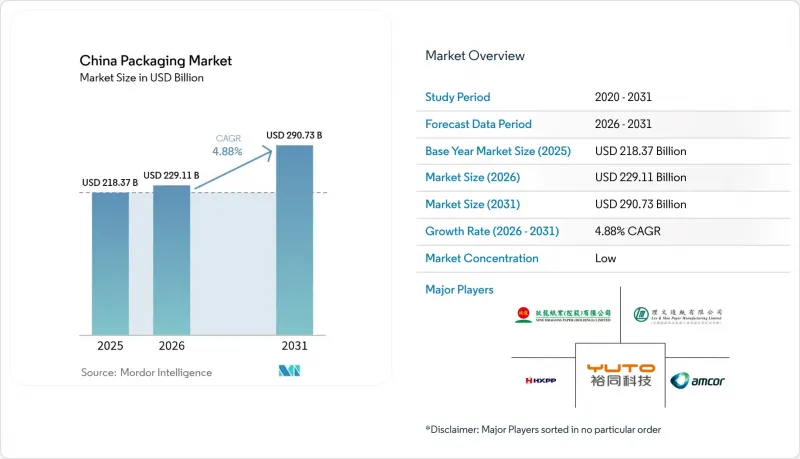
本報告按包裝材料(塑膠、紙/紙板、玻璃、金屬等)、包裝類型(初級包裝、二級包裝、三級包裝)、包裝形式(硬包裝、軟包裝)和終端用戶行業(食品飲料、醫療保健/製藥、美容/個人護理等)進行分類。市場預測以美元計價。
中國包裝市場趨勢與洞察
電子商務小包裹量呈現爆炸性成長。
預計到2026年,小包裹量將達到2,140億件,高於2025年的1,990億件,這一規模已超過美國和歐盟的總合。物流平台透過將供應商提供的瓦楞紙箱尺寸與分類中心設備相匹配,消除了倉庫內的重新包裝環節,從而增加了對價格更高的「貨架即用型」二次包裝盒的需求。到2025年,本地電子商務計畫將涵蓋1212個縣級城市,使中國包裝市場的潛在基本客群遠遠超出沿海特大城市。國家郵政局目前正強制要求到2026年,95%的小包裹必須使用可回收或可生物分解的材料,這將使瓦楞紙箱的成本增加約8%,並加速水性黏合劑和紙膠帶的普及應用。
對永續紙質包裝的需求正在飆升。
具有法律約束力的綠色包裝目標要求到2030年一次性塑膠的使用量比2020年減少40%。九龍紙業正在重慶投資60億元人民幣(約8.28億美元)建設一座綜合設施,該設施預計到2027年每年可生產170萬噸再生瓦楞紙板。世紀陽光紙業啟動了一個投資202億元人民幣(約27.9億美元)的塗佈紙項目,旨在取代聚乙烯複合紙盒。一項使用可重複使用塑膠托特包的閉合迴路項目,在50個循環後可減少63%的溫室氣體排放,但該項目目前僅限於大都會圈的試點項目,且小包裹中瓦楞紙板的使用量僅減少了不到2%。
關於塑膠禁令和生產者延伸責任(EPR)的法規
上海的聚對苯二甲酸乙二醇酯(PET)瓶押金返還制度在六個月內實現了68%的返還率,但內陸江蘇省的框架尚未最終確定,這使得全國範圍內的推廣實施面臨挑戰。國家郵政局於2025年6月發布的規定,到2026年禁止在電子商務小包裹中使用不可生物分解性塑膠信封,這加速了向紙質包裝的轉變。然而,符合GB/T 20197標準的生物分解性塑膠比傳統聚乙烯貴40%至60%,小規模電商經銷商不願承擔這部分成本,從而限制了中國包裝市場的利潤流入。
細分市場分析
到2025年,紙和紙板將佔中國包裝市場45.83%的佔有率,這得益於國內箱板紙年產能超過5000萬噸。到2025年中期,光是九龍紙業一家企業的產能就將達到2,890萬噸,足以保障阿里巴巴和京東分銷網路的大規模供應。雖然瓦楞紙板的需求仍然集中在沿海物流樞紐附近,但重慶和湖北省的擴建項目表明,內陸地區的產能需求正在成長。
塑膠是成長最快的材料,複合年成長率達4.93%,這反映了即飲飲料包裝袋和藥品包裝泡殼包裝的廣泛應用。軟性樹脂具有減薄和透明的潛力,但其成本仍易受原油價格波動的影響。玻璃在白酒和高階飲料領域佔據著一定的市場佔有率,而金屬罐則能延長能量飲料的保存期限,並在都市區便利商店通路中維持著穩定的基本客群。儘管替代材料的總合仍低於5%,但隨著品牌所有者對可再生材料的重視,甘蔗衍生的生物以金額為準聚合物正逐步滲透到化妝品行業。
2025年,中國包裝市場中,初級包裝材料佔比51.48%,而二級包裝材料則以5.03%的複合年成長率快速成長。到2025年,沃爾瑪中國和家樂福要求78%的乾貨SKU使用可直接上架的二級包裝。這項轉變將拆箱和上架工作從門市員工轉移到了上游供應商,預計每家門市的人工時間將減少12%。這一趨勢正在重塑包裝加工商的策略。根據李文紙業的報告顯示,2025會計年度,可直接上架的瓦楞紙箱的價格將比標準運輸容器高出15%,這將推動淨利潤預期成長38%至47%。
加工商可獲得15%的貨架即用型瓦楞紙板溢價,從而保護其利潤率免受紙漿價格波動的影響。儘管用於三級包裝的拉伸膜和捆紮帶的需求與物流行業的基準成長保持同步,但在京東物流使用230萬個可重複使用週轉箱構建的閉合迴路網路中,需求正在逐漸減弱。逆向物流的成本和尺寸標準化等障礙正在減緩週轉箱在大都會圈以外的普及,這為中國包裝產業傳統收縮膜的成長留下了空間。
其他好處:
- Excel格式的市場預測(ME)表
- 3個月的分析師支持
目錄
第1章:引言
- 研究假設和市場定義
- 調查範圍
第2章:調查方法
第3章執行摘要
第4章 市場狀況
- 市場概覽
- 市場促進因素
- 電子商務小包裹量的爆炸性成長
- 對永續印刷媒體的需求激增
- 便利即飲食品包裝的普及
- 擴大藥品冷鏈
- 實施物聯網支援的追蹤和可追溯包裹
- 用於超低溫生物製藥物流的包裝
- 市場限制因素
- 關於禁止使用塑膠和生產者延伸責任的法規
- 揮發性紙漿和聚合物原料價格
- 各地的回收基礎設施不盡相同。
- 可重複使用托特包試點計畫正在削弱都市區對紙板的需求。
- 產業價值鏈分析
- 監理情勢
- 波特五力分析
- 宏觀經濟因素對市場的影響
第5章 市場規模與成長預測
- 透過包裝材料
- 塑膠
- 紙張和紙板
- 玻璃
- 金屬
- 其他材料
- 按包裝類型
- 初級包裝
- 二級包裝
- 三級包裝
- 按包裝類型
- 硬包裝
- 軟包裝
- 按最終用戶行業分類
- 食品/飲料
- 醫療和藥品
- 美容及個人護理
- 產業
- 其他終端用戶產業
第6章 競爭情勢
- 市場集中度
- 策略趨勢
- 市佔率分析
- 公司簡介
- Nine Dragons Paper(Holdings)Ltd.
- Lee and Man Paper Manufacturing Ltd.
- Shanying International Holdings Co., Ltd.
- Hexing Packaging Co., Ltd.
- Greatview Aseptic Packaging Co., Ltd.
- Wuxi Huatai Co., Ltd.
- Shanghai Zijiang Enterprise Group Co., Ltd.
- YUTO Packaging Technology Co., Ltd.
- Zhejiang Xinlei Packaging Co., Ltd.
- Guangdong Champ New Material Co., Ltd.
- Crown Holdings, Inc.
- Amcor Plc
- Berry Global Group, Inc.
- International Paper Company
- WestRock Company
- Sealed Air Corporation
- Tetra Pak(China)Ltd.
- Beijing Hualian Printing Co., Ltd.
- Zhejiang Jiashan Dingxin Packaging Co., Ltd.
- Shenzhen Yutong Packaging Technology Co., Ltd.
- Smurfit Kappa Group Plc
- DS Smith Plc
- Huhtamaki Oyj
- Mondi Group
第7章 市場機會與未來展望
According to Mordor Intelligence, the China packaging market size is projected to be USD 218.37 billion in 2025, USD 229.11 billion in 2026, and reach USD 290.73 billion by 2031, growing at a CAGR of 4.88% from 2026 to 2031.
This report is Segmented by Packaging Material (Plastic, Paper and Paperboard, Glass, Metal, and More), Packaging Type (Primary Packaging, Secondary Packaging, and Tertiary Packaging), Packaging Format (Rigid Packaging and Flexible Packaging), and End-User Industry (Food and Beverages, Healthcare and Pharmaceutical, Beauty and Personal Care, and More). The Market Forecasts are Provided in Terms of Value (USD).
China Packaging Market Trends and Insights
Explosive Growth Of E-Commerce Parcel Volume
Parcel throughput climbed from 199 billion pieces in 2025 to a targeted 214 billion in 2026, a scale that already eclipses combined U.S. and EU totals. Logistics platforms are eliminating in-warehouse repacking by synchronizing supplier carton dimensions with sorting-center equipment, thereby raising demand for shelf-ready secondary boxes with a higher unit value. Rural e-commerce programs rolled out to 1,212 county-level cities in 2025, expanding the addressable base for the China packaging market far beyond coastal megacities. The State Post Bureau now requires 95% of parcels to use recyclable or degradable materials by 2026, which bumps corrugated-box costs by roughly 8% but accelerates the adoption of water-based adhesives and paper tapes.
Demand Spike For Sustainable Paper-Based Formats
Binding green-packaging targets mandate a 40% reduction in single-use plastics versus 2020 by 2030. Nine Dragons Paper is spending RMB 6 billion (USD 828 million) on a Chongqing complex that will deliver 1.7 million tonnes annually of recycled containerboard by 2027. Century Sunshine Paper launched a RMB 20.2 billion (USD 2.79 billion) coated-paperboard project designed to displace polyethylene-laminated cartons. Closed-loop programs using reusable plastic totes can cut greenhouse-gas emissions 63% after 50 rotations, yet deployment remains limited to metropolitan pilot circles, trimming corrugated use by less than 2% of parcel volume.
Plastic-Ban and Extended-Producer-Responsibility Rules
Shanghai's deposit-return program for polyethylene terephthalate bottles achieved a 68% recovery rate within six months, but inland Jiangsu has yet to finalize its framework, complicating nationwide compliance. The State Post Bureau's June 2025 regulation banning non-degradable plastic mailers for e-commerce parcels by 2026 is accelerating the shift to paper-based alternatives, but degradable plastics certified under GB/T 20197 standards cost 40-60% more than conventional polyethylene, a premium that small online merchants are reluctant to absorb, restraining profit transfer into the China packaging market.
Other drivers and restraints analyzed in the detailed report include:
- Convenience Ready-To-Drink Food Packaging Adoption
- Pharmaceutical Cold-Chain Expansion
- Volatile Pulp and Polymer Feedstock Costs
For complete list of drivers and restraints, kindly check the Table Of Contents.
Segment Analysis
Paper and paperboard held 45.83% of the China packaging market size in 2025, led by over 50 million tonnes per year of domestic containerboard capacity. Nine Dragons Paper alone operated 28.9 million tonnes by mid-2025, ensuring scale supply to Alibaba and JD.com distribution networks. Corrugated demand continues to concentrate around coastal shipping hubs, yet expansion projects in Chongqing and Hubei show inland appetite for capacity
Plastic is the fastest-growing material at a 4.93% CAGR, reflecting pouch adoption for ready-to-drink beverages and blister packs for pharmaceuticals. Flexible resins offer down-gauging potential and transparency but remain exposed to crude-linked cost swings. Glass retains a niche in baijiu and premium beverages, while metal cans stabilize shelf life in energy drinks, keeping a loyal base in urban convenience channels. Together, alternative materials sit below 5% by value, yet bio-based polymers derived from sugarcane are edging into cosmetics as brand owners pursue renewable content credence.
Primary layers represented 51.48% of the China packaging market in 2025, but secondary formats are pacing ahead at a 5.03% CAGR. Walmart China and Carrefour mandated shelf-ready secondary packaging for 78% of dry-grocery SKUs in 2025, a shift that transfers box-opening and shelf-stacking tasks from store employees to upstream suppliers, cutting labor hours per store by an estimated 12%. This trend is reshaping converter strategies; Lee and Man Paper reported that shelf-ready corrugated boxes commanded a 15% price premium versus standard shipping containers in fiscal 2025, contributing to a 38-47% increase in net profit guidance
Converters receive a 15% price premium on shelf-ready corrugated, protecting margins against pulp volatility. Tertiary stretch-film and strapping track baseline logistics growth but face dilution in closed-loop networks using 2.3 million reusable totes installed by JD Logistics. Reverse-logistics costs and size standardization barriers slow tote penetration beyond megacities, ensuring a runway for conventional shrink film inside the China packaging industry.
Complete Report Scope:
- By Packaging Material
- Plastic
- Paper and Paperboard
- Glass
- Metal
- Other Materials
- By Packaging Type
- Primary Packaging
- Secondary Packaging
- Tertiary Packaging
- By Packaging Format
- Rigid Packaging
- Flexible Packaging
- By End-User Industry
- Food and Beverages
- Healthcare and Pharmaceutical
- Beauty and Personal Care
- Industrial
- Other End-User Industries
List of Companies Covered in this Report:
- Nine Dragons Paper (Holdings) Ltd.
- Lee and Man Paper Manufacturing Ltd.
- Shanying International Holdings Co., Ltd.
- Hexing Packaging Co., Ltd.
- Greatview Aseptic Packaging Co., Ltd.
- Wuxi Huatai Co., Ltd.
- Shanghai Zijiang Enterprise Group Co., Ltd.
- YUTO Packaging Technology Co., Ltd.
- Zhejiang Xinlei Packaging Co., Ltd.
- Guangdong Champ New Material Co., Ltd.
- Crown Holdings, Inc.
- Amcor Plc
- Berry Global Group, Inc.
- International Paper Company
- WestRock Company
- Sealed Air Corporation
- Tetra Pak (China) Ltd.
- Beijing Hualian Printing Co., Ltd.
- Zhejiang Jiashan Dingxin Packaging Co., Ltd.
- Shenzhen Yutong Packaging Technology Co., Ltd.
- Smurfit Kappa Group Plc
- DS Smith Plc
- Huhtamaki Oyj
- Mondi Group
Additional Benefits:
- The market estimate (ME) sheet in Excel format
- 3 months of analyst support
TABLE OF CONTENTS
1 INTRODUCTION
- 1.1 Study Assumptions and Market Definition
- 1.2 Scope of the Study
2 RESEARCH METHODOLOGY
3 EXECUTIVE SUMMARY
4 MARKET LANDSCAPE
- 4.1 Market Overview
- 4.2 Market Drivers
- 4.2.1 Explosive Growth of E-Commerce Parcel Volume
- 4.2.2 Demand Spike for Sustainable Paper-Based Formats
- 4.2.3 Convenience Ready-to-Drink Food Packaging Adoption
- 4.2.4 Pharmaceutical Cold-Chain Expansion
- 4.2.5 IoT-Enabled Track and Trace Packaging Rollout
- 4.2.6 Ultra-Low-Temperature Bio-Pharma Logistics Packaging
- 4.3 Market Restraints
- 4.3.1 Plastic Ban and Extended Producer Responsibility Rules
- 4.3.2 Volatile Pulp and Polymer Feedstock Costs
- 4.3.3 Patchy Provincial Recycling Infrastructure
- 4.3.4 Reusable Tote Pilots Eroding Urban Corrugated Demand
- 4.4 Industry Value Chain Analysis
- 4.5 Regulatory Landscape
- 4.6 Porter's Five Forces Analysis
- 4.6.1 Threat of New Entrants
- 4.6.2 Bargaining Power of Suppliers
- 4.6.3 Bargaining Power of Buyers
- 4.6.4 Threat of Substitutes
- 4.6.5 Competitive Rivalry
- 4.7 Impact of Macroeconomic Factors on the Market
5 MARKET SIZE AND GROWTH FORECASTS (VALUES)
- 5.1 By Packaging Material
- 5.1.1 Plastic
- 5.1.2 Paper and Paperboard
- 5.1.3 Glass
- 5.1.4 Metal
- 5.1.5 Other Materials
- 5.2 By Packaging Type
- 5.2.1 Primary Packaging
- 5.2.2 Secondary Packaging
- 5.2.3 Tertiary Packaging
- 5.3 By Packaging Format
- 5.3.1 Rigid Packaging
- 5.3.2 Flexible Packaging
- 5.4 By End-User Industry
- 5.4.1 Food and Beverages
- 5.4.2 Healthcare and Pharmaceutical
- 5.4.3 Beauty and Personal Care
- 5.4.4 Industrial
- 5.4.5 Other End-User Industries
6 COMPETITIVE LANDSCAPE
- 6.1 Market Concentration
- 6.2 Strategic Moves
- 6.3 Market Share Analysis
- 6.4 Company Profiles (includes Global Level Overview, Market Level Overview, Core Segments, Financials as available, Strategic Information, Market Rank/Share, Products and Services, Recent Developments)
- 6.4.1 Nine Dragons Paper (Holdings) Ltd.
- 6.4.2 Lee and Man Paper Manufacturing Ltd.
- 6.4.3 Shanying International Holdings Co., Ltd.
- 6.4.4 Hexing Packaging Co., Ltd.
- 6.4.5 Greatview Aseptic Packaging Co., Ltd.
- 6.4.6 Wuxi Huatai Co., Ltd.
- 6.4.7 Shanghai Zijiang Enterprise Group Co., Ltd.
- 6.4.8 YUTO Packaging Technology Co., Ltd.
- 6.4.9 Zhejiang Xinlei Packaging Co., Ltd.
- 6.4.10 Guangdong Champ New Material Co., Ltd.
- 6.4.11 Crown Holdings, Inc.
- 6.4.12 Amcor Plc
- 6.4.13 Berry Global Group, Inc.
- 6.4.14 International Paper Company
- 6.4.15 WestRock Company
- 6.4.16 Sealed Air Corporation
- 6.4.17 Tetra Pak (China) Ltd.
- 6.4.18 Beijing Hualian Printing Co., Ltd.
- 6.4.19 Zhejiang Jiashan Dingxin Packaging Co., Ltd.
- 6.4.20 Shenzhen Yutong Packaging Technology Co., Ltd.
- 6.4.21 Smurfit Kappa Group Plc
- 6.4.22 DS Smith Plc
- 6.4.23 Huhtamaki Oyj
- 6.4.24 Mondi Group
7 MARKET OPPORTUNITIES AND FUTURE OUTLOOK
- 7.1 White-Space and Unmet-Need Assessment

 折疊扇市場 - 全球市場預測 2026-2032
 電子順磁共振(ESR)波譜儀市場規模、佔有率和成長分析:按波譜儀類型、頻段、應用、最終用戶、配置和地區分類-2026-2033年產業預測
 木質合板包裝市場:策略性洞察與預測(2026-2031年)
 西班牙包裝產業:市場佔有率分析、產業趨勢與統計、成長預測(2026-2031)泰國包裝產業:市場佔有率分析、產業趨勢與統計、成長預測(2026-2031)包裝泵和分配器:市場佔有率分析、行業趨勢和統計數據、成長預測(2026-2031 年)非洲包裝市場:市場佔有率分析、產業趨勢與統計及成長預測(2026-2031 年)
 微波爐適用包裝市場分析及至2035年預測:類型、技術、應用、形狀、材料類型、製程、最終用戶、功能、設備
 2034年纖維基阻隔性包裝市場預測-全球分析(依纖維材料、阻隔塗層、包裝形式、阻隔技術、最終用戶和地區分類)復古包裝市場規模、佔有率、成長、全球產業分析、區域趨勢及2026-2034年預測