


 |
市場調查報告書
商品編碼
2124585
包裝泵和分配器:市場佔有率分析、行業趨勢和統計數據、成長預測(2026-2031 年)Packaging Pumps and Dispensers - Market Share Analysis, Industry Trends & Statistics, Growth Forecasts (2026 - 2031) |
||||||

※ 本網頁內容可能與最新版本有所差異。詳細情況請與我們聯繫。
根據 Mordor Intelligence 估計,包裝泵和分配器市場在 2025 年的價值為 100.3 億美元,預計到 2031 年將從 2026 年的 105.2 億美元成長到 134.3 億美元,在預測期(2026-2031 年成長率)內的複合年成長率為 5.01%。
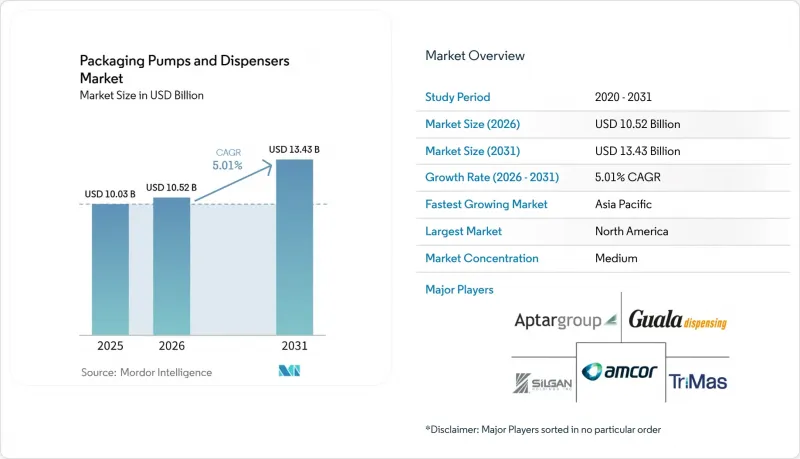
本報告按產品類型(乳液/乳霜泵、噴霧/觸發泵、泡沫泵、真空泵等)、材質類型(塑膠、金屬、玻璃等)、應用領域(美容/個人護理、家居護理等)、分銷管道(超級市場/大賣場、專賣店等)和地區進行細分。市場預測以美元(USD)計價。
全球包裝幫浦和分配器市場趨勢及洞察
對定量分裝和便捷包裝的需求日益成長。
定量分裝已成為護膚、藥品和消費品產業的核心需求。這不僅能減少產品浪費,還能確保更一致的使用效果。對於外用藥物和在臨床環境之外使用的市售鼻腔產品而言,這種需求尤其突出。 Aptar公司報告稱,其2025年的藥品銷售額將達到17.4億美元,年增6%,這主要得益於急救醫療、注射系統和消費者保健解決方案的強勁成長。該公司還報告稱,其美容部門的核心銷售額成長了13%,尤其是在個人護理領域,包括護髮、身體保養和防曬油產品。對於能夠將便利的操作與藥品級分裝技術結合的供應商而言,這種情況無疑是利好消息。
美容及個人保健產品的優質化
高階美妝產品需要手感、外觀和性能始終如一的包裝容器。無氣泵、定製香氛噴嘴和可填充系統比傳統泵更具附加價值。這些設計還有助於品牌保護嬌嫩的成分,並提供差異化的用戶體驗。 Silgan報告稱,在Wiener Packaging的整合以及其香氛和美妝業務成長的推動下,其包裝容器和特殊瓶蓋的銷售額在2025年達到27億美元,成長17%。 Aptar在2025年將持股比率增至80%,並為Christian Dior和Valentino的新品發布提供了INUNE的高階香氛泵。小規模的皮膚護理品牌也在尋求客製化噴嘴,這提升了快速模具製造和裝飾能力的價值。
樹脂、金屬和零件的成本波動很大。
聚丙烯和聚乙烯是標準泵浦組件的主要材料成分。由於這些材料的價格與原油和石腦油價格的波動密切相關,小規模製造商可能難以應對。受關稅、供應商中斷、生產效率下降以及產品組合變化的影響,Aptar 美容部門的調整後EBITDA獲利率從 2024 年的 13.0% 下降至 2025 年的 12.1%。 Silgan 收購 Wiener 後,利用其在歐洲的大規模製造地來支持成本轉嫁機制。大型供應商可以透過廣泛的供應鏈網路分散採購風險,而小型製造商可能缺乏設計變更和合規所需的資金。此外,在對精度要求極高的香水和製藥業,鋼製彈簧的成本也是一個重要因素。
細分市場分析
截至2025年,乳液和乳霜泵將佔據包裝泵和分配器市場佔有率的28.43%。這些幫浦廣泛應用於洗髮精、潤膚露、護髮素和大眾護膚品中。其操作特性使其適用於需要輕鬆擠出大量液體的產品。自有品牌和低價品牌繼續將這些幫浦作為標準配置。即使高階品牌採用專用系統,這種現有的市場基礎也能確保穩定的需求。
無氣泵預計到2031年將以5.78%的複合年成長率成長。它們廣泛應用於不含防腐劑的護膚品、臨床皮膚化妝品和外用藥物製劑。其抗氧化特性和劑量精準性確保了產品在這些應用中的穩定性。 「Magic One」採用單引擎設計,可實現0.3毫升至1毫升的出液量,並採用符合PPWR標準的聚烯材料。噴霧泵和觸發泵在家庭護理產品中繼續發揮重要作用,而泡沫泵則用於洗手液和低過敏性清潔產品。工業和食品服務業的專用瓶蓋的發展趨勢與工業生產規模而非消費品趨勢保持一致。
截至2025年,塑膠在包裝幫浦和分配器材料市佔率中佔76.91%。聚丙烯和聚乙烯因其優異的耐化學性、加工性和成本效益而被廣泛應用於各種領域。聚丙烯仍然是標準乳液幫浦和觸發幫浦的常用材料。聚乙烯擴大用於尋求可回收性認證的單一材料系統。當整個系統相容時,這些材料有助於泵浦滿足可回收性設計要求。
預計到2031年,金屬產業將以5.63%的複合年成長率成長。金屬零件被廣泛應用於高階香水、藥品分配器和優質護膚品中,以確保精準度並提升產品外觀。它們也適用於那些對奢華質感和結構剛性要求較高的應用領域。玻璃在超高階護膚品和藥品包裝中仍佔據小規模。 PVC正面臨歐盟PPWR法規的監管壓力,而PET則在食品和飲料瓶蓋的應用有限。在包裝泵和分配器行業,塑膠產品設計正轉向單一材料的聚乙烯和聚丙烯,但預計到2030年後,金屬化和多層產品將面臨更嚴格的要求。
區域分析
2025年,北美將佔包裝幫浦和分配器市場29.56%的佔有率。高階美容產品的普及、成熟的零售網路以及可回收泵的早期應用,都支撐了該地區對包裝泵和分配器的整體需求。雖然美國佔據了該地區的大部分市場佔有率,但加拿大和墨西哥也透過有組織的零售和藥品包裝推動了需求成長。 Silgan預計2026年分配器出貨量和調整後息稅前利潤將超過2025年的水平,併計劃投資3.1億美元用於資本支出,以支持其分配器和寵物食品業務的成長。南美洲以巴西為中心,Aptar收購Somaplast有助於增強其口服藥品分配器的供給能力。
在歐洲,包裝幫浦和分配器市場已擁有成熟的高階化妝品和藥品包裝基礎。 PPWR(包裝產品回收條例)將於2026年8月生效,屆時供應商必須提供可回收性證明。德國、法國、英國、義大利和西班牙是包裝幫浦和分配器的主要需求市場。安姆科已在德國洛恩啟動其「Magic One」運作線,預計2027年初交付首批交付。土耳其、沙烏地阿拉伯和阿拉伯聯合大公國(阿拉伯聯合大公國)也為中東地區對客製化高階香水幫浦的需求提供了支持。
預計到2031年,亞太地區包裝幫浦和分配器市場將以6.09%的複合年成長率成長,成為所有地區中成長最快的市場。中國、印度、韓國、日本和澳洲人口眾多,預計這些國家對美容和個人保健產品的消費量將會增加。在中國,注重成分的美容產品推動了無氣分配器的普及;在印度,零售網路的擴張促使泵式產品在農村城市開始使用。韓國品牌正在採用雙腔和無氣系統,這些系統未來可能會被推廣到全球產品線;在非洲,南非、埃及、奈及利亞和肯亞的需求尚處於起步階段,消費者正從袋裝產品轉向泵個人保健產品。
其他好處:
- Excel格式的市場預測(ME)表
- 3個月的分析師支持
目錄
第1章:引言
- 研究假設和市場定義
- 調查範圍
第2章:調查方法
第3章執行摘要
第4章 市場狀況
- 市場概覽
- 市場促進因素
- 對定量包裝和便利包裝的需求日益成長。
- 美容及個人保健產品的優質化
- 液態和半液態產品形式的擴展
- 衛生、消毒和家庭護理應用領域的成長
- 採用可回收的單一材料泵浦系統
- 電子商務對防漏和可鎖定分配器的要求
- 市場限制因素
- 樹脂、金屬和零件的成本波動
- 客製化幫浦類型的模具和製造成本很高
- 由於製劑不相容和劑量不均勻而導致的故障。
- 多材料幫浦組件的回收基礎設施有限。
- 宏觀經濟因素對市場的影響
- 產業價值鏈分析
- 監理情勢
- 技術展望
- 波特五力分析
第5章 市場規模與成長預測
- 依產品類型
- 用於乳液和乳霜的按壓泵
- 噴霧泵和觸發泵
- 泡沫泵
- 無氣泵
- 其他產品類型
- 依材料類型
- 塑膠
- 聚丙烯(PP)
- 聚乙烯(PE)
- 聚對苯二甲酸乙二醇酯(PET)
- 聚氯乙烯(PVC)
- 其他塑膠
- 金屬
- 玻璃
- 其他材料類型
- 塑膠
- 透過使用
- 美容及個人護理
- 居家照護
- 藥品和醫療保健
- 食品/飲料
- 工業和汽車
- 其他用途
- 透過分銷管道
- 超級市場和大賣場
- 專賣店
- 網路商店和市場
- 按地區
- 北美洲
- 美國
- 加拿大
- 墨西哥
- 南美洲
- 巴西
- 阿根廷
- 哥倫比亞
- 其他南美國家
- 歐洲
- 德國
- 英國
- 法國
- 義大利
- 西班牙
- 俄羅斯
- 其他歐洲國家
- 亞太地區
- 中國
- 印度
- 日本
- 韓國
- 澳洲
- 其他亞太國家
- 中東
- 沙烏地阿拉伯
- 阿拉伯聯合大公國
- 土耳其
- 其他中東國家
- 非洲
- 南非
- 埃及
- 奈及利亞
- 肯亞
- 其他非洲國家
- 北美洲
第6章 競爭情勢
- 市場集中度
- 策略趨勢
- 市佔率分析
- 公司簡介
- AptarGroup, Inc.
- Silgan Holdings Inc.
- Amcor plc
- TriMas Corporation
- Coster Tecnologie Speciali SpA
- Guala Dispensing SpA
- Frapak Packaging BV
- Mitani Valve Co., Ltd.
- Quadpack Industries
- Taplast SpA
- Raepak Ltd.
- Afa Dispensing Group BV
- Zhejiang Sun-Rain Industrial Co., Ltd.
- Gerresheimer AG
- Precision Valve Corporation
第7章 市場機會與未來展望
According to Mordor Intelligence, the packaging pumps and dispensers market size was USD 10.03 billion in 2025 and is estimated to grow from USD 10.52 billion in 2026 to reach USD 13.43 billion by 2031, at a CAGR of 5.01% during the forecast period (2026-2031).
This report is Segmented by Product Type (Lotion and Cream Pumps, Spray and Trigger Pumps, Foam Pumps, Airless Pumps, and More), Material Type (Plastic, Metal, Glass, and More), Application (Beauty and Personal Care, Homecare, and More), Distribution Channel (Supermarkets and Hypermarkets, Specialty Stores, and More), and Geography. The Market Forecasts are Provided in Terms of Value (USD).
Global Packaging Pumps and Dispensers Market Trends and Insights
Rising Demand for Controlled-Dose and Convenient Packaging
Controlled-dose dispensing has become a core requirement in skincare, pharmaceutical, and household applications. It reduces product waste and can provide more consistent use. The need is especially visible in topical medicines and over-the-counter nasal products used outside clinical settings. Aptar reported USD 1.74 billion in 2025 pharma sales, up 6%, supported by emergency medicine, injectable systems, and consumer healthcare solutions. Its beauty segment also reported 13% core sales growth in personal care, including hair, body, and sun care products. These conditions favor suppliers that can combine consumer-friendly operation with pharmaceutical-grade dispensing experience.
Premiumization of Beauty and Personal Care Products
Premium beauty products require dispensers with a consistent feel, appearance, and performance. Airless pumps, custom fragrance actuators, and refillable systems carry higher value than conventional pumps. These designs also help brands protect sensitive ingredients and support a differentiated user experience. Silgan reported USD 2.7 billion in 2025 dispensing and specialty closures sales, a 17% increase, following the integration of Weener Packaging and growth in the fragrance and beauty segments. Aptar increased its ownership of BTY to 80% in 2025 and supplied INUNE prestige fragrance pumps for the launches of Christian Dior and Valentino. Smaller dermocosmetics brands are also seeking customized actuators, which increases the value of rapid tooling and decoration capabilities.
Volatile Resin, Metal, and Component Costs
Polypropylene and polyethylene represent much of the material content in standard pump assemblies. Their prices follow crude oil and naphtha movements, which can be difficult for smaller manufacturers to manage. Aptar's beauty segment adjusted EBITDA margin declined to 12.1% in 2025 from 13.0% in 2024, due to tariffs, supplier disruptions, manufacturing inefficiencies, and product mix. Silgan used its larger European manufacturing base after the Weener acquisition to support cost pass-through arrangements. Larger suppliers can spread sourcing risk through broader supply networks, while smaller producers may have less capital for redesign and compliance work. Steel spring costs also matter in fragrance and pharmaceutical products, where precision cannot be reduced.
Other drivers and restraints analyzed in the detailed report include:
- Adoption of Recyclable and Mono-Material Pump Systems
- E-Commerce Demand for Leak-Resistant and Lockable Dispensers
- Limited Recycling Infrastructure for Multi-Material Pump Assemblies
For complete list of drivers and restraints, kindly check the Table Of Contents.
Segment Analysis
Lotion and cream pumps held 28.43% of the packaging pumps and dispensers market share in 2025. They are widely used for shampoos, body lotions, conditioners, and mass skin care products. Their operating profile suits products that need high-volume dispensing with low actuation force. Private-label and value brands continue to use these pumps as a standard format. This installed base supports stable demand even as premium brands add specialized systems.
Airless pumps are projected to grow at a CAGR of 5.78% through 2031. They are used in preservative-free skin care, clinical dermocosmetics, and pharmaceutical topicals. Oxidation protection and dose accuracy support product stability claims in these applications. Magic One provides outputs from 0.3 ml to 1 ml through a single-engine concept and uses a PPWR-aligned polyolefin design. Spray and trigger pumps remain important in home care, while foam pumps are used in hand hygiene and gentle cleansing products. Specialty closures for industrial and food-service uses follow industrial output rather than consumer-product trends.
Plastic held 76.91% of the packaging pumps and dispensers market share by material type in 2025. Polypropylene and polyethylene are used across a range of applications because they offer chemical resistance, processability, and cost-effectiveness. Polypropylene remains common in standard lotion and trigger pumps. Polyethylene is gaining use in mono-material systems where brands seek recyclability certification. These materials can help a pump meet design-for-recycling requirements when the overall system is compatible.
Metal is projected to grow at a CAGR of 5.63% through 2031. Premium fragrances, pharmaceutical dispensing, and luxury skin care use metal components to ensure precision and enhance product presentation. Metal components are also used where a premium tactile effect and structural rigidity are important. Glass retains a small position in ultra-premium skin care and pharmaceutical packaging. PVC faces regulatory pressure under EU PPWR rules, while PET has modest use in food and beverage closures. The packaging pumps and dispensers industry is moving plastic designs toward mono-material polyethylene and polypropylene, while metalized and multi-layer formats face tighter requirements from 2030.
Complete Report Scope:
- By Product Type
- Lotion and Cream Pumps
- Spray and Trigger Pumps
- Foam Pumps
- Airless Pumps
- Other Product Types
- By Material Type
- Plastic
- Polypropylene (PP)
- Polyethylene (PE)
- Polyethylene Terephthalate (PET)
- Polyvinyl Chloride (PVC)
- Other Plastics
- Metal
- Glass
- Other Material Types
- Plastic
- By Application
- Beauty and Personal Care
- Homecare
- Pharmaceuticals and Healthcare
- Food and Beverages
- Industrial and Automotive
- Other Applications
- By Distribution Channel
- Supermarkets and Hypermarkets
- Specialty Stores
- Online Stores and Marketplaces
- By Geography
- North America
- United States
- Canada
- Mexico
- South America
- Brazil
- Argentina
- Colombia
- Rest of South America
- Europe
- Germany
- United Kingdom
- France
- Italy
- Spain
- Russia
- Rest of Europe
- Asia-Pacific
- China
- India
- Japan
- South Korea
- Australia
- Rest of Asia-Pacific
- Middle East
- Saudi Arabia
- United Arab Emirates
- Turkey
- Rest of Middle East
- Africa
- South Africa
- Egypt
- Nigeria
- Kenya
- Rest of Africa
- North America
Geography Analysis
North America held 29.56% of the packaging pumps and dispensers market share in 2025. Premium beauty adoption, established retail networks, and early uptake of recyclable pumps support demand across the packaging pumps and dispensers market in the region. The United States accounts for much of the regional base, while Canada and Mexico add demand through organized retail and pharmaceutical packaging. Silgan expects 2026 dispensing volumes and adjusted EBIT to exceed 2025 levels, with USD 310 million in capital expenditure directed toward dispensing and pet food growth. South America is centered on Brazil, where Aptar's acquisition of Sommaplast supports oral pharmaceutical dispensing capabilities.
Europe has a large base of premium beauty and pharmaceutical packaging in the packaging pumps and dispensers market. The PPWR applies from August 2026 and requires suppliers to demonstrate recyclability. Germany, France, the United Kingdom, Italy, and Spain are the primary demand markets for packaging pumps and dispensers. Amcor is commissioning a Magic One line in Lohne, Germany, with first deliveries expected in early 2027. Turkey, Saudi Arabia, and the UAE support demand in the Middle East for customized premium fragrance pumps.
Asia-Pacific is projected to grow at a CAGR of 6.09% through 2031, the fastest regional rate in the packaging pumps and dispensers market. China, India, South Korea, Japan, and Australia combine population scale with expanding beauty and personal care consumption. China's ingredient-focused beauty products support airless formats, while India's retail expansion supports first-time pump use in lower-tier cities. South Korean brands use dual-chamber and airless systems that can later appear in global product lines, while Africa has early-stage demand in South Africa, Egypt, Nigeria, and Kenya as consumers move from sachets toward pump-dispensed personal care products.
- AptarGroup, Inc.
- Silgan Holdings Inc.
- Amcor plc
- TriMas Corporation
- Coster Tecnologie Speciali S.p.A.
- Guala Dispensing S.p.A.
- Frapak Packaging B.V.
- Mitani Valve Co., Ltd.
- Quadpack Industries
- Taplast S.p.A.
- Raepak Ltd.
- Afa Dispensing Group B.V.
- Zhejiang Sun-Rain Industrial Co., Ltd.
- Gerresheimer AG
- Precision Valve Corporation
Additional Benefits:
- The market estimate (ME) sheet in Excel format
- 3 months of analyst support
TABLE OF CONTENTS
1 INTRODUCTION
- 1.1 Study Assumptions and Market Definition
- 1.2 Scope of the Study
2 RESEARCH METHODOLOGY
3 EXECUTIVE SUMMARY
4 MARKET LANDSCAPE
- 4.1 Market Overview
- 4.2 Market Drivers
- 4.2.1 Rising Demand for Controlled-Dose and Convenient Packaging
- 4.2.2 Premiumization of Beauty and Personal Care Products
- 4.2.3 Expansion of Liquid and Semi-Liquid Product Formats
- 4.2.4 Growth of Hygiene, Sanitizer, and Homecare Applications
- 4.2.5 Adoption of Recyclable and Mono-Material Pump Systems
- 4.2.6 E-Commerce Requirements for Leak-Resistant and Lockable Dispensers
- 4.3 Market Restraints
- 4.3.1 Volatile Resin, Metal, and Component Costs
- 4.3.2 High Tooling and Manufacturing Costs for Customized Pump Formats
- 4.3.3 Formulation Compatibility and Dose-Consistency Failures
- 4.3.4 Limited Recycling Infrastructure for Multi-Material Pump Assemblies
- 4.4 Impact of Macroeconomic Factors on the Market
- 4.5 Industry Value Chain Analysis
- 4.6 Regulatory Landscape
- 4.7 Technological Outlook
- 4.8 Porter's Five Forces Analysis
- 4.8.1 Threat of New Entrants
- 4.8.2 Bargaining Power of Suppliers
- 4.8.3 Bargaining Power of Buyers
- 4.8.4 Threat of Substitutes
- 4.8.5 Competitive Rivalry
5 MARKET SIZE AND GROWTH FORECASTS (VALUE)
- 5.1 By Product Type
- 5.1.1 Lotion and Cream Pumps
- 5.1.2 Spray and Trigger Pumps
- 5.1.3 Foam Pumps
- 5.1.4 Airless Pumps
- 5.1.5 Other Product Types
- 5.2 By Material Type
- 5.2.1 Plastic
- 5.2.1.1 Polypropylene (PP)
- 5.2.1.2 Polyethylene (PE)
- 5.2.1.3 Polyethylene Terephthalate (PET)
- 5.2.1.4 Polyvinyl Chloride (PVC)
- 5.2.1.5 Other Plastics
- 5.2.2 Metal
- 5.2.3 Glass
- 5.2.4 Other Material Types
- 5.2.1 Plastic
- 5.3 By Application
- 5.3.1 Beauty and Personal Care
- 5.3.2 Homecare
- 5.3.3 Pharmaceuticals and Healthcare
- 5.3.4 Food and Beverages
- 5.3.5 Industrial and Automotive
- 5.3.6 Other Applications
- 5.4 By Distribution Channel
- 5.4.1 Supermarkets and Hypermarkets
- 5.4.2 Specialty Stores
- 5.4.3 Online Stores and Marketplaces
- 5.5 By Geography
- 5.5.1 North America
- 5.5.1.1 United States
- 5.5.1.2 Canada
- 5.5.1.3 Mexico
- 5.5.2 South America
- 5.5.2.1 Brazil
- 5.5.2.2 Argentina
- 5.5.2.3 Colombia
- 5.5.2.4 Rest of South America
- 5.5.3 Europe
- 5.5.3.1 Germany
- 5.5.3.2 United Kingdom
- 5.5.3.3 France
- 5.5.3.4 Italy
- 5.5.3.5 Spain
- 5.5.3.6 Russia
- 5.5.3.7 Rest of Europe
- 5.5.4 Asia-Pacific
- 5.5.4.1 China
- 5.5.4.2 India
- 5.5.4.3 Japan
- 5.5.4.4 South Korea
- 5.5.4.5 Australia
- 5.5.4.6 Rest of Asia-Pacific
- 5.5.5 Middle East
- 5.5.5.1 Saudi Arabia
- 5.5.5.2 United Arab Emirates
- 5.5.5.3 Turkey
- 5.5.5.4 Rest of Middle East
- 5.5.6 Africa
- 5.5.6.1 South Africa
- 5.5.6.2 Egypt
- 5.5.6.3 Nigeria
- 5.5.6.4 Kenya
- 5.5.6.5 Rest of Africa
- 5.5.1 North America
6 COMPETITIVE LANDSCAPE
- 6.1 Market Concentration
- 6.2 Strategic Moves
- 6.3 Market Share Analysis
- 6.4 Company Profiles (includes Global Level Overview, Market Level Overview, Core Segments, Financials as available, Strategic Information, Market Rank/Share, Products and Services, Recent Developments)
- 6.4.1 AptarGroup, Inc.
- 6.4.2 Silgan Holdings Inc.
- 6.4.3 Amcor plc
- 6.4.4 TriMas Corporation
- 6.4.5 Coster Tecnologie Speciali S.p.A.
- 6.4.6 Guala Dispensing S.p.A.
- 6.4.7 Frapak Packaging B.V.
- 6.4.8 Mitani Valve Co., Ltd.
- 6.4.9 Quadpack Industries
- 6.4.10 Taplast S.p.A.
- 6.4.11 Raepak Ltd.
- 6.4.12 Afa Dispensing Group B.V.
- 6.4.13 Zhejiang Sun-Rain Industrial Co., Ltd.
- 6.4.14 Gerresheimer AG
- 6.4.15 Precision Valve Corporation
7 MARKET OPPORTUNITIES AND FUTURE OUTLOOK
- 7.1 White-Space and Unmet-Need Assessment

 折疊扇市場 - 全球市場預測 2026-2032
 電子順磁共振(ESR)波譜儀市場規模、佔有率和成長分析:按波譜儀類型、頻段、應用、最終用戶、配置和地區分類-2026-2033年產業預測
 木質合板包裝市場:策略性洞察與預測(2026-2031年)
 西班牙包裝產業:市場佔有率分析、產業趨勢與統計、成長預測(2026-2031)泰國包裝產業:市場佔有率分析、產業趨勢與統計、成長預測(2026-2031)非洲包裝市場:市場佔有率分析、產業趨勢與統計及成長預測(2026-2031 年)
 微波爐適用包裝市場分析及至2035年預測:類型、技術、應用、形狀、材料類型、製程、最終用戶、功能、設備
 2034年纖維基阻隔性包裝市場預測-全球分析(依纖維材料、阻隔塗層、包裝形式、阻隔技術、最終用戶和地區分類)復古包裝市場規模、佔有率、成長、全球產業分析、區域趨勢及2026-2034年預測行動包裝市場規模、佔有率、成長率、全球產業分析、區域分析及未來預測(2026-2034)