


 |
市場調查報告書
商品編碼
2123028
德國包裝產業:市場佔有率分析、產業趨勢與統計、成長預測(2026-2031)Germany Packaging - Market Share Analysis, Industry Trends & Statistics, Growth Forecasts (2026 - 2031) |
||||||

※ 本網頁內容可能與最新版本有所差異。詳細情況請與我們聯繫。
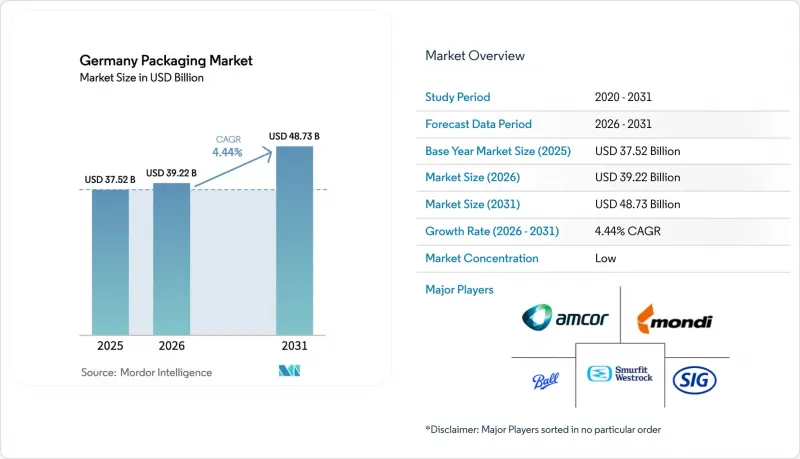
根據 Mordor Intelligence 預測,德國包裝市場規模將從 2026 年的 392.2 億美元成長到 2031 年的 487.3 億美元,2026 年至 2031 年的複合年成長率為 4.44%。
本報告按材料類型(紙和紙板、塑膠、其他)、產品類型(紙和紙板製品、塑膠製品、其他)、包裝類型(硬質、軟質)、最終用戶(食品、飲料、醫藥和醫療保健、個人護理和化妝品、工業和化學品、其他)以及地區(歐洲、其他)進行細分。市場預測以美元計價。
德國包裝市場的趨勢與洞察
英國脫歐後藥品冷鏈的擴張
歐洲生物製藥運輸曾經集中在英國,如今擴大經由法蘭克福和漢堡,這推動了對溫控二級包裝和預認證托盤運輸容器的需求。擁有ISO 15378初級包裝認證的德國加工商正與疫苗生產商簽訂多年供應契約,而格勒斯海默公司投資20億歐元(約22.6億美元)擴大其氣密泡殼包裝產能,使其能夠獲得高價值訂單。肖特製藥公司於2024年推出的帶有整合針頭保護裝置的聚合物注射器,進一步顯示了自動化填充和包裝環境中對耐損傷包裝的需求正在成長。
監理機關應促進押金退還制度的推廣。
2025年,德國擴大了押金回收計畫的適用範圍,將牛奶和果汁紙盒納入其中,預計僅第一年就將為逆向物流通路增加約6億個紙盒。加工商迅速重新設計聚對苯二甲酸乙二醇酯(PET)瓶,以提高光學分類效率。同時,機械供應商克朗斯和阿爾普拉也吹塑成型線進行了改造,以符合關於繫繩瓶蓋的法規。歐盟的《包裝和包裝廢棄物法規》採用了德國90%的回收率標準,這將使德國國內生產商在2026年至2031年期間的法規遵從方面領先,從而減少為應對不可預見的情況而進行的資本投資。
高速自動化領域熟練勞動力短缺
由於勞動力老化和職業培訓供不應求,許多加工企業難以找到具備操作多通道袋裝灌裝機和旋轉吹塑成型機所需機電一體化和PLC程式設計技能的負責人。儘管企業正在實施操作員輔助介面和遠距離診斷模組以部分彌補勞動力短缺,但這些解決方案無法完全取代經驗豐富的技術人員。因此,現有設備的預期速度提升計畫進展緩慢,短期內提高加工能力的計畫也受到阻礙。
細分市場分析
到2025年,紙和紙板在德國包裝市場佔比將達到37.91%,這主要得益於電子商務運輸對瓦楞紙板的需求。然而,生物分解性塑膠正以4.83%的複合年成長率快速成長,預計到2030年,歐洲生質塑膠產能將加倍,達到469萬噸,其中德國將佔據最大佔有率。德國聯邦食品和農業部的津貼正在加速生物基聚合物的研發,鼓勵加工商改造其擠出生產線,以加工聚乳酸(PLA)和聚丁二酸丁二醇酯(PBS)共混物。
加工商將生物樹脂視為對沖化石基聚合物價格波動和即將強制使用再生材料的措施。斯道拉恩索對其位於馬克紹的工廠維修(耗資1.2億歐元,約合1.356億美元),新增了特種阻隔紙板,用於替代乾貨和冷凍食品應用中的聚對苯二甲酸乙二醇酯(PET)複合材料。金屬包裝(主要是鋁罐)受益於高達98%的回收率,而玻璃容器則在製藥業佔據獨特的地位,因為該行業更注重惰性而非重量。
預計到2025年,瓦楞紙箱的市佔率將達到23.88%,而軟包裝袋的複合年成長率預計將達到5.21%,這主要得益於消費者對可重複密封和輕包裝的偏好。 Mondi公司於2024年推出的蒸餾蒸煮軟包裝袋,在保持保存期限的同時,與鋼罐相比可減少70%的材料用量,展現出其作為常溫食品包裝的潛在替代方案。折疊紙盒在非處方藥和化妝品市場仍得到應用,但隨著品牌嘗試使用數位印刷技術進行季節性設計,其訂單量正在下降。
在硬質塑膠領域,瓶子需求保持穩定,但瓶蓋製造商正轉向採用繫繩式設計,以符合歐盟關於防止亂丟垃圾的法規。金屬氣霧劑容器仍然是工業潤滑劑的必需品,而當地飲料罐製造商正在增加套標印刷功能,以服務小批量精釀飲料。柯尼希鮑爾的數位印刷機(預計2024年包裝器材銷售額為12.7億歐元,約合14.4億美元)支援快速更換設計稿,以滿足細分市場行銷宣傳活動。
其他好處:
- Excel格式的市場預測(ME)表
- 3個月的分析師支持
目錄
第1章:引言
- 研究假設和市場定義
- 調查範圍
第2章:調查方法
第3章執行摘要
第4章 市場狀況
- 市場概覽
- 市場促進因素
- 永續性驅動的材料轉型
- 電子商務交易量激增。
- 智慧活性包裝簡介
- 人工智慧驅動的大規模客製化
- 為回應德國的強制性再利用政策,開發物流系統。
- 將傳統生產線維修為工業5.0
- 市場限制因素
- 塑膠和聚丙烯纖維的嚴格合規成本
- 樹脂和能源價格波動
- 食品級認證PCR聚烯供不應求
- 人們對可重複使用包裝的認知與行動之間存在差距
- 產業價值鏈分析
- 監理情勢
- 波特五力分析
第5章 市場規模與成長預測
- 材料類型
- 紙張和紙板
- 塑膠
- 聚乙烯聚丙烯(PP)
- 高密度聚苯乙烯(HDPE)和低密度聚乙烯(LDPE)
- 聚對苯二甲酸乙二醇酯(PET)
- 聚氯乙烯(PVC)
- 聚苯乙烯(PS)
- 其他塑膠
- 金屬
- 容器用玻璃器皿
- 依產品類型
- 紙和紙板產品類型
- 折疊式紙盒和硬紙盒
- 瓦楞紙箱和容器
- 免洗紙製品
- 其他紙和紙板產品類型
- 塑膠製品類型
- 硬質塑膠
- 瓶子和罐子
- 蓋子和封口
- 散裝產品
- 其他類型的硬質塑膠膠製品
- 軟質塑膠
- 小袋
- 包包
- 薄膜和包裝
- 其他類型的柔軟性塑膠製品
- 硬質塑膠
- 金屬製品類型
- 坎
- 蓋子和閉合部件
- 氣霧劑容器
- 其他金屬製品類型
- 玻璃容器的產品類型
- 瓶子
- 瓶子
- 紙和紙板產品類型
- 按包裝類型
- 硬質包裝形式
- 軟包裝
- 最終用戶
- 食物
- 飲料
- 藥品和醫療保健
- 個人護理化妝品
- 工業和化學
- 農業
- 車
- 其他最終用戶
第6章 競爭情勢
- 市場集中度
- 策略趨勢
- 市佔率分析
- 公司簡介
- Amcor plc
- Mondi plc
- Ball Corporation
- Ardagh Group SA
- Crown Holdings Inc.
- OI Glass Germany GmbH
- Smurfit WestRock plc
- Stora Enso Oyj
- Constantia Flexibles GmbH
- SIG Combibloc Group
- Gerresheimer AG
- Schutz GmbH & Co. KGaA
- Klockner Pentaplast GmbH
- Heidelberger Druck-maschinen AG
- Mayr-Melnhof Gruppe
- ALPLA Werke Alwin Lehner GmbH & Co KG
- Sealed Air Corp.
- Greif Germany GmbH
第7章 市場機會與未來展望
According to Mordor Intelligence, the Germany packaging market size is expected to increase from USD 39.22 billion in 2026 to USD 48.73 billion by 2031, growing at a 4.44% CAGR over 2026-2031.
This report is Segmented by Material Type (Paper and Paperboard, Plastic, and More), Product Type (Paper and Paperboard Products, Plastic Products, and More), Packaging Format (Rigid, and Flexible), End-User (Food, Beverage, Pharmaceutical and Medical, Personal Care and Cosmetics, Industrial and Chemical, and More), and Geography (Europe, and More). The Market Forecasts are Provided in Terms of Value (USD).
Germany Packaging Market Trends and Insights
Pharmaceutical Cold-Chain Expansion Post-Brexit
European biologics traffic that once consolidated in the United Kingdom is increasingly staged through Frankfurt and Hamburg, lifting demand for temperature-controlled secondary packaging and pre-qualified pallet shippers. German converters that hold ISO 15378 certification for primary containers have secured multi-year supply agreements with vaccine producers, and Gerresheimer's investment in hermetic blister capacity (EUR 2 billion, USD 2.26 billion) positions the company to capture higher value orders. Polymer syringes with integrated needle shields introduced by SCHOTT Pharma in 2024 further illustrate the migration toward break-resistant formats in automated fill-finish environments.
Regulatory Push for Deposit Return System Expansion
In 2025, Germany extended its deposit scheme to milk and juice cartons, adding an estimated 600 million additional units to reverse-logistics channels within the first year. Converters swiftly re-engineered bottles in polyethylene terephthalate to improve optical sorting efficiency, while machinery suppliers Krones and ALPLA retrofitted blow-molding lines for tethered-cap compliance. Because the EU Packaging and Packaging Waste Regulation mirrors Germany's 90% collection benchmark, domestic producers enter the 2026-2031 horizon with a compliance head start, translating into lower contingency capital expenditure.
Skilled Labor Shortfall in High-Speed Automation
An aging workforce and tight vocational-training pipeline leave many converters struggling to staff mechatronics and PLC programming roles needed to operate multi-lane pouch fillers and rotary blow molders. Companies are installing operator-assist interfaces and remote-diagnostics modules to partially offset the talent gap, but these solutions cannot fully replace experienced technicians. As a result, planned speed increases on existing assets are slipping, curbing near-term throughput gains.
Other drivers and restraints analyzed in the detailed report include:
- Luxury Goods Export Growth Fueling Premium Packaging
- 3D Printing of Packaging Tooling Reducing Lead Times
- Capital Expenditure Freeze Amid Interest Rate Volatility
For complete list of drivers and restraints, kindly check the Table Of Contents.
Segment Analysis
Paper and paperboard commanded 37.91% of the Germany packaging market size in 2025 due to corrugated demand from e-commerce shipments. Nevertheless, biodegradable plastics are expanding at a 4.83% CAGR and are on track to double European bioplastic capacity to 4.69 million tons by 2030, with Germany contributing the largest share. Federal grants from the Ministry of Food and Agriculture accelerate R&D in bio-based polymers, encouraging converters to retrofit extrusion lines to run polylactic acid and polybutylene succinate blends.
Converters view bio-resins as a hedge against volatility in fossil-based polymers and looming recycled-content mandates. Stora Enso's Maxau mill upgrade (EUR 120 million, USD 135.6 million) adds specialty barrier paperboard that enables dry food and frozen applications to displace polyethylene terephthalate laminates. Metal packaging, led by aluminum cans, benefits from the 98% return infrastructure, while container glass retains niche positions in pharmaceuticals where inertness outweighs weight penalties.
Corrugated boxes held 23.88% share in 2025, yet pouches are forecast to expand at a 5.21% CAGR, leveraging consumer preference for resealable, lightweight formats. Mondi's retortable pouch, commercialized in 2024, cut material use by 70% compared with steel cans while preserving shelf life, illustrating the substitution pathway for shelf-stable meals. Folding cartons continue to serve OTC pharmaceuticals and cosmetics, but order sizes are shortening as brands test seasonal graphics via digital print.
Within rigid plastics, bottle demand is stable, though closure makers are moving toward tethered designs to meet EU litter-prevention rules. Metal aerosol containers remain critical for industrial lubricants, and local beverage canners have added sleeving capability for small-batch craft drinks. Koenig and Bauer's digital presses (EUR 1.27 billion, USD 1.44 billion in packaging machinery revenue, 2024) support rapid artwork swaps that align with micro-segmented marketing campaigns.
Complete Report Scope:
- By Material Type
- Paper and Paperboard
- Plastic
- Polyethylene Polypropylene (PP)
- High-density Polyethylene (HDPE) and Low-density Polyethylene (LDPE)
- Polyethylene Terephthalate (PET)
- Polyvinyl Chloride (PVC)
- Polystyrene (PS)
- Other Plastics
- Metal
- Container Glass
- By Product Type
- Paper and Paperboard Product Type
- Folding Carton and Rigid Boxes
- Corrugated Boxes and Containers
- Single-use Paper Products
- Other Paper and Paperboard Product Types
- Plastic Product Type
- Rigid Plastics
- Bottles and Jars
- Caps and Closures
- Bulk-Grade Products
- Other Rigid Plastics Product Types
- Flexible Plastics
- Pouches
- Bags
- Films and Wraps
- Other Flexible Plastics Product Types
- Rigid Plastics
- Metal Product Type
- Cans
- Caps and Closures
- Aerosol Containers
- Other Metal Product Types
- Container Glass Product Type
- Bottles
- Jars
- Paper and Paperboard Product Type
- By Packaging Format
- Rigid Packaging Format
- Flexible Packaging Format
- By End-user
- Food
- Beverage
- Pharmaceutical and Medical
- Personal Care and Cosmetics
- Industrial and Chemical
- Agriculture
- Automotive
- Other End-users
List of Companies Covered in this Report:
- Amcor plc
- Mondi plc
- Ball Corporation
- Ardagh Group S.A.
- Crown Holdings Inc.
- O-I Glass Germany GmbH
- Smurfit WestRock plc
- Stora Enso Oyj
- Constantia Flexibles GmbH
- SIG Combibloc Group
- Gerresheimer AG
- Schutz GmbH & Co. KGaA
- Klockner Pentaplast GmbH
- Heidelberger Druck-maschinen AG
- Mayr-Melnhof Gruppe
- ALPLA Werke Alwin Lehner GmbH & Co KG
- Sealed Air Corp.
- Greif Germany GmbH
Additional Benefits:
- The market estimate (ME) sheet in Excel format
- 3 months of analyst support
TABLE OF CONTENTS
1 INTRODUCTION
- 1.1 Study Assumptions and Market Definition
- 1.2 Scope of the Study
2 RESEARCH METHODOLOGY
3 EXECUTIVE SUMMARY
4 MARKET LANDSCAPE
- 4.1 Market Overview
- 4.2 Market Drivers
- 4.2.1 Sustainability-Driven Material Shift
- 4.2.2 E-Commerce Volume Surge
- 4.2.3 Smart and Active Packaging Adoption
- 4.2.4 AI-Enabled Mass-Customization
- 4.2.5 Germany's Reusable Mandate Logistics Build-Out
- 4.2.6 Industry-5.0 Retrofit of Legacy Lines
- 4.3 Market Restraints
- 4.3.1 Stringent Plastics and PPWR Compliance Cost
- 4.3.2 Volatile Resin and Energy Prices
- 4.3.3 Shortage of Authorized Food-Grade PCR Polyolefins
- 4.3.4 Reusable Packaging Attitude-Behaviour Gap
- 4.4 Industry Value Chain Analysis
- 4.5 Regulatory Landscape
- 4.6 Porter's Five Forces Analysis
- 4.6.1 Threat of New Entrants
- 4.6.2 Bargaining Power of Buyers
- 4.6.3 Bargaining Power of Suppliers
- 4.6.4 Threat of Substitutes
- 4.6.5 Competitive Rivalry
5 MARKET SIZE AND GROWTH FORECASTS (VALUE)
- 5.1 By Material Type
- 5.1.1 Paper and Paperboard
- 5.1.2 Plastic
- 5.1.2.1 Polyethylene Polypropylene (PP)
- 5.1.2.2 High-density Polyethylene (HDPE) and Low-density Polyethylene (LDPE)
- 5.1.2.3 Polyethylene Terephthalate (PET)
- 5.1.2.4 Polyvinyl Chloride (PVC)
- 5.1.2.5 Polystyrene (PS)
- 5.1.2.6 Other Plastics
- 5.1.3 Metal
- 5.1.4 Container Glass
- 5.2 By Product Type
- 5.2.1 Paper and Paperboard Product Type
- 5.2.1.1 Folding Carton and Rigid Boxes
- 5.2.1.2 Corrugated Boxes and Containers
- 5.2.1.3 Single-use Paper Products
- 5.2.1.4 Other Paper and Paperboard Product Types
- 5.2.2 Plastic Product Type
- 5.2.2.1 Rigid Plastics
- 5.2.2.1.1 Bottles and Jars
- 5.2.2.1.2 Caps and Closures
- 5.2.2.1.3 Bulk-Grade Products
- 5.2.2.1.4 Other Rigid Plastics Product Types
- 5.2.2.2 Flexible Plastics
- 5.2.2.2.1 Pouches
- 5.2.2.2.2 Bags
- 5.2.2.2.3 Films and Wraps
- 5.2.2.2.4 Other Flexible Plastics Product Types
- 5.2.2.1 Rigid Plastics
- 5.2.3 Metal Product Type
- 5.2.3.1 Cans
- 5.2.3.2 Caps and Closures
- 5.2.3.3 Aerosol Containers
- 5.2.3.4 Other Metal Product Types
- 5.2.4 Container Glass Product Type
- 5.2.4.1 Bottles
- 5.2.4.2 Jars
- 5.2.1 Paper and Paperboard Product Type
- 5.3 By Packaging Format
- 5.3.1 Rigid Packaging Format
- 5.3.2 Flexible Packaging Format
- 5.4 By End-user
- 5.4.1 Food
- 5.4.2 Beverage
- 5.4.3 Pharmaceutical and Medical
- 5.4.4 Personal Care and Cosmetics
- 5.4.5 Industrial and Chemical
- 5.4.6 Agriculture
- 5.4.7 Automotive
- 5.4.8 Other End-users
6 COMPETITIVE LANDSCAPE
- 6.1 Market Concentration
- 6.2 Strategic Moves
- 6.3 Market Share Analysis
- 6.4 Company Profiles (includes Global level Overview, Market level overview, Core Segments, Financials as available, Strategic Information, Market Rank/Share for key companies, Products and Services, and Recent Developments)
- 6.4.1 Amcor plc
- 6.4.2 Mondi plc
- 6.4.3 Ball Corporation
- 6.4.4 Ardagh Group S.A.
- 6.4.5 Crown Holdings Inc.
- 6.4.6 O-I Glass Germany GmbH
- 6.4.7 Smurfit WestRock plc
- 6.4.8 Stora Enso Oyj
- 6.4.9 Constantia Flexibles GmbH
- 6.4.10 SIG Combibloc Group
- 6.4.11 Gerresheimer AG
- 6.4.12 Schutz GmbH & Co. KGaA
- 6.4.13 Klockner Pentaplast GmbH
- 6.4.14 Heidelberger Druck-maschinen AG
- 6.4.15 Mayr-Melnhof Gruppe
- 6.4.16 ALPLA Werke Alwin Lehner GmbH & Co KG
- 6.4.17 Sealed Air Corp.
- 6.4.18 Greif Germany GmbH
7 MARKET OPPORTUNITIES AND FUTURE OUTLOOK
- 7.1 White-space and Unmet-Need Assessment

 西班牙包裝產業:市場佔有率分析、產業趨勢與統計、成長預測(2026-2031)包裝泵和分配器:市場佔有率分析、行業趨勢和統計數據、成長預測(2026-2031 年)非洲包裝市場:市場佔有率分析、產業趨勢與統計及成長預測(2026-2031 年)
 微波爐適用包裝市場分析及至2035年預測:類型、技術、應用、形狀、材料類型、製程、最終用戶、功能、設備
 2034年纖維基阻隔性包裝市場預測-全球分析(依纖維材料、阻隔塗層、包裝形式、阻隔技術、最終用戶和地區分類)法國包裝:市場佔有率分析、產業趨勢與統計、成長預測(2026-2031)中國包裝市場:市場佔有率分析、產業趨勢與統計、成長預測(2026-2031)義大利包裝產業:市場佔有率分析、產業趨勢與統計及成長預測(2026-2031 年)英國包裝業:市場佔有率分析、產業趨勢與統計、成長預測(2026-2031)高視覺性包裝解決方案:市場佔有率分析、產業趨勢與統計、成長預測(2026-2031 年)