


 |
市場調查報告書
商品編碼
2123043
法國包裝:市場佔有率分析、產業趨勢與統計、成長預測(2026-2031)France Packaging - Market Share Analysis, Industry Trends & Statistics, Growth Forecasts (2026 - 2031) |
||||||

※ 本網頁內容可能與最新版本有所差異。詳細情況請與我們聯繫。
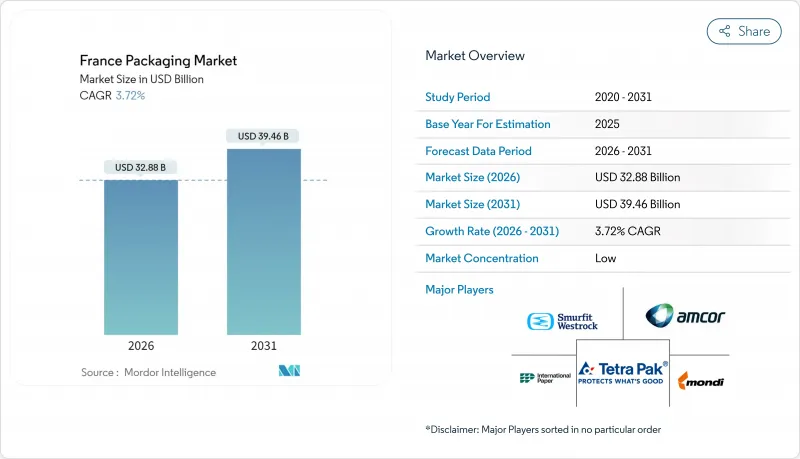
根據 Mordor Intelligence 預測,法國包裝市場規模預計將在 2026 年達到 328.8 億美元,到 2031 年達到 394.6 億美元,預測期內複合年成長率為 3.72%。
本報告按材料(紙/紙板、塑膠、金屬、玻璃容器)、包裝類型(軟包裝、硬包裝)、產品類型(紙/紙板製品、塑膠製品、金屬製品、玻璃容器)和最終用戶(食品、飲料、醫藥/醫療、汽車及其他)進行分類。市場預測以美元計價。
法國包裝市場的趨勢與洞察
對永續和可回收包裝的需求日益成長
乳製品、個人護理和飲料行業的品牌所有者正優先使用再生材料和生物基聚合物,以避免因不可回收包裝而產生的額外費用。家樂福覆蓋345家門市的Loop網路計畫到2030年減少1.5萬噸原生塑膠的使用,這迫使加工商設計能夠承受20至50次循環填充且不影響阻隔性能的容器。隨著聚乳酸(PLA)產能的提升,全球生質塑膠產量預計將從2024年的247萬噸增加至2029年的573萬噸,其中45%預計將用於包裝。由於成本較高且耐熱性較差,PLA僅限於冷填充和常溫產品,而聚對苯二甲酸乙二醇酯(PET)和聚丙烯(PP)仍用於高溫填充生產線。歐盟對再生材料含量的法規日益嚴格,迫使即使是小規模加工商也轉向單一材料結構。因此,儘早獲得生物基樹脂的供應合約將確保法國包裝市場的戰略穩定。
電子商務和小包裹物流的成長
到2025年,電子商務將佔法國零售總額的13%,產生超過10億個小包裹,這些包裹需要瓦楞紙板外箱、緩衝材料和防篡改膠帶。每批貨物的運輸都需要額外的處理工序,導致每筆交易的包裝用量比實體店高出60%。牛皮紙襯裡工廠的電力成本仍約為2021年之前的兩倍,達到每兆瓦時150至180歐元,這進一步推高了瓦楞紙箱的成本。像Smurfit WestRock這樣的綜合製造商正在利用自身的再生纖維循環來緩解價格波動的影響。小包裹承運商現在指定使用更輕的瓦楞紙箱,這促使加工商採用微型瓦楞和高性能黏合劑,即使在較低的紙張重量也能保持層壓強度。
嚴格禁止使用一次性塑膠製品和徵收生產者責任延伸費
法國的AGEC法規禁止使用聚苯乙烯托盤、一次性刀叉餐具和彩色聚對苯二甲酸乙二醇酯(PET)瓶。同時,歐盟的《包裝和包裝廢棄物法規》規定了最低再生材料含量標準和統一的生產者責任延伸(EPR)費用。生態調節罰款會對不可回收的產品形式徵收高達30%的額外費用,從而壓縮了為生鮮食品和休閒食品品牌供應產品的加工商的利潤率。由於飲料製造商為了避免玻璃瓶的額外費用而減輕瓶子重量並改用鋁罐,Bellaria公司2024年第三季的銷售額自然下降了6.8%。缺乏研發預算的中小型企業難以快速改進黏合劑和塗料,這加速了產業的整合。合規相關的支出正在擠壓成長資本,減緩了法國包裝市場對新生產線的投資。
細分市場分析
到2025年,塑膠仍將佔據法國包裝市場52.54%的佔有率。這主要歸功於聚乙烯、聚丙烯和PET容器在乳製品、醬料和個人保健產品等不同SKU中的廣泛應用。同時,紙張和紙板預計將超越其他所有材料,到2031年將維持4.32%的年複合成長率(CAGR)。這主要得益於用於電商的瓦楞紙箱、可折疊紙盒和模塑紙漿托盤等環保產品帶來的折扣優惠。玻璃容器在葡萄酒和高階飲料市場仍然佔據主導地位,但由於瓶身重量減輕,其需求有所下降。金屬罐則繼續用於需要密封或蒸餾滅菌的品類,傳遞出「無限循環利用」的訊息。
由於纖維短缺和能源成本上漲,牛皮紙襯紙生產的成本可預測性仍面臨挑戰。然而,整合了造紙廠和加工商的企業可以透過其內部回收循環來抵消原料價格的波動。 PET 因其透明度和易於獲得食品接觸認證而在飲料包裝市場佔據主導地位,其單一材料熱成型產品現在有資格享受更高的 EPR 折扣。高密度聚苯乙烯(HDPE) 和低密度聚乙烯 (LDPE) 仍然佔據清潔劑市場的重要佔有率,也用於薄膜生產。另一方面,聚丙烯 (PP) 在瓶蓋和微波爐適用容器領域表現出色。相較之下,由於 AGEC 法規和消費者負面認知的風險,聚氯乙烯(PVC) 和聚苯乙烯的需求正在下降。
預計到2025年,軟包裝將佔據法國包裝市場56.86%的佔有率,並將在2031年之前以4.75%的複合年成長率成長。這一成長主要得益於立式袋、多層薄膜和電商配送袋的普及,與硬質包裝相比,這些包裝可節省高達50%的材料。儘管重量較重,但對於碳酸飲料、藥品和高階化妝品等需要具備抗跌落和抗衝擊性能的產品而言,硬質包裝仍然不可或缺。目前,柔軟性基材採用阻隔性聚乙烯或聚丙烯共混物,這些材料已通過新的可回收性測試,使加工商能夠避免因生產者延伸責任制(EPR)而受到處罰。
數位浮水印技術的測試已達到88-94%的檢測準確率,為大規模軟性單料分類鋪平了道路。家樂福的「循環」系統正擴大採用硬質瓶和填充用填充袋的組合,從而減少了高達70%的原生塑膠淨用量。電商企業對氣泡郵袋和氣枕的需求不斷成長,這些產品能夠有效降低體積重量,這對擁有在線擠出和製袋能力的加工商來說極具優勢。雖然硬質玻璃和金屬在對口味敏感的行業和監管嚴格的細分市場中仍佔有一席之地,但軟性複合材料的相對成本優勢正確保其市場佔有率的持續成長。
其他好處:
- Excel格式的市場預測(ME)表
- 3個月的分析師支持
目錄
第1章:引言
- 研究假設和市場定義
- 調查範圍
第2章:調查方法
第3章執行摘要
第4章 市場狀況
- 市場概覽
- 市場促進因素
- 對永續和可回收包裝材料的需求日益成長
- 電子商務和小包裹物流的成長
- 強大的食品飲料生產基地
- 政府主導的智慧包裝研發經費投入;
- 擴大散裝零售店和補充計量銷售零售店
- 引入數位浮水印以實現更先進的回收利用
- 市場限制因素
- 嚴格禁止使用一次性塑膠製品和徵收生產者責任延伸費
- 原物料和能源價格波動
- 再生材料(rPET、rHDPE)供應瓶頸
- 包裝工程領域人員短缺
- 宏觀經濟因素對市場的影響
- 產業價值鏈分析
- 監理情勢
- 技術展望
- 波特五力分析
- 投資分析
第5章 市場規模與成長預測
- 材料類型
- 紙張和紙板
- 塑膠
- 聚乙烯聚丙烯(PP)
- 高密度聚苯乙烯(HDPE)和低密度聚乙烯(LDPE)
- 聚對苯二甲酸乙二醇酯(PET)
- 聚氯乙烯(PVC)
- 聚苯乙烯(PS)
- 其他塑膠
- 金屬
- 容器用玻璃器皿
- 依產品類型
- 紙和紙板產品類型
- 折疊式紙盒和硬紙盒
- 瓦楞紙箱和容器
- 免洗紙製品
- 其他紙和紙板產品類型
- 塑膠製品類型
- 硬質塑膠
- 瓶子和罐子
- 蓋子和封口
- 散裝產品
- 其他類型的硬質塑膠膠製品
- 軟質塑膠
- 小袋
- 包包
- 薄膜和包裝
- 其他類型的柔軟性塑膠製品
- 硬質塑膠
- 金屬製品類型
- 坎
- 氣霧劑容器
- 蓋子和密封部件
- 其他金屬製品類型
- 玻璃容器的產品類型
- 瓶子
- 瓶子
- 紙和紙板產品類型
- 按包裝類型
- 硬質包裝形式
- 軟包裝
- 最終用戶
- 食物
- 飲料
- 藥品和醫療保健
- 個人護理化妝品
- 工業和化學
- 農業
- 車
- 其他最終用戶
第6章 競爭情勢
- 市場集中度
- 策略趨勢
- 市佔率分析
- 公司簡介
- Amcor plc
- Smurfit WestRock
- Tetra Pak International SA
- Ball Corporation
- Mondi plc
- Crown Holdings Inc.
- Owens-Illinois Inc.
- Ardagh Group SA
- Constantia Flexibles GmbH
- Verallia SA
- Groupe Guillin SA
- Albea Services SAS
- Sealed Air Corporation
- Huhtamaki Oyj
- ALPLA Werke Alwin Lehner GmbH
- Plastipak Holdings Inc.
- Sleever International
- AR Packaging(Graphic Packaging Intl.)
- Ahlstrom-Munksjo Oyj
- International Paper Company
第7章 市場機會與未來展望
According to Mordor Intelligence, the France packaging market size is USD 32.88 billion in 2026 and it is projected to reach USD 39.46 billion by 2031, reflecting a 3.72% CAGR during the forecast period.
This report is Segmented by Material Type (Paper and Paperboard, Plastic, Metal, and Container Glass), Packaging Format (Flexible, and Rigid), Product Type (Paper and Paperboard Product Type, Plastic Product Type, Metal Product Type, and Container Glass Product Type), End-User (Food, Beverage, Pharmaceuticals and Medical, Automotive, and More). The Market Forecasts are Provided in Terms of Value (USD).
France Packaging Market Trends and Insights
Rising Demand For Sustainable And Recyclable Packaging
Brand owners across dairy, personal care, and beverage categories are prioritizing recycled content and bio-based polymers to avoid surcharges on non-recyclable formats. Carrefour's Loop network, active in 345 stores, targets removal of 15,000 tonnes of virgin plastic by 2030, pushing converters to design containers that tolerate 20-50 refill cycles without barrier loss. Polylactic acid capacity is projected to help lift global bioplastics output from 2.47 million tonnes in 2024 to 5.73 million tonnes in 2029, with 45% earmarked for packaging. Cost premiums and modest heat resistance confine polylactic acid to cold-fill and ambient goods, so hot-fill lines still rely on polyethylene terephthalate and polypropylene. EU recycled-content mandates tighten each review period, forcing even small converters to switch to mono-material structures. Early supply deals for bio-based resin therefore deliver strategic security in the France packaging market.
Growth of E-Commerce And Parcel Logistics
E-commerce accounted for 13% of French retail sales in 2025, generating more than 1 billion parcels that require corrugated outers, void fill, and tamper-evident tape. Each shipment endures extra handling, so packaging intensity per transaction exceeds in-store requirements by up to 60%. Kraft-liner mills still pay EUR 150-180 per megawatt-hour for power, about double the pre-2021 norm, lifting box costs. Integrated producers such as Smurfit WestRock leverage captive recycled-fiber loops to buffer volatility. Parcel carriers now specify lighter boxes, prompting converters to adopt micro-flute and high-performance adhesives that retain stacking strength at lower basis weight.
Stringent Single-Use Plastic Bans And EPR Fees
France's AGEC law prohibits polystyrene trays, single-use cutlery, and colored polyethylene terephthalate bottles, while the EU Packaging and Packaging Waste Regulation enforces minimum recycled-content thresholds and harmonized EPR fees. Eco-modulation penalties add up to 30% on non-recyclable formats, shrinking margins for converters that serve fresh produce and snack brands. Verallia saw Q3 2024 revenue fall 6.8% organically as beverage customers lightweighted bottles or shifted to aluminum cans to avoid glass surcharges. SMEs without R&D budgets struggle to reformulate adhesives and coatings quickly, fueling consolidation. Compliance spending crowds out growth capital, delaying new-line investments across the France packaging market.
Other drivers and restraints analyzed in the detailed report include:
- Robust Food And Beverage Production Base
- Government-Led Funding For Smart Packaging R&D
- Volatile Raw-Material And Energy Prices
For complete list of drivers and restraints, kindly check the Table Of Contents.
Segment Analysis
Plastic maintained a 52.54% share of the France packaging market in 2025, owing to versatile polyethylene, polypropylene, and PET containers across dairy, sauces, and personal-care SKUs. Paper and paperboard, however, are set to outpace all materials with a 4.32% CAGR through 2031 as e-commerce corrugated boxes, folding cartons, and molded-pulp trays unlock eco-modulation discounts. Container glass remains entrenched in the wine and premium beverage markets, but the lightweighting of bottles reduces tonnage demand. Metal cans continue to serve hermetic or retort categories, offering infinite recyclability messaging.
Cost visibility in kraft liner production remains challenging due to fiber scarcity and elevated energy tariffs; however, integrated mill-converter players can offset input swings through captive recyclate loops. PET dominates beverage packaging due to its clarity and ready food-contact approvals, and its mono-material thermoforms now qualify for higher EPR discounts. High-density polyethylene and low-density polyethylene retain a significant share of the detergent market and are used to produce films, while polypropylene excels in closures and microwaveable containers. In contrast, PVC and polystyrene experience demand declines under AGEC restrictions and risks to consumer perception.
Flexible formats captured 56.86% of the France packaging market in 2025 and are projected to grow at a 4.75% CAGR through 2031, driven by stand-up pouches, multi-layer films, and e-commerce mailers that achieve up to 50% material savings compared to their rigid counterparts. Rigid solutions, although heavier, remain indispensable for carbonated beverages, pharmaceuticals, and premium cosmetics that need drop resistance and shelf impact. Lightweighting in flexible substrates now leverages high-barrier polyethylene or polypropylene blends that pass new recyclability tests, enabling converters to avoid EPR penalties.
Digital watermarking trials achieved 88-94% detection accuracy, paving the way for flexible mono-material sortation at scale. Rigid bottles are increasingly paired with refill pouches in Carrefour's Loop, reducing net virgin plastic use by up to 70%. E-commerce brands demand bubble mailers and air pillows that trim dimensional weight, which favors converters with in-line extrusion and pouch-forming capabilities. While rigid glass and metal keep a share in flavor-critical or regulatory niches, the relative cost advantage of flexible laminates secures their expansion.
Complete Report Scope:
- By Material Type
- Paper and Paperboard
- Plastic
- Polyethylene Polypropylene (PP)
- High-density Polyethylene (HDPE) and Low-density Polyethylene (LDPE)
- Polyethylene Terephthalate (PET)
- Polyvinyl Chloride (PVC)
- Polystyrene (PS)
- Other Plastics
- Metal
- Container Glass
- By Product Type
- Paper and Paperboard Product Type
- Folding Carton and Rigid Boxes
- Corrugated Boxes and Containers
- Single-use Paper Products
- Other Paper and Paperboard Product Types
- Plastic Product Type
- Rigid Plastics
- Bottles and Jars
- Caps and Closures
- Bulk-Grade Products
- Other Rigid Plastics Product Types
- Flexible Plastics
- Pouches
- Bags
- Films and Wraps
- Other Flexible Plastics Product Types
- Rigid Plastics
- Metal Product Type
- Cans
- Aerosol Containers
- Caps and Closures
- Other Metal Product Types
- Container Glass Product Type
- Bottles
- Jars
- Paper and Paperboard Product Type
- By Packaging Format
- Rigid Packaging Format
- Flexible Packaging Format
- By End-user
- Food
- Beverage
- Pharmaceuticals and Medical
- Personal Care and Cosmetics
- Industrial and Chemical
- Agriculture
- Automotive
- Other End-users
List of Companies Covered in this Report:
- Amcor plc
- Smurfit WestRock
- Tetra Pak International SA
- Ball Corporation
- Mondi plc
- Crown Holdings Inc.
- Owens-Illinois Inc.
- Ardagh Group S.A.
- Constantia Flexibles GmbH
- Verallia SA
- Groupe Guillin SA
- Albea Services SAS
- Sealed Air Corporation
- Huhtamaki Oyj
- ALPLA Werke Alwin Lehner GmbH
- Plastipak Holdings Inc.
- Sleever International
- AR Packaging (Graphic Packaging Intl.)
- Ahlstrom-Munksjo Oyj
- International Paper Company
Additional Benefits:
- The market estimate (ME) sheet in Excel format
- 3 months of analyst support
TABLE OF CONTENTS
1 INTRODUCTION
- 1.1 Study Assumptions and Market Definition
- 1.2 Scope of the Study
2 RESEARCH METHODOLOGY
3 EXECUTIVE SUMMARY
4 MARKET LANDSCAPE
- 4.1 Market Overview
- 4.2 Market Drivers
- 4.2.1 Rising Demand for Sustainable and Recyclable Packaging
- 4.2.2 Growth of E-commerce and Parcel Logistics
- 4.2.3 Robust Food and Beverage Production Base
- 4.2.4 Government-Led Funding for Smart Packaging R&D
- 4.2.5 Expansion of Refill and Bulk Retail Stations
- 4.2.6 Digital Watermarking Roll-out for Advanced Recycling
- 4.3 Market Restraints
- 4.3.1 Stringent Single-Use Plastic Bans and EPR Fees
- 4.3.2 Volatile Raw-Material and Energy Prices
- 4.3.3 Recycling Feedstock Bottlenecks (rPET, rHDPE)
- 4.3.4 Packaging-Engineering Talent Shortage
- 4.4 Impact of Macroeconomic Factors on the Market
- 4.5 Industry Value Chain Analysis
- 4.6 Regulatory Landscape
- 4.7 Technological Outlook
- 4.8 Porter's Five Forces Analysis
- 4.8.1 Bargaining Power of Suppliers
- 4.8.2 Bargaining Power of Buyers
- 4.8.3 Threat of New Entrants
- 4.8.4 Threat of Substitutes
- 4.8.5 Intensity of Competitive Rivalry
- 4.9 Investment Analysis
5 MARKET SIZE AND GROWTH FORECASTS (VALUE)
- 5.1 By Material Type
- 5.1.1 Paper and Paperboard
- 5.1.2 Plastic
- 5.1.2.1 Polyethylene Polypropylene (PP)
- 5.1.2.2 High-density Polyethylene (HDPE) and Low-density Polyethylene (LDPE)
- 5.1.2.3 Polyethylene Terephthalate (PET)
- 5.1.2.4 Polyvinyl Chloride (PVC)
- 5.1.2.5 Polystyrene (PS)
- 5.1.2.6 Other Plastics
- 5.1.3 Metal
- 5.1.4 Container Glass
- 5.2 By Product Type
- 5.2.1 Paper and Paperboard Product Type
- 5.2.1.1 Folding Carton and Rigid Boxes
- 5.2.1.2 Corrugated Boxes and Containers
- 5.2.1.3 Single-use Paper Products
- 5.2.1.4 Other Paper and Paperboard Product Types
- 5.2.2 Plastic Product Type
- 5.2.2.1 Rigid Plastics
- 5.2.2.1.1 Bottles and Jars
- 5.2.2.1.2 Caps and Closures
- 5.2.2.1.3 Bulk-Grade Products
- 5.2.2.1.4 Other Rigid Plastics Product Types
- 5.2.2.2 Flexible Plastics
- 5.2.2.2.1 Pouches
- 5.2.2.2.2 Bags
- 5.2.2.2.3 Films and Wraps
- 5.2.2.2.4 Other Flexible Plastics Product Types
- 5.2.2.1 Rigid Plastics
- 5.2.3 Metal Product Type
- 5.2.3.1 Cans
- 5.2.3.2 Aerosol Containers
- 5.2.3.3 Caps and Closures
- 5.2.3.4 Other Metal Product Types
- 5.2.4 Container Glass Product Type
- 5.2.4.1 Bottles
- 5.2.4.2 Jars
- 5.2.1 Paper and Paperboard Product Type
- 5.3 By Packaging Format
- 5.3.1 Rigid Packaging Format
- 5.3.2 Flexible Packaging Format
- 5.4 By End-user
- 5.4.1 Food
- 5.4.2 Beverage
- 5.4.3 Pharmaceuticals and Medical
- 5.4.4 Personal Care and Cosmetics
- 5.4.5 Industrial and Chemical
- 5.4.6 Agriculture
- 5.4.7 Automotive
- 5.4.8 Other End-users
6 COMPETITIVE LANDSCAPE
- 6.1 Market Concentration
- 6.2 Strategic Moves
- 6.3 Market Share Analysis
- 6.4 Company Profiles (includes Global Level Overview, Market Level Overview, Core Segments, Financials as available, Strategic Information, Market Rank/Share for key companies, Products and Services, and Recent Developments)
- 6.4.1 Amcor plc
- 6.4.2 Smurfit WestRock
- 6.4.3 Tetra Pak International SA
- 6.4.4 Ball Corporation
- 6.4.5 Mondi plc
- 6.4.6 Crown Holdings Inc.
- 6.4.7 Owens-Illinois Inc.
- 6.4.8 Ardagh Group S.A.
- 6.4.9 Constantia Flexibles GmbH
- 6.4.10 Verallia SA
- 6.4.11 Groupe Guillin SA
- 6.4.12 Albea Services SAS
- 6.4.13 Sealed Air Corporation
- 6.4.14 Huhtamaki Oyj
- 6.4.15 ALPLA Werke Alwin Lehner GmbH
- 6.4.16 Plastipak Holdings Inc.
- 6.4.17 Sleever International
- 6.4.18 AR Packaging (Graphic Packaging Intl.)
- 6.4.19 Ahlstrom-Munksjo Oyj
- 6.4.20 International Paper Company
7 MARKET OPPORTUNITIES AND FUTURE OUTLOOK
- 7.1 White-Space and Unmet-Need Assessment

 折疊扇市場 - 全球市場預測 2026-2032
 電子順磁共振(ESR)波譜儀市場規模、佔有率和成長分析:按波譜儀類型、頻段、應用、最終用戶、配置和地區分類-2026-2033年產業預測
 木質合板包裝市場:策略性洞察與預測(2026-2031年)
 西班牙包裝產業:市場佔有率分析、產業趨勢與統計、成長預測(2026-2031)泰國包裝產業:市場佔有率分析、產業趨勢與統計、成長預測(2026-2031)包裝泵和分配器:市場佔有率分析、行業趨勢和統計數據、成長預測(2026-2031 年)非洲包裝市場:市場佔有率分析、產業趨勢與統計及成長預測(2026-2031 年)
 微波爐適用包裝市場分析及至2035年預測:類型、技術、應用、形狀、材料類型、製程、最終用戶、功能、設備
 2034年纖維基阻隔性包裝市場預測-全球分析(依纖維材料、阻隔塗層、包裝形式、阻隔技術、最終用戶和地區分類)復古包裝市場規模、佔有率、成長、全球產業分析、區域趨勢及2026-2034年預測