


 |
市場調查報告書
商品編碼
2122221
航空燃料:市場佔有率分析、產業趨勢與統計、成長預測(2026-2031)Aviation Fuel - Market Share Analysis, Industry Trends & Statistics, Growth Forecasts (2026 - 2031) |
||||||

※ 本網頁內容可能與最新版本有所差異。詳細情況請與我們聯繫。
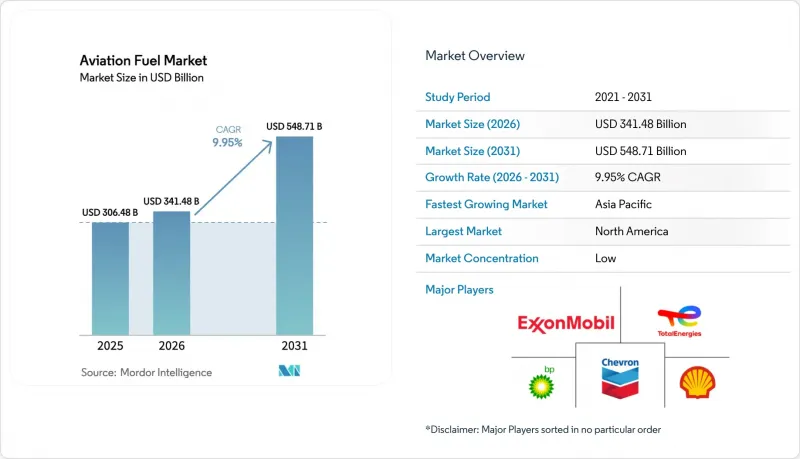
根據 Mordor Intelligence 預測,航空燃油市場規模預計將從 2025 年的 3,064.8 億美元成長到 2026 年的 3,414.8 億美元,到 2031 年達到 5,487.1 億美元,2026 年至 2031 年的複合年成長率為 9.95%。
本報告按燃料類型(傳統噴射機燃料、永續航空燃料、航空汽油)、飛機類型(窄體飛機、寬體飛機、支線噴射機和渦輪螺旋槳飛機、貨機)、應用(商業航空公司、國防和軍事航空、通用航空和公務航空)以及地區(北美、歐洲、亞太地區、南美、中東和非洲)進行分類。
全球航空燃油市場趨勢及洞察
疫情後客運量迅速復甦
2024年,客運量恢復至47億人次,與2019年的尖峰時段持平。國際航空運輸協會(IATA)預測,到2040年,客運量將達88億人次。休閒旅遊率先復甦,隨後是商務旅遊,目前許多區域航線的這兩個細分市場客運量均已超過危機前水準。最佳化載客率提高了每次飛行循環的燃油裝載量。這是因為,隨著飛機接近滿載,效率不斷提高,每增加一個座位,燃油裝載量也會隨之增加。在亞太地區和中東,中產階級收入的成長以及航空服務協議的自由化推動了兩位數的需求成長。 2024年,光是中國國內旅客就增加了1億多人次,印度的旅客吞吐量更是突破了2億人次。這支撐了區域機場持續的加油需求。遠程窄體飛機實現的點對點航線網路,正在使燃油需求不再局限於大型樞紐機場,並重塑航空燃油市場的整體分銷物流。
廉價航空公司(LCC)在新興市場的擴張
廉價航空公司(LCC)在全球座位運力中所佔比例已從2019年的30%成長至2024年的35%,並在印度、東南亞和拉丁美洲擴大了市場佔有率。靛藍航空(IndiGo)計劃在2025年營運370架飛機,並已訂購500架A320neo系列飛機,預示著未來十年燃油消耗量將持續成長。亞洲航空(AirAsia)、Volaris和JetSmart等公司正在效仿廉價航空公司的經營模式,創造新的客運需求,而不是取代現有航空公司。廉價航空公司的飛機通常每天營運12至14小時,且客座率高於全服務航空公司,因此每日燃油需求量也更高。開放天空協議和印度的UDAN計畫等獎勵降低了航線開通的門檻,使廉價航空公司能夠進入燃油供應基礎設施仍然有限的區域性城市。這將迫使供應商將業務拓展到航空燃油市場的新區域。
原油價格波動與碳定價/CORSIA合規成本
2024年至2025年間,布蘭特原油價格在每桶70美元至90美元之間波動,價格每變動10美元,航空公司的營運成本就會增加3%至4%。歐洲營運能力的下降擴大了噴射機燃料裂解價差,進一步加劇了地緣政治衝擊導致的價格飆升。國際航空碳抵銷和減排計畫(CORSIA)的試點計畫於2024年啟動,該計畫要求航空公司為超過2019年基準值的成長購買碳權額度,價格為每噸1至3美元。預計到2027年,這一價格將上漲至每噸20美元左右。歐盟排放交易體系(EU ETS)也為歐洲航空公司帶來了額外的負擔,到2025年初,排放權價格將接近每噸80歐元(87美元)。燃油和碳價格的波動,以及其他因素,正在加劇利潤率風險,加速行業重組,並促使航空公司簽訂多年期永續航空燃料(SAF)契約,以穩定航空燃油市場的合規要素。
細分市場分析
到2025年,傳統噴射機燃料將佔銷售量和收入的96.1%,但由於監管日益嚴格,永續航空燃油(SAF)預計到2031年將以37.0%的複合年成長率成長,成為所有細分市場中成長最快的。 Neste已將其在新加坡的產能擴大至每年220萬噸,並與歐洲和亞洲的多家航空公司簽訂了長期收購協議。埃克森美孚和菲利普斯66等美國煉油商正在聯合處理廢油,以利用《通貨膨脹控制法案》(IRA)的稅收抵免持前達到合規要求。在整個航空燃油市場中,SAF的價值佔有率超過了其銷售佔有率。這是因為其溢價成長超過了混合燃料量的成長,從而支撐了利潤率的擴大,即使原料價格波動。
與Avgaz相關的航空燃料市場仍然微乎其微,並且隨著活塞式引擎飛機的老化以及美國聯邦航空管理局(FAA)EAGLE計劃下無鉛替代燃料的推廣,這一趨勢正在下降。由於現有渦輪飛機和全球「從管道到機翼」的基礎設施,傳統噴射機燃料在未來十年仍將至關重要,但其增量成長正在放緩。石油衍生電子煤油和醇制噴射燃料路線將帶來除脂質基高能量脂肪酸(HEFA)之外的原料多元化,但它們的商業化取決於降低電解槽成本、完善二氧化碳捕集基礎設施以及進行清晰的生命週期排放計算。供應商正在平衡現有設施的改造為共加工以及新的石油衍生路線投資,從而拓展其選擇範圍,並準備在2030年後監管加速推進的情況下,在航空燃料市場重新分配的市場佔有率中佔據一席之地。
區域分析
到2025年,北美將佔全球需求的37.7%。這得益於樞紐輻射式航線網路、大規模的通用飛機機隊以及早期針對地面航空燃料(SAF)的稅收優惠政策。預計到2027年,雪佛龍和菲利普斯66等綜合性巨頭將透過煉油廠維修新增超過5億加侖的SAF產能,進而建立區域供應基地。加拿大北部航線的最佳化和墨西哥廉價航空公司(LCC)的擴張正在提振需求,而下一代空中交通管理系統(NextGen)將降低單次航班的燃油消耗,但這無法抵消航班數量增加帶來的總需求成長。航空燃油市場受益於穩定的政策、充足的原料供應和成熟的物流網路,即使飛機效率不斷提高,市場仍保持溫和成長。
亞太地區預計將成為成長最快的地區,年複合成長率將達到12.6%,這主要得益於中國機場建設熱潮和印度國內航班蓬勃發展推動的燃料需求成長。東協的自由化進程使航空公司能夠開通區域城市間的航線,從而促進了供應鏈多元化和加油站數量的增加。日本和韓國正致力於永續航空燃料(SAF)的研發和氫能示範項目,旨在出口相關技術的同時,應對國內碳排放上限的限制。澳洲的超遠程航線規劃,例如澳航的“日出計劃”,正在推動對包括SAF混合燃料在內的高能量密度燃料的需求。憑藉這些多元化的成長動力,亞太地區必將在預測期內對航空燃料市場規模的成長發揮至關重要的作用。
歐洲實行最嚴格的脫碳方案,「ReFuelEU Aviation」計畫設定了2025年永續航空燃料(SAF)摻混比例2%的要求,此後這一比例將迅速提高,迫使煉油廠和機場開發摻混和儲存基礎設施。碳價超過每噸80美元,加速了老舊飛機的退役,並促使航空公司與Neste和LanzaJet等公司簽訂長期SAF合約。在中東,以樞紐機場為中心的擴張仍在繼續,阿拉伯聯合大公國航空、卡達航空和阿提哈德航空都在擴大其寬體飛機運力,而阿布達比國家石油公司(ADNOC)正在投資SAF生產能力,以鞏固阿拉伯聯合大公國作為樞紐的地位。南美洲和巴西國內市場都出現了復甦跡象,但仍面臨基礎設施短缺和外匯波動的挑戰。在非洲,SAF的普及率仍然很低,埃塞俄比亞航空主導非洲大陸的擴張,並鼓勵投資建造本地燃料倉儲設施。這些趨勢結合起來,形成了一個多極化的航空燃油市場,其中政策、資本密集度和乘客趨勢因地區而異。
其他好處:
- Excel格式的市場預測(ME)表
- 3個月的分析師支持
目錄
第1章:引言
- 研究假設和市場定義
- 調查範圍
第2章:調查方法
第3章執行摘要
第4章 市場狀況
- 市場概覽
- 市場促進因素
- 疫情後客運量迅速恢復
- 廉價航空公司在新興市場的擴張
- 設備現代化改造和交付燃油效率更高的新型飛機。
- 全球國防航空領域支出增加
- 將飛機改裝成專用貨機的做法正在迅速增加。
- 利用電轉液(PtL)技術擴大電子煤油產能。
- 市場限制因素
- 原油價格波動劇烈。
- 碳定價和CORSIA合規成本
- SAF原料供應瓶頸
- 飛機和引擎的能源效率迅速提高
- 供應鏈分析
- 監理情勢
- 技術展望
- 波特五力模型
第5章 市場規模與成長預測
- 按燃料類型
- 傳統噴射機燃料
- 永續航空燃料(SAF)
- 航空汽油(Avgas)
- 按飛機類型
- 窄體飛機
- 寬體飛機
- 支線噴射機和渦輪螺旋槳飛機
- 貨機/專用貨機
- 透過使用
- 私人航空公司
- 國防/軍用航空
- 通用航空和公務航空
- 按地區
- 北美洲
- 美國
- 加拿大
- 墨西哥
- 歐洲
- 德國
- 英國
- 法國
- 西班牙
- 義大利
- 北歐國家
- 俄羅斯
- 其他歐洲國家
- 亞太地區
- 中國
- 印度
- 日本
- 韓國
- 東南亞國協
- 澳洲和紐西蘭
- 其他亞太國家
- 南美洲
- 巴西
- 阿根廷
- 智利
- 其他南美國家
- 中東和非洲
- 沙烏地阿拉伯
- 阿拉伯聯合大公國
- 南非
- 埃及
- 其他中東和非洲國家
- 北美洲
第6章 競爭情勢
- 市場集中度
- 策略趨勢(併購、聯盟、購電協議)
- 市場佔有率分析(主要公司的市場排名和市場佔有率)
- 公司簡介
- Exxon Mobil Corporation
- Shell plc
- BP plc(Air BP)
- Chevron Corporation
- TotalEnergies SE(Air Total)
- Gazprom Neft PJSC
- Phillips 66
- Valero Energy Corporation
- Abu Dhabi National Oil Company(ADNOC)
- Emirates National Oil Company
- Indian Oil Corporation Ltd
- Bharat Petroleum Corp Ltd
- World Fuel Services Corp
- Vitol Aviation
- Neste Oyj
- LanzaJet Inc.
- Gevo Inc.
- Honeywell UOP
- Red Rock Biofuels LLC
- Swedish Biofuels AB
- Allied Aviation Services Inc.
第7章 市場機會與未來展望
According to Mordor Intelligence, the aviation fuel market size is expected to increase from USD 306.48 billion in 2025 to USD 341.48 billion in 2026 and reach USD 548.71 billion by 2031, growing at a CAGR of 9.95% over 2026-2031.
This report is Segmented by Fuel Type (Conventional Jet Fuel, Sustainable Aviation Fuel, and Avgas), Aircraft Type (Narrow-Body, Wide-Body, Regional Jets and Turboprops, and Cargo/Freighters), Application (Commercial Airlines, Defense/Military Aviation, and General and Business Aviation), and Geography (North America, Europe, Asia Pacific, South America, and Middle East and Africa).
Global Aviation Fuel Market Trends and Insights
Surging Post-Pandemic Passenger Traffic Recovery
Passenger enplanements rebounded to 4.7 billion in 2024, equal to the 2019 peak, and IATA projects 8.8 billion by 2040. Leisure travel returned first, corporate trips later, yet both segments now outstrip pre-crisis levels on many regional routes. Load-factor optimization is intensifying fuel uplift per cycle because fuller cabins translate every additional seat into extra kerosene uplift despite fleet efficiency gains. Asia-Pacific and the Middle East show double-digit demand growth as rising middle-class incomes intersect with liberalized air-service agreements. China alone added over 100 million domestic passengers in 2024, while India crossed the 200 million mark, underpinning continuous refueling demand at secondary airports. Point-to-point networks enabled by long-range narrow-bodies disperse fuel demand beyond mega-hubs, reshaping distributor logistics across the aviation fuel market.
Expansion of Low-Cost Carriers in Emerging Markets
Low-cost carriers (LCCs) rose to 35% of global seat capacity in 2024, up from 30% in 2019, capturing share across India, Southeast Asia, and Latin America. IndiGo operated 370 aircraft in 2025 and ordered another 500 A320neo-family jets, ensuring a decade-long fuel-consumption uptrend. AirAsia, Volaris, and JetSMART emulate the ultra-low-cost template, stimulating new traffic rather than displacing incumbents. LCC aircraft typically fly 12-14 hours daily, outpacing full-service carriers in utilization and thereby sustaining higher daily fuel demand. Open-skies pacts and incentives such as India's UDAN scheme reduce route-launch friction, letting LCCs penetrate secondary cities where fuel-farm infrastructure remains limited, compelling suppliers to extend into new geographies within the aviation fuel market.
Volatile Crude-Oil Pricing and Carbon-Pricing/CORSIA Compliance Costs
Brent prices oscillated between USD 70-90 per barrel through 2024-2025, with each USD 10 swing moving airline operating costs by 3-4%. Jet-fuel crack spreads widened as European capacity closed, magnifying price spikes from geopolitical shocks. CORSIA's pilot phase began in 2024, obligating carriers to buy carbon credits for growth above 2019 baselines at USD 1-3 per ton, set to rise toward USD 20 by 2027. EU ETS exposure further burdens European operators with allowances near EUR 80 per ton (USD 87) in early 2025. Combined fuel and carbon volatility amplifies margin risk, fueling consolidation and spurring airlines to lock in multiyear SAF deals that stabilize the compliance component of the aviation fuel market.
Other drivers and restraints analyzed in the detailed report include:
- Fleet Modernization and Delivery of Fuel-Efficient Aircraft
- Rising Defense Aviation Spending, Air-Cargo Freighter Conversions, and PtL E-Kerosene Capacity
- SAF Feedstock Supply Bottlenecks and Rapid Aircraft/Engine Energy-Efficiency Gains
For complete list of drivers and restraints, kindly check the Table Of Contents.
Segment Analysis
Conventional jet fuel underpinned 96.1% of volume and revenue in 2025, yet tightening mandates drive SAF to a 37.0% CAGR through 2031, the fastest among all sub-segments. Neste expanded Singapore capacity to 2.2 million tons per year, locking in long-term offtake with multiple European and Asian carriers. U.S. refiners such as ExxonMobil and Phillips 66 are co-processing waste oils to secure early compliance under Inflation Reduction Act credits. Within the aviation fuel market size, SAF's dollar share overtakes its volumetric share because premium pricing outweighs blended volumes, supporting margin expansion despite feedstock volatility.
The aviation fuel market size attached to Avgaz remains marginal and trends downward as piston-engine fleets age out and unleaded substitutes progress under the FAA's EAGLE program. Conventional jet fuel remains indispensable throughout the decade due to installed turbine fleets and global pipeline-to-wing infrastructure, yet its incremental growth moderates. PtL e-kerosene and alcohol-to-jet pathways diversify feedstocks beyond lipid-based HEFA, though commercialization hinges on electrolyzer-cost compression, CO2-capture infrastructure, and clear lifecycle-emission accounting. Suppliers that balance co-processing retrofits with greenfield PtL investments build optionality, positioning to capture the aviation fuel market share redistribution as mandates accelerate post-2030.
Complete Report Scope:
- By Fuel Type
- Conventional Jet Fuel
- Sustainable Aviation Fuel (SAF)
- Avgas
- By Aircraft Type
- Narrow-body
- Wide-body
- Regional Jets and Turboprops
- Cargo/Freighters
- By Application
- Commercial Airlines
- Defense/Military Aviation
- General and Business Aviation
- By Geography
- North America
- United States
- Canada
- Mexico
- Europe
- Germany
- United Kingdom
- France
- Spain
- Italy
- NORDIC Countries
- Russia
- Rest of Europe
- Asia-Pacific
- China
- India
- Japan
- South Korea
- ASEAN Countries
- Australia and New Zealand
- Rest of Asia-Pacific
- South America
- Brazil
- Argentina
- Chile
- Rest of South America
- Middle East and Africa
- Saudi Arabia
- United Arab Emirates
- South Africa
- Egypt
- Rest of Middle East and Africa
- North America
Geography Analysis
North America accounted for 37.7% of global demand in 2025, supported by hub-and-spoke structures, a large general-aviation fleet, and early SAF tax incentives. Integrated majors such as Chevron and Phillips 66 will add more than 500 million gallons of SAF capacity by 2027 through refinery retrofits, anchoring regional supply. Canadian northern-route optimization and Mexican LCC expansion together add incremental uplift, while NextGen air-traffic management trims per-flight fuel burn yet fails to offset aggregate volume tied to rising flight numbers. The aviation fuel market benefits from stable policy, accessible feedstocks, and mature logistics, sustaining moderate growth despite fleet efficiency gains.
Asia-Pacific is expected to register a 12.6% CAGR, the fastest regional expansion, as China's airport-construction spree and India's domestic boom widen the fuel-demand base. ASEAN liberalization lets carriers open secondary city pairs, decentralizing supply chains and multiplying refueling points. Japan and South Korea focus on SAF R&D and hydrogen demonstrations, hoping to export technology while tackling domestic carbon caps. Australia's ultra-long-haul plans, such as Qantas Project Sunrise, reinforce demand for high-energy-density fuels, including SAF blends. This diversity of growth engines cements Asia-Pacific as the pivotal contributor to the incremental aviation fuel market size during the outlook period.
Europe operates under the strictest decarbonization regime; ReFuelEU Aviation sets a 2% SAF mandate in 2025, rising steeply thereafter, compelling refiners and airports to build blending and storage infrastructure. Carbon prices above USD 80 per ton accelerate legacy fleet retirements and drive airlines toward long-term SAF contracts with Neste and LanzaJet. The Middle East continues hub-centric expansion; Emirates, Qatar Airways, and Etihad each grow wide-body capacity, while ADNOC invests in SAF capacity to reinforce the UAE's hub status. South America recovers alongside Brazil's domestic market, yet wrestles with infrastructure gaps and currency volatility. Africa remains under-penetrated; Ethiopian Airlines leads intra-continental expansion, prompting localized fuel-farm investments. Collectively, these dynamics shape a multipolar aviation fuel market in which policy, capital intensity, and traffic trends vary sharply by region.
- Exxon Mobil Corporation
- Shell plc
- BP plc (Air BP)
- Chevron Corporation
- TotalEnergies SE (Air Total)
- Gazprom Neft PJSC
- Phillips 66
- Valero Energy Corporation
- Abu Dhabi National Oil Company (ADNOC)
- Emirates National Oil Company
- Indian Oil Corporation Ltd
- Bharat Petroleum Corp Ltd
- World Fuel Services Corp
- Vitol Aviation
- Neste Oyj
- LanzaJet Inc.
- Gevo Inc.
- Honeywell UOP
- Red Rock Biofuels LLC
- Swedish Biofuels AB
- Allied Aviation Services Inc.
Additional Benefits:
- The market estimate (ME) sheet in Excel format
- 3 months of analyst support
TABLE OF CONTENTS
1 Introduction
- 1.1 Study Assumptions & Market Definition
- 1.2 Scope of the Study
2 Research Methodology
3 Executive Summary
4 Market Landscape
- 4.1 Market Overview
- 4.2 Market Drivers
- 4.2.1 Surging post-pandemic passenger traffic recovery
- 4.2.2 Expansion of low-cost carriers in emerging markets
- 4.2.3 Fleet modernization & delivery of new fuel-efficient aircraft
- 4.2.4 Rising defense aviation spending worldwide
- 4.2.5 Booming air-cargo freighter conversions
- 4.2.6 Build-out of power-to-liquid (PtL) e-kerosene capacity
- 4.3 Market Restraints
- 4.3.1 Volatile crude-oil price environment
- 4.3.2 Carbon-pricing & CORSIA compliance costs
- 4.3.3 SAF feedstock supply bottlenecks
- 4.3.4 Rapid gains in aircraft /engine energy efficiency
- 4.4 Supply-Chain Analysis
- 4.5 Regulatory Landscape
- 4.6 Technological Outlook
- 4.7 Porter's Five Forces
- 4.7.1 Bargaining Power of Suppliers
- 4.7.2 Bargaining Power of Buyers
- 4.7.3 Threat of New Entrants
- 4.7.4 Threat of Substitutes
- 4.7.5 Intensity of Competitive Rivalry
5 Market Size & Growth Forecasts
- 5.1 By Fuel Type
- 5.1.1 Conventional Jet Fuel
- 5.1.2 Sustainable Aviation Fuel (SAF)
- 5.1.3 Avgas
- 5.2 By Aircraft Type
- 5.2.1 Narrow-body
- 5.2.2 Wide-body
- 5.2.3 Regional Jets and Turboprops
- 5.2.4 Cargo/Freighters
- 5.3 By Application
- 5.3.1 Commercial Airlines
- 5.3.2 Defense/Military Aviation
- 5.3.3 General and Business Aviation
- 5.4 By Geography
- 5.4.1 North America
- 5.4.1.1 United States
- 5.4.1.2 Canada
- 5.4.1.3 Mexico
- 5.4.2 Europe
- 5.4.2.1 Germany
- 5.4.2.2 United Kingdom
- 5.4.2.3 France
- 5.4.2.4 Spain
- 5.4.2.5 Italy
- 5.4.2.6 NORDIC Countries
- 5.4.2.7 Russia
- 5.4.2.8 Rest of Europe
- 5.4.3 Asia-Pacific
- 5.4.3.1 China
- 5.4.3.2 India
- 5.4.3.3 Japan
- 5.4.3.4 South Korea
- 5.4.3.5 ASEAN Countries
- 5.4.3.6 Australia and New Zealand
- 5.4.3.7 Rest of Asia-Pacific
- 5.4.4 South America
- 5.4.4.1 Brazil
- 5.4.4.2 Argentina
- 5.4.4.3 Chile
- 5.4.4.4 Rest of South America
- 5.4.5 Middle East and Africa
- 5.4.5.1 Saudi Arabia
- 5.4.5.2 United Arab Emirates
- 5.4.5.3 South Africa
- 5.4.5.4 Egypt
- 5.4.5.5 Rest of Middle East and Africa
- 5.4.1 North America
6 Competitive Landscape
- 6.1 Market Concentration
- 6.2 Strategic Moves (M&A, Partnerships, PPAs)
- 6.3 Market Share Analysis (Market Rank/Share for key companies)
- 6.4 Company Profiles (includes Global level Overview, Market level overview, Core Segments, Financials as available, Strategic Information, Products & Services, and Recent Developments)
- 6.4.1 Exxon Mobil Corporation
- 6.4.2 Shell plc
- 6.4.3 BP plc (Air BP)
- 6.4.4 Chevron Corporation
- 6.4.5 TotalEnergies SE (Air Total)
- 6.4.6 Gazprom Neft PJSC
- 6.4.7 Phillips 66
- 6.4.8 Valero Energy Corporation
- 6.4.9 Abu Dhabi National Oil Company (ADNOC)
- 6.4.10 Emirates National Oil Company
- 6.4.11 Indian Oil Corporation Ltd
- 6.4.12 Bharat Petroleum Corp Ltd
- 6.4.13 World Fuel Services Corp
- 6.4.14 Vitol Aviation
- 6.4.15 Neste Oyj
- 6.4.16 LanzaJet Inc.
- 6.4.17 Gevo Inc.
- 6.4.18 Honeywell UOP
- 6.4.19 Red Rock Biofuels LLC
- 6.4.20 Swedish Biofuels AB
- 6.4.21 Allied Aviation Services Inc.
7 Market Opportunities & Future Outlook
- 7.1 White-space & unmet-need assessment

 歐洲航空燃油:市場佔有率分析、行業趨勢和統計數據、成長預測(2026-2031 年)
 航空燃料市場:全球市場預測,2026-2032年運輸燃料市場:依燃料類型、來源、混合比例、最終用戶和分銷管道分類-2026-2032年全球市場預測
 全球航空燃料市場規模、佔有率、趨勢和成長分析報告(2026-2034年)
 航空燃料市場機會、成長促進因素、產業趨勢分析及2026-2035年預測。南美航空燃料:市場佔有率分析、產業趨勢與統計及成長預測(2025-2031 年)
 可再生/生物噴射機燃料市場-全球產業規模、佔有率、趨勢、機會、預測:按轉換路徑、來源、地區和競爭格局分類,2021-2031年
 航空燃料市場預測至2034年—按燃料類型、飛機類型、最終用戶和地區分類的全球分析航空燃油添加劑市場:商業機會、成長要素、產業趨勢分析及 2026-2035 年預測。航空燃料市場規模、佔有率、成長及全球產業分析:按類型、應用和地區分類,並預測至2026-2034年