


 |
市場調查報告書
商品編碼
2122036
非洲農業曳引機機械:市場佔有率分析、產業趨勢與統計及成長預測(2026-2031 年)Africa Agricultural Tractor Machinery - Market Share Analysis, Industry Trends & Statistics, Growth Forecasts (2026 - 2031) |
||||||

※ 本網頁內容可能與最新版本有所差異。詳細情況請與我們聯繫。
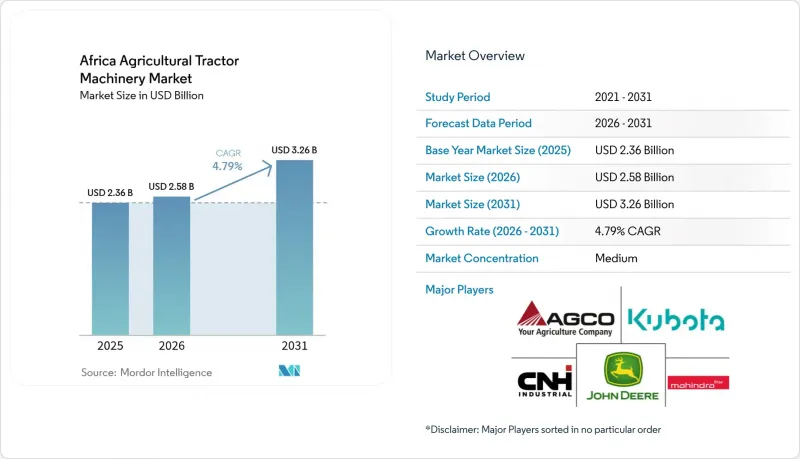
根據 Mordor Intelligence 預測,非洲農業曳引機機械市場規模將從 2025 年的 23.6 億美元成長到 2026 年的 25.8 億美元,到 2031 年將達到 32.6 億美元,2026 年至 2031 年的複合年成長率為 4.79%。
本報告按產品類型(犁地和農業機械、播種機械、噴霧器、乾草和飼料機械及其他)、最終用戶(小規模農戶、中型商業農場、大型種植園和農業股權公司等)以及地區(奈及利亞、南非等)進行細分。市場預測以美元計價。
非洲農業曳引機機械市場趨勢與洞察
擴大機械化和泛非資金籌措項目的津貼
低利率貸款計劃和補貼租賃正在降低初始資本需求並縮短投資回收期,即使是僅有5公頃的小規模農場也是如此。各國的補貼計畫正在推動機械採購從個人所有權轉向合作所有權和公共管理的租賃中心。 2025年2月,聯邦政府啟動了非洲規模最大的農業機械化舉措,在全國部署了2000台曳引機和9000多台精準農業工具。該舉措旨在提高生產力、擴大耕地面積並增強糧食安全。 2023年,肯亞農業和畜牧業發展部啟動了“國家機械化計畫”,旨在透過將農業機械化率從目前的30%提高到50%來加強糧食和營養安全。該計劃旨在提供農業機械、設備及相關工具,並將未充分利用的國有土地改造成機械化農場。這些措施在確保需求可預測性的同時,集中進行價格談判,鼓勵製造商促進在地採購並同意延長付款期限。這些措施將共同改變以所有權為基礎的經濟模式,從長達數十年的長期合約轉變為更易於管理的營運租賃,並加快車輛更換週期,重振非洲農業曳引機機械市場。
大規模商業農業的擴張
平均佔地5000公頃的大型農場吸引了大量外國直接投資,帶來了大量的曳引機訂單,並為鄰近的小規模農戶樹立了榜樣。肯亞農業部門已呈現顯著復甦,糧食收穫面積從2021年的268萬公頃增加到2024年的294萬公頃。這一成長需要擴大犁地、播種和收割能力。肯亞的園藝作物出口在2025年7月至9月期間達到1.956億美元,主要依賴窄軌曳引機,它們能夠實現厘米級的灌溉和果園修剪精度。蘇丹衝突後的農業復甦以傑濟拉計畫為中心。 2025年灌溉基礎設施的修復使許多公頃土地恢復生產,從而推動了對曳引機及相關機械的需求。大型農場是經銷商網路的中心,降低了售後服務零件的物流成本,並在整個種植季節穩定了需求。
售後服務網路分散,限制了機器的運作。
經銷商網路薄弱和零件交付週期過長導致大量曳引機在關鍵的耕作季節運作。據奈及利亞農業部稱,近年來,由於沿海倉庫的零件到貨時間過長,大量使用年限超過數年的曳引機運作。在衣索比亞,每年都有相當一部分政府配發的曳引機被迫長時間運作。同樣,肯亞農村地區的服務交付也存在嚴重延誤,導致全年曳引機利用率下降。 「Hello Tractor」透過部署流動維修技師來解決這個問題,通常可在幾天內完成維修。雖然製造商正在努力建立區域基地並扶持獨立維修店,但偏遠地區曳引機數量少仍然阻礙了專用服務中心的經濟可行性。
細分市場分析
犁地和間耕機械是最大的產品類型,預計到2025年將佔非洲農業曳引機機械市場佔有率的41.6%。這是因為土壤準備仍然是小規模農場運作的必要前提。坦尚尼亞政府的一項代金券計劃將機械化預算分配給耕耘機和耙,以彌補因人工耕作造成的產量損失。 2026年2月,奈及利亞聯邦政府正式啟動了「希望之國農業機械化計畫」(RHAMP),發放超過9,000台農具,其中包括大量圓盤耙。由於許多農地在實施微創耕作系統之前需要進行犁地,因此保護性耕作宣傳活動的需求依然強勁。
噴霧器是成長最快的產品線,預計到2031年將以5.9%的複合年成長率成長,這主要得益於出口市場更嚴格的殘留物標準以及鼓勵精準使用化學品的氣候變遷減緩項目。南非的葡萄酒和柑橘生產商正在採用智慧技術,例如變數噴霧器,以提高效率和永續性。這些努力旨在應對氣候變遷帶來的挑戰以及日益成長的有效水資源管理需求。預計噴霧器將在非洲農業曳引機機械市場穩步成長,並從通用犁和播種機手中奪取市場佔有率,因為精準的噴灑量調節可以降低農藥成本。包括播種機、播種器和噴霧器在內的播種機械預計將在未來幾年佔據顯著的市場佔有率,這主要得益於主要玉米和大豆產區對精準播種技術的日益普及。包括收割機、調理機和打包機的乾草和飼料機械預計將在支持南非畜牧業和肯亞酪農產業方面發揮關鍵作用。此外,其他型號的機型,包括馬鈴薯收割機和甘蔗收割機等專用農業機械,預計將滿足特定的農業需求,並支援小眾作物市場。
其他好處:
- Excel格式的市場預測(ME)表
- 3個月的分析師支持
目錄
第1章:引言
- 研究假設和市場定義
- 調查範圍
第2章:調查方法
第3章執行摘要
第4章 市場狀況
- 市場概覽
- 市場促進因素
- 增加對機械化和泛非金融項目的補貼
- 大規模商業農業的擴張
- 付費使用制數位設備租賃平台的成長
- 鼓勵發展氣候友善農業的獎勵正在推動對精準農業機械的需求。
- 中國和非洲的工業園區正在實現低成本組裝全散件組裝(CKD)曳引機。
- 在陽光充足的地區,由可再生能源驅動的自主設備正在出現。
- 市場限制因素
- 售後服務網路分散,限制了機器的運作。
- 該地貨幣貶值推高了進口零件的成本。
- 土地所有權的不確定性阻礙了投資週期較長的投資。
- 由於電控系統(ECU)晶片供不應求,交貨時間正在延長。
- 監理情勢
- 技術展望
- 波特五力分析
第5章 市場規模與成長預測
- 依產品類型
- 犁地和間耕機械
- 犁
- 光環
- 旋耕機和耕耘機
- 其他機械
- 種植機械
- 播種機
- 播種機
- 撒佈器
- 其他種植機械
- 噴霧器
- 乾草和飼料機械
- 割草機和壓草機
- 打包機
- 其他乾草和飼料機械
- 其他類型
- 犁地和間耕機械
- 最終用戶
- 小規模農戶
- 中型商業農場
- 大型農場和農業企業
- 合約租賃及計程車輛
- 按地區
- 奈及利亞
- 南非
- 肯亞
- 埃及
- 衣索比亞
- 其他非洲國家
第6章 競爭情勢
- 市場集中度
- 策略趨勢
- 市佔率分析
- 公司簡介
- Deere & Company
- CNH Industrial NV
- AGCO Corporation
- Mahindra & Mahindra Limited
- Kubota Corporation
- Rovic & Leers(Pty)Ltd.
- Yanmar Holdings Co., Ltd.
- International Tractors Limited
- CLAAS KGaA mbH
- Weichai Lovol Intelligent Agricultural Technology Co., Ltd.(Weichai Power Co., Ltd.)
- SDF SpA(Same Deutz-Fahr)
- Agrimont Industrial Group
- Dongfeng Agricultural Machinery Group Co., Ltd.
- Zoomlion Heavy Industry Science and Technology Co., Ltd.
- Zetor Tractors as(HTC Holding)
第7章 市場機會與未來展望
According to Mordor Intelligence, the Africa agricultural tractor machinery market size is projected to grow from USD 2.36 billion in 2025 to USD 2.58 billion in 2026 and is forecast to reach USD 3.26 billion by 2031 at a 4.79% CAGR over 2026-2031.
This report is Segmented by Product Type (Plowing and Cultivating Machinery, Planting Machinery, Sprayers, Haying and Forage Machinery, and Other Types), by End-User (Smallholder Farms, Medium Commercial Farms, Large Estates and Agro-Holdings, and More), and by Geography (Nigeria, South Africa, and More). The Market Forecasts are Provided in Terms of Value (USD).
Africa Agricultural Tractor Machinery Market Trends and Insights
Rising Mechanization Subsidies and Pan-African Finance Programs
Soft-loan schemes and subsidized leases lower initial capital requirements and shorten payback periods for farms as small as 5 hectares. National subsidy schemes are shifting machinery procurement from individual ownership to cooperative pools and publicly managed hiring centers. In February 2025, the Federal Government launched the largest agricultural mechanization initiative in Africa, deploying 2,000 tractors and over 9,000 precision implements nationwide. This initiative aims to enhance productivity, expand cultivated land, and improve food security. The Kenyan Ministry of Agriculture and Livestock Development launched the National Mechanization Program in 2023 to enhance food and nutritional security by increasing farm mechanization from the current 30% to 50%. This program aims to supply farm machinery, equipment, and related implements to transform underutilized government-owned land into mechanized farming operations. Such initiatives assure predictable demand while concentrating price negotiations, pushing manufacturers to localize parts content and to agree to extended payment terms. Collectively, these schemes shift ownership economics from a decade-long commitment to manageable operating leases, accelerate fleet renewal cycles, and bolster the Africa agricultural tractor machinery market.
Expansion of Large-Scale Commercial Farming
Large estates, averaging 5,000 hectares, attract foreign direct investment, generate bulk tractor orders, and serve as demonstration models for neighboring smallholders. Kenya's agricultural sector experienced a notable recovery, with the cereal harvested area increasing to 2.94 million hectares in 2024, up from 2.68 million hectares in 2021. This growth necessitated additional plowing, planting, and harvesting capacity. Kenya's export horticulture, worth USD 195.6 million between July and September 2025, relies on narrow-track tractors that deliver centimeter-level accuracy for irrigation and orchard pruning. Sudan's agricultural recovery following the conflict has focused on the Gezira Scheme. The rehabilitation of irrigation infrastructure in 2025 facilitated the return of hectares to production, driving demand for tractors and related machinery. Mega-farms anchor dealership footprints, reduce logistical costs for after-sales parts, and stabilize demand across cropping seasons.
Fragmented After-Sales Networks Limiting Machinery Uptime
Sparse dealer networks and prolonged parts-delivery times result in a significant number of tractors being out of service during critical agricultural periods. According to Nigeria's agriculture ministry, a majority of tractors older than several years were non-functional in recent years due to replacement parts requiring extended periods to arrive from coastal warehouses. In Ethiopia, a substantial portion of state-distributed tractors experienced lengthy annual downtimes. Similarly, rural counties in Kenya experienced significant service delays, reducing annual tractor utilization. Hello Tractor addresses this issue by deploying mobile mechanics, who typically restore machines within a few days. While manufacturers are establishing regional hubs and training independent workshops, low machinery densities in remote areas continue to hinder the economic feasibility of dedicated service centers.
Other drivers and restraints analyzed in the detailed report include:
- Growth of Pay-Per-Use Digital Equipment Hire Platforms
- Climate-Smart Agriculture Incentives Boosting Demand for Precision Implements
- Land-Tenure Uncertainty Deterring Long-Payback Investments
For complete list of drivers and restraints, kindly check the Table Of Contents.
Segment Analysis
Plowing and cultivating machinery is the largest product type and captured 41.6% of the Africa agricultural tractor machinery market share in 2025, as soil preparation remains a precursor for most smallholder and medium farm operations. Government voucher programs in Tanzania allocated mechanization budgets to plows and harrows to offset yield losses from manual tillage. In February 2026, the Federal Government of Nigeria officially commenced the distribution of over 9,000 agricultural implements, which include a significant number of disc harrows, as part of the Renewed Hope National Agricultural Mechanisation Programme (RHAMP). Demand persists across conservation-tillage campaigns because many fields still require initial deep ripping before adopting minimal-disturbance systems.
Sprayers are the fastest-growing product line, advancing at a 5.9% CAGR through 2031 as export markets enforce residue limits and climate projects incentivize precise chemical use. South African wine and citrus producers are adopting smart technologies, such as variable-rate sprayers, to enhance efficiency and sustainability. These efforts address challenges posed by climate change and the growing need for effective water management. As calibrated applications reduce pesticide costs, the Africa agricultural tractor machinery market for sprayers is projected to grow steadily, capturing budget share from generic plows and seeders. Planting machinery, including seed drills, planters, and spreaders, is projected to hold a significant market share in the coming years, driven by the increasing adoption of precision planting techniques in key maize- and soybean-producing regions. Haying and forage machinery, including mowers, conditioners, and balers, is anticipated to play a crucial role, particularly in supporting the livestock industry in South Africa and the dairy sector in Kenya. Other machinery types, including specialized implements such as potato diggers and sugarcane harvesters, are projected to serve niche crop markets, addressing specific agricultural needs.
Complete Report Scope:
- By Product Type
- Plowing and Cultivating Machinery
- Plows
- Harrows
- Rotovators and Cultivators
- Other Equipment
- Planting Machinery
- Seed Drills
- Planters
- Spreaders
- Other Planting Machinery
- Sprayers
- Haying and Forage Machinery
- Mowers and Conditioners
- Balers
- Other Haying and Forage Machinery
- Other Types
- Plowing and Cultivating Machinery
- By End-User
- Smallholder Farms
- Medium Commercial Farms
- Large Estates and Agro-holdings
- Contract-Hire and Rental Fleets
- By Geography
- Nigeria
- South Africa
- Kenya
- Egypt
- Ethiopia
- Rest of Africa
List of Companies Covered in this Report:
- Deere & Company
- CNH Industrial N.V.
- AGCO Corporation
- Mahindra & Mahindra Limited
- Kubota Corporation
- Rovic & Leers (Pty) Ltd.
- Yanmar Holdings Co., Ltd.
- International Tractors Limited
- CLAAS KGaA mbH
- Weichai Lovol Intelligent Agricultural Technology Co., Ltd. (Weichai Power Co., Ltd.)
- SDF S.p.A (Same Deutz-Fahr)
- Agrimont Industrial Group
- Dongfeng Agricultural Machinery Group Co., Ltd.
- Zoomlion Heavy Industry Science and Technology Co., Ltd.
- Zetor Tractors a.s. (HTC Holding)
Additional Benefits:
- The market estimate (ME) sheet in Excel format
- 3 months of analyst support
TABLE OF CONTENTS
1 Introduction
- 1.1 Study Assumptions and Market Definition
- 1.2 Scope of the Study
2 Research Methodology
3 Executive Summary
4 Market Landscape
- 4.1 Market Overview
- 4.2 Market Drivers
- 4.2.1 Rising mechanization subsidies and pan-African finance programs
- 4.2.2 Expansion of large-scale commercial farming
- 4.2.3 Growth of pay-per-use digital equipment hire platforms
- 4.2.4 Climate-smart agriculture incentives boosting demand for precision implements
- 4.2.5 China-Africa industrial parks enabling low-cost completely knocked down tractor assembly
- 4.2.6 Emergence of renewable-powered autonomous equipment in high-solar belts
- 4.3 Market Restraints
- 4.3.1 Fragmented after-sales networks limiting machinery uptime
- 4.3.2 Local-currency depreciation escalating import component costs
- 4.3.3 Land-tenure uncertainty deterring long-payback investments
- 4.3.4 Electronic-control-unit chip shortages prolonging delivery cycles
- 4.4 Regulatory Landscape
- 4.5 Technological Outlook
- 4.6 Porter's Five Forces Analysis
- 4.6.1 Bargaining Power of Suppliers
- 4.6.2 Bargaining Power of Buyers
- 4.6.3 Threat of New Entrants
- 4.6.4 Threat of Substitutes
- 4.6.5 Intensity of Competitive Rivalry
5 Market Size and Growth Forecasts (Value)
- 5.1 By Product Type
- 5.1.1 Plowing and Cultivating Machinery
- 5.1.1.1 Plows
- 5.1.1.2 Harrows
- 5.1.1.3 Rotovators and Cultivators
- 5.1.1.4 Other Equipment
- 5.1.2 Planting Machinery
- 5.1.2.1 Seed Drills
- 5.1.2.2 Planters
- 5.1.2.3 Spreaders
- 5.1.2.4 Other Planting Machinery
- 5.1.3 Sprayers
- 5.1.4 Haying and Forage Machinery
- 5.1.4.1 Mowers and Conditioners
- 5.1.4.2 Balers
- 5.1.4.3 Other Haying and Forage Machinery
- 5.1.5 Other Types
- 5.1.1 Plowing and Cultivating Machinery
- 5.2 By End-User
- 5.2.1 Smallholder Farms
- 5.2.2 Medium Commercial Farms
- 5.2.3 Large Estates and Agro-holdings
- 5.2.4 Contract-Hire and Rental Fleets
- 5.3 By Geography
- 5.3.1 Nigeria
- 5.3.2 South Africa
- 5.3.3 Kenya
- 5.3.4 Egypt
- 5.3.5 Ethiopia
- 5.3.6 Rest of Africa
6 Competitive Landscape
- 6.1 Market Concentration
- 6.2 Strategic Moves
- 6.3 Market Share Analysis
- 6.4 Company Profiles (Includes Global Level Overview, Market Level Overview, Core Segments, Financials as Available, Strategic Information, Market Rank/Share for Key Companies, Products and Services, and Recent Developments)
- 6.4.1 Deere & Company
- 6.4.2 CNH Industrial N.V.
- 6.4.3 AGCO Corporation
- 6.4.4 Mahindra & Mahindra Limited
- 6.4.5 Kubota Corporation
- 6.4.6 Rovic & Leers (Pty) Ltd.
- 6.4.7 Yanmar Holdings Co., Ltd.
- 6.4.8 International Tractors Limited
- 6.4.9 CLAAS KGaA mbH
- 6.4.10 Weichai Lovol Intelligent Agricultural Technology Co., Ltd. (Weichai Power Co., Ltd.)
- 6.4.11 SDF S.p.A (Same Deutz-Fahr)
- 6.4.12 Agrimont Industrial Group
- 6.4.13 Dongfeng Agricultural Machinery Group Co., Ltd.
- 6.4.14 Zoomlion Heavy Industry Science and Technology Co., Ltd.
- 6.4.15 Zetor Tractors a.s. (HTC Holding)
7 Market Opportunities and Future Outlook

 2026年全球農業曳引機機械市場報告
 越南農業曳引機:市場佔有率分析、產業趨勢與統計及成長預測(2026-2031)中國農業曳引機市場:市場佔有率分析、產業趨勢與統計及成長預測(2026-2031年)德國農業曳引機機械:市場佔有率分析、行業趨勢和統計數據、成長預測(2026-2031)歐洲農業曳引機和機械:市場佔有率分析、行業趨勢和統計數據以及成長預測(2026-2031 年)亞太地區農業曳引機:市佔率分析、產業趨勢與統計及成長預測(2026-2031 年)北美農業曳引機:市場佔有率分析、行業趨勢和統計數據以及成長預測(2026-2031 年)南美洲農業曳引機市場佔有率分析、行業趨勢和統計數據以及成長預測(2026-2031 年)美國農業曳引機機械:市場佔有率分析、行業趨勢和統計數據、成長預測(2026-2031 年)2026年全球果園曳引機市場報告