


 |
市場調查報告書
商品編碼
2113510
南美洲農業曳引機市場佔有率分析、行業趨勢和統計數據以及成長預測(2026-2031 年)South America Agricultural Tractor Machinery - Market Share Analysis, Industry Trends & Statistics, Growth Forecasts (2026 - 2031) |
||||||

※ 本網頁內容可能與最新版本有所差異。詳細情況請與我們聯繫。
據 Mordor Intelligence 稱,2025 年南美農業曳引機市場價值 42 億美元,預計到 2031 年將從 2026 年的 45.5 億美元成長到 67.9 億美元,預測期(2026-2031 年)複合年成長率為 8.34%。
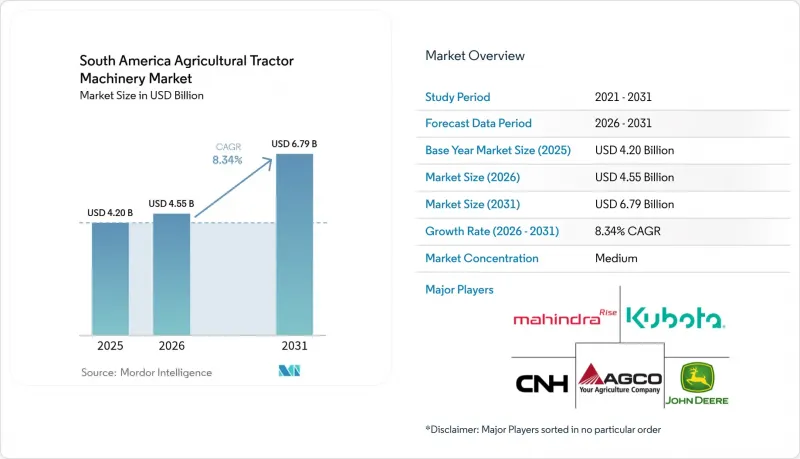
本報告按機械類型(犁地和間耕機械、播種機械、乾草和飼料機械、撒播機及其他)和地區(例如巴西)進行分類。市場預測以貨幣價值(美元)表示。
南美洲農業曳引機市場趨勢與洞察
政府支持的慷慨貸款計畫用於機械化
巴西的「Moderfrota」計畫由巴西國家開發銀行(BNDES)負責實施,為2024/25作物年度撥款約23億美元,利率在7%至10.5%之間。這項撥款較上一周期成長15%,彌補了商業銀行貸款下降8%造成的缺口。阿根廷國家銀行(Banco de la Nacion Argentina)提供了12億美元的農業機械貸款,但披索降低了購買力,並縮小了生產者的採購範圍。巴拉圭的Credo Agricola de Habilitacion公司在2024年也提供了資金,其中近四分之一用於農業機械。這反映了該國計劃在2030年將其大豆出口量翻倍。 CNH Industrial和John Deere的專屬金融子公司正利用這些計劃,透過提供低於市場利率的捆綁式貸款和服務計劃來鞏固品牌忠誠度。
巴西和阿根廷商業大豆種植面積增加
2024/25年度,巴西大豆種植面積達4,700萬至4,820萬公頃,較上年度的4,630萬公頃增加。阿根廷緊追在後,種植面積增加7%,達到4,400萬英畝,該地區大豆產量達2.378億噸。雙季種植制度縮短了播種期,使得高容量播種機、自動噴藥機和配備產量監測器的收割機更具優勢。馬托皮巴地區的農場面積通常在2000至5000公頃之間,需要能夠應付頻繁降雨的農業機械。據阿根廷國家農業技術研究所(INTA)稱,精準播種使產量提高了5%至10%,進一步提升了種子和作物保護材料可變施用技術的價值。中國強勁的石油開採利潤和穩定的需求使現金流保持健康,導致機械設備的再投資率比其他作物高出 30%。
外匯波動推高了進口零件的價格。
2024年,巴西幣對美元貶值11%,推高了進口引擎、變速箱和液壓子系統的到岸成本,這些零件的成本佔曳引機零件總成本的一半之多。 2024年底,阿根廷披索的貶值速度加快,每月跌幅達25%,迫使原始設備製造商(OEM)每六週調整一次價格,導致許多農民延後購買。哥倫比亞披索貶值8%,使進口播種機和噴藥機的價格上漲了3000至5000美元。雖然本地組裝緩解了部分影響,但電控系統和精準導航模組仍然依賴海外供應商。原始設備製造商正在試點以該地貨幣結算的供應契約,並迅速轉向本地採購,但要真正實現本地化至少需要兩個季度的時間。
細分市場分析
在巴西的塞拉多地區和阿根廷的潘帕斯地區,傳統耕作方式仍然佔據主導地位,因此犁地設備在南美農業曳引機市場中佔據最大佔有率,預計到2025年將佔總銷量的33.35%。雖然條耕機的普及速度有所放緩,但尚未取代深耕的需求,尤其是在雙季種植將田間準備工作集中在有限的適宜天氣條件下的地區。製造商正利用這一需求,提供雙向犁和重型耕耘機,這些設備旨在處理大豆和玉米輪作特有的粘土土壤和高殘留量土壤。試用條耕機的農場發現,具有殘留物處理功能的淺耕機有市場需求,這些設備在改善苗床品質的同時,還能維持土壤結構。
噴霧器是成長最快的品類,預計到2031年將維持10.11%的複合年成長率,在南美農業曳引機和機械市場中穩步擴大市場佔有率。 Cromai的AI雜草檢測系統可減少高達65%的除草劑用量,因此在面臨投入成本上漲的農民中廣受歡迎。配備40公尺噴桿和可自訂噴嘴組的自走式平台正在推動面積超過1500公頃的農場的採購。即插即用的改裝套件使中型農戶能夠在現有底盤上安裝點噴模組,以遠低於更換成本的面積提升性能,進一步擴大了小型農戶的採用率。提供廣泛遠端資訊處理相容性的製造商透過提供數據驅動的農業服務來提高客戶留存率。
其他好處:
- Excel格式的市場預測(ME)表
- 3個月的分析師支持
目錄
第1章:引言
- 研究假設和市場定義
- 調查範圍
第2章:調查方法
第3章執行摘要
第4章 市場狀況
- 市場概覽
- 市場促進因素
- 政府為機械化提供了慷慨的信貸支持
- 巴西和阿根廷商業大豆種植面積增加
- 勞動力短缺正在推動對自行式設備的需求。
- 原始設備製造商的財務部門正在降低整體擁有成本。
- 精密農業改裝套件正在促進附件的銷售。
- 低馬力農業機械的碳智慧農業補貼
- 市場限制因素
- 外匯波動推高了進口零件的價格。
- 土地所有權的分散限制了大型設備的廣泛應用。
- 第三階段排放氣體法規實施延遲
- 二手曳引機從灰色市場湧入,阻礙了新曳引機的銷售。
- 監理情勢
- 技術展望
- 波特五力模型
第5章 市場規模與成長預測
- 按機器類型
- 犁地和間耕機械
- 犁
- 光環
- 旋耕機和耕耘機
- 其他犁地和間耕機械
- 播種機
- 播種機
- 播種機
- 撒佈器
- 其他種植機械
- 乾草和飼料機械
- 割草機和壓草機
- 打包機
- 其他乾草和飼料機械
- 噴霧器
- 其他類型
- 犁地和間耕機械
第6章 競爭情勢
- 市場集中度
- 策略趨勢
- 市佔率分析
- 公司簡介
- Deere & Company
- CNH Industrial NV
- AGCO Corporation
- Kubota Corporation
- Mahindra & Mahindra Ltd.
- Yanmar Holdings Co., Ltd.
- SDF Group
- Grupo Jacto
- Stara S/A Industria de Implementos Agricolas
- Grupo Agrale
- LS Mtron Tractors
- Claas KGaA mbH
- Kuhn Group(Bucher Industries)
第7章 市場機會與未來展望
According to Mordor Intelligence, the South America agricultural tractor machinery market size was valued at USD 4.20 billion in 2025 and estimated to grow from USD 4.55 billion in 2026 to reach USD 6.79 billion by 2031, at a CAGR of 8.34% during the forecast period (2026-2031).
This report is Segmented by Machinery Type (Plowing and Cultivating Machinery, Planting Machinery, Haying and Forage Machinery, Sprayers, and Other Types) and Geography (Brazil, and More). The Market Forecasts are Provided in Terms of Value (USD).
South America Agricultural Tractor Machinery Market Trends and Insights
Robust Government Credit Lines for Mechanization
Brazil's Moderfrota program, managed by the Brazilian Development Bank (BNDES), earmarked around USD 2.3 billion for the 2024/25 crop year at interest rates between 7% and 10.5%. The allocation rose 15% from the previous cycle and filled the gap left by an 8% drop in commercial bank lending. Argentina's Banco de la Nacion Argentina extended USD 1.2 billion in machinery loans, yet peso devaluation trimmed purchasing power and narrowed growers' shopping lists. Paraguay's Credito Agricola de Habilitacion disbursed funds in 2024 and channeled almost one-quarter into equipment, reflecting the nation's plan to double soybean exports by 2030. Captive finance subsidiaries of CNH Industrial and John Deere are leveraging these programs to package below-market loans with bundled service plans that lock in brand loyalty.
Rising Commercial Soybean Acreage in Brazil and Argentina
Brazil's soybean area reached 47-48.2 million hectares for the 2024/25 cycle, up from 46.3 million hectares in the prior year. Argentina followed with a 7% jump to 44 million acres, pushing regional output to 237.8 million metric tons. Double-cropping systems compress planting windows, which favors high-capacity planters, autonomous sprayers, and harvesters equipped with yield monitors. Farms in MATOPIBA routinely span 2,000-5,000 hectares and require machinery that can work around frequent rain events. Precision planting lifted yields 5-10% according to Argentina's National Institute of Agricultural Technology (INTA), reinforcing the value proposition of variable-rate technology for both seed and crop protection inputs. Robust crush margins and steady Chinese demand keep cash flow healthy, driving machinery reinvestment rates that are 30% greater than for other crops.
Currency-Exchange Volatility Inflating Imported Component Prices
The Brazilian real weakened 11% against the United States dollar during 2024, lifting the landed cost of imported engines, transmissions, and hydraulic subsystems that form up to half of a tractor's bill of materials. Argentina's peso depreciation accelerated to 25% per month by late 2024, forcing OEMs to reprice every six weeks and pushing many growers to delay purchases. Colombia's peso lost 8%, adding USD 3,000-5,000 to the price of imported planters and sprayers. Local assembly cushions part of the shock, yet electronic control units and precision guidance modules still rely on offshore suppliers. OEMs are testing local-currency supply contracts and fast-tracking regional sourcing, but meaningful localization takes at least two seasons to execute.
Other drivers and restraints analyzed in the detailed report include:
- Labor Scarcity Driving Demand for Self-Propelled Equipment
- OEM Financing Arms Lowering Total Cost of Ownership
- Fragmented Land-Holding Patterns Limiting Large-Equipment Penetration
For complete list of drivers and restraints, kindly check the Table Of Contents.
Segment Analysis
Plowing and cultivating equipment generated the largest slice of the South America agricultural tractor machinery market size, accounting for 33.35% of 2025 revenue, as conventional tillage remained prevalent across Brazil's Cerrado and Argentina's Pampas. Strip-till adoption softens but does not yet displace deep-plowing demand, especially where double-cropping squeezes field preparation into narrow weather windows. Manufacturers capitalize by offering reversible plows and heavy-duty cultivators engineered for clay soils and high residue loads that characterize soybean-corn rotations. On farms experimenting with no-till, shallow cultivators equipped with residue managers find niche demand that preserves soil structure while improving seedbed quality.
Sprayers are the fastest-growing category, projected to log a 10.11% CAGR through 2031 and steadily capture a larger share of the South America agricultural tractor machinery market. Artificial-intelligence weed-detection systems from Cromai cut herbicide use up to 65% and appeal to growers facing rising input costs. Self-propelled platforms with 40-meter booms and customizable nozzle banks dominate purchases on estates above 1,500 hectares. Plug-and-play retrofits push growth farther down the acreage ladder, as mid-sized farmers outfit existing chassis with spot-spray modules that upgrade performance for a fraction of the replacement cost. Manufacturers offering broad telematics compatibility unlock data-driven agronomy services that deepen client stickiness.
Complete Report Scope:
- By Machinery Type
- Plowing and Cultivating Machinery
- Plows
- Harrows
- Rotovators and Cultivators
- Other Plowing and Cultivating Machinery
- Planting Machinery
- Seed Drills
- Planters
- Spreaders
- Other Planting Machinery
- Haying and Forage Machinery
- Mowers and Conditioners
- Balers
- Other Haying and Forage Machinery
- Sprayers
- Other Types
- Plowing and Cultivating Machinery
List of Companies Covered in this Report:
- Deere & Company
- CNH Industrial N.V.
- AGCO Corporation
- Kubota Corporation
- Mahindra & Mahindra Ltd.
- Yanmar Holdings Co., Ltd.
- SDF Group
- Grupo Jacto
- Stara S/A Industria de Implementos Agricolas
- Grupo Agrale
- LS Mtron Tractors
- Claas KGaA mbH
- Kuhn Group (Bucher Industries)
Additional Benefits:
- The market estimate (ME) sheet in Excel format
- 3 months of analyst support
TABLE OF CONTENTS
1 Introduction
- 1.1 Study Assumptions and Market Definition
- 1.2 Scope of the Study
2 Research Methodology
3 Executive Summary
4 Market Landscape
- 4.1 Market Overview
- 4.2 Market Drivers
- 4.2.1 Robust government credit lines for mechanization
- 4.2.2 Rising commercial soybean acreage in Brazil and Argentina
- 4.2.3 Labor scarcity driving demand for self-propelled equipment
- 4.2.4 OEM financing arms lowering total cost of ownership
- 4.2.5 Precision-ag retrofit kits boosting attachment sales
- 4.2.6 Carbon-smart farming subsidies for low-HP machinery
- 4.3 Market Restraints
- 4.3.1 Currency-exchange volatility inflating imported component prices
- 4.3.2 Fragmented land-holding patterns limiting large equipment penetration
- 4.3.3 Slow roll-out of Tier III emission norms
- 4.3.4 Gray-market inflow of used tractors undermining new sales
- 4.4 Regulatory Landscape
- 4.5 Technological Outlook
- 4.6 Porter's Five Forces
- 4.6.1 Bargaining Power of Suppliers
- 4.6.2 Bargaining Power of Buyers
- 4.6.3 Threat of New Entrants
- 4.6.4 Threat of Substitutes
- 4.6.5 Intensity of Competitive Rivalry
5 Market Size and Growth Forecasts (Value)
- 5.1 By Machinery Type
- 5.1.1 Plowing and Cultivating Machinery
- 5.1.1.1 Plows
- 5.1.1.2 Harrows
- 5.1.1.3 Rotovators and Cultivators
- 5.1.1.4 Other Plowing and Cultivating Machinery
- 5.1.2 Planting Machinery
- 5.1.2.1 Seed Drills
- 5.1.2.2 Planters
- 5.1.2.3 Spreaders
- 5.1.2.4 Other Planting Machinery
- 5.1.3 Haying and Forage Machinery
- 5.1.3.1 Mowers and Conditioners
- 5.1.3.2 Balers
- 5.1.3.3 Other Haying and Forage Machinery
- 5.1.4 Sprayers
- 5.1.5 Other Types
- 5.1.1 Plowing and Cultivating Machinery
6 Competitive Landscape
- 6.1 Market Concentration
- 6.2 Strategic Moves
- 6.3 Market Share Analysis
- 6.4 Company Profiles (Includes Global Level Overview, Market Level overview, Core Segments, Financials as available, Strategic Information, Market Rank/Share for key companies, Products & Services, and Recent Developments)
- 6.4.1 Deere & Company
- 6.4.2 CNH Industrial N.V.
- 6.4.3 AGCO Corporation
- 6.4.4 Kubota Corporation
- 6.4.5 Mahindra & Mahindra Ltd.
- 6.4.6 Yanmar Holdings Co., Ltd.
- 6.4.7 SDF Group
- 6.4.8 Grupo Jacto
- 6.4.9 Stara S/A Industria de Implementos Agricolas
- 6.4.10 Grupo Agrale
- 6.4.11 LS Mtron Tractors
- 6.4.12 Claas KGaA mbH
- 6.4.13 Kuhn Group (Bucher Industries)
7 Market Opportunities and Future Outlook

 越南農業曳引機:市場佔有率分析、產業趨勢與統計及成長預測(2026-2031)中國農業曳引機市場:市場佔有率分析、產業趨勢與統計及成長預測(2026-2031年)德國農業曳引機機械:市場佔有率分析、行業趨勢和統計數據、成長預測(2026-2031)亞太地區農業曳引機:市佔率分析、產業趨勢與統計及成長預測(2026-2031 年)北美農業曳引機:市場佔有率分析、行業趨勢和統計數據以及成長預測(2026-2031 年)美國農業曳引機機械:市場佔有率分析、行業趨勢和統計數據、成長預測(2026-2031 年)
 2026年全球果園曳引機市場報告
 農業曳引機市場:2026-2032年全球市場預測(按曳引機類型、功率範圍、燃料類型、應用和最終用戶分類)印度農業曳引機和機械:市場佔有率分析、行業趨勢和統計數據以及成長預測(2026-2031 年)
 果園曳引機市場機會、成長要素、產業趨勢分析及2026-2035年預測