


 |
市場調查報告書
商品編碼
2113531
亞太地區農業曳引機:市佔率分析、產業趨勢與統計及成長預測(2026-2031 年)Asia-Pacific Agricultural Tractor Machinery - Market Share Analysis, Industry Trends & Statistics, Growth Forecasts (2026 - 2031) |
||||||

※ 本網頁內容可能與最新版本有所差異。詳細情況請與我們聯繫。
根據 Mordor Intelligence 預測,亞太地區農業曳引機市場規模預計將從 2025 年的 250 億美元成長到 2026 年的 263.6 億美元,然後在 2031 年達到 343.4 億美元,2026 年至 2031 年的複合年成長率為 5.45%。
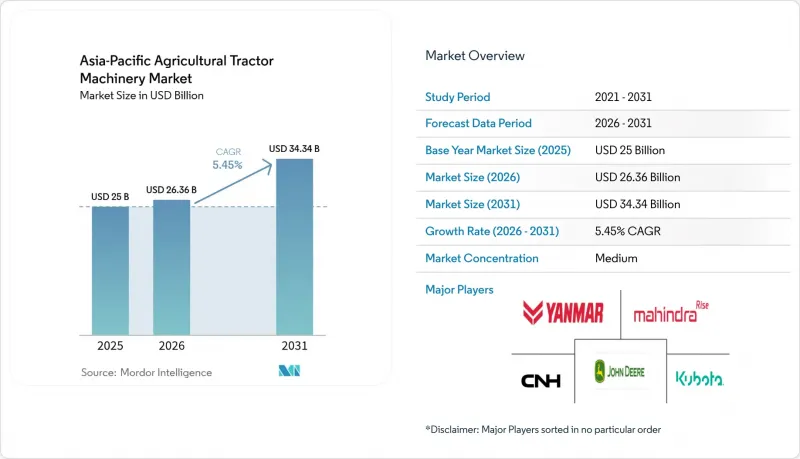
本報告按產品類型(犁地和農業機械、播種機械、噴霧器、乾草和飼料機械等)和地區(中國、印度、日本、澳洲等)進行分類。市場預測以貨幣價值(美元)表示。
亞太地區農業曳引機市場趨勢及洞察
政府機械化補貼和貸款計劃
2024年,亞太地區的直接補貼支出超過42億美元,使農機購置成本降低了約四分之一。在印度,一項與Aadhaar(印度居民身分識別系統)掛鉤的補助計畫確保了補貼的及時發放。同時,在中國,指定省份目前正在提供高達100馬力以下曳引機價格60%的補貼。在泰國和越南,除了補貼外,還提供免息或有上限的貸款,鼓勵生產者採用連網設備,將使用資料傳輸給農業推廣服務機構。這些舉措共同加速了曳引機的更新換代,推動了對中等馬力曳引機的需求,並穩定了整車製造商的訂單。
農村地區嚴重的人手不足正在推動對曳引機的需求。
2020年至2024年間,亞太地區農業工人減少了830萬人,原因是移工湧入都市區工廠。在旁遮普邦,日工資上漲至600至700印度盧比(約7.2至8.40美元),這給勞動密集型作物的獲利能力帶來了壓力,促使農民轉向機械化犁地和播種。日本農業人口老化以及中國戶籍制度改革進一步減少了季節性勞動力供應,推動了合作社聯合購買曳引機,並增加了對能夠縮短操作員培訓時間的直覺用戶界面的需求。
高昂的初始實施成本和資金籌措成本
在印度,一台入門級35馬力曳引機的標價為55萬至65萬印度盧比(約6600至7800美元),相當於小規模農戶年淨收入的兩倍多。在印度尼西亞,貸款利率平均為11.5%;在越南,首付必須達到30%,這給流動資金帶來了壓力。在菲律賓,由於缺乏抵押品,購車者只能轉向二手市場,而二手車的維護風險更高。這些經濟障礙尤其阻礙了人們購買高配置車型。
細分市場分析
至2025年,犁地和行間耕作機械將佔該細分市場39.95%的佔有率,凸顯其在亞太地區不同種植系統中整地的關鍵作用。這包括中國機械化的小麥產區和印度分散的稻田,在印度,旋耕機被廣泛用於濕地泥土翻耕。此類別的主導地位源自於所有作物類型對犁地的普遍需求。在澳洲廣闊的小麥種植區,犁鏵仍然發揮著至關重要的作用,犁地深翻將雜草種子埋入土壤,並將石灰混入土壤中。同時,在東南亞的雙季種植系統中,由於需要在收穫和播種之間快速轉換,圓盤耙是首選。隨著保護性耕作方法的日益普及,該細分市場的成長速度正在放緩。旋耕機和耕耘機正在不斷改進,例如增加了耙齒深度調節和液壓側移功能,從而能夠實現精確的整地。這些技術創新會帶來 15-20% 的價格溢價,但它們也能透過減少所需的額外耙地工作量,顯著降低燃料消耗。
預計2026年至2031年間,噴霧器市場將以9.12%的複合年成長率成長,超過所有其他產品類型。這項成長主要得益於精準噴灑技術和無人機系統的進步,這些技術正在革新作物保護方式。例如,大疆創新(DJI)於2024年推出的Agras T50無人機噴霧器,每小時可噴灑16公頃,並將人事費用降低至人工背負式噴霧器的十分之一。生產力的顯著提升正加速其在印度棉花產區和中國果園的普及。播種機,包括播種機和精準播種機,在合約種植集群中越來越受歡迎。這些機器能夠實現均勻的播種間距,使產量提高8%至12%。變數播種機也越來越受歡迎,它能夠根據衛星影像產生的土壤肥力圖調整播種密度。在澳洲的犁地小麥產區,人們對耙式播種機的興趣也重新高漲。鍊式耙用於處理殘茬,不會破壞土壤結構,並有助於在關鍵的發芽階段保持土壤水分。顆粒肥料撒佈機採用GPS引導的分段控制,可防止撒佈機前端出現重疊施肥,進而在大農場降低6-9%的投入成本。
其他好處:
- Excel格式的市場預測(ME)表
- 3個月的分析師支持
目錄
第1章:引言
- 研究假設和市場定義
- 調查範圍
第2章:調查方法
第3章執行摘要
第4章 市場狀況
- 市場概覽
- 市場促進因素
- 政府為機械化提供的補貼和貸款計劃
- 農村地區嚴重的勞動力短缺正在推動對曳引機的需求。
- 擴大平均農場規模和合約農業模式
- 精密農業的應用正在迅速成長。
- 利用遠端資訊處理技術的「機械即服務」經營模式。
- 適用於不穩定季風模式的耐候設備。
- 市場限制因素
- 初始購置和資金籌措成本相對較高。
- 土地所有權的分散阻礙了大馬力車輛的銷售。
- 外包就業中心的擴張導致我們公司本身的用工需求減少。
- 安全法規不一致導致認證延誤。
- 監理情勢
- 技術展望
- 波特五力分析
第5章 市場規模與成長預測
- 依產品類型
- 犁地和間耕機械
- 犁
- 光環
- 旋耕機和耕耘機
- 其他設備
- 種植機械
- 播種機
- 播種機
- 撒佈器
- 其他種植機械
- 噴霧器
- 乾草和飼料機械
- 割草機和壓草機
- 打包機
- 其他乾草和飼料機械
- 其他類型
- 犁地和間耕機械
- 按地區
- 中國
- 印度
- 日本
- 澳洲
- 韓國
- 印尼
- 泰國
- 越南
- 其他亞太國家
第6章 競爭情勢
- 市場集中度
- 策略趨勢
- 市佔率分析
- 公司簡介
- Kubota Corporation
- Mahindra and Mahindra Ltd.
- Deere and Company
- Yanmar Co., Ltd.
- Iseki & Co., Ltd.
- Escorts Kubota Ltd.(Kubota Corporation)
- CNH Industrial NV
- Lovol Heavy Industry Co., Ltd.
- Daedong Corporation
- Zoomlion Heavy Industry Science and Technology Co., Ltd.
- Shandong Shifeng Group Co., Ltd.
- AGCO Corporation
- SDF Group
- CLAAS KGaA mbH
- TYM Corporation
第7章 市場機會與未來展望
According to Mordor Intelligence, the Asia-Pacific agricultural tractor machinery market size is expected to grow from USD 25 billion in 2025 to USD 26.36 billion in 2026 and is forecast to reach USD 34.34 billion by 2031 at 5.45% CAGR over 2026-2031.
This report is Segmented by Product Type (Plowing and Cultivating Machinery, Planting Machinery, Sprayers, Haying and Forage Machinery, and Other Types) and by Geography (China, India, Japan, Australia, and More). The Market Forecasts in Terms of Value (USD).
Asia-Pacific Agricultural Tractor Machinery Market Trends and Insights
Government Mechanization Subsidies and Credit Programs
Direct subsidy outlays surpassed USD 4.2 billion in 2024 across Asia-Pacific, trimming acquisition costs by roughly one-quarter. India's Aadhaar-linked benefit transfers guarantee timely payments, while China now reimburses up to 60% of sub-100-horsepower tractor prices in designated counties. Thailand and Vietnam complement grants with zero-interest or capped-rate loans, nudging growers toward connected equipment that feeds usage data to extension services. These initiatives collectively accelerate fleet replacement, steer demand toward mid-range horsepower, and stabilize OEM order pipelines.
Acute Rural Labor Shortages Driving Tractor Demand
Asia-Pacific lost 8.3 million agricultural workers between 2020 and 2024 as migrants shifted to urban factories. Rising daily wages now INR 600-700 (USD 7.2-8.4) in Punjab compress margins for labor-intensive crops, pushing growers toward mechanized tillage and transplanting. Japan's aging farmer base and China's Hukou reforms further drain seasonal labor pools, boosting cooperative tractor purchases and spurring intuitive user interfaces that shorten operator training time.
High Upfront Acquisition and Financing Costs
Entry-level 35-horsepower units list at INR 550,000-650,000 (USD 6,600-7,800) in India, more than double a marginal farmer's annual net income. Indonesian loan rates average 11.5%, and Vietnam enforces 30% down-payments that sap working capital. Collateral gaps in the Philippines drive applicants toward second-hand markets with higher maintenance risks. These financial frictions postpone purchases, especially for higher-spec models.
Other drivers and restraints analyzed in the detailed report include:
- Rising Average Farm Size and Contract-Farming Models
- Surge in Precision-Farming Adoption
- Fragmented Land Holdings Curbing High-Horsepower Sales
For complete list of drivers and restraints, kindly check the Table Of Contents.
Segment Analysis
Plowing and cultivating machinery accounted for 39.95% of the segment share in 2025, underscoring its critical role in seedbed preparation across Asia-Pacific's diverse cropping systems. This includes China's mechanized wheat zones and India's fragmented rice paddies, where rotovators are widely used for wet-land puddling operations. The dominance of this category is driven by the universal need for tillage across all crop types. Moldboard plows remain significant in Australia's broadacre wheat regions, where deep inversion buries weed seeds and incorporates lime amendments. Meanwhile, disc harrows are preferred in Southeast Asia's double-cropping systems, which require a quick turnaround between harvest and planting. The segment's growth is slowing as conservation tillage practices gain momentum. Rotovators and cultivators are being upgraded with features such as adjustable tine depths and hydraulic side-shift capabilities, which enable precise seedbed leveling. These advancements, which command a 15-20% price premium, also deliver measurable fuel savings by reducing the need for additional harrowing passes.
Sprayers are projected to grow at a 9.12% CAGR from 2026 to 2031, outpacing all other product categories. This growth is driven by advancements in precision application technologies and drone-mounted systems, which are transforming crop protection practices. For instance, DJI's Agras T50 drone sprayer, launched in 2024, can cover 16 hectares per hour at one-tenth the labor cost of manual knapsack spraying. This significant productivity improvement is accelerating adoption in India's cotton belt and China's fruit orchards. Planting machinery, including seed drills and precision planters, is gaining traction in contract-farming clusters. These machines enable uniform plant spacing, resulting in 8-12% yield improvements. Variable-rate planters, which adjust seed populations based on soil fertility maps generated from satellite imagery, are becoming increasingly popular. Harrows are experiencing renewed interest in Australia's no-till wheat zones. Chain harrows are used to manage stubble residue without disturbing soil structure, helping to preserve moisture during the critical germination phase. Spreaders for granular fertilizers are incorporating GPS-guided section control, which prevents overlap in headlands and reduces input costs by 6-9% in large-scale operations.
Complete Report Scope:
- By Product Type
- Plowing and Cultivating Machinery
- Plows
- Harrows
- Rotovators and Cultivators
- Other Equipment
- Planting Machinery
- Seed Drills
- Planters
- Spreaders
- Other Planting Machinery
- Sprayers
- Haying and Forage Machinery
- Mowers and Conditioners
- Balers
- Other Haying and Forage Machinery
- Other Types
- Plowing and Cultivating Machinery
- By Geography
- China
- India
- Japan
- Australia
- South Korea
- Indonesia
- Thailand
- Vietnam
- Rest of Asia-Pacific
List of Companies Covered in this Report:
- Kubota Corporation
- Mahindra and Mahindra Ltd.
- Deere and Company
- Yanmar Co., Ltd.
- Iseki & Co., Ltd.
- Escorts Kubota Ltd. (Kubota Corporation)
- CNH Industrial N.V.
- Lovol Heavy Industry Co., Ltd.
- Daedong Corporation
- Zoomlion Heavy Industry Science and Technology Co., Ltd.
- Shandong Shifeng Group Co., Ltd.
- AGCO Corporation
- SDF Group
- CLAAS KGaA mbH
- TYM Corporation
Additional Benefits:
- The market estimate (ME) sheet in Excel format
- 3 months of analyst support
TABLE OF CONTENTS
1 Introduction
- 1.1 Study Assumptions and Market Definition
- 1.2 Scope of the Study
2 Research Methodology
3 Executive Summary
4 Market Landscape
- 4.1 Market Overview
- 4.2 Market Drivers
- 4.2.1 Government mechanization subsidies and credit programs
- 4.2.2 Acute rural labor shortages driving tractor demand
- 4.2.3 Rising average farm size and contract-farming models
- 4.2.4 Surge in precision-farming adoption
- 4.2.5 Telematics-enabled machinery-as-a-service business models
- 4.2.6 Climate-resilient equipment suited for erratic monsoon patterns
- 4.3 Market Restraints
- 4.3.1 High upfront acquisition and financing costs
- 4.3.2 Fragmented land holdings curbing high-horsepower sales
- 4.3.3 Expansion of custom-hiring centers reducing ownership need
- 4.3.4 Non-harmonized safety regulations delaying certifications
- 4.4 Regulatory Landscape
- 4.5 Technological Outlook
- 4.6 Porter's Five Forces Analysis
- 4.6.1 Threat of New Entrants
- 4.6.2 Bargaining Power of Suppliers
- 4.6.3 Bargaining Power of Buyers
- 4.6.4 Threat of Substitutes
- 4.6.5 Intensity of Competitive Rivalry
5 Market Size and Growth Forecasts (Value)
- 5.1 By Product Type
- 5.1.1 Plowing and Cultivating Machinery
- 5.1.1.1 Plows
- 5.1.1.2 Harrows
- 5.1.1.3 Rotovators and Cultivators
- 5.1.1.4 Other Equipment
- 5.1.2 Planting Machinery
- 5.1.2.1 Seed Drills
- 5.1.2.2 Planters
- 5.1.2.3 Spreaders
- 5.1.2.4 Other Planting Machinery
- 5.1.3 Sprayers
- 5.1.4 Haying and Forage Machinery
- 5.1.4.1 Mowers and Conditioners
- 5.1.4.2 Balers
- 5.1.4.3 Other Haying and Forage Machinery
- 5.1.5 Other Types
- 5.1.1 Plowing and Cultivating Machinery
- 5.2 By Geography
- 5.2.1 China
- 5.2.2 India
- 5.2.3 Japan
- 5.2.4 Australia
- 5.2.5 South Korea
- 5.2.6 Indonesia
- 5.2.7 Thailand
- 5.2.8 Vietnam
- 5.2.9 Rest of Asia-Pacific
6 Competitive Landscape
- 6.1 Market Concentration
- 6.2 Strategic Moves
- 6.3 Market Share Analysis
- 6.4 Company Profiles (Includes Global Level Overview, Market Level overview, Core Segments, Financials as available, Strategic Information, Market Rank/Share for key companies, Products and Services, and Recent Developments)
- 6.4.1 Kubota Corporation
- 6.4.2 Mahindra and Mahindra Ltd.
- 6.4.3 Deere and Company
- 6.4.4 Yanmar Co., Ltd.
- 6.4.5 Iseki & Co., Ltd.
- 6.4.6 Escorts Kubota Ltd. (Kubota Corporation)
- 6.4.7 CNH Industrial N.V.
- 6.4.8 Lovol Heavy Industry Co., Ltd.
- 6.4.9 Daedong Corporation
- 6.4.10 Zoomlion Heavy Industry Science and Technology Co., Ltd.
- 6.4.11 Shandong Shifeng Group Co., Ltd.
- 6.4.12 AGCO Corporation
- 6.4.13 SDF Group
- 6.4.14 CLAAS KGaA mbH
- 6.4.15 TYM Corporation
7 Market Opportunities and Future Outlook

 越南農業曳引機:市場佔有率分析、產業趨勢與統計及成長預測(2026-2031)中國農業曳引機市場:市場佔有率分析、產業趨勢與統計及成長預測(2026-2031年)德國農業曳引機機械:市場佔有率分析、行業趨勢和統計數據、成長預測(2026-2031)北美農業曳引機:市場佔有率分析、行業趨勢和統計數據以及成長預測(2026-2031 年)南美洲農業曳引機市場佔有率分析、行業趨勢和統計數據以及成長預測(2026-2031 年)美國農業曳引機機械:市場佔有率分析、行業趨勢和統計數據、成長預測(2026-2031 年)
 2026年全球果園曳引機市場報告
 農業曳引機市場:2026-2032年全球市場預測(按曳引機類型、功率範圍、燃料類型、應用和最終用戶分類)印度農業曳引機和機械:市場佔有率分析、行業趨勢和統計數據以及成長預測(2026-2031 年)
 果園曳引機市場機會、成長要素、產業趨勢分析及2026-2035年預測