


 |
市場調查報告書
商品編碼
2114274
越南農業曳引機:市場佔有率分析、產業趨勢與統計及成長預測(2026-2031)Vietnam Agricultural Tractor - Market Share Analysis, Industry Trends & Statistics, Growth Forecasts (2026 - 2031) |
||||||

※ 本網頁內容可能與最新版本有所差異。詳細情況請與我們聯繫。
根據 Mordor Intelligence 預測,越南農業曳引機市場規模將從 2025 年的 3.11 億美元成長到 2026 年的 3.3096 億美元,到 2031 年將達到 4.5178 億美元,2026 年至 2031 年的複合年成長率為 6.42%。
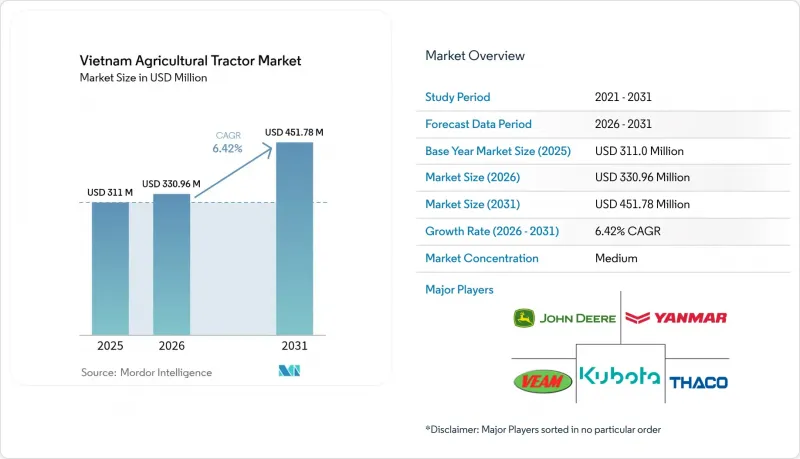
本報告按引擎功率(15馬力以下、15-30馬力、31-45馬力及以上)、驅動方式(兩輪驅動和四輪驅動)、應用領域(農田、果園和人工林)以及動力技術(柴油、混合動力和純電動)進行細分。市場預測以美元計價。
越南農業曳引機市場趨勢及洞察
人們越來越關注農業機械化。
勞動力向工業區外流導致農業部門勞動力短缺,促使農場機械化程度提高以維持生產力。國家發展計畫鼓勵減少體力勞動,推動了全部區域農業機械的需求。在沿海地區,農業機械租賃服務正成為新的收入來源,使農民無需購買即可使用機械。在湄公河三角洲等肥沃地區,大面積耕地加速了農業機械化的普及。檢驗中心確保設備符合安全標準,增強了人們對機械使用的信心,並加速了向技術主導農業的轉型。
政府對機械化的補貼激增
政府的財政措施正透過低利率貸款和扶持本地機械製造商來推動農業機械的引進。這些補貼減輕了農民的經濟負擔,並鼓勵他們投資能夠提高生產力的設備。這些項目增強了國內零件供應商的實力,減少了對進口的依賴,並縮短了交貨時間。基於績效的資金投入確保了補貼機械能夠切實提高作物產量和作業效率。這種模式正在推動農業現代化和加強農業供應鏈,從而促進農村經濟發展。
土地所有權結構極為分散
越南農業的特徵是土地所有權結構分散且規模小規模,限制了規模經濟效益,也限制了農民投資農業機械的能力。由於耕地面積小,個人擁有農業機械在經濟上不可行。在此背景下,「土地服務提供者」應運而生,為農業機械的共享使用提供中介服務。在山區,陡峭的地形增加了營運成本,並限制了大型機械的使用。儘管政府正致力於整合農地以提高機械化潛力,但傳統的社會習俗和繼承法阻礙了這一進程,迫使農民依賴非正式的共用協議和社區解決方案。
細分市場分析
預計到2025年,46-75馬力等級的農用曳引機將佔越南農用曳引機市場規模的40.62%,充分展現了其在越南多樣化地形中的適用性。這些中型農用曳引機能夠有效率地完成稻田和旱地的犁地、耙地和運輸作業。它們能夠操作多行播種機並輕鬆穿越狹窄的田頭,因此深受追求動力和操控性平衡的農民的青睞。緊湊型31-45馬力曳引機的成長率最高,年複合成長率達5.74%,主要得益於湄公河三角洲等地區小規模農場的增加,在這些地區,成本和操控性是農民的首要考慮因素。
15馬力以下的農用曳引機仍活躍於北方梯田,而75馬力及以上的機型則被應用於大規模的合約農場。目前,業界正在為中功率的機型標配GPS、ISOBUS相容性和遙測功能。這些機型易於升級,以適應精密農業,例如變數施肥。專注於31-75馬力機型混合動力化的製造商預計銷量和利潤率將有所成長。
預計到2025年,四輪驅動曳引機將佔越南農業曳引機市場佔有率的57.48%,年複合成長率達6.43%。其廣泛應用反映了在水稻田和陡峭的咖啡種植園中對可靠牽引力的需求。這些曳引機能夠減少打滑,最大限度地減少土壤壓實,並能承載更重的農具,即使在雨季地區也能保持其基本功能。雖然兩輪驅動曳引機在乾燥的高地地區仍然實用,但隨著融資管道的改善,四輪驅動曳引機更容易獲得,其市場佔有率正在下降。
四輪驅動農用曳引機每年可提高 18% 的運作,進而提升投資報酬率。電動曳引機由於四輪驅動系統需要更大的動力,因此面臨許多技術挑戰。雖然智慧扭矩向量控制可以有效管理電力消耗,但可靠的充電基礎設施仍然至關重要。目前,製造商正致力於動力傳動系統效率演算法和牽引力最佳化技術,以滿足數據驅動型農業的需求,競相降低每公頃的油耗和瓦時消耗。
其他好處:
- Excel格式的市場預測(ME)表
- 3個月的分析師支持
目錄
第1章:引言
- 研究假設和市場定義
- 調查範圍
第2章:調查方法
第3章執行摘要
第4章 市場狀況
- 市場概覽
- 市場促進因素
- 人們越來越關注農業機械化。
- 政府對機械化的補貼激增
- 擴大合約農業計劃
- 擴大高附加價值作物的種植面積
- 擴大對農產品的貿易支持
- 擴大低利率農業銀行貸款機制
- 市場限制因素
- 土地所有權結構極為分散
- 農產品價格波動
- 農村地區電動曳引機充電基礎設施不足
- 熟練農民短缺
- 監理情勢
- 技術展望
- 波特五力分析
第5章 市場規模與成長預測
- 按引擎輸出
- 小於15馬力
- 15~30 HP
- 31~45 HP
- 46~75 HP
- 75馬力或以上
- 透過驅動系統
- 兩輪驅動(2WD)
- 四輪驅動(4WD)
- 透過使用
- 農地農業
- 果園和人工林
- 透過推進技術
- 柴油引擎
- 混合
- 純電動
第6章 競爭情勢
- 市場集中度
- 策略趨勢
- 市佔率分析
- 公司簡介
- Kubota Corporation
- Yanmar Holdings Co., Ltd.
- Vietnam Engine & Agricultural Machinery Corp(VEAM)
- Iseki & Co., Ltd.
- Truong Hai Group Corporation(THACO)
- Deere & Company(TTC Bien Hoa)
- Mahindra & Mahindra Ltd.
- LS Group
- Zetor Tractors as(HTC Investments)
- Zoomlion Heavy Industry Science and Technology Co., Ltd.
第7章 市場機會與未來展望
According to Mordor Intelligence, the Vietnam agricultural tractor market size is expected to grow from USD 311.0 million in 2025 to USD 330.96 million in 2026 and is forecast to reach USD 451.78 million by 2031 at 6.42% CAGR over 2026-2031.
This report is Segmented by Engine Power (Less Than 15 HP, 15-30 HP, 31-45 HP, and More), by Drive Type (Two-Wheel Drive and Four-Wheel Drive), by Application (Row-Crop Farming and Orchard and Plantation), and by Propulsion Technology (Diesel, Hybrid, and Fully Electric). The Market Forecasts are Provided in Terms of Value (USD).
Vietnam Agricultural Tractor Market Trends and Insights
Rising Focus on Farm Mechanization
Labor migration to industrial centers is creating workforce gaps in agriculture, driving farms to adopt mechanization to maintain productivity. National development plans encourage a shift from manual labor, increasing the need for machinery across rural regions. In coastal areas, machinery services have become an income stream, helping farmers access equipment without ownership costs. Larger plot sizes in fertile regions like the Mekong Delta support mechanized farming adoption. Inspection centers ensure equipment meets safety standards, increasing confidence in machine use and supporting the transition to technology-driven agricultural practices.
Surge in Government Mechanization Subsidies
Government financial initiatives are increasing agricultural machinery adoption through low-interest loans and support for local equipment manufacturers. These subsidies lower farmers' financial burden and encourage investment in productivity-enhancing tools. The programs strengthen domestic parts suppliers, reducing import dependence and shortening delivery times. Performance-based funding ensures subsidized equipment improves crop yields and operational efficiency. This approach modernizes farming practices and strengthens the agricultural supply chain, supporting rural economic development.
Highly Fragmented Landholding Structure
Vietnam's agricultural sector is characterized by small, fragmented landholdings, which restrict farmers' ability to invest in machinery due to limited economies of scale. The small plot sizes make individual equipment ownership financially impractical. Land-service providers have emerged as intermediaries, offering shared machinery access. In mountainous areas, steep terrain increases operational costs and limits the use of large machinery. Despite government initiatives for land consolidation to improve mechanization potential, traditional social practices and inheritance laws impede progress, forcing farmers to rely on informal sharing arrangements and community-based solutions.
Other drivers and restraints analyzed in the detailed report include:
- Growth of Contract-farming Programs
- Expansion of High-value Crop Acreage
- Limited Rural Charging Infrastructure for E-tractors
For complete list of drivers and restraints, kindly check the Table Of Contents.
Segment Analysis
The 46-75 HP segment accounts for 40.62% of the 2025 Vietnam agricultural tractor market size, demonstrating its versatility across Vietnamese terrains. These mid-range agricultural tractors effectively handle plowing, harrowing, and transport tasks in rice paddies and upland fields. Their capacity to operate multi-row planters while navigating tight headlands makes them popular among farmers seeking balanced power and maneuverability. Compact 31- 45 HP units show the highest growth at 5.74% CAGR, driven by smaller farm sizes in regions like the Mekong Delta, where cost and agility are primary concerns.
Agricultural tractors under 15 HP maintain their presence in terraced northern plots, while units above 75 HP serve larger contract farms. The industry now incorporates GPS, ISOBUS compatibility, and telemetry in mid-power machines as standard features. These frames readily accommodate precision agriculture upgrades like variable-rate fertilization, and manufacturers focusing on 31-75 HP models for hybridization position themselves for increased volume and margins.
Four-wheel-drive tractors represent 57.48% of the Vietnam agricultural tractor market share in 2025, growing at a 6.43% CAGR. Their prevalence reflects the requirement for reliable traction in water-logged rice paddies and steep coffee estates. These machines reduce slippage, minimize soil compaction, and support heavier implements without stalling essential features in monsoon regions. Two-wheel-drive units remain viable in dry upland areas but decline as financing options improve four-wheel-drive accessibility.
Four-wheel-drive agricultural tractors record 18% more annual operating hours, improving investment returns. Electric variants face engineering challenges due to the increased power requirements of four-wheel systems. While intelligent torque vectoring manages power consumption, a reliable charging infrastructure remains crucial. Manufacturers now focus on power-train efficiency algorithms and traction optimization, competing on fuel or watt-hour consumption per hectare to meet data-driven farming needs.
Complete Report Scope:
- By Engine Power
- Less than 15 HP
- 15 - 30 HP
- 31- 45 HP
- 46 -75 HP
- Above 75 HP
- By Drive Type
- Two-wheel Drive (2WD)
- Four-wheel Drive (4WD)
- By Application
- Row-crop Farming
- Orchard and Plantation
- By Propulsion Technology
- Diesel
- Hybrid
- Fully Electric
List of Companies Covered in this Report:
- Kubota Corporation
- Yanmar Holdings Co., Ltd.
- Vietnam Engine & Agricultural Machinery Corp (VEAM)
- Iseki & Co., Ltd.
- Truong Hai Group Corporation (THACO)
- Deere & Company (TTC Bien Hoa)
- Mahindra & Mahindra Ltd.
- LS Group
- Zetor Tractors a.s. (HTC Investments)
- Zoomlion Heavy Industry Science and Technology Co., Ltd.
Additional Benefits:
- The market estimate (ME) sheet in Excel format
- 3 months of analyst support
TABLE OF CONTENTS
1 Introduction
- 1.1 Study Assumptions and Market Definition
- 1.2 Scope of the Study
2 Research Methodology
3 Executive Summary
4 Market Landscape
- 4.1 Market Overview
- 4.2 Market Drivers
- 4.2.1 Rising Focus on Farm Mechanization
- 4.2.2 Surge in Government Mechanization Subsidies
- 4.2.3 Growth of Contract-farming Programs
- 4.2.4 Expansion of High-value Crop Acreage
- 4.2.5 Growing Trade Support for Agricultural Goods
- 4.2.6 Emerging Low-interest Agribank Credit Lines
- 4.3 Market Restraints
- 4.3.1 Highly Fragmented Landholding Structure
- 4.3.2 Volatility in Farm Commodity Prices
- 4.3.3 Limited Rural Charging Infrastructure for E-tractors
- 4.3.4 Shortage of Skilled Farmers
- 4.4 Regulatory Landscape
- 4.5 Technological Outlook
- 4.6 Porter's Five Forces Analysis
- 4.6.1 Bargaining Power of Suppliers
- 4.6.2 Bargaining Power of Buyers
- 4.6.3 Threat of New Entrants
- 4.6.4 Threat of Substitute Products
- 4.6.5 Intensity of Competitive Rivalry
5 Market Size and Growth Forecasts (Value)
- 5.1 By Engine Power
- 5.1.1 Less than 15 HP
- 5.1.2 15 - 30 HP
- 5.1.3 31- 45 HP
- 5.1.4 46 -75 HP
- 5.1.5 Above 75 HP
- 5.2 By Drive Type
- 5.2.1 Two-wheel Drive (2WD)
- 5.2.2 Four-wheel Drive (4WD)
- 5.3 By Application
- 5.3.1 Row-crop Farming
- 5.3.2 Orchard and Plantation
- 5.4 By Propulsion Technology
- 5.4.1 Diesel
- 5.4.2 Hybrid
- 5.4.3 Fully Electric
6 Competitive Landscape
- 6.1 Market Concentration
- 6.2 Strategic Moves
- 6.3 Market Share Analysis
- 6.4 Company Profiles (Includes Global Level Overview, Market Level Overview, Core Segments, Financials as Available, Strategic Information, Market Rank/Share for Key Companies, Products and Services, and Recent Developments)
- 6.4.1 Kubota Corporation
- 6.4.2 Yanmar Holdings Co., Ltd.
- 6.4.3 Vietnam Engine & Agricultural Machinery Corp (VEAM)
- 6.4.4 Iseki & Co., Ltd.
- 6.4.5 Truong Hai Group Corporation (THACO)
- 6.4.6 Deere & Company (TTC Bien Hoa)
- 6.4.7 Mahindra & Mahindra Ltd.
- 6.4.8 LS Group
- 6.4.9 Zetor Tractors a.s. (HTC Investments)
- 6.4.10 Zoomlion Heavy Industry Science and Technology Co., Ltd.
7 Market Opportunities and Future Outlook

 中國農業曳引機市場:市場佔有率分析、產業趨勢與統計及成長預測(2026-2031年)德國農業曳引機機械:市場佔有率分析、行業趨勢和統計數據、成長預測(2026-2031)亞太地區農業曳引機:市佔率分析、產業趨勢與統計及成長預測(2026-2031 年)北美農業曳引機:市場佔有率分析、行業趨勢和統計數據以及成長預測(2026-2031 年)南美洲農業曳引機市場佔有率分析、行業趨勢和統計數據以及成長預測(2026-2031 年)美國農業曳引機機械:市場佔有率分析、行業趨勢和統計數據、成長預測(2026-2031 年)
 2026年全球果園曳引機市場報告
 農業曳引機市場:2026-2032年全球市場預測(按曳引機類型、功率範圍、燃料類型、應用和最終用戶分類)印度農業曳引機和機械:市場佔有率分析、行業趨勢和統計數據以及成長預測(2026-2031 年)
 果園曳引機市場機會、成長要素、產業趨勢分析及2026-2035年預測