


 |
市場調查報告書
商品編碼
2113235
美國農業曳引機機械:市場佔有率分析、行業趨勢和統計數據、成長預測(2026-2031 年)United States Agricultural Tractor Machinery - Market Share Analysis, Industry Trends & Statistics, Growth Forecasts (2026 - 2031) |
||||||

※ 本網頁內容可能與最新版本有所差異。詳細情況請與我們聯繫。
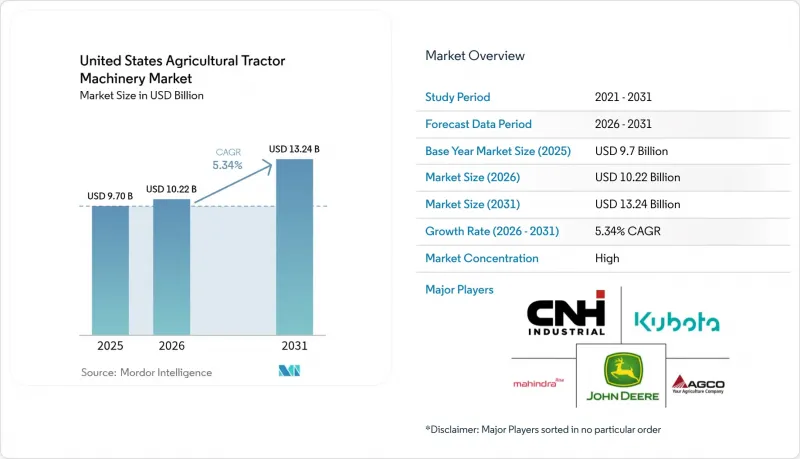
據 Mordor Intelligence 稱,2025 年美國農業曳引機機械市場價值為 97 億美元,預計到 2031 年將從 2026 年的 102.2 億美元成長至 132.4 億美元,預測期(2026-2031 年)的複合年成長率為 5.34%。
本報告依產品類型(犁地機械、播種機械、噴霧器等)進行分類。市場預測以美元計價。
美國農業曳引機機械市場趨勢與洞察
精密農業的擴展
全球定位系統 (GPS) 導航、變數施肥控制器和地塊控制噴嘴已成為1500英畝以上農場的標準配備。至2024年,美國中西部地區75%的玉米和大豆面積將採用GPS導航技術,高於2020年的62%。勞動力短缺使得田間人工調整不切實際,迫使農民依賴自動化。隨著遠端資訊處理資料傳輸到雲端平台,轉換成本不斷上升,競爭優勢也從馬力轉向軟體互通性。隨著舊農機設備達到使用壽命終點,升級改造會自動整合感測器和連接功能,進而提升美國農業曳引機市場的單機技術價值。
加大電氣化獎勵
聯邦政府提供的稅額扣抵可涵蓋購買電動或混合動力設備成本的30%,加上加州逐步淘汰小型柴油引擎的舉措,正在刺激對低馬力電池驅動曳引機的需求。 2024年,Monarch Tractor公司在該技術的商業性可行性方面取得了重大進展,向加州農民交付了200多台配備農具的電動曳引機。雖然電動驅動系統並未取代高馬力行間作物種植領域,但它們正在為面積小於500英畝的特色農場開闢一個平行市場。這種市場分化進一步豐富了美國農業曳引機機械市場的產品線。
缺乏尖端技術的維修技能
到2024年,68%的農機經銷商報告技術人員短缺,高級技術職位的平均招募週期超過120天。持續存在的農村寬頻覆蓋不足問題(影響美國約30%的農地)進一步限制了遠距離診斷的有效性,並削弱了精準農機具的運作優勢。因此,擁有密集且資源豐富的服務網路的原始設備製造商(OEM)享有明顯的競爭優勢,而規模小規模的企業和新參與企業則難以在全部區域維持足夠的客戶支援。
細分市場分析
至2025年,播種機仍將維持其在美國農業曳引機機械市場中最大的細分市場地位,佔30.62%。在1500英畝及以上的農場,變數播種技術已接近飽和,即時種子間距調整和下壓力控制正逐漸從高階配置轉變為標配功能。這些精準技術的廣泛應用正在縮小硬體價格差距,競爭焦點也轉向附加價值服務,例如農業諮詢、數據分析以及與農場管理平台的整合。如今,農民不僅重視播種機的質量,還重視軟體相容性、經銷商校準支援以及最佳化產量和投入效率的實用建議,這提升了播種機在美國農業曳引機機械市場中的戰略重要性。
噴霧器是成長最快的細分市場,預計到2031年將以7.52%的複合年成長率成長。分段控制噴嘴和脈衝寬度調變(PWM)系統已成為2000英畝及以上農場的標準配置,精準噴灑正從可選升級轉變為營運必要。牽引式噴桿設計正逐漸被整合GPS和可變噴灑速率控制器的自走式噴霧器所取代。美國中西部地區的農作物種植者認為,額外花費30萬至50萬美元購買這些設備,可以節省勞動成本、減少重複噴灑農藥,並更好地遵守環境法規,因此物有所值。由於這些機器可以將數據直接傳輸到農場管理軟體,因此擁有強大的軟體生態系統和經銷商校準支援的製造商擁有顯著的競爭優勢,這凸顯了智慧噴霧器技術在美國農業機械市場中日益重要的作用。
其他好處:
- Excel格式的市場預測(ME)表
- 3個月的分析師支持
目錄
第1章:引言
- 研究假設和市場定義
- 調查範圍
第2章:調查方法
第3章執行摘要
第4章 市場狀況
- 市場概覽
- 市場促進因素
- 精密農業的擴展
- 擴大電氣化獎勵
- 大型農場人事費用不斷上漲
- 經銷商主導的訂閱模式採用率高
- 第232條關稅:向在地化生產過渡
- 低排放設備的碳權收入
- 市場限制因素
- 資本投資增加
- 價格波動
- 尖端技術維護技能存在缺口
- 將鋼鐵和鋁關稅的成本轉嫁出去
- 監理情勢
- 技術展望
- 波特五力分析
第5章 市場規模與成長預測
- 依產品類型
- 犁地和翻土機械
- 犁
- 光環
- 旋耕機和耕耘機
- 其他
- 播種機
- 播種機
- 播種機
- 撒佈器
- 其他
- 噴霧器
- 乾草和飼料機械
- 割草機和壓草機
- 打包機
- 其他
- 其他
- 犁地和翻土機械
第6章 競爭情勢
- 市場集中度
- 策略趨勢
- 市佔率分析
- 公司簡介
- Deere & Company
- CNH Industrial NV
- AGCO Corporation
- Kubota Corporation
- Mahindra & Mahindra Ltd.
- Claas Group
- SDF Group
- Buhler Industries
- Yanmar Holdings
- JCB Group
- Trimble Inc.
- Monarch Tractor
- Autonomous Solutions Inc.
- Blue White Robotics
第7章 市場機會與未來展望
According to Mordor Intelligence, the United States agricultural tractor machinery market size was valued at USD 9.7 billion in 2025 and estimated to grow from USD 10.22 billion in 2026 to reach USD 13.24 billion by 2031, at a CAGR of 5.34% during the forecast period (2026-2031).
This report is Segmented by Product Type (Plowing and Cultivating Machinery, Planting Machinery, Sprayers, and More). The Market Forecasts are Provided in Terms of Value (USD).
United States Agricultural Tractor Machinery Market Trends and Insights
Increase in Adoption of Precision Agriculture
Global Positioning System (GPS) guidance, variable-rate controllers, and section-control nozzles have become standard practices on farms exceeding 1,500 acres. In 2024, 75% of Midwest corn and soybean acres were planted using GPS-guided technology, up from 62% in 2020 . Farmers rely on automation because labor shortages make manual in-field adjustments unworkable. Telematics now feeds data to cloud platforms, which raises switching costs, so the competitive edge is tied to software interoperability rather than horsepower. As older implements reach the end of their life, upgrades automatically embed sensors and connectivity, increasing the technology content per unit in the United States agricultural tractor machinery market.
Rising in Electrification Incentives
Federal tax credits that cover up to 30% of electric or hybrid equipment cost and California rules that phase out small diesel engines are stimulating demand for lower-horsepower battery units . Monarch Tractor shipped more than 200 electric tractors with paired implements to California growers in 2024, marking a significant milestone in the commercial viability of the technology. Electric drives are not displacing the high-horsepower row-crop segment but are carving out a parallel lane for specialty farms under 500 acres. This bifurcation widens the product palette inside the United States agricultural tractor machinery market.
Advanced-Technology Maintenance Skill Gap
In 2024, 68% of equipment dealers reported technician shortages, with average hiring times exceeding 120 days for advanced-technology roles. Persistent rural broadband gaps affecting nearly 30% of the United States' farmland further limit the effectiveness of remote diagnostics, reducing the uptime benefits of precision tractor implements. As a result, OEMs (Original Equipment Manufacturers) with dense, well-resourced service networks gain a clear competitive edge, while smaller or newer market entrants struggle to maintain adequate support coverage across dispersed farming regions.
Other drivers and restraints analyzed in the detailed report include:
- Labor Cost Inflation on Large Farms
- High Adoption of Dealer-Led Subscription Models
- Steel and Aluminum Tariff Cost Pass-Through
For complete list of drivers and restraints, kindly check the Table Of Contents.
Segment Analysis
Planting machinery retained its position as the largest segment at 30.62% of the United States agricultural tractor machinery market size in 2025. Variable-rate seeding is nearing saturation on farms above 1,500 acres, making real-time seed spacing and downforce control standard rather than premium features. This normalization of precision technology has compressed hardware price spreads, pushing competition toward value-added services such as agronomic advice, data analytics, and integration with farm-management platforms. Farmers now prioritize not only the quality of seeding equipment but also software compatibility, dealer calibration support, and actionable insights that optimize yields and input efficiency, reinforcing the strategic importance of planting machinery in the United States agricultural tractor machinery market.
Sprayers are the fastest-growing segment with a projected 7.52% CAGR through 2031. Section-control nozzles and pulse-width-modulation systems have become standard for farms over 2,000 acres, turning precision application from an optional upgrade into an operational necessity. Pull-type boom designs are gradually giving way to self-propelled sprayers with integrated GPS and variable-rate controllers. Midwest row-crop growers justify the USD 300,000 to USD 500,000 premium through labor savings, reduced chemical overlap, and improved environmental compliance. Because these machines feed data directly into farm-management software, manufacturers with strong software ecosystems and dealer calibration support gain a significant competitive edge, highlighting the growing role of smart sprayer technologies in the United States agricultural tractor machinery market.
Complete Report Scope:
- By Product Type
- Plowing and Cultivating Machinery
- Plows
- Harrows
- Rotovators and Cultivators
- Other Plowing and Cultivating Machinery
- Planting Machinery
- Seed Drills
- Planters
- Spreaders
- Other Planting Machinery
- Sprayers
- Haying and Forage Machinery
- Mowers and Conditioners
- Balers
- Other Haying and Forage Machinery
- Other Types
- Plowing and Cultivating Machinery
List of Companies Covered in this Report:
- Deere & Company
- CNH Industrial N.V.
- AGCO Corporation
- Kubota Corporation
- Mahindra & Mahindra Ltd.
- Claas Group
- SDF Group
- Buhler Industries
- Yanmar Holdings
- JCB Group
- Trimble Inc.
- Monarch Tractor
- Autonomous Solutions Inc.
- Blue White Robotics
Additional Benefits:
- The market estimate (ME) sheet in Excel format
- 3 months of analyst support
TABLE OF CONTENTS
1 Introduction
- 1.1 Study Assumptions and Market Definition
- 1.2 Scope of the Study
2 Research Methodology
3 Executive Summary
4 Market Landscape
- 4.1 Market Overview
- 4.2 Market Drivers
- 4.2.1 Increase in Adoption of Precision Agriculture
- 4.2.2 Rising in Electrification Incentives
- 4.2.3 Labor Cost Inflation on Large Farms
- 4.2.4 High Adoption of Dealer-Led Subscription Models
- 4.2.5 Section 232 Tariff-Driven Localization
- 4.2.6 Carbon-Credit Revenue for Low-Emission Equipment
- 4.3 Market Restraints
- 4.3.1 High Equipment Capital Expenditure
- 4.3.2 Commodity-Price Volatility
- 4.3.3 Advanced-Technology Maintenance Skill Gap
- 4.3.4 Steel and Aluminum Tariff Cost Pass-Through
- 4.4 Regulatory Landscape
- 4.5 Technological Outlook
- 4.6 Porters Five Forces Analysis
- 4.6.1 Threat of New Entrants
- 4.6.2 Bargaining Power of Suppliers
- 4.6.3 Bargaining Power of Buyers
- 4.6.4 Threat of Substitutes
- 4.6.5 Intensity of Competitive Rivalry
5 Market Size and Growth Forecasts (Value)
- 5.1 By Product Type
- 5.1.1 Plowing and Cultivating Machinery
- 5.1.1.1 Plows
- 5.1.1.2 Harrows
- 5.1.1.3 Rotovators and Cultivators
- 5.1.1.4 Other Plowing and Cultivating Machinery
- 5.1.2 Planting Machinery
- 5.1.2.1 Seed Drills
- 5.1.2.2 Planters
- 5.1.2.3 Spreaders
- 5.1.2.4 Other Planting Machinery
- 5.1.3 Sprayers
- 5.1.4 Haying and Forage Machinery
- 5.1.4.1 Mowers and Conditioners
- 5.1.4.2 Balers
- 5.1.4.3 Other Haying and Forage Machinery
- 5.1.5 Other Types
- 5.1.1 Plowing and Cultivating Machinery
6 Competitive Landscape
- 6.1 Market Concentration
- 6.2 Strategic Moves
- 6.3 Market Share Analysis
- 6.4 Company Profiles (Includes Global Level Overview, Market Level Overview, Core Segments, Financials as Available, Strategic Information, Market Rank/Share, Products & Services, and Recent Developments)
- 6.4.1 Deere & Company
- 6.4.2 CNH Industrial N.V.
- 6.4.3 AGCO Corporation
- 6.4.4 Kubota Corporation
- 6.4.5 Mahindra & Mahindra Ltd.
- 6.4.6 Claas Group
- 6.4.7 SDF Group
- 6.4.8 Buhler Industries
- 6.4.9 Yanmar Holdings
- 6.4.10 JCB Group
- 6.4.11 Trimble Inc.
- 6.4.12 Monarch Tractor
- 6.4.13 Autonomous Solutions Inc.
- 6.4.14 Blue White Robotics
7 Market Opportunities and Future Outlook

 越南農業曳引機:市場佔有率分析、產業趨勢與統計及成長預測(2026-2031)中國農業曳引機市場:市場佔有率分析、產業趨勢與統計及成長預測(2026-2031年)德國農業曳引機機械:市場佔有率分析、行業趨勢和統計數據、成長預測(2026-2031)亞太地區農業曳引機:市佔率分析、產業趨勢與統計及成長預測(2026-2031 年)北美農業曳引機:市場佔有率分析、行業趨勢和統計數據以及成長預測(2026-2031 年)南美洲農業曳引機市場佔有率分析、行業趨勢和統計數據以及成長預測(2026-2031 年)
 2026年全球果園曳引機市場報告
 農業曳引機市場:2026-2032年全球市場預測(按曳引機類型、功率範圍、燃料類型、應用和最終用戶分類)印度農業曳引機和機械:市場佔有率分析、行業趨勢和統計數據以及成長預測(2026-2031 年)
 果園曳引機市場機會、成長要素、產業趨勢分析及2026-2035年預測