


 |
市場調查報告書
商品編碼
2121722
歐洲黏合劑和密封劑:市場佔有率分析、行業趨勢和統計數據以及成長預測(2026-2031 年)Europe Adhesives And Sealants - Market Share Analysis, Industry Trends & Statistics, Growth Forecasts (2026 - 2031) |
||||||

※ 本網頁內容可能與最新版本有所差異。詳細情況請與我們聯繫。
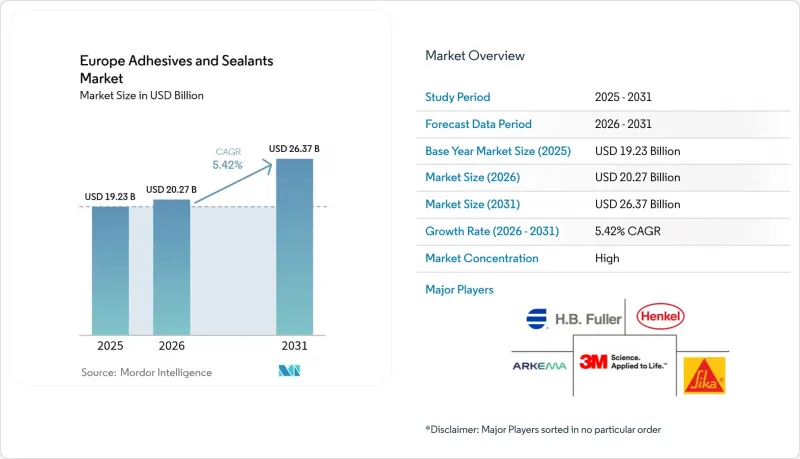
據 Mordor Intelligence 稱,歐洲黏合劑和密封劑市場預計到 2026 年價值 202.7 億美元,高於 2025 年的 192.3 億美元,預計到 2031 年將達到 263.7 億美元。
預計 2026 年至 2031 年的複合年成長率為 5.42%。
本報告按黏合劑樹脂(丙烯酸、氰基丙烯酸酯、環氧樹脂、其他)、黏合劑技術(熱熔、反應型、溶劑型、其他)、密封劑樹脂(聚氨酯、環氧樹脂、丙烯酸、其他)、最終用戶產業(航太、汽車、建築、其他)和地區(德國、英國、法國、義大利、西班牙、俄羅斯、北歐國家和其他歐洲國家)進行分類。
歐洲黏合劑和密封劑市場的趨勢和洞察
住宅翻新需求增加
受強制性節能要求和疫情後生活方式改變的影響,歐洲的維修活動正蓬勃發展,人們在隔熱材料、地板材料和門窗維修的支出不斷增加。歐盟「翻新浪潮」計畫旨在2030年將建築維修加倍,從而推動對消除熱橋的連續黏合系統的需求。在德國每年500億歐元(約584.5億美元)的翻新市場中,生物基產品,例如漢高的“樂泰HB S ECO”,正被擴大選用。與化石燃料基產品相比,該產品可減少60%以上的二氧化碳排放。北歐供應商在預製外牆板的工廠塗裝黏合劑的開發方面處於領先地位,這種黏合劑既能實現現場快速組裝,又能滿足嚴格的室內空氣品質標準。預計這種維修需求將使歐洲黏合劑和密封劑市場的銷售量持續成長至2028年。
電子商務包裹量激增
隨著小包裹運輸量的成長,加工商擴大採用符合歐洲包裝聯合會 (FEICA) 發布的紙張回收指南的快速、無溶劑黏合劑解決方案。軟包裝黏合劑需要支援單一材料設計,以簡化歐盟塑膠戰略下的回收流程,同時保持黏合強度和脫墨性能之間的平衡。德國和荷蘭正在進行自動化生產線的升級改造,以滿足對精確黏度控制和快速固化的需求。這些趨勢正在推動歐洲市場的逐步成長,尤其是適用於高速加工的熱熔膠和水性黏合劑及密封劑。
日益成長的環境問題
REACH法規中關於二異氰酸酯的規定將於2023年8月生效,屆時將強制要求對聚氨酯體系進行重組或對工人進行培訓;而甲醛排放上限規定將於2026年8月生效,這將加速向超低排放等級的過渡。新增的247種高度關注物質(SVHC),包括八甲基三矽氧烷,進一步加劇了監管的不確定性。永續發展的投資將使歐洲化學工業的年度資本支出增加70%,這將對利潤率造成壓力,但也會刺激生物基原料的長期創新。
細分市場分析
由於丙烯酸樹脂用途廣泛且對多種基材具有良好的黏合性,預計到2025年,其在歐洲黏合劑和密封劑市場將保持36.55%的市場佔有率。同時,隨著碳排放法規日益嚴格,預計到2031年,包括生物基創新產品在內的其他樹脂將以6.58%的複合年成長率成長。隨著BASF將可再生丙烯酸乙酯推向市場,以及木聚醣基熱熔膠被證實可重複使用且搭接剪切強度達到30 MPa,歐洲黏合劑和密封劑市場中生物基樹脂的市場規模預計將會擴大。氰基丙烯酸黏合劑因其在電子設備小型化方面的應用而備受關注,聚氨酯混煉商正在開發無需接受二異氰酸酯處理培訓的濕固化系統。矽基產品在高溫應用領域不斷成長,而VAE/EVA則憑藉其成本優勢保持著一定的市場佔有率。
2025年,水性平台產品將佔總銷售額的42.70%,這反映了其成熟的生產線以及對VOC法規的合規性。同時,由於組裝廠對即時黏合的需求,預計到2031年,UV固化系統將以6.21%的複合年成長率成長。 Panacol的黑色UV環氧樹脂目前被指定用於電動車馬達線束的應力消除接頭,因為它能形成較厚的固化層,並消除陰影區域。
反應型熱熔膠兼具快速固化和強黏合力,廣泛應用於高速包裝生產線。在航太領域,溶劑型產品的需求依然強勁,因為該領域對較長的開放時間要求很高;同時,高固態產品有助於滿足日益嚴格的排放法規。 LED-UV燈的升級正在降低能耗,並進一步加速歐洲黏合劑和密封劑市場的技術轉型。
其他好處
- Excel格式的市場預測(ME)表
- 3個月的分析師支持
目錄
第1章:引言
- 研究假設和市場定義
- 調查範圍
第2章:調查方法
第3章執行摘要
第4章 市場狀況
- 市場概覽
- 市場促進因素
- 住宅翻新需求增加
- 電子商務包裹量激增
- 加速歐洲汽車產業的減重進程
- 快速成長的風力發電機葉片黏接市場
- 預製和模組化建築的普及
- 市場限制因素
- 日益成長的環境問題
- 原物料價格波動
- 使用機器人進行黏合劑塗抹工作的工人技能存在差距
- 價值鏈分析
- 波特五力模型
第5章 市場規模與成長預測
- 黏合劑樹脂類型
- 丙烯酸纖維
- 氰基丙烯酸酯
- 環氧樹脂
- 聚氨酯
- 矽
- VAE/EVA
- 其他樹脂(矽烷改質聚合物(SMP)、生物基樹脂等)
- 黏合劑技術
- 熱熔膠
- 反應型
- 溶劑型
- 紫外線固化型
- 水溶液
- 密封樹脂類型
- 聚氨酯
- 環氧樹脂
- 丙烯酸纖維
- 矽
- 其他樹脂(聚硫化物、SMP混合樹脂等)
- 按最終用戶行業分類
- 航太
- 車
- 建築/施工
- 鞋類和皮革
- 衛生保健
- 包裝
- 木工和細木工
- 其他終端用戶產業(可再生能源、電子產品和家用電器等)
- 按地區
- 德國
- 英國
- 法國
- 義大利
- 西班牙
- 俄羅斯
- 北歐國家
- 其他歐洲國家
第6章 競爭情勢
- 市場集中度
- 策略趨勢
- 市佔率和排名分析
- 公司簡介
- 3M
- Akzo Nobel NV
- Arkema
- Avery Dennison Corporation
- BASF
- Dow
- Dymax
- HB Fuller Company
- Henkel AG & Co. KGaA
- Huntsman International LLC.
- Jowat
- Mapei SpA
- Momentive
- Munzing
- PPG Industries, Inc.
- Sika AG
- Soudal Group
- Wacker Chemie AG
第7章 市場機會與未來展望
According to Mordor Intelligence, the Europe adhesives and sealants market size in 2026 is estimated at USD 20.27 billion, growing from 2025 value of USD 19.23 billion with 2031 projections showing USD 26.37 billion, growing at 5.42% CAGR over 2026-2031.
This report is Segmented by Adhesive Resin (Acrylic, Cyanoacrylate, Epoxy, and More), Adhesive Technology (Hot-Melt, Reactive, Solvent-Borne, and More), Sealant Resin (Polyurethane, Epoxy, Acrylic, and More), End-User Industry (Aerospace, Automotive, Building and Construction, and More), and Geography (Germany, United Kingdom, France, Italy, Spain, Russia, NORDIC Countries, and Rest of Europe).
Europe Adhesives And Sealants Market Trends and Insights
Rising Demand from Residential Renovation
European renovation activity is gathering momentum as energy-efficiency mandates and post-pandemic lifestyle shifts lift spending on insulation, flooring, and window upgrades. The EU Renovation Wave aims to double building refurbishment rates by 2030, bolstering demand for continuous-bonding systems that eliminate thermal bridging. Germany's EUR 50 billion (~USD 58.45 billion) annual renovation market increasingly specifies bio-based products such as Henkel's LOCTITE HB S ECO, which cuts embodied CO2 by more than 60% compared with fossil-based counterparts. Nordic suppliers pioneer factory-applied adhesives for prefabricated facade panels, allowing rapid site assembly while meeting stringent indoor-air-quality norms. This renovation push is set to sustain volume growth for the European adhesives and sealants market through 2028.
Surge in E-Commerce Packaging Volumes
Rising parcel shipments prompt converters to adopt high-speed, solvent-free bonding solutions compatible with paper-recycling guidelines published by FEICA. Flexible-packaging adhesives must balance bond strength and de-inkability while supporting mono-material designs that simplify recycling under the EU Plastics Strategy. Germany and the Netherlands are upgrading automated lines that require tight viscosity control and quick setting. These trends underpin incremental gains for the European adhesives and sealants market, especially in hot-melt and waterborne grades engineered for rapid throughput.
Rising Environmental Concerns
REACH diisocyanate restrictions effective August 2023 force reformulation of polyurethane systems or mandatory worker training, while formaldehyde emission ceilings effective August 2026 drive shifts to ultra-low-emission grades. The addition of 247 SVHCs, including octamethyltrisiloxane, extends regulatory uncertainty. Sustainability investment needs 70% higher annual capital outlays across Europe's chemical sector, compressing margins yet spurring long-run innovation in bio-based feedstocks.
Other drivers and restraints analyzed in the detailed report include:
- Accelerating Lightweighting in European Auto Industry
- Fast-Growing Wind-Turbine Blade Bonding Market
- Volatile Feedstock Prices
For complete list of drivers and restraints, kindly check the Table Of Contents.
Segment Analysis
Acrylics retained 36.55% revenue share of the European adhesives and sealants market in 2025, thanks to versatility and adhesion to diverse substrates. Other resins, including bio-based innovations, are forecast to expand 6.58% CAGR to 2031 as carbon-reduction mandates intensify. Europe adhesives and sealants market size for bio-based grades is projected to widen as BASF's renewable ethyl acrylate rolls out and xylan hot-melts demonstrate 30 MPa lap-shear while remaining reusable. Cyanoacrylates gain traction in electronics miniaturization, and polyurethane formulators pursue moisture-curing systems that bypass diisocyanate training. Silicone chemistries grow in high-temperature segments, whereas VAE/EVA retains cost-driven niches.
Waterborne platforms accounted for 42.70% of the 2025 revenue base, reflecting entrenched production lines and alignment with VOC caps. UV-cured systems, however, will post a 6.21% CAGR through 2031 as assembly plants seek instant-bond processing. Panacol's black UV epoxies cure in thicker layers, eliminating shadow areas, and are now specified in EV motor wire stress-relief joints.
Reactive hot melts combine rapid set with strong final bonds, serving high-speed packaging lines. Solvent-borne demand persists in aerospace, where long open time is critical, but higher-solids versions help meet tightening emission norms. Equipment upgrades toward LED-UV lamps cut energy use and further incentivize technology switching in the European adhesives and sealants market.
Complete Report Scope:
- By Adhesive Resin
- Acrylic
- Cyanoacrylate
- Epoxy
- Polyurethane
- Silicone
- VAE / EVA
- Other Resins (Silane-Modified Polymer (SMP), Bio-based Resins, etc.)
- By Adhesive Technology
- Hot-Melt
- Reactive
- Solvent-Borne
- UV-Cured
- Water-Borne
- By Sealant Resin
- Polyurethane
- Epoxy
- Acrylic
- Silicone
- Other Resins (Polysulfide, SMP Hybrid, etc.)
- By End-User Industry
- Aerospace
- Automotive
- Building and Construction
- Footwear and Leather
- Healthcare
- Packaging
- Woodworking and Joinery
- Other End-User Industries (Renewable Energy,Electronics and Appliances, etc.)
- By Geography
- Germany
- United Kingdom
- France
- Italy
- Spain
- Russia
- NORDIC Countries
- Rest of Europe
List of Companies Covered in this Report:
- 3M
- Akzo Nobel N.V.
- Arkema
- Avery Dennison Corporation
- BASF
- Dow
- Dymax
- H.B. Fuller Company
- Henkel AG & Co. KGaA
- Huntsman International LLC.
- Jowat
- Mapei S.p.A
- Momentive
- Munzing
- PPG Industries, Inc.
- Sika AG
- Soudal Group
- Wacker Chemie AG
Additional Benefits:
- The market estimate (ME) sheet in Excel format
- 3 months of analyst support
TABLE OF CONTENTS
1 Introduction
- 1.1 Study Assumptions and Market Definition
- 1.2 Scope of the Study
2 Research Methodology
3 Executive Summary
4 Market Landscape
- 4.1 Market Overview
- 4.2 Market Drivers
- 4.2.1 Rising Demand from Residential-Renovation
- 4.2.2 Surge in E-Commerce Packaging Volumes
- 4.2.3 Accelerating Lightweighting in European Auto Industry
- 4.2.4 Fast-Growing Wind-Turbine Blade Bonding Market
- 4.2.5 Prefab Modular Construction Uptake
- 4.3 Market Restraints
- 4.3.1 Rising Environmental Concerns
- 4.3.2 Volatile Feedstock Prices
- 4.3.3 Skill Gap in Robotic Adhesive-Dispensing Workforce
- 4.4 Value Chain Analysis
- 4.5 Porter's Five Forces
- 4.5.1 Bargaining Power of Suppliers
- 4.5.2 Bargaining Power of Consumers
- 4.5.3 Threat of New Entrants
- 4.5.4 Threat of Substitute Products and Services
- 4.5.5 Degree of Competition
5 Market Size and Growth Forecasts (Value)
- 5.1 By Adhesive Resin
- 5.1.1 Acrylic
- 5.1.2 Cyanoacrylate
- 5.1.3 Epoxy
- 5.1.4 Polyurethane
- 5.1.5 Silicone
- 5.1.6 VAE / EVA
- 5.1.7 Other Resins (Silane-Modified Polymer (SMP), Bio-based Resins, etc.)
- 5.2 By Adhesive Technology
- 5.2.1 Hot-Melt
- 5.2.2 Reactive
- 5.2.3 Solvent-Borne
- 5.2.4 UV-Cured
- 5.2.5 Water-Borne
- 5.3 By Sealant Resin
- 5.3.1 Polyurethane
- 5.3.2 Epoxy
- 5.3.3 Acrylic
- 5.3.4 Silicone
- 5.3.5 Other Resins (Polysulfide, SMP Hybrid, etc.)
- 5.4 By End-User Industry
- 5.4.1 Aerospace
- 5.4.2 Automotive
- 5.4.3 Building and Construction
- 5.4.4 Footwear and Leather
- 5.4.5 Healthcare
- 5.4.6 Packaging
- 5.4.7 Woodworking and Joinery
- 5.4.8 Other End-User Industries (Renewable Energy,Electronics and Appliances, etc.)
- 5.5 By Geography
- 5.5.1 Germany
- 5.5.2 United Kingdom
- 5.5.3 France
- 5.5.4 Italy
- 5.5.5 Spain
- 5.5.6 Russia
- 5.5.7 NORDIC Countries
- 5.5.8 Rest of Europe
6 Competitive Landscape
- 6.1 Market Concentration
- 6.2 Strategic Moves
- 6.3 Market Share(%)/Ranking Analysis
- 6.4 Company Profiles (includes Global level Overview, Market level overview, Core Segments, Financials as available, Strategic Information, Market Rank/Share for key companies, Products and Services, and Recent Developments)
- 6.4.1 3M
- 6.4.2 Akzo Nobel N.V.
- 6.4.3 Arkema
- 6.4.4 Avery Dennison Corporation
- 6.4.5 BASF
- 6.4.6 Dow
- 6.4.7 Dymax
- 6.4.8 H.B. Fuller Company
- 6.4.9 Henkel AG & Co. KGaA
- 6.4.10 Huntsman International LLC.
- 6.4.11 Jowat
- 6.4.12 Mapei S.p.A
- 6.4.13 Momentive
- 6.4.14 Munzing
- 6.4.15 PPG Industries, Inc.
- 6.4.16 Sika AG
- 6.4.17 Soudal Group
- 6.4.18 Wacker Chemie AG
7 Market Opportunities and Future Outlook
- 7.1 White-space and Unmet-Need Assessment
- 7.2 EU Green Deal push for low-VOC and circular materials
- 7.3 Innovation and Development of Bio-based Adhesives

 黏合劑和密封劑:市場佔有率分析、行業趨勢和統計數據、成長預測(2026-2031 年)彈性黏合劑和密封劑:市場佔有率分析、行業趨勢和統計數據、成長預測(2026-2031 年)印度黏合劑和密封劑市場:市場佔有率分析、行業趨勢和統計數據以及成長預測(2026-2031 年)中東和非洲的黏合劑和密封劑:市場佔有率分析、行業趨勢和統計數據以及成長預測(2025-2031 年)
 建築圍護結構黏合劑和密封劑市場-2026-2032年全球市場預測防水黏合劑和密封劑市場:2026-2032年全球市場預測(依產品類型、技術、形態、固化機制、基材、最終用途、應用和分銷通路分類)黏合劑和密封劑市場:2026-2032年全球市場預測(按產品類型、技術、形態、最終用途產業、應用和分銷管道分類)彈性黏合劑和密封劑市場:按樹脂類型、包裝類型、技術、形式、終端用戶產業和分銷管道分類-全球預測,2026-2032年混合型黏合劑和密封劑:市場佔有率分析、行業趨勢和統計數據以及成長預測(2026-2031 年)
 雙層玻璃黏合劑和密封劑市場報告:按樹脂類型、最終用戶和地區分類(2026-2034 年)