


 |
市場調查報告書
商品編碼
2115014
彈性黏合劑和密封劑:市場佔有率分析、行業趨勢和統計數據、成長預測(2026-2031 年)Elastic Bonding Adhesive And Sealant - Market Share Analysis, Industry Trends & Statistics, Growth Forecasts (2026 - 2031) |
||||||

※ 本網頁內容可能與最新版本有所差異。詳細情況請與我們聯繫。
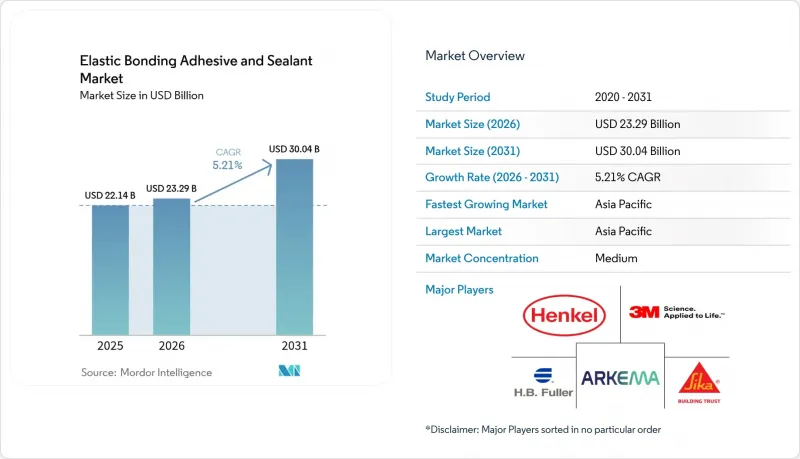
根據 Mordor Intelligence 預測,彈性黏合劑和密封劑的市場規模預計將從 2025 年的 221.4 億美元成長到 2026 年的 232.9 億美元,然後從 2026 年到 2031 年以 5.21% 的複合年成長率,到 2031 年達到 300.4 億美元。
本報告按產品類型(聚氨酯 (PU)、矽烷改質聚合物等)、終端用戶產業(建築和施工、汽車和交通運輸、工業及其他終端用戶產業)和地區(亞太地區、北美地區、歐洲地區、南美地區以及中東和非洲地區)進行細分。市場預測以美元 (USD) 為單位。
全球彈性黏合劑和密封劑市場趨勢及洞察
向輕量化、多材料車輛結構過渡
汽車製造商正用高強度黏合劑取代焊接和鉚接,以減輕車身重量、達到二氧化碳排放目標並改善NVH(噪音、振動和不平順性)。複合材料車身(包括鋼、鋁、碳纖維增強複合材料和生物複合材料)需要使用能夠彌補熱膨脹係數顯著差異的黏合劑。黏合劑的使用量已從2001年每輛車30英尺(約9公尺)增加到目前車型的400多英尺(約122公尺)。在電池式電動車(BEV)中,這種依賴性更為顯著,因為在電池組封裝設計中,需要使用結構黏合劑來散發電池產生的熱量。像Parker LORD這樣的供應商正在推出針對抗剝離性和碰撞能量吸收進行最佳化的丙烯酸和環氧樹脂產品。由於即使減輕0.1公斤的重量也能轉化為續航里程的增加,因此隨著每款新汽車平臺的推出,彈性黏合劑和密封劑市場的需求都在持續成長。
模組化帷幕牆系統的應用日益廣泛
為了縮短工期、降低施工風險並打造精美的玻璃帷幕牆,建築師擴大採用預製幕牆單元。這些系統依賴結構矽酮密封膠,必須能夠承受颶風、地震和紫外線劣化30年以上。 Momentive公司的「UltraGlaze」密封膠已被上海和芝加哥等地的地標嵌裝玻璃所採用。 HB Fuller公司的「Kodiglaze」混合產品使設計師能夠縮小框架截面、增加玻璃面積,並在無需在外牆上鑽孔的情況下整合物聯網感測器。隨著綠高層建築標準對空氣洩漏率的要求越來越嚴格,建築商開始選擇連續輪胎邊緣黏合,這推動了彈性黏合劑和密封膠市場的需求。
原料價格波動(異氰酸酯、矽酮)
2025年初,由於東亞煉油廠停產,MDI供應商宣布不可抗力,導致異氰酸酯價格飆升。此外,石英供不應求和運費上漲也造成矽酮原料價格顯著的周度波動。儘管歐洲環氧樹脂供應因建築需求放緩而恢復,但長期價格前景仍對化合物生產商的利潤率構成壓力。這種不確定性導致產品上市延遲,加工商庫存增加,嚴重限制彈性黏合劑和密封劑市場的短期成長。
細分市場分析
到2025年,聚氨酯將佔據彈性黏合劑和密封劑市場41.63%的佔有率,凸顯其在汽車車身、窗框和風力渦輪機葉片等應用領域的廣泛用途。其韌性、低溫固化性能和廣泛的基材相容性鞏固了其市場地位,但對遊離異氰酸酯濃度的更嚴格監管要求對其配方進行重新評估。隨著加工商尋求無需二次防潮塗層的無VOC塗料,對矽烷改質聚合物的需求正以7.01%的複合年成長率成長。混合型聚氨酯結合了聚氨酯主鏈的強度和矽烷封端基團,延長了保存期限,並確保即使在潮濕氣候下也能無氣泡固化。漢高、西卡和波士特目前供應鋁箔包裝的預聚物混合物,以減少包裝廢棄物並方便機器人應用。矽酮和環氧樹脂化學品在需要耐高溫(180 度C以上)的應用領域中繼續發揮至關重要的作用,例如航太內部裝潢建材、電子灌封和高溫墊片。在這些小眾應用領域,高價策略和小批量生產使得每公斤銷售量保持在高位,從而緩解了彈性黏合劑和密封劑整體市場利潤率的壓力。
第二代生物基聚氨酯從大豆油和蓖麻油中提取多元醇,與石油基同類產品相比,二氧化碳排放量最多可減少40%。德國先導計畫住宅建築試點計畫證實,該產品無需底漆即可黏合交叉層壓材料,從而在大規模木結構建築領域催生了新的需求。奈米管增強環氧樹脂的斷裂韌性提高了30%,使其成為風力渦輪機葉片製造商應對邊緣侵蝕問題的理想選擇。隨著產品系列的多樣化,分銷商現在可以小批量銷售各種SKU,從而促進客製化產品選擇和諮詢服務,進一步鞏固了彈性黏合劑和密封劑市場。
區域分析
預計到2025年,亞太地區將佔全球銷售額的42.88%,到2031年將維持6.67%的複合年成長率,成為所有地區中成長最快的地區。中國強大的電池供應鏈正推動兩位數的成長,進而刺激對導熱間隙填充劑和聚氨酯墊片的需求。在印度,由於公共部門住宅建設和“印度製造”汽車計劃的推進,對黏合劑的需求激增。漢高獲得LEED金級認證的庫爾昆布工廠產能的提升進一步促進了這一需求,縮短了前置作業時間並減少了進口。日本和韓國正致力於精密電子產品和下一代移動出行技術的發展,這需要用於相機模組和ADAS感測器的超低揮發性配方。東南亞國協正在投資建造快速公車(BRT)線路和資料中心,這兩項工程都依賴阻燃密封劑,進一步擴大了該地區對彈性黏合劑和密封劑的需求。
北美仍是第二大市場。加州的VOC排放限制正在加速無溶劑產品的普及,而《通膨抑制法案》正推動數十億美元湧入風力發電和電動車工廠,這兩個產業都需要消耗大量的黏合劑。華盛頓州和魁北克省的主要航太公司正在指定使用耐高溫雙雙馬來亞醯胺糊劑來製造複合材料材料短艙。墨西哥以出口為導向的汽車產業叢集正在引入機器人輪胎邊緣系統,以提高生產週期的可預測性並減少返工,從而為彈性黏合劑和密封劑創造了新的需求來源。
在歐洲,成熟的市場需求和監管主導,加上2023年8月實施的REACH法規將二異氰酸酯含量限制在0.1%以內,正在加速向混合型產品的轉型。這促使德國、奧地利和義大利的研發中心進行了無催化劑固化製程的示範測試。中歐的汽車組裝廠對能夠承受電著底漆爐高溫並吸收碰撞能量的黏合劑技術的需求日益成長。北海的離岸風力發電正在使用耐疲勞環氧樹脂黏合葉片,從而延長更換週期。雖然南美洲、中東和非洲的市場佔有率總合較小,但諸如巴西BR-163高速公路改造和沙烏地阿拉伯GIGA項目等基礎設施建設正在獎勵當地生產,預計未來將有更多企業進入彈性黏合劑和密封劑市場。
其他好處:
- Excel格式的市場預測(ME)表
- 3個月的分析師支持
目錄
第1章:引言
- 研究假設和市場定義
- 調查範圍
第2章:調查方法
第3章執行摘要
第4章 市場狀況
- 市場概覽
- 市場促進因素
- 向輕量化、多材料車輛結構過渡
- 模組化帷幕牆系統的應用日益廣泛
- 更嚴格的VOC法規正在促進無溶劑化學技術的推廣。
- 降低風力發電機葉片疲勞的必要性
- 電動車電池組間隙填充以控制熱衝擊
- 市場限制因素
- 原料價格波動(異氰酸酯、矽酮)
- 新型混合化學組合物的耐久性數據不足
- 智慧機械緊固件作為一種替代解決方案
- 價值鏈分析
- 波特五力分析
第5章 市場規模與成長預測
- 依產品類型
- 聚氨酯(PU)
- 矽烷基和矽烷改質聚合物
- 矽酮
- 其他產品
- 按最終用戶行業分類
- 建築/施工
- 汽車和運輸業
- 產業
- 其他終端用戶產業
- 按地區
- 亞太地區
- 中國
- 印度
- 日本
- 韓國
- ASEAN
- 其他亞太國家
- 北美洲
- 美國
- 加拿大
- 墨西哥
- 歐洲
- 德國
- 英國
- 法國
- 義大利
- 西班牙
- 其他歐洲國家
- 南美洲
- 巴西
- 阿根廷
- 其他南美國家
- 中東和非洲
- 沙烏地阿拉伯
- 阿拉伯聯合大公國
- 南非
- 奈及利亞
- 其他中東和非洲國家
- 亞太地區
第6章 競爭情勢
- 市場集中度
- 策略趨勢
- 市佔率(%)/排名分析
- 公司簡介
- 3M
- Arkema(Bostik)
- Cemedine Co., Ltd.
- Dow
- HB Fuller Company
- Henkel AG & Co. KGaA
- Huntsman International LLC
- Jowat SE
- MAPEI SpA
- Permabond LLC
- PPG Industries, Inc.
- RPM International Inc.
- Sika AG
- ThreeBond Holdings Co. Ltd
- Wacker Chemie AG
第7章 市場機會與未來展望
According to Mordor Intelligence, the elastic bonding adhesive and sealant market size is expected to grow from USD 22.14 billion in 2025 to USD 23.29 billion in 2026 and is forecast to reach USD 30.04 billion by 2031 at 5.21% CAGR over 2026-2031.
This report is Segmented by Product Type (Polyurethane (PU), Silyl and Silane Modified Polymers, and More), End-User Industry (Building and Construction, Automotive and Transportation, Industrial, and Other End-User Industries), and Geography (Asia-Pacific, North America, Europe, South America, and Middle East and Africa). The Market Forecasts are Provided in Terms of Value (USD).
Global Elastic Bonding Adhesive And Sealant Market Trends and Insights
Shift to Lightweight Multi-Material Vehicle Structures
Automakers are replacing welds and rivets with high-strength bonding to shave vehicle weight, meet CO2 targets, and improve NVH. Mixed-material bodies that combine steel, aluminum, CFRP, and bio-composites demand adhesives able to bridge wide differences in thermal expansion. Adoption grew from 30 linear feet of adhesive per car in 2001 to more than 400 feet in current models. Battery-electric vehicles deepen this dependence because cell-to-pack designs require structural bonding that also channels heat away from cells. Suppliers such as Parker LORD have released acrylic and epoxy grades tuned for peel resistance and crash energy absorption. As every tenth of a kilogram saved translates into longer driving range, the Elastic Bonding Adhesive and Sealant market captures recurring volume per new vehicle platform.
Rising Adoption of Modular Facade and Curtain Wall Systems
Architects favor prefabricated facade units to accelerate schedules, lower labor risk, and achieve sleek glass exteriors. These systems rely on structural silicone glazing that must resist hurricane-force winds, seismic sway, and UV degradation for 30 years or more. Momentive UltraGlaze sealants are already specified on landmark towers from Shanghai to Chicago. Kodiglaze hybrids from H.B. Fuller let designers slim frame profiles, enlarge pane area, and integrate IoT sensors without drilling hardware through the envelope. As green-building codes tighten air-leakage rates, builders opt for continuous bead bonding, which raises unit demand for the Elastic Bonding Adhesive and Sealant market.
Raw-Material Price Volatility (Isocyanates, Silicone)
Isocyanate costs surged in early 2025 after refinery outages in East Asia forced force-majeure at MDI suppliers. Silicone feedstock values swung week-to-week due to quartz shortages and freight spikes. Epoxy supply rebounded in Europe when construction demand softened, but the lack of long-term price visibility squeezes formulators' margins. Such unpredictability delays product launches and prompts converters to carry higher inventory, weighing on near-term growth for the Elastic Bonding Adhesive and Sealant market.
Other drivers and restraints analyzed in the detailed report include:
- Stricter VOC Regulations Driving Solvent-Free Chemistries
- Wind-Turbine Blade Fatigue Mitigation Needs
- Limited Durability Data for New Hybrid Chemistries
For complete list of drivers and restraints, kindly check the Table Of Contents.
Segment Analysis
Polyurethane commanded 41.63% of Elastic Bonding Adhesive and Sealant market share in 2025, underlining its versatility in vehicle bodies, window frames, and wind blades. Toughness, low-temperature cure, and broad substrate compatibility keep polyurethane entrenched, yet regulatory scrutiny of free isocyanate levels creates reformulation urgency. Silyl-modified polymer demand is climbing at a 7.01% CAGR as processors seek VOC-free dispensing without secondary moisture-barrier paints. Hybrid grades blend polyurethane backbone strength with silane end-groups, extending shelf life and ensuring bubble-free cures even in humid climates. Henkel, Sika, and Bostik now supply pre-polymer blends shipped in foil packs that cut packaging waste and aid robotic application. Silicone and epoxy chemistries still serve aerospace interiors, electronics potting, and high-temperature gasketing where heat resistance above 180 °C is critical. Within these niche use-cases, premium pricing and lower volume still lift revenue per kilogram, cushioning margin pressure across the Elastic Bonding Adhesive and Sealant market.
Second-generation bio-based polyurethane pulls polyols from soybean oil and castor beans, lowering CO2-equivalent by up to 40% against petroleum analogues. Pilot housing projects in Germany report primer-less adhesion to cross-laminated timber, opening fresh volumes in mass-timber construction. Nanotube-reinforced epoxies deliver 30% higher fracture toughness, appealing to wind-blade makers fighting edge erosion. As product portfolios diversify, distributors carry smaller lot sizes but wider SKU counts, fostering bespoke selection and advisory services that strengthen the Elastic Bonding Adhesive and Sealant market.
Complete Report Scope:
- By Product Type
- Polyurethane (PU)
- Silyl and Silane Modified Polymers
- Silicone
- Other Products
- By End-User Industry
- Building and Construction
- Automotive and Transportation
- Industrial
- Other End-User Industries
- By Geography
- Asia-Pacific
- China
- India
- Japan
- South Korea
- ASEAN
- Rest of Asia-Pacific
- North America
- United States
- Canada
- Mexico
- Europe
- Germany
- United Kingdom
- France
- Italy
- Spain
- Rest of Europe
- South America
- Brazil
- Argentina
- Rest of South America
- Middle East and Africa
- Saudi Arabia
- United Arab Emirates
- South Africa
- Nigeria
- Rest of Middle East and Africa
- Asia-Pacific
Geography Analysis
Asia-Pacific generated 42.88% of global revenue in 2025 and is projected to post a 6.67% CAGR to 2031, the highest regional pace. China's dominant battery supply chain pulls in thermally conductive gap fillers and polyurethane gasketing at double-digit growth. India's adhesive demand surges on public-sector housing and the Make-in-India automotive push, reinforced by Henkel's LEED-Gold Kurkumbh facility ramp-up, which shortens lead times and trims imports. Japan and South Korea focus on precision electronics and next-generation mobility, requiring ultra-low outgassing formulas for camera modules and ADAS sensors. ASEAN economies invest in mass-rapid-transit lines and data centers, both reliant on fire-retardant sealants, therefore extending the regional pull on the Elastic Bonding Adhesive and Sealant market.
North America remains the second-largest market. California's VOC cap accelerates zero-solvent adoption, while the Inflation Reduction Act channels billions into wind-power and EV factories, each consuming kilogram-scale adhesive lines. Aerospace primes in Washington and Quebec specify high-temperature bismaleimide pastes for composite nacelles. Mexico's export-oriented auto clusters integrate robotic bead systems that improve cycle-time predictability and cut rework, contributing new demand nodes to the Elastic Bonding Adhesive and Sealant market.
Europe blends mature demand with regulatory leadership. The August 2023 REACH limit on diisocyanates above 0.1% spurs accelerated substitution toward hybrids, pushing R&D centers in Germany, Austria, and Italy to pilot catalyst-free cure routes. Automotive assembly plants in Central Europe hunger for bonding that tolerates e-coat ovens and provides crash energy absorption. Offshore wind farms in the North Sea rely on fatigue-resistant epoxies for blade bonding, safeguarding replacement intervals. South America and the Middle East and Africa collectively hold smaller shares, yet infrastructure builds such as Brazil's BR-163 upgrades and Saudi giga-projects open localized production incentives, pointing to future participation in the Elastic Bonding Adhesive and Sealant market.
- 3M
- Arkema (Bostik)
- Cemedine Co., Ltd.
- Dow
- H.B. Fuller Company
- Henkel AG & Co. KGaA
- Huntsman International LLC
- Jowat SE
- MAPEI S.p.A.
- Permabond LLC
- PPG Industries, Inc.
- RPM International Inc.
- Sika AG
- ThreeBond Holdings Co. Ltd
- Wacker Chemie AG
Additional Benefits:
- The market estimate (ME) sheet in Excel format
- 3 months of analyst support
TABLE OF CONTENTS
1 Introduction
- 1.1 Study Assumptions and Market Definition
- 1.2 Scope of the Study
2 Research Methodology
3 Executive Summary
4 Market Landscape
- 4.1 Market Overview
- 4.2 Market Drivers
- 4.2.1 Shift to Lightweight Multi-Material Vehicle Structures
- 4.2.2 Rising Adoption of Modular Facade and Curtain Wall Systems
- 4.2.3 Stricter VOC Regulations Driving Solvent-Free Chemistries
- 4.2.4 Wind-Turbine Blade Fatigue Mitigation Needs
- 4.2.5 EV Battery Pack Gap-Filling for Thermal Shock Control
- 4.3 Market Restraints
- 4.3.1 Raw-Material Price Volatility (Isocyanates, Silicone)
- 4.3.2 Limited Durability Data for New Hybrid Chemistries
- 4.3.3 Smart Mechanical Fasteners as Substitute Solutions
- 4.4 Value Chain Analysis
- 4.5 Porter's Five Forces Analysis
- 4.5.1 Bargaining Power of Suppliers
- 4.5.2 Bargaining Power of Buyers
- 4.5.3 Threat of New Entrants
- 4.5.4 Threat of Substitute Products
- 4.5.5 Degree of Competition
5 Market Size and Growth Forecasts (Value)
- 5.1 By Product Type
- 5.1.1 Polyurethane (PU)
- 5.1.2 Silyl and Silane Modified Polymers
- 5.1.3 Silicone
- 5.1.4 Other Products
- 5.2 By End-User Industry
- 5.2.1 Building and Construction
- 5.2.2 Automotive and Transportation
- 5.2.3 Industrial
- 5.2.4 Other End-User Industries
- 5.3 By Geography
- 5.3.1 Asia-Pacific
- 5.3.1.1 China
- 5.3.1.2 India
- 5.3.1.3 Japan
- 5.3.1.4 South Korea
- 5.3.1.5 ASEAN
- 5.3.1.6 Rest of Asia-Pacific
- 5.3.2 North America
- 5.3.2.1 United States
- 5.3.2.2 Canada
- 5.3.2.3 Mexico
- 5.3.3 Europe
- 5.3.3.1 Germany
- 5.3.3.2 United Kingdom
- 5.3.3.3 France
- 5.3.3.4 Italy
- 5.3.3.5 Spain
- 5.3.3.6 Rest of Europe
- 5.3.4 South America
- 5.3.4.1 Brazil
- 5.3.4.2 Argentina
- 5.3.4.3 Rest of South America
- 5.3.5 Middle East and Africa
- 5.3.5.1 Saudi Arabia
- 5.3.5.2 United Arab Emirates
- 5.3.5.3 South Africa
- 5.3.5.4 Nigeria
- 5.3.5.5 Rest of Middle East and Africa
- 5.3.1 Asia-Pacific
6 Competitive Landscape
- 6.1 Market Concentration
- 6.2 Strategic Moves
- 6.3 Market Share (%)/ Ranking Analysis
- 6.4 Company Profiles (includes Global level Overview, Market level overview, Core Segments, Financials as available, Strategic Information, Market Rank/Share for key companies, Products and Services, and Recent Developments)
- 6.4.1 3M
- 6.4.2 Arkema (Bostik)
- 6.4.3 Cemedine Co., Ltd.
- 6.4.4 Dow
- 6.4.5 H.B. Fuller Company
- 6.4.6 Henkel AG & Co. KGaA
- 6.4.7 Huntsman International LLC
- 6.4.8 Jowat SE
- 6.4.9 MAPEI S.p.A.
- 6.4.10 Permabond LLC
- 6.4.11 PPG Industries, Inc.
- 6.4.12 RPM International Inc.
- 6.4.13 Sika AG
- 6.4.14 ThreeBond Holdings Co. Ltd
- 6.4.15 Wacker Chemie AG
7 Market Opportunities and Future Outlook
- 7.1 White-space and Unmet-need Assessment

 黏合劑和密封劑:市場佔有率分析、行業趨勢和統計數據、成長預測(2026-2031 年)歐洲黏合劑和密封劑:市場佔有率分析、行業趨勢和統計數據以及成長預測(2026-2031 年)印度黏合劑和密封劑市場:市場佔有率分析、行業趨勢和統計數據以及成長預測(2026-2031 年)中東和非洲的黏合劑和密封劑:市場佔有率分析、行業趨勢和統計數據以及成長預測(2025-2031 年)
 建築圍護結構黏合劑和密封劑市場-2026-2032年全球市場預測防水黏合劑和密封劑市場:2026-2032年全球市場預測(依產品類型、技術、形態、固化機制、基材、最終用途、應用和分銷通路分類)黏合劑和密封劑市場:2026-2032年全球市場預測(按產品類型、技術、形態、最終用途產業、應用和分銷管道分類)彈性黏合劑和密封劑市場:按樹脂類型、包裝類型、技術、形式、終端用戶產業和分銷管道分類-全球預測,2026-2032年混合型黏合劑和密封劑:市場佔有率分析、行業趨勢和統計數據以及成長預測(2026-2031 年)
 雙層玻璃黏合劑和密封劑市場報告:按樹脂類型、最終用戶和地區分類(2026-2034 年)