


 |
市場調查報告書
商品編碼
2121468
黏合劑和密封劑:市場佔有率分析、行業趨勢和統計數據、成長預測(2026-2031 年)Adhesives And Sealants - Market Share Analysis, Industry Trends & Statistics, Growth Forecasts (2026 - 2031) |
||||||

※ 本網頁內容可能與最新版本有所差異。詳細情況請與我們聯繫。
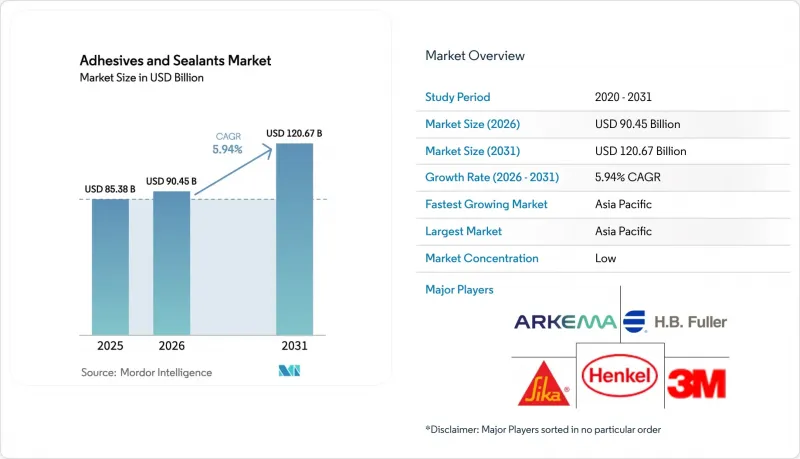
預計到 2026 年,黏合劑和密封劑市場價值將達到 904.5 億美元,高於 2025 年的 853.8 億美元,預計到 2031 年將達到 1206.7 億美元。
預計 2026 年至 2031 年的複合年成長率為 5.94%。
本報告黏合劑樹脂(聚氨酯、環氧樹脂等)、黏合劑技術(溶劑型、反應型等)、密封劑樹脂(矽酮、聚氨酯等)、終端用戶產業(航太、汽車等)和地區(亞太地區、北美、歐洲、南美、中東和非洲)進行細分。市場預測以美元計價。
全球黏合劑和密封劑市場趨勢及洞察
輕量化、多材料汽車組件的激增正在推動結構性黏著劑的應用。
電動車製造商正以結構性黏著劑取代焊接和鉚接,以減輕重量、提高碰撞安全性,並實現鋁、複合材料和高抗張強度鋼的連接。黏合劑也用於固定電池外殼,在溫度控管和電絕緣方面發揮重要作用。電池組內部的熱界面材料在黏合劑和密封劑市場中佔據著特殊的地位,因為它們可以防止電池過熱並延長電池壽命。汽車製造商期望膠合劑技術能夠在較大的溫度波動範圍內保持尺寸穩定性,並在車輛的整個使用壽命期間承受液體的侵蝕。這些嚴格的要求促使複合材料開發商採用兼具強度和柔軟性的反應型聚氨酯熱熔膠和改質環氧樹脂。因此,電動車的日益普及正在推動黏合劑和密封劑市場對結構膠合劑的需求。
全球電子商務的爆炸性成長催生了對高性能包裝黏合劑解決方案的需求。
在直接面對消費者的運輸中,瓦楞紙箱會受到振動、潮濕和極端溫度變化的影響,因此品牌商紛紛採用高黏性熱熔膠和水性膠系統,以確保在複雜的物流鏈中實現牢固密封。包裝產業佔黏合劑和密封劑市場的43%,隨著電子商務交易量的成長,這一佔有率仍在持續擴大。如今,永續性標準要求黏合劑必須與可回收製程相容。漢高和Paksize聯合推出了Eco-Pax,這是一種生物基熱熔膠,每年生產3.4億個紙箱可減少32%的溫室氣體排放。此外,自動化瓦楞紙箱組裝為了節能,還需要即使在低溫下也能流動的低黏度黏合劑。這些促進因素的創新正在推動黏合劑和密封劑市場穩步銷售量。
異氰酸酯和丙烯酸單體的供應鏈不穩定,造成成本壓力。
歐盟新規要求所有處理遊離異氰酸酯含量超過0.1%的聚氨酯產品的員工必須接受專門培訓,這增加了管理成本,並限制了中小型加工商的准入。同時,丙烯酸供應緊張加劇了價格波動,迫使終端用戶每季重新談判合約。製造商正透過在地化原料採購和採用植物油等生物基生產方式來規避風險,但這些措施需要資本投入,並擠壓了利潤空間。原物料價格的急劇上漲正蔓延至下游價格,導致建築和汽車業的專案核准延遲。因此,黏合劑和密封劑市場必須在保持性能的同時應對不斷上漲的成本,而這種平衡需求正在減緩市場成長前景。
細分市場分析
2025年,丙烯酸樹脂在黏合劑和密封劑市場中佔據23.45%的佔有率,這主要得益於其與多種基材的兼容性以及經濟實惠的價格。然而,預計2026年至2031年矽酮的複合年成長率將達到8.23%,這表明市場將轉向對耐高溫和耐候性要求較高的應用領域,尤其是在汽車電子和建築外觀。這種轉變是由性能差異化所驅動的。矽酮黏合劑在-50 度C至200 度C的溫度範圍內保持彈性,具有良好的電絕緣性和抗紫外線劣化性能,因此適用於LED組件和5G天線模組。相較之下,丙烯酸樹脂正在透過新一代配方進行應對,這些配方透過對功能單體的改性,實現了更快的固化速度以及對低表面能塑膠的黏合力。聚氨酯仍然是承受動態負載的結構連接的理想選擇,而氰基丙烯酸黏合劑則應用於精密醫療設備和家用電子電器產品領域。由甘油和木質素製成的生物基環氧樹脂在早期階段就展現出良好的前景,這標誌著黏合劑和密封劑產業正在逐步脫碳。
水性系統符合區域揮發性有機化合物(VOC)法規,且對多孔基材具有優異的黏合力,預計到2025年將佔銷售額的41.70%。這些體系在黏合劑和密封劑市場的關鍵細分領域佔據主導地位,例如瓦楞紙箱封裝、標籤覆膜和家具組裝。聚合物分散技術的進步正在縮短乾燥時間,從而消除自動化生產線中傳統的速度限制。
反應型技術透過交聯形成熱固性網路,實現了以往只有環氧樹脂才具備的結構強度,從而在黏合劑和密封劑產業中實現了7.98%的最高複合年成長率。反應型聚氨酯熱熔膠由於即時初始強度高,且遇水後能形成最終化學鍵,因此可縮短家電和運輸設備製造商的組裝時間。紫外光固化丙烯酸酯滿足了電子和醫療設備應用的需求,這些應用對無溶劑性和快速加工至關重要。溶劑型和橡膠基系統仍應用於汽車內裝和鞋類等特定領域,其獨特的黏性和剝離強度平衡使其能夠克服監管障礙。
區域分析
預計到2025年,亞太地區將佔全球銷售額的36.70%,年複合成長率達6.44%,主要得益於大型企劃以及電子供應鏈東南亞國協的轉移。中國持續投資大規模高速鐵路和可再生能源,刺激了對風力渦輪機葉片用結構密封劑和黏合劑系統的需求。印度1.4兆美元的國家基礎設施計畫正在推動道路、機場和經濟適用住宅建設領域的黏合劑消費。越南和韓國電子製造業的擴張,推動了該地區對用於半導體和顯示面板的低空隙率、高導熱性黏合劑的需求。由於這些產業對溫度穩定性的要求不斷提高,矽酮產品從中受益最大,亞太地區也因此繼續保持其在黏合劑和密封劑市場的主導地位。
北美是一個成熟的市場,技術差異化和快速遵守法規至關重要。 2024年,美國電動車產量突破100萬輛,推動了電池組和車身本體組裝用結構膠合劑和耐撞黏合劑的需求成長。聯邦政府對橋樑和寬頻的撥款進一步刺激了對能夠在惡劣氣候條件下保持柔軟性的土木密封膠的需求。在加拿大木結構建築領域,聚氨酯黏合劑,這種膠黏劑透過氣密性組裝提高能源效率。隨著製造商提供與現有產品相容且符合加州空氣資源委員會 (CARB) 和美國環保署 (EPA) VOC 法規的水性替代品,黏合劑和密封劑市場正以中等個位數的穩定成長率成長。
在歐洲,歐盟綠色交易呼籲在2050年實現碳中和產品,這正在推動市場發展。製造商正在加速向木質素和酚類替代品以及生物基環氧樹脂轉型,以維持市場准入。經認證的低VOC黏合劑正被用於德國和斯堪的納維亞預製構件廠的層壓木材(CLT)模組中,從而提振了對用於門窗和幕牆密封的矽酮的需求。歐洲黏合劑和密封劑市場受益於嚴格的品質要求,但監管合規成本正在降低息稅前利潤率。東歐的汽車工廠正在擴大生產設施,進一步增加了該地區對黏合劑的需求。
南美洲雖然規模較小,但仍是一個充滿活力的市場。在巴西,住宅短缺促使政府資助的社會計畫引入矽酮和丙烯酸密封劑,用於建造低成本住宅。在阿根廷的農產品包裝產業,熱熔膠正在改進,以滿足長期儲存和出口的要求。在智利,礦業公司正在採用耐酸混合密封黏合劑,從而在黏合劑和密封劑市場中開闢了一個新的成長領域。
在中東和非洲地區,沙烏地阿拉伯的NEOM新城和奈及利亞的拉各斯-伊巴丹鐵路等基礎建設項目正在推動市場成長。在氣候條件惡劣的地區,具有高抗紫外線和耐砂磨損性能的矽酮和聚硫密封膠備受青睞。海灣國家的進口替代政策促進了本地黏合劑工廠的建立,從而降低了運輸成本和交貨週期。整體而言,不同的氣候條件和監管環境正在塑造區域內各黏合劑和密封膠企業的產品線差異化。
其他好處:
- Excel格式的市場預測(ME)表
- 3個月的分析師支持
目錄
第1章:引言
- 研究假設和市場定義
- 調查範圍
第2章:調查方法
第3章執行摘要
第4章 市場狀況
- 市場概覽
- 市場促進因素
- 輕量化、多材料汽車組件的激增正在推動結構性黏著劑的應用。
- 在全球範圍內,電子商務的爆炸式成長推動了對高性能包裝黏合劑解決方案的需求。
- 亞太地區模組化和預製建築方法的快速發展
- 歐盟綠色交易和全球監管運動正在加速採用生物基、低VOC黏合劑。
- 醫療保健穿戴式裝置的普及推動了對醫用級反應型熱熔膠的需求。
- 市場限制因素
- 異氰酸酯和丙烯酸單體的供應鏈高度不穩定,對成本帶來了上行壓力。
- 嚴格的環境法規對揮發性有機化合物(VOC)排放進行監管
- 新興市場中機械緊固件替代品的低成本限制了其市場滲透率。
- 價值鏈分析
- 波特五力模型
第5章 市場規模與成長預測
- 通過粘合樹脂
- 聚氨酯
- 環氧樹脂
- 丙烯酸纖維
- 矽酮
- 氰基丙烯酸酯
- VAE/EVA
- 其他樹脂(聚酯、橡膠等)
- 透過黏合技術
- 溶劑型
- 反應性
- 熱熔膠
- 紫外線固化型
- 水溶液
- 密封樹脂類型
- 矽酮
- 聚氨酯
- 丙烯酸纖維
- 環氧樹脂
- 其他樹脂(瀝青基樹脂、聚硫化物基紫外光固化樹脂等)
- 按最終用戶行業分類
- 航太
- 車
- 建築/施工
- 鞋類和皮革
- 衛生保健
- 包裝(紙質和軟包裝)
- 木工和細木工
- 其他終端用戶產業(電子產品、消費品/DIY等)
- 按地區
- 亞太地區
- 中國
- 印度
- 日本
- 韓國
- 印尼
- 馬來西亞
- 泰國
- 越南
- 其他亞太國家
- 北美洲
- 美國
- 加拿大
- 墨西哥
- 歐洲
- 德國
- 英國
- 法國
- 義大利
- 西班牙
- 俄羅斯
- 土耳其
- 北歐國家
- 其他歐洲國家
- 南美洲
- 巴西
- 阿根廷
- 哥倫比亞
- 其他南美國家
- 中東和非洲
- 沙烏地阿拉伯
- 阿拉伯聯合大公國
- 卡達
- 埃及
- 南非
- 阿爾及利亞
- 中東和非洲其他地區
- 亞太地區
第6章 競爭情勢
- 市場集中度
- 策略趨勢
- 市佔率分析
- 公司簡介(包括全球整體概覽、市場概覽、主要業務板塊、財務資訊、策略資訊、市場排名/佔有率、產品和服務以及近期發展動態)
- 3M
- Aica Kogyo Co. Ltd.
- Akzo Nobel NV
- Arkema SA(Bostik)
- Avery Dennison Corporation
- DELO Industrial Adhesives
- DIC Corporation
- Dow
- DuPont
- Dymax
- HB Fuller Company
- Henkel AG & Co. KGaA
- Illinois Tool Works Inc.
- MAPEI SpA
- Nanpao Resins Chemical Group
- Parker Hannifin
- Permabond LLC
- Pidilite Industries Ltd.
- RPM International Inc.
- Sika AG
- Soudal Group
- Wacker Chemie AG
第7章 市場機會與未來展望
According to Mordor Intelligence, adhesives and sealants market size in 2026 is estimated at USD 90.45 billion, growing from 2025 value of USD 85.38 billion with 2031 projections showing USD 120.67 billion, growing at 5.94% CAGR over 2026-2031.
This report is Segmented by Adhesive Resin (Polyurethane, Epoxy, and More), Adhesives Technology (Solvent-Borne, Reactive, and More), Sealant Resin (Silicone, Polyurethane, and More), End-User Industry (Aerospace, Automotive, and More), and Geography (Asia-Pacific, North America, Europe, South America, and Middle East and Africa). The Market Forecasts are Provided in Terms of Value (USD).
Global Adhesives And Sealants Market Trends and Insights
Surge in Lightweight Multi-material Vehicle Assemblies Boosting Structural Adhesive Uptake
Electric-vehicle makers are replacing welds and rivets with structural adhesives to save weight, improve crash performance, and enable joining of aluminum, composites, and high-strength steel. Adhesives also secure battery housings, where they manage heat and provide electrical insulation. Thermal interface materials inside packs prevent runaway and extend battery life, creating a specialized niche within the adhesives and sealants market. Automakers expect bonding technologies to remain dimensionally stable across wide temperature swings and resist fluid exposure for the entire vehicle lifespan. Such stringent requirements are pushing formulators toward reactive polyurethane hot-melts and modified epoxies that combine strength with flexibility. Growing EV penetration therefore acts as a structural demand catalyst for the adhesives and sealants market.
Explosive Growth of E-commerce Requiring High-Performance Packaging Adhesive Solutions Globally
Direct-to-consumer shipping exposes cartons to vibration, humidity, and temperature extremes, prompting brand owners to adopt high-tack hot-melt and water-based systems that keep packages sealed throughout complex logistics chains. Packaging represents 43% of the adhesives and sealants market and continues to expand as e-commerce volumes rise. Sustainability standards now require adhesives compatible with recycling streams; Henkel and Packsize introduced Eco-Pax, a bio-based hot-melt that can cut greenhouse gas emissions by 32% per 340 million boxes produced annually. Automated case-erection lines also demand low-viscosity grades that flow at reduced temperatures to save energy. Innovation in this driver underpins steady volume growth in the adhesives and sealants market.
Volatile Isocyanate & Acrylic Monomer Supply Chains Creating Cost Pressures
New EU rules require special training for anyone handling polyurethane systems with greater than 0.1% free isocyanate, adding administrative cost and limiting smaller converters' access. Parallel tightness in acrylic acid supply elevates price volatility, prompting end users to renegotiate contracts quarterly. Producers hedge by localizing feedstock procurement and adopting bio-routes from vegetable oils, yet these measures involve capital outlays that weigh on margins. Sudden spikes in raw-material indices ripple through downstream prices, delaying project approvals in construction and automotive. The adhesives and sealants market must therefore navigate cost inflation while maintaining performance, a balancing act that tempers the growth outlook.
Other drivers and restraints analyzed in the detailed report include:
- Rapid Expansion of Modular & Prefabricated Construction Methods in Asia-Pacific
- EU Green Deal & Global Regulatory Push Accelerating Bio-based, Low-VOC Adhesives
- Stringent Environmental Regulations Regarding VOC Emissions
For complete list of drivers and restraints, kindly check the Table Of Contents.
Segment Analysis
Acrylic resins generated 23.45% of the adhesives and sealants market revenue in 2025, favored for broad substrate compatibility and moderate cost. Nevertheless, silicone's 8.23% CAGR over 2026-2031 signals a pivot toward high-temperature, weather-resistant applications, notably in automotive electronics and building facades. Performance differentiation drives this shift. Silicone adhesives retain elasticity from -50 °C to 200 °C, remain electrically insulating, and resist UV degradation, making them fit for LED assemblies and 5G antenna modules. Acrylics respond with next-generation formulations that cure faster and bond low-surface-energy plastics through functional monomer modifications. Polyurethane remains the choice for structural joints exposed to dynamic loads, while cyanoacrylates serve precision medical and consumer electronics uses. Bio-based epoxies produced from glycerol and lignin showcase early-stage potential, signaling a gradual decarbonization of the adhesives and sealants industry.
Water-based systems held 41.70% revenue in 2025, aided by compliance with regional VOC caps and robust adhesion on porous substrates. They dominate corrugated box sealing, label lamination, and furniture assembly, all critical subsegments of the adhesives and sealants market. Product advances in polymer dispersion lower drying times, addressing historical speed constraints on automated lines.
Reactive technologies deliver the fastest 7.98% CAGR in the adhesives and sealants industry because they crosslink into thermoset networks, achieving structural strength once considered exclusive to epoxies. Reactive polyurethane hot-melts supply instant green strength plus final chemical bonding after moisture exposure, reducing assembly time for appliance and transportation manufacturers. UV-cured acrylates address electronics and medical devices where solvent elimination and rapid throughput are essential. Solvent-borne and rubber-based systems persist in niche uses, such as automotive interior trim and footwear, where their unique balance of tack and peel strength offsets regulatory hurdles.
Complete Report Scope:
- By Adhesive Resin
- Polyurethane
- Epoxy
- Acrylic
- Silicone
- Cyanoacrylate
- VAE / EVA
- Other Resins (Polyester, Rubber, etc.)
- By Adhesive Technology
- Solvent-borne
- Reactive
- Hot Melt
- UV-cured
- Water-borne
- By Sealant Resin
- Silicone
- Polyurethane
- Acrylic
- Epoxy
- Other Resins (Bituminous, Polysulfide UV-curable, etc.)
- By End-user Industry
- Aerospace
- Automotive
- Building and Construction
- Footwear and Leather
- Healthcare
- Packaging (Paper and Flexible)
- Woodwork and Joinery
- Other End-user Industries (Electronics, Consumer/DIY, etc.)
- By Geography
- Asia-Pacific
- China
- India
- Japan
- South Korea
- Indonesia
- Malaysia
- Thailand
- Vietnam
- Rest of Asia-Pacific
- North America
- United States
- Canada
- Mexico
- Europe
- Germany
- United Kingdom
- France
- Italy
- Spain
- Russia
- Turkey
- Nordic Countries
- Rest of Europe
- South America
- Brazil
- Argentina
- Colombia
- Rest of South America
- Middle East and Africa
- Saudi Arabia
- United Arab Emirates
- Qatar
- Egypt
- South Africa
- Algeria
- Rest of Middle and Africa
- Asia-Pacific
Geography Analysis
Asia-Pacific generated 36.70% of global revenue in 2025 and is growing at 6.44% CAGR, driven by infrastructure megaprojects and the relocation of electronics supply chains into ASEAN nations. China continues large-scale high-speed rail and renewable-energy investments, stimulating demand for structural sealants and wind blade bonding systems. India's USD 1.4 trillion National Infrastructure Pipeline channels adhesive consumption into roads, airports, and affordable housing. Electronics manufacturing in Vietnam and South Korea deepens regional requirements for low-void, high-thermal-conductivity adhesives used in semiconductors and display panels. Silicone products benefit most, given relentless pursuit of temperature stability in these sectors, ensuring Asia-Pacific retains primacy within the adhesives and sealants market.
North America represents a mature arena emphasizing technology differentiation and rapid regulatory alignment. U.S. electric-vehicle output surpassed 1 million units in 2024, raising consumption of structural, crash-durable adhesives for battery packs and body-in-white assemblies. Federal funding for bridges and broadband further elevates demand for civil-engineering sealants that remain flexible under extreme climates. Canadian wood-frame construction accelerates adoption of polyurethane adhesives that improve energy efficiency through airtight assemblies. The adhesives and sealants market shows steady mid-single-digit growth as producers offer drop-in water-borne alternatives conforming to CARB and EPA VOC limits.
Europe is shaped by the EU Green Deal's call for carbon-neutral products by 2050. Manufacturers accelerate the transition to lignin-based phenolic alternatives and bio-renewable epoxies to retain market access. German and Nordic prefabrication plants rely on certified low-VOC adhesives in cross-laminated timber modules, reinforcing silicone demand for window and facade sealing. The adhesives and sealants market in Europe benefits from stringent quality expectations, though compliance costs lower EBIT margins. Eastern European vehicle plants broaden production footprints, amplifying regional adhesive requirements.
South America remains a small but vibrant arena. Brazil's housing deficit spurs government-funded social programs that channel silicone and acrylic sealants into low-cost housing. Argentina's agricultural packaging sector benefits from hot-melt upgrades to address prolonged storage and export routes. Chilean miners apply hybrid sealants that withstand acid exposure, adding niche growth pockets inside the adhesives and sealants market.
The Middle East & Africa lean on infrastructure ambitions such as Saudi Arabia's NEOM city and Nigeria's Lagos-Ibadan railway. Harsh climates reward silicone and polysulfide sealants with elevated UV and sand-abrasion resistance. Import substitution policies in the Gulf encourage local adhesive plants, reducing freight costs and delivery times. Overall, diverse climatic and regulatory landscapes shape differentiated product lineups for regional players in the adhesives and sealants market.
- 3M
- Aica Kogyo Co. Ltd.
- Akzo Nobel N.V.
- Arkema S.A. (Bostik)
- Avery Dennison Corporation
- DELO Industrial Adhesives
- DIC Corporation
- Dow
- DuPont
- Dymax
- H.B. Fuller Company
- Henkel AG & Co. KGaA
- Illinois Tool Works Inc.
- MAPEI S.p.A.
- Nanpao Resins Chemical Group
- Parker Hannifin
- Permabond LLC
- Pidilite Industries Ltd.
- RPM International Inc.
- Sika AG
- Soudal Group
- Wacker Chemie AG
Additional Benefits:
- The market estimate (ME) sheet in Excel format
- 3 months of analyst support
TABLE OF CONTENTS
1 Introduction
- 1.1 Study Assumptions and Market Definition
- 1.2 Scope of the Study
2 Research Methodology
3 Executive Summary
4 Market Landscape
- 4.1 Market Overview
- 4.2 Market Drivers
- 4.2.1 Surge in Lightweight Multi-material Vehicle Assemblies Boosting Structural Adhesive Uptake
- 4.2.2 Explosive Growth of E-commerce Requiring High-Performance Packaging Adhesive Solutions Globally
- 4.2.3 Rapid Expansion of Modular and Prefabricated Construction Methods in Asia-Pacific
- 4.2.4 EU Green Deal and Global Regulatory Push Accelerating Bio-based, Low-VOC Adhesives
- 4.2.5 Healthcare Wearables Adoption Driving Medical-grade Reactive Hot-Melt Adhesives
- 4.3 Market Restraints
- 4.3.1 Volatile Isocyanate and Acrylic Monomer Supply Chains Creating Cost Pressures
- 4.3.2 Stringent Environmental Regulations Regarding VOC Emissions
- 4.3.3 Low Substitution Cost of Mechanical Fasteners in Emerging Markets Limiting Penetration
- 4.4 Value Chain Analysis
- 4.5 Porter's Five Forces
- 4.5.1 Bargaining Power of Suppliers
- 4.5.2 Bargaining Power of Buyers
- 4.5.3 Threat of New Entrants
- 4.5.4 Threat of Substitutes
- 4.5.5 Degree of Competition
5 Market Size and Growth Forecasts (Value)
- 5.1 By Adhesive Resin
- 5.1.1 Polyurethane
- 5.1.2 Epoxy
- 5.1.3 Acrylic
- 5.1.4 Silicone
- 5.1.5 Cyanoacrylate
- 5.1.6 VAE / EVA
- 5.1.7 Other Resins (Polyester, Rubber, etc.)
- 5.2 By Adhesive Technology
- 5.2.1 Solvent-borne
- 5.2.2 Reactive
- 5.2.3 Hot Melt
- 5.2.4 UV-cured
- 5.2.5 Water-borne
- 5.3 By Sealant Resin
- 5.3.1 Silicone
- 5.3.2 Polyurethane
- 5.3.3 Acrylic
- 5.3.4 Epoxy
- 5.3.5 Other Resins (Bituminous, Polysulfide UV-curable, etc.)
- 5.4 By End-user Industry
- 5.4.1 Aerospace
- 5.4.2 Automotive
- 5.4.3 Building and Construction
- 5.4.4 Footwear and Leather
- 5.4.5 Healthcare
- 5.4.6 Packaging (Paper and Flexible)
- 5.4.7 Woodwork and Joinery
- 5.4.8 Other End-user Industries (Electronics, Consumer/DIY, etc.)
- 5.5 By Geography
- 5.5.1 Asia-Pacific
- 5.5.1.1 China
- 5.5.1.2 India
- 5.5.1.3 Japan
- 5.5.1.4 South Korea
- 5.5.1.5 Indonesia
- 5.5.1.6 Malaysia
- 5.5.1.7 Thailand
- 5.5.1.8 Vietnam
- 5.5.1.9 Rest of Asia-Pacific
- 5.5.2 North America
- 5.5.2.1 United States
- 5.5.2.2 Canada
- 5.5.2.3 Mexico
- 5.5.3 Europe
- 5.5.3.1 Germany
- 5.5.3.2 United Kingdom
- 5.5.3.3 France
- 5.5.3.4 Italy
- 5.5.3.5 Spain
- 5.5.3.6 Russia
- 5.5.3.7 Turkey
- 5.5.3.8 Nordic Countries
- 5.5.3.9 Rest of Europe
- 5.5.4 South America
- 5.5.4.1 Brazil
- 5.5.4.2 Argentina
- 5.5.4.3 Colombia
- 5.5.4.4 Rest of South America
- 5.5.5 Middle East and Africa
- 5.5.5.1 Saudi Arabia
- 5.5.5.2 United Arab Emirates
- 5.5.5.3 Qatar
- 5.5.5.4 Egypt
- 5.5.5.5 South Africa
- 5.5.5.6 Algeria
- 5.5.5.7 Rest of Middle and Africa
- 5.5.1 Asia-Pacific
6 Competitive Landscape
- 6.1 Market Concentration
- 6.2 Strategic Moves
- 6.3 Market Share Analysis
- 6.4 Company Profiles {includes Global level Overview, Market level overview, Core Segments, Financials as available, Strategic Information, Market Rank/Share, Products and Services, Recent Developments}
- 6.4.1 3M
- 6.4.2 Aica Kogyo Co. Ltd.
- 6.4.3 Akzo Nobel N.V.
- 6.4.4 Arkema S.A. (Bostik)
- 6.4.5 Avery Dennison Corporation
- 6.4.6 DELO Industrial Adhesives
- 6.4.7 DIC Corporation
- 6.4.8 Dow
- 6.4.9 DuPont
- 6.4.10 Dymax
- 6.4.11 H.B. Fuller Company
- 6.4.12 Henkel AG & Co. KGaA
- 6.4.13 Illinois Tool Works Inc.
- 6.4.14 MAPEI S.p.A.
- 6.4.15 Nanpao Resins Chemical Group
- 6.4.16 Parker Hannifin
- 6.4.17 Permabond LLC
- 6.4.18 Pidilite Industries Ltd.
- 6.4.19 RPM International Inc.
- 6.4.20 Sika AG
- 6.4.21 Soudal Group
- 6.4.22 Wacker Chemie AG
7 Market Opportunities and Future Outlook
- 7.1 Increasing Awareness of Renewable and Eco-friendly Products
- 7.2 White-space and Unmet-need Assessment

 彈性黏合劑和密封劑:市場佔有率分析、行業趨勢和統計數據、成長預測(2026-2031 年)歐洲黏合劑和密封劑:市場佔有率分析、行業趨勢和統計數據以及成長預測(2026-2031 年)印度黏合劑和密封劑市場:市場佔有率分析、行業趨勢和統計數據以及成長預測(2026-2031 年)中東和非洲的黏合劑和密封劑:市場佔有率分析、行業趨勢和統計數據以及成長預測(2025-2031 年)
 建築圍護結構黏合劑和密封劑市場-2026-2032年全球市場預測防水黏合劑和密封劑市場:2026-2032年全球市場預測(依產品類型、技術、形態、固化機制、基材、最終用途、應用和分銷通路分類)黏合劑和密封劑市場:2026-2032年全球市場預測(按產品類型、技術、形態、最終用途產業、應用和分銷管道分類)彈性黏合劑和密封劑市場:按樹脂類型、包裝類型、技術、形式、終端用戶產業和分銷管道分類-全球預測,2026-2032年混合型黏合劑和密封劑:市場佔有率分析、行業趨勢和統計數據以及成長預測(2026-2031 年)
 雙層玻璃黏合劑和密封劑市場報告:按樹脂類型、最終用戶和地區分類(2026-2034 年)