


 |
市場調查報告書
商品編碼
2121651
歐洲勞動力管理軟體:市場佔有率分析、產業趨勢與統計及成長預測(2026-2031 年)Europe Workforce Management Software - Market Share Analysis, Industry Trends & Statistics, Growth Forecasts (2026 - 2031) |
||||||

※ 本網頁內容可能與最新版本有所差異。詳細情況請與我們聯繫。
據 Mordor Intelligence 稱,歐洲勞動力管理軟體市場預計到 2026 年價值 28.9 億美元,高於 2025 年的 26.6 億美元,預計到 2031 年將達到 43.4 億美元。
預計從 2026 年到 2031 年,其複合年成長率將達到 8.48%。
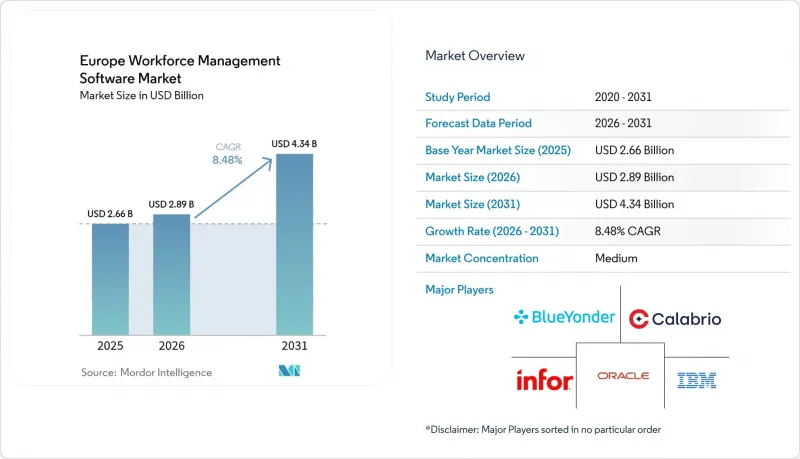
本報告按部署類型(本地部署、雲端部署)、組織規模(中小企業、大型企業)、軟體功能(員工排班和分析、考勤管理等)、最終用戶行業(醫療保健、銀行、金融服務和保險等)以及地區(英國、德國、法國等)進行細分。市場預測以美元計價。
歐洲勞動力管理軟體市場趨勢與洞察
中型企業轉型為「雲端優先」模式。
中型企業正從本地環境遷移到雲端平台,以獲得快速擴充性、整合安全性和跨多地點的即時可見性。大型企業是推動這項遷移的主要力量,預計到2025年,三分之一的中型企業將採用雲端系統。隨著整體擁有成本 (TCO) 在五年內降低超過三分之一,企業正加速擺脫本地伺服器的趨勢。隨著訂閱模式成為標準,不具備雲端原生架構的供應商將在歐洲勞動力管理軟體市場面臨市場佔有率下滑的局面。此次遷移也提高了人們對服務水準的期望,包括持續的功能更新和零停機發布。
引入人工智慧驅動的勞動力預測和排班系統
人工智慧模組將排班方式從被動的工時表管理轉變為預測性最佳化。機器學習模型整合了歷史需求、季節性趨勢和本地事件等外部因素,在受控初步試驗中實現了超過 80% 的預測準確率。零售商和物流供應商報告稱,透過將人工智慧建議與人工監督相結合,生產力提高了 20-30%。儘管準確率不斷提高,但企業仍需要投入資源進行資料品質審核和人工覆蓋,這凸顯了建立強大的訓練資料管道以實現完全自動化的必要性。人工智慧的應用是邁向對話式助理的墊腳石,使現場管理人員能夠透過語音或聊天修改工時表。
GDPR引發了人們對資料主權的擔憂。
對GDPR的嚴格解讀增加了合規成本,因為企業必須證明處理位置、生物識別和行為資料的合法依據。在德國和法國,資料保護機構對未經明確同意的跨境資料傳輸處以重罰,這使得引進週期延長至多一年。供應商正透過部署區域資料中心和「隱私設計」架構來應對,但這些措施推高了開發成本,延遲了新功能的發布,並抑制了歐洲勞動力管理軟體市場的整體成長。
細分市場分析
到2025年,雲端技術將佔歐洲勞動力管理軟體市場62.90%的佔有率,預計到2031年將以11.17%的複合年成長率成長。快速部署、自動續訂和訂閱式收費系統模式正受到尋求節省資金並確保跨多個司法管轄區合規性的企業的強力支持。雖然中型企業引領雲端技術的採用,但大型企業也擴大將各個業務部門遷移到雲端環境,作為更廣泛的數位轉型的一部分。
在嚴格監管的行業和對資料主權要求極高的組織中,本地部署仍然十分普遍。雖然這些用戶重視對資料儲存和系統客製化的直接控制,但由於硬體更新周期帶來的高昂生命週期成本以及對專業內部支援的需求,其發展受到限制。混合模式正逐漸成為一種遷移策略,它允許敏感資料保留在本地,而分析和行動存取則在雲端運行。
到2025年,大型企業將佔據歐洲勞動力管理軟體市場54.60%的收入佔有率。這反映了跨多個地區複雜的排班、薪資核算和合規性要求。整合套件將勞動力管理模組與更廣泛的人力資本管理、薪資核算和財務系統連接起來,從而鞏固了與供應商的長期合作關係。隨著數位化策略的日趨成熟,升級的重點正從完全替換平台轉向人工智慧分析。
預計到2031年,中小企業(SME)的複合年成長率將達到10.63%。雲端服務的普及和付費使用制消除了高昂的前期成本,使得企業級功能得以廣泛應用。面對不斷上漲的人事費用和複雜的加班法規,中小企業採購負責人正在採用勞動力管理工具,這些工具提供以往難以企及的功能,以減輕管理負擔並維護可審計的記錄。
其他好處:
- Excel格式的市場預測(ME)表
- 3個月的分析師支持
目錄
第1章:引言
- 研究假設和市場定義
- 調查範圍
第2章:調查方法
第3章執行摘要
第4章 市場狀況
- 市場概覽
- 市場促進因素
- 面向中型企業的雲端優先遷移
- 引入人工智慧驅動的勞動力預測和排班系統
- 一個用於自動遵守歐盟工作時間指令的系統。
- 能源成本最佳化演算法調度
- 員工福祉與疲勞分析的整合
- 為網站管理員提供人工智慧助手
- 市場限制因素
- GDPR引發了人們對資料主權的擔憂。
- 整合複雜的傳統ERP和WFM系統的成本。
- 工會抗議不透明的排班演算法
- 認證的勞動力管理實施人員短缺
- 價值供應鏈分析
- 監理情勢
- 技術展望
- 波特五力分析
第5章 市場規模與成長預測
- 部署模式
- 現場
- 雲
- 按組織規模
- 小型企業
- 大公司
- 按功能分類的軟體
- 人員排班與分析
- 考勤管理
- 績效和目標管理
- 缺勤和休假管理
- 任務/疲勞管理
- 按最終用戶行業分類
- 衛生保健
- BFSI
- 製造業
- 消費品和零售
- 運輸/物流
- 飯店業
- 國家
- 英國
- 德國
- 法國
- 義大利
- 西班牙
- 荷蘭
- 比利時
- 北歐國家(瑞典、挪威、丹麥、芬蘭)
- 其他歐洲國家(奧地利、葡萄牙等)
第6章 競爭情勢
- 市場集中度
- 策略趨勢
- 市佔率分析
- 公司簡介
- Automatic Data Processing, Inc.(ADP)
- Atoss Software AG
- Blue Yonder Group, Inc.
- Calabrio, Inc.
- Ceridian HCM Holding Inc.
- IBM Corporation
- Infor Global Solutions, Inc.
- NICE Ltd.
- Oracle Corporation
- Quinyx AB
- Reflexis Systems(Zebra Technologies Corp.)
- SAP SE
- SD Worx NV
- SISQUAL Workforce Management, Lda
- Tamigo ApS
- Ultimate Kronos Group(UKG Inc.)
- Verint Systems Inc.
- Workday, Inc.
- WorkForce Software, LLC
- Zucchetti SpA
第7章 市場機會與未來展望
According to Mordor Intelligence, the Europe workforce management software market size in 2026 is estimated at USD 2.89 billion, growing from 2025 value of USD 2.66 billion with 2031 projections showing USD 4.34 billion, growing at 8.48% CAGR over 2026-2031.
This report is Segmented by Deployment Mode (On-Premise, Cloud), Organization Size (Small & Medium Enterprises, Large Enterprises), Software Function (Workforce Scheduling & Analytics, Time & Attendance Management, and More), End-User Industry (Healthcare, BFSI, and More), and Geography (United Kingdom, Germany, France, and More). The Market Forecasts are Provided in Terms of Value (USD).
Europe Workforce Management Software Market Trends and Insights
Cloud-First Migrations Among Mid-Market Employers
Mid-market firms are abandoning on-premise installations for cloud platforms that offer rapid scalability, integrated security, and real-time visibility across multiple sites . companies lead the shift, with one-third of mid-size enterprises already live on cloud systems by 2025. Lower total cost of ownership cut by more than one-third over five years further accelerates movement away from self-hosted servers. Vendors that lack cloud-native architectures face erosion of Europe workforce management software market share as subscription models become the norm. The migration also raises the bar for service-level expectations, including continuous feature updates and zero-downtime releases.
AI-Driven Labor Forecasting and Scheduling Adoption
AI modules elevate scheduling from reactive roster management to predictive optimization. Machine-learning models ingest historical demand, seasonal trends, and external factors such as local events to reach forecast accuracy above 80% in controlled pilots. Retailers and logistics operators report 20-30% productivity gains when AI recommendations are coupled with human oversight. Despite accuracy improvements, enterprises still allocate resources for data-quality audits and manual overrides, highlighting the need for robust training data pipelines before full automation. AI adoption acts as a stepping-stone toward conversational assistants that let frontline managers revise rosters by voice or chat.
GDPR-Driven Data-Sovereignty Concerns
Strict interpretation of GDPR elevates compliance costs as firms must prove lawful bases for processing location, biometric, and behavioral data. In Germany and France, data-protection authorities impose heavy fines for cross-border transfers lacking explicit consent, lengthening implementation cycles by as much as one year. Vendors respond with regional data centers and privacy-by-design architectures, yet these measures drive up development expenses and delay new features, tempering the overall expansion of the Europe workforce management software market.
Other drivers and restraints analyzed in the detailed report include:
- EU Working-Time-Directive Compliance Automation
- Algorithmic Scheduling for Energy-Cost Optimization
- Complex Legacy ERP/WFM Integration Costs
For complete list of drivers and restraints, kindly check the Table Of Contents.
Segment Analysis
Cloud deployment accounted for 62.90% of Europe workforce management software market size in 2025 and is on track to grow at an 11.17% CAGR through 2031. Rapid rollouts, automatic updates, and subscription pricing resonate strongly with organizations seeking to conserve capital and ensure regulatory compliance across multiple jurisdictions. Mid-market firms drive adoption, yet large enterprises increasingly migrate individual business units to cloud instances as part of wider digital-transformation programs.
On-premise installations persist within highly regulated sectors and entities with stringent data-sovereignty mandates. These users value direct control over data storage and system customization, but growth remains limited because hardware refresh cycles and skilled in-house support inflate lifetime costs. Hybrid models are emerging as a transition strategy, allowing sensitive data to stay on-site while analytics and mobile access run in the cloud.
Large enterprises generated 54.60% of Europe workforce management software market revenue in 2025, reflecting complex scheduling, payroll, and compliance requirements that span multiple geographies. Consolidated suites tie workforce modules to broader human-capital, payroll, and finance systems, locking in vendor relationships for years. As digital strategies mature, upgrades center on AI analytics rather than wholesale platform replacement.
Small and medium enterprises delivered a 10.63% CAGR outlook to 2031. Cloud availability and pay-as-you-go pricing have removed prohibitive upfront fees, democratizing access to enterprise-grade functionality. SME buyers, pressured by rising wage bills and complex overtime regulations, adopt workforce tools to cut administrative overhead and keep audit-ready records-capabilities previously out of reach.
Complete Report Scope:
- By Deployment Mode
- On-premise
- Cloud
- By Organization Size
- Small and Medium Enterprises
- Large Enterprises
- By Software Function
- Workforce Scheduling and Analytics
- Time and Attendance Management
- Performance and Goal Management
- Absence and Leave Management
- Task / Fatigue Management
- By End-User Industry
- Healthcare
- BFSI
- Manufacturing
- Consumer Goods and Retail
- Transportation and Logistics
- Hospitality
- By Country
- United Kingdom
- Germany
- France
- Italy
- Spain
- Netherlands
- Belgium
- Nordics (Sweden, Norway, Denmark, Finland)
- Rest of Europe (Austria, Portugal, etc.)
List of Companies Covered in this Report:
- Automatic Data Processing, Inc. (ADP)
- Atoss Software AG
- Blue Yonder Group, Inc.
- Calabrio, Inc.
- Ceridian HCM Holding Inc.
- IBM Corporation
- Infor Global Solutions, Inc.
- NICE Ltd.
- Oracle Corporation
- Quinyx AB
- Reflexis Systems (Zebra Technologies Corp.)
- SAP SE
- SD Worx NV
- SISQUAL Workforce Management, Lda
- Tamigo ApS
- Ultimate Kronos Group (UKG Inc.)
- Verint Systems Inc.
- Workday, Inc.
- WorkForce Software, LLC
- Zucchetti SpA
Additional Benefits:
- The market estimate (ME) sheet in Excel format
- 3 months of analyst support
TABLE OF CONTENTS
1 INTRODUCTION
- 1.1 Study Assumptions and Market Definition
- 1.2 Scope of the Study
2 RESEARCH METHODOLOGY
3 EXECUTIVE SUMMARY
4 MARKET LANDSCAPE
- 4.1 Market Overview
- 4.2 Market Drivers
- 4.2.1 Cloud-first migrations among mid-market employers
- 4.2.2 AI-driven labor forecasting and scheduling adoption
- 4.2.3 EU Working-Time-Directive compliance automation
- 4.2.4 Algorithmic scheduling for energy-cost optimization
- 4.2.5 Worker-well-being and fatigue analytics integration
- 4.2.6 Generative-AI assistants for frontline managers
- 4.3 Market Restraints
- 4.3.1 GDPR-driven data-sovereignty concerns
- 4.3.2 Complex legacy ERP/WFM integration costs
- 4.3.3 Union push-back on opaque scheduling algorithms
- 4.3.4 Shortage of certified WFM implementation talent
- 4.4 Value / Supply-Chain Analysis
- 4.5 Regulatory Landscape
- 4.6 Technological Outlook
- 4.7 Porter's Five Forces Analysis
- 4.7.1 Bargaining Power of Suppliers
- 4.7.2 Bargaining Power of Buyers
- 4.7.3 Threat of New Entrants
- 4.7.4 Threat of Substitute Products
- 4.7.5 Intensity of Competitive Rivalry
5 MARKET SIZE AND GROWTH FORECASTS (VALUE)
- 5.1 By Deployment Mode
- 5.1.1 On-premise
- 5.1.2 Cloud
- 5.2 By Organization Size
- 5.2.1 Small and Medium Enterprises
- 5.2.2 Large Enterprises
- 5.3 By Software Function
- 5.3.1 Workforce Scheduling and Analytics
- 5.3.2 Time and Attendance Management
- 5.3.3 Performance and Goal Management
- 5.3.4 Absence and Leave Management
- 5.3.5 Task / Fatigue Management
- 5.4 By End-User Industry
- 5.4.1 Healthcare
- 5.4.2 BFSI
- 5.4.3 Manufacturing
- 5.4.4 Consumer Goods and Retail
- 5.4.5 Transportation and Logistics
- 5.4.6 Hospitality
- 5.5 By Country
- 5.5.1 United Kingdom
- 5.5.2 Germany
- 5.5.3 France
- 5.5.4 Italy
- 5.5.5 Spain
- 5.5.6 Netherlands
- 5.5.7 Belgium
- 5.5.8 Nordics (Sweden, Norway, Denmark, Finland)
- 5.5.9 Rest of Europe (Austria, Portugal, etc.)
6 COMPETITIVE LANDSCAPE
- 6.1 Market Concentration
- 6.2 Strategic Moves
- 6.3 Market Share Analysis
- 6.4 Company Profiles (includes Global level Overview, Market level overview, Core Segments, Financials as available, Strategic Information, Market Rank/Share for key companies, Products and Services, and Recent Developments)
- 6.4.1 Automatic Data Processing, Inc. (ADP)
- 6.4.2 Atoss Software AG
- 6.4.3 Blue Yonder Group, Inc.
- 6.4.4 Calabrio, Inc.
- 6.4.5 Ceridian HCM Holding Inc.
- 6.4.6 IBM Corporation
- 6.4.7 Infor Global Solutions, Inc.
- 6.4.8 NICE Ltd.
- 6.4.9 Oracle Corporation
- 6.4.10 Quinyx AB
- 6.4.11 Reflexis Systems (Zebra Technologies Corp.)
- 6.4.12 SAP SE
- 6.4.13 SD Worx NV
- 6.4.14 SISQUAL Workforce Management, Lda
- 6.4.15 Tamigo ApS
- 6.4.16 Ultimate Kronos Group (UKG Inc.)
- 6.4.17 Verint Systems Inc.
- 6.4.18 Workday, Inc.
- 6.4.19 WorkForce Software, LLC
- 6.4.20 Zucchetti SpA
7 MARKET OPPORTUNITIES AND FUTURE OUTLOOK
- 7.1 White-space and Unmet-Need Assessment
- 7.2 Investment Analysis

 勞動力追蹤軟體市場分析及預測(至2035年):依類型、產品、服務、技術、組件、應用、部署模式、最終用戶、模組及功能分類
 神經多樣性勞動力管理市場預測至2034年—按管理解決方案、人才管理職能、支援職能、人才分析、最終用戶和地區分類的全球分析
 中東和非洲(MEA)勞動力管理軟體:市場佔有率分析、行業趨勢和統計數據以及成長預測(2026-2031 年)物流人力資源管理軟體:市場佔有率分析、產業趨勢與統計、成長預測(2026-2031)勞動力管理軟體:市場佔有率分析、行業趨勢和統計數據、成長預測(2026-2031 年)
 勞動力管理軟體市場:按組件、部署類型、組織規模和產業分類-2026-2032年全球市場預測
 2026年全球員工敬業度管理領域的成長機會
 2026-2030年全球人力資源管理軟體市場旅館業勞動力管理(WFM):市場佔有率分析、產業趨勢與統計、成長預測(2026-2031)臨時勞動力管理平台:市場佔有率分析、產業趨勢與統計、成長預測(2026-2031)