


 |
市場調查報告書
商品編碼
2122027
中東和非洲(MEA)勞動力管理軟體:市場佔有率分析、行業趨勢和統計數據以及成長預測(2026-2031 年)MEA Workforce Management Software - Market Share Analysis, Industry Trends & Statistics, Growth Forecasts (2026 - 2031) |
||||||

※ 本網頁內容可能與最新版本有所差異。詳細情況請與我們聯繫。
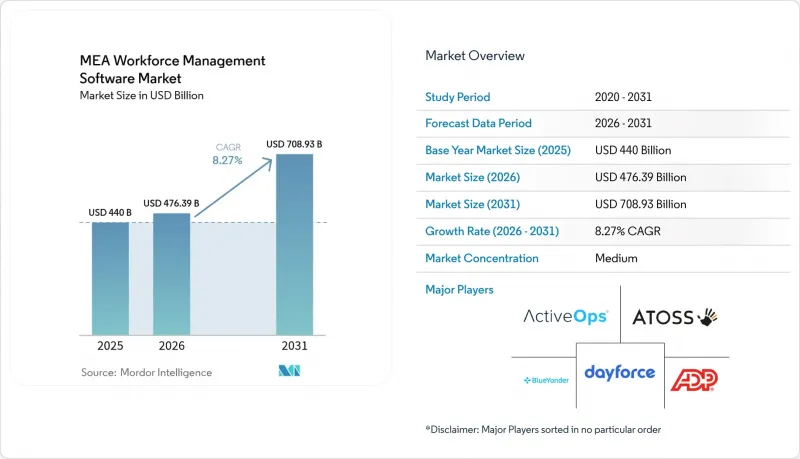
根據 Mordor Intelligence 預測,中東和非洲 (MEA) 地區的勞動力管理軟體市場將從 2025 年的 4.4 億美元成長到 2026 年的 4.7639 億美元,然後在 2031 年達到 7.0893 億美元,2026 年至 2031 年的複合年成長率為 20317%。
本報告按解決方案類型(例如,工作日程管理和分析、考勤管理)、部署模式(本地部署、雲端部署)、最終用戶行業(例如,銀行、金融服務和保險 (BFSI)、零售/消費品)、組織規模(大型企業、中型企業、中小企業)和地區進行細分。市場預測以價值(美元)表示。
中東和非洲(MEA)勞動力管理軟體市場的趨勢和見解。
雲端基礎設施現代化正在加速WFM(勞動力管理)的普及。
雲端技術已成為大多數新計畫的基礎,65.70% 的佔有率反映了雇主對快速擴充性、自動更新和跨境可用性的需求。沙烏地阿拉伯國家技能平台透過將雲端架構整合到其政府資助的技能發展計畫中,進一步加速了這一趨勢。 WorkForce Software 從 Azure 遷移到 Oracle 雲端後效能提升 40%,這清楚展現了雲端技術帶來的營運優勢。合規性是另一個促進因素。阿拉伯聯合大公國的員工監控框架建議預設使用具有稽核追蹤和授權管理功能的 SaaS 套件。像 NEOM 這樣的大型企劃,員工人數可能在短短幾個月內波動數萬人,這凸顯了彈性容量的重要性。
監管合規要求正在推動考勤管理的發展。
由於中東和非洲地區各司法管轄區的加班法規存在顯著差異,考勤管理仍然是至關重要的領域。國際勞工組織 (ILO) 的指導方針要求企業實施可配置的系統,以適應各國特定的規則。為了因應這種複雜性,SAP SuccessFactors 2024 版新增了在 Microsoft Teams 中記錄考勤以及與薪資核算週期自動整合的功能。非洲各地計劃於 2025 年進行的勞動法改革,包括贊比亞正在考慮的加班立法,正在推動對受監管的數位追蹤的需求。沙烏地阿拉伯 Qiwa 平台的交易量清晰地表明了正在進行的監管合規自動化規模,2023 年的交易量達到了 1.26 億筆。
整合過程的複雜性成為推廣應用的障礙。
中東和非洲地區三分之二的中小型企業 (SME) 在將勞動力管理 (WFM) 套件與其現有的人力資源和薪資管理系統整合時面臨諸多挑戰,導致專案週期延長,總體擁有成本 (TCO) 增加。 SAP SuccessFactors 的實施成本有時甚至高達第一年的訂閱費,這進一步提高了中型企業買家的預算門檻。然而,成功的實施可以帶來可量化的回報。 Visa 的整合式人力資本管理 (HCM) 環境已透過大幅降低薪資處理成本,展現了投資回報的潛力。
細分市場分析
2025年,全部區域組織優先考慮遵守不同的國家加班法規,考勤管理將佔總收入的33.62%。勞動力分析雖然規模較小,但由於人工智慧驅動的預測性和指導性洞察,正以9.31%的複合年成長率快速成長。整合到UKG Bryte中的晉升代理人透過減少人工人力資源工作流程,展現了人工智慧的實際價值。 SAP SuccessFactors透過整合預測性目標提案和技能檢驗功能,改善了績效管理。隨著企業從考勤卡轉向分析儀表板,中東和非洲地區的勞動力管理軟體市場不斷湧現遠超基本排班功能的附加元件模組。
在安全至關重要的行業中,對疲勞管理和現場服務最佳化工具的需求日益成長。 Pulsar Informatics 的「Fleet Insight」為航空業者提供疲勞風險評分功能,幫助他們滿足監管規定的飛行任務限制。因此,中東和非洲地區的勞動力管理軟體市場正明顯轉向整合套件,這些套件融合了合規性、員工福祉和數據驅動的預測功能。
預計到2025年,雲端將佔據65.25%的市場佔有率,複合年成長率(CAGR)為10.02%,反映出企業正從本地部署轉向雲端營運。勞動力管理軟體遷移到Oracle雲端後,系統效能提升了40%,為投資報酬率(ROI)的討論樹立了新的標竿。對數據主權要求嚴格的企業正在轉向採用「Workday on AWS」方案,該方案允許他們在本地司法管轄區內儲存數據,同時保持SaaS的敏捷性。對於在監管嚴格的產油國和監管相對寬鬆的市場均有業務的企業集團而言,混合部署仍然可行,這凸顯了中東和非洲(MEA)地區勞動力管理軟體市場對架構柔軟性的需求。
Continuum Global Solutions 遷移到 NICE IEX 雲端套件後,實現了 99.5% 的運轉率,並擴大了自助服務的使用範圍。這表明,對於許多採用者而言,營運收益遠大於遷移帶來的挑戰。隨著超大規模資料中心在中東和北非地區的不斷擴展,基礎架構的擔憂逐漸減少,進一步凸顯了雲端的優勢。
其他好處:
- Excel格式的市場預測(ME)表
- 3個月的分析師支持
目錄
第1章:引言
- 研究假設和市場定義
- 調查範圍
第2章:調查方法
第3章執行摘要
第4章 市場狀況
- 市場概覽
- 市場促進因素
- 基於雲端的倉庫設施管理 (WFM) 的採用率正在迅速提高。
- 關於加班記錄的監管義務
- 智慧型手機的興起催生了「行動優先」的工作場所設施管理(WFM)模式。
- 最佳化多角化經營中的人事費用
- 擴大零工經濟和快速商務領域的勞動力。
- 需要調整大型企劃的人員配置。
- 市場限制因素
- 整合成本和複雜性
- 勞動力管理分析人員短缺
- 資料居住要求造成的雲端採用障礙
- 文化上對即時追蹤的抗拒情緒
- 供應鏈分析
- 監理情勢
- 技術展望
- 波特五力分析
- 對影響市場的宏觀經濟因素進行評估
第5章 市場規模與成長預測
- 按解決方案類型
- 人員排班與分析
- 考勤管理
- 績效和目標管理
- 缺勤和休假管理
- 勞動力管理設施(WFM)用於疲勞管理、工作管理和現場服務。
- 部署模式
- 現場
- 雲
- 按最終用戶行業分類
- BFSI
- 零售和消費品
- 衛生保健
- 製造業
- 能源公用事業
- 運輸/物流
- 飯店業
- 其他行業
- 按組織規模
- 大型公司(員工人數1000人或以上)
- 中型企業(250-999名員工)
- 小規模企業(員工人數少於250人)
- 國家
- 阿拉伯聯合大公國
- 沙烏地阿拉伯
- 南非
- 奈及利亞
- 埃及
- 其他中東和非洲國家
第6章 競爭情勢
- 策略趨勢
- 市佔率分析
- 公司簡介
- Active Ops Management International LLP
- ADP LLC
- Atoss Software AG
- Blue Yonder Group Inc.
- Ceridian HCM Inc.(Dayforce)
- Deputy Group Pty Ltd
- IBM Corporation
- Infor Group
- Kirona Solutions Ltd
- NICE Ltd
- Oracle Corporation
- Reflexis Systems Inc.
- Sage Group plc
- SAP SE(SuccessFactors)
- ServiceMax Inc.
- SISQUAL
- Tamigo Solutions A/S
- UKG Inc.(Kronos+Ultimate)
- Workday Inc.
- WorkForce Software LLC
- Zoho Corporation Pvt Ltd(Zoho People)
第7章 市場機會與未來展望
According to Mordor Intelligence, the MEA workforce management software market size is expected to grow from USD 440 million in 2025 to USD 476.39 million in 2026 and is forecast to reach USD 708.93 million by 2031 at 8.27% CAGR over 2026-2031.
This report is Segmented by Solution Type (Workforce Scheduling and Analytics, Time and Attendance Management, and More), Deployment Mode (On-Premise, Cloud), End-User Industry (BFSI, Retail and Consumer Goods, and More), Organisation Size (Large Enterprises, Medium Enterprises, Small Enterprises), and Geography. The Market Forecasts are Provided in Terms of Value (USD).
MEA Workforce Management Software Market Trends and Insights
Cloud Infrastructure Modernization Accelerates WFM Adoption
Cloud deployment already underpins most new projects, and its 65.70% share reflects employers' preference for rapid scalability, automated updates, and cross-border availability. The Saudi National Skills Platform adds momentum by embedding cloud architecture in state-backed skilling programmes. WorkForce Software's migration from Azure to Oracle Cloud yielded a 40% performance gain, illustrating the operational upside. Compliance is another catalyst: the UAE's employee-monitoring framework favours SaaS suites that provide audit trails and consent management by default. Mega-projects such as NEOM, whose headcount can swing by tens of thousands within months, underline why elastic capacity is critical.
Regulatory Compliance Mandates Drive Time-Tracking Sophistication
Time and Attendance Management retains its lead because overtime rules differ markedly across MEA jurisdictions. The International Labour Office's guidelines push enterprises to deploy configurable systems capable of country-level rule sets. SAP SuccessFactors' 2024 release added Microsoft Teams punch-in and automated payroll-cycle alignment to address this complexity. Africa-wide labour-law changes slated for 2025, including Zambia's pending overtime legislation, heighten demand for compliant digital tracking. Transaction volumes on Saudi Arabia's Qiwa platform underscore the scale of regulatory automation already in play, with 126 million transactions processed in 2023.
Integration Complexity Creates Implementation Barriers
Two-thirds of MEA SMEs struggle to integrate WFM suites with legacy HR and payroll stacks, extending project timelines and elevating total cost of ownership. SAP SuccessFactors can charge implementation fees equal to the first year's subscription, amplifying budget hurdles for mid-market buyers. Yet successful roll-outs signal quantifiable returns: Visa's consolidated HCM environment cut payroll processing costs materially, illustrating payback potential.
Other drivers and restraints analyzed in the detailed report include:
- Mobile-First Solutions Capitalize on Smartphone Penetration
- AI-Powered Analytics Transform Workforce Optimisation
- Cultural Resistance to Real-Time Monitoring Persists
For complete list of drivers and restraints, kindly check the Table Of Contents.
Segment Analysis
Time and Attendance Management retained 33.62% of overall revenue in 2025 as organisations prioritised compliance under divergent overtime statutes across MEA. Workforce Analytics, while smaller, is expanding at 9.31% CAGR on the back of AI-driven forecasting and prescriptive insights. The Promotion Agent inside UKG Bryte trims manual HR workflows, illustrating practical AI value. SAP SuccessFactors embeds predictive goal suggestions and skills validation to elevate performance management. As enterprises graduate from punch clocks to analytics dashboards, the MEA Workforce Management Software market repeatedly absorbs add-on modules that stretch far beyond basic scheduling.
Increasing demand for fatigue and field-service optimisation tools is visible in safety-critical industries. Pulsar Informatics' Fleet Insight offers fatigue risk scoring for aviation operators, meeting regulatory flight-duty constraints. The MEA Workforce Management Software market therefore exhibits a clear shift toward unified suites that integrate compliance, wellbeing and data-driven forecasting.
Cloud captured 65.25% share in 2025 and is on a 10.02% CAGR trajectory, reflecting a decisive pivot away from on-premise upkeep. WorkForce Software's move to Oracle Cloud lifted system performance by 40%, providing a benchmark for ROI discussions. Enterprises with stringent sovereignty mandates turn to Workday-on-AWS deployments that house data within local jurisdictions yet retain SaaS agility. Hybrid roll-outs remain relevant where corporate groups operate both in regulated petro-states and lightly regulated markets, underscoring the MEA Workforce Management Software market's need for architectural flexibility.
Continuum Global Solutions' switch to NICE IEX cloud suite achieved 99.5% uptime and broader self-service adoption, underscoring operational benefits that now outweigh migration pain points for many adopters. As hyperscale data-centre footprints expand in MENA, infrastructural concerns recede, reinforcing cloud's leadership.
Complete Report Scope:
- By Solution Type
- Workforce Scheduling and Analytics
- Time and Attendance Management
- Performance and Goal Management
- Absence and Leave Management
- Fatigue, Task and Field Service WFM
- By Deployment Mode
- On-Premise
- Cloud
- By End-user Industry
- BFSI
- Retail and Consumer Goods
- Healthcare
- Manufacturing
- Energy and Utilities
- Transportation and Logistics
- Hospitality
- Other Industries
- By Organisation Size
- Large Enterprises (≥1 000 staff)
- Medium Enterprises (250-999)
- Small Enterprises (<250)
- By Country
- United Arab Emirates
- Saudi Arabia
- South Africa
- Nigeria
- Egypt
- Rest of Middle East and Africa
List of Companies Covered in this Report:
- Active Ops Management International LLP
- ADP LLC
- Atoss Software AG
- Blue Yonder Group Inc.
- Ceridian HCM Inc. (Dayforce)
- Deputy Group Pty Ltd
- IBM Corporation
- Infor Group
- Kirona Solutions Ltd
- NICE Ltd
- Oracle Corporation
- Reflexis Systems Inc.
- Sage Group plc
- SAP SE (SuccessFactors)
- ServiceMax Inc.
- SISQUAL
- Tamigo Solutions A/S
- UKG Inc. (Kronos + Ultimate)
- Workday Inc.
- WorkForce Software LLC
- Zoho Corporation Pvt Ltd (Zoho People)
Additional Benefits:
- The market estimate (ME) sheet in Excel format
- 3 months of analyst support
TABLE OF CONTENTS
1 INTRODUCTION
- 1.1 Study Assumptions and Market Definition
- 1.2 Scope of the Study
2 RESEARCH METHODOLOGY
3 EXECUTIVE SUMMARY
4 MARKET LANDSCAPE
- 4.1 Market Overview
- 4.2 Market Drivers
- 4.2.1 Cloud-based WFM adoption surge
- 4.2.2 Regulatory overtime-tracking mandates
- 4.2.3 Mobile-first WFM via smartphone ubiquity
- 4.2.4 Labor-cost optimisation amid diversification
- 4.2.5 Gig and quick-commerce workforce expansion
- 4.2.6 Mega-project workforce orchestration needs
- 4.3 Market Restraints
- 4.3.1 Integration cost and complexity
- 4.3.2 Shortage of WFM analytics talent
- 4.3.3 Data-residency barriers to cloud rollout
- 4.3.4 Cultural push-back on real-time tracking
- 4.4 Supply-Chain Analysis
- 4.5 Regulatory Landscape
- 4.6 Technological Outlook
- 4.7 Porter's Five Forces Analysis
- 4.7.1 Bargaining Power of Suppliers
- 4.7.2 Bargaining Power of Buyers
- 4.7.3 Threat of New Entrants
- 4.7.4 Threat of Substitutes
- 4.7.5 Competitive Rivalry
- 4.8 Assessment of Macroeconomic Factors on the Market
5 MARKET SIZE AND GROWTH FORECASTS (VALUE)
- 5.1 By Solution Type
- 5.1.1 Workforce Scheduling and Analytics
- 5.1.2 Time and Attendance Management
- 5.1.3 Performance and Goal Management
- 5.1.4 Absence and Leave Management
- 5.1.5 Fatigue, Task and Field Service WFM
- 5.2 By Deployment Mode
- 5.2.1 On-Premise
- 5.2.2 Cloud
- 5.3 By End-user Industry
- 5.3.1 BFSI
- 5.3.2 Retail and Consumer Goods
- 5.3.3 Healthcare
- 5.3.4 Manufacturing
- 5.3.5 Energy and Utilities
- 5.3.6 Transportation and Logistics
- 5.3.7 Hospitality
- 5.3.8 Other Industries
- 5.4 By Organisation Size
- 5.4.1 Large Enterprises (≥1 000 staff)
- 5.4.2 Medium Enterprises (250-999)
- 5.4.3 Small Enterprises (<250)
- 5.5 By Country
- 5.5.1 United Arab Emirates
- 5.5.2 Saudi Arabia
- 5.5.3 South Africa
- 5.5.4 Nigeria
- 5.5.5 Egypt
- 5.5.6 Rest of Middle East and Africa
6 COMPETITIVE LANDSCAPE
- 6.1 Strategic Moves
- 6.2 Market Share Analysis
- 6.3 Company Profiles (includes Global level Overview, Market level overview, Core Segments, Financials as available, Strategic Information, Market Rank/Share, Products and Services, Recent Developments)
- 6.3.1 Active Ops Management International LLP
- 6.3.2 ADP LLC
- 6.3.3 Atoss Software AG
- 6.3.4 Blue Yonder Group Inc.
- 6.3.5 Ceridian HCM Inc. (Dayforce)
- 6.3.6 Deputy Group Pty Ltd
- 6.3.7 IBM Corporation
- 6.3.8 Infor Group
- 6.3.9 Kirona Solutions Ltd
- 6.3.10 NICE Ltd
- 6.3.11 Oracle Corporation
- 6.3.12 Reflexis Systems Inc.
- 6.3.13 Sage Group plc
- 6.3.14 SAP SE (SuccessFactors)
- 6.3.15 ServiceMax Inc.
- 6.3.16 SISQUAL
- 6.3.17 Tamigo Solutions A/S
- 6.3.18 UKG Inc. (Kronos + Ultimate)
- 6.3.19 Workday Inc.
- 6.3.20 WorkForce Software LLC
- 6.3.21 Zoho Corporation Pvt Ltd (Zoho People)
7 MARKET OPPORTUNITIES AND FUTURE OUTLOOK
- 7.1 White-space and Unmet-Need Assessment

 勞動力追蹤軟體市場分析及預測(至2035年):依類型、產品、服務、技術、組件、應用、部署模式、最終用戶、模組及功能分類
 神經多樣性勞動力管理市場預測至2034年—按管理解決方案、人才管理職能、支援職能、人才分析、最終用戶和地區分類的全球分析
 物流人力資源管理軟體:市場佔有率分析、產業趨勢與統計、成長預測(2026-2031)歐洲勞動力管理軟體:市場佔有率分析、產業趨勢與統計及成長預測(2026-2031 年)勞動力管理軟體:市場佔有率分析、行業趨勢和統計數據、成長預測(2026-2031 年)
 勞動力管理軟體市場:按組件、部署類型、組織規模和產業分類-2026-2032年全球市場預測
 2026年全球員工敬業度管理領域的成長機會
 2026-2030年全球人力資源管理軟體市場旅館業勞動力管理(WFM):市場佔有率分析、產業趨勢與統計、成長預測(2026-2031)臨時勞動力管理平台:市場佔有率分析、產業趨勢與統計、成長預測(2026-2031)