


 |
市場調查報告書
商品編碼
2118000
物流人力資源管理軟體:市場佔有率分析、產業趨勢與統計、成長預測(2026-2031)Logistics Workforce Management Software - Market Share Analysis, Industry Trends & Statistics, Growth Forecasts (2026 - 2031) |
||||||

※ 本網頁內容可能與最新版本有所差異。詳細情況請與我們聯繫。
根據 Mordor Intelligence 預測,物流人力資源管理軟體市場規模將從 2025 年的 3.4989 億美元和 2026 年的 4.0963 億美元成長到 2031 年的 8.3044 億美元,2026 年至 2031 年的年複合成長率(CAGR)15.10% 為 15.8%。
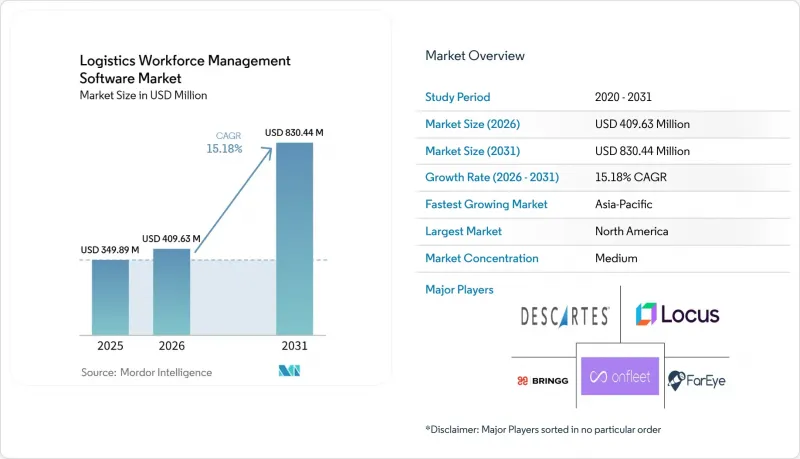
本報告依產品類型(軟體、服務)、部署模式(雲端、本地部署)、最終用戶及企業規模(大型企業、中小企業)、最終用戶(物流及第三方物流供應商、電子商務及零售、食品雜貨及消費品宅配、其他)及地區細分。市場預測以美元計價。
全球物流人力資源管理軟體市場趨勢及洞察
電子商務及當日送達業務的拓展
消費者對配送速度的期望日益提高,導致物流供應商用於路線規劃和人員配備的時間越來越少。隨著亞馬遜計畫於2026年5月下旬將其當日達配送網路擴展至多個地點和其他大都會圈,物流供應商面臨越來越大的壓力,需要在24小時內完成配送。這催生了物流勞動力管理軟體市場對能夠在工作時間內重新分配司機和路線的系統的需求。根據Shipium的報告,在2025年第二季至2026年第二季期間,24小時內送達的D2C(直接面對消費者)訂單比例年增,這主要得益於經銷商使用四個或更多履約中心。這種轉變降低了為D2C品牌提供服務的第三方物流供應商採用固定班次計畫的效用。能夠整合車輛分配、員工運作和配送異常情況的軟體,使供應商能夠在不增加人工調整的情況下應對各種情況。
最佳化人事費用並留住司機
人事費用上升和司機離職率上升使得更完善的人力資源規劃對運輸公司而言變得日益重要。根據ATRI的一份報告,到2025年,每英里卡車的平均營運成本將達到2.336美元,其中司機工資和福利是最大的成本組成部分。 2026年2月,Platform Science的報告顯示,52%的受訪駕駛表示,技術因素會影響他們是否繼續留在原公司。物流人力資源管理軟體市場可以透過減少而非增加司機的行政負擔來幫助留住司機,其方式包括排班、考勤管理、路線溝通、薪資核算整合和合規工作流程。這些工具還可以幫助車隊經理改善輪班安排、監控駕駛時間限制、應對臨時變更的日程安排,並讓司機更清楚地了解調度資訊和付款狀態。將年度離職率從90%降低到60-70%可以降低擁有200名司機的車隊的替換成本,但其有效性取決於司機是否接受他們在日常工作中使用的工具。
整合舊有系統和遷移資料的複雜性。
在大規模物流網路中部署新系統時,與舊有系統整合是一項重大限制。 2025 年的一項商業調查顯示,42% 的供應鏈負責人認為與現有系統整合是部署的主要挑戰,而 37% 的經理則認為存在數據可用性和品質問題。許多營運商同時運行傳統的運輸管理系統、現有的倉庫管理應用程式以及獨立的勞動力管理工具。即使更換單一應用程式,也可能擾亂連接這些系統的未記錄工作流程。在物流人力資源管理軟體市場,提供應用程式介面 (API) 和中介軟體相容性的供應商比需要完全替換系統的供應商更受歡迎。從 EDI 遷移到 API 的要求可能會增加成本,並延長評估和部署流程。
細分市場分析
到2025年,軟體銷售額將佔總銷售額的69.32%。這一結果反映了物流行業正從使用獨立的調度工具轉向整合調度、追蹤、分析和合規功能的單一平台。領先的物流供應商通常會採用一到兩個標準平台,以減少需要維護的系統連接數量並簡化營運管理。這種集中化模式使成熟的軟體供應商能夠建立長期的客戶關係,提高平台採用率,並支援持續的產品開發。
預計到2031年,服務業將以17.12%的複合年成長率成長,成為成長最快的產業。在物流人力資源管理軟體市場,這種成長反映了將平台功能轉化為可執行的日常業務流程所需的營運工作。隨著基於人工智慧的調度功能和跨系統整合功能被添加到平台中,部署、配置和託管支援的重要性日益凸顯。 2026年5月,曼哈頓聯合公司推出了“解決方案設計工作室”,該工作室利用人工智慧技術,透過自然語言輸入來輔助配置供應鏈系統。該工具仍需專業服務團隊提供密集的部署支持,客戶才能直接使用。由於供應商需要同時支援產品和營運設計,這種軟體和服務結合的交付模式可能會增加轉換成本。
預計到2025年,雲端收入將佔總收入的64.81%,並預計在2031年之前以18.79%的複合年成長率成長。這一比例表明,尋求更靈活、可擴展技術模式的客戶越來越傾向於選擇基於雲端的部署方案。雲端減少了對硬體所有權和專用維護人員的需求,從而降低了企業管理其物流技術環境的營運複雜性。此外,雲端還允許客戶在無需替換或大幅升級其本地運算資源的情況下,利用最新的人工智慧功能。模組化的SaaS(軟體即服務)產品部署速度比傳統的本地部署更快,使企業能夠在維持相同核心營運目標的同時,更有效率地引入新功能。
2026年2月,SAP正式在區域與衛星站點推出SAP物流管理SaaS產品。據該公司稱,該產品可在數天內運作,並支援透過SAP商業網路與承運商進行協作。在政府機構、國防機構和受監管的營運機構中,由於存在資料保留義務,本地部署系統仍然發揮著至關重要的作用。中國、德國和海灣地區的國內法規可能會迫使客戶採用混合架構。在這種架構中,調度邏輯在雲端運行,而敏感的駕駛員識別資訊則儲存在本機伺服器上。
區域分析
預計到2025年,北美將佔全球銷售額的38.19%,這得益於該地區成熟的物流技術生態系統以及對數位化勞動力管理工具的早期應用。北美聚集了眾多物流技術供應商、領先的第三方物流服務商、小包裹遞送網路以及成熟的平台預算,這些都為持續投資於排班、考勤管理、車輛調度和合規解決方案提供了支援。美國運輸部的「服務時間」法規正在推動對駕駛員考勤管理工具的需求,因為物流業者需要系統來監控工作時間並確保合規性。美國憑藉大規模的物流基礎設施和先進的技術應用,在北美市場處於領先地位。同時,加拿大和墨西哥正透過拓展跨境貿易基礎設施和物流走廊來推動相關技術的應用。
北美運輸業者正利用人工智慧驅動的調度和預測排班技術,在不延長工時的前提下提高每位運輸人員的行駛里程。根據ATRI的一份報告,到2025年,每位運輸人員的平均實際駕駛時間將為每天7.41小時,而可用時間為11小時,這為排班平台設定了明確的營運目標。在歐洲,人工智慧驅動的調度技術應用廣泛,合規要求也不斷發展,包括根據歐盟企業永續發展報告指令和ISO 14083:2023標準揭露運輸排放資訊。總部位於瑞典的勞動力管理軟體供應商Quinyx正在加強其在歐洲、中東和非洲的業務基礎,以提供基於人工智慧的排班、勞動力最佳化和合規解決方案。該地區的勞動法規、工時要求和資料保護標準持續推動對具備強大排班、合規追蹤和員工資料管治功能的勞動力管理平台的需求。
在亞太地區,中國、印度、日本和東南亞國家正在大力發展電子商務和快餐服務,這需要大規模的零工人員,預計到2031年,該市場將以17.26%的複合年成長率成長。這些國家的物流人力資源管理軟體市場需要能夠處理大量貨運和適應當地勞動實踐的產品。根據印度國家轉型委員會(NITI Aayog)的數據,2020-2021年印度電子商務和快餐業的零工人員數量為770萬,預計到2029-2030年將達到2350萬。此外,中東和非洲地區也率先採用了相關技術,阿拉伯聯合大公國和沙烏地阿拉伯正在加大對數位物流基礎設施的投資。同時,在南美洲,生物識別考勤管理工具正在被應用,以提高薪資核算的準確性並確保符合勞動法。
其他好處
- Excel格式的市場預測(ME)表
- 3個月的分析師支持
目錄
第1章:引言
- 研究假設和市場定義
- 調查範圍
第2章:調查方法
第3章執行摘要
第4章 市場狀況
- 市場概覽
- 市場促進因素
- 電子商務及當日送達業務的拓展
- 最佳化人事費用並留住司機
- 即時視覺化和客戶溝通
- AI原生動態調度與預測性重新調度
- 永續發展報告和低排放車輛法規的遵守情況
- 員工身分和技能的跨平台可移植性
- 市場限制因素
- 整合舊有系統和遷移資料的複雜性。
- 中小企業實施成本高昂
- 促進要素隱私、監控與工人抵制
- 遠端資訊處理、電信業者和薪資核算數據的標準存在差異。
- 宏觀經濟因素對市場的影響
- 產業價值鏈分析
- 監理情勢
- 技術展望
- 波特五力分析
- 功能能力和適應性評估
- 人員排班和車輛調度
- 路線最佳化與規劃
- 人員追蹤和現場可視性
- 交付執行和異常處理
- 面向駕駛員的行動應用程式和通訊
- 人力資源分析、生產力、合規性
第5章 市場規模與成長預測
- 透過提供
- 軟體
- 服務
- 部署模式
- 雲
- 現場
- 按最終用途/公司規模分類
- 大公司
- 小型企業
- 最終用戶
- 物流和第三方物流供應商
- 電子商務與零售
- 食品和日用品宅配
- 小包裹、宅配、快遞
- 製造業和工業分銷
- 醫療和藥品分銷
- 按地區
- 北美洲
- 美國
- 加拿大
- 墨西哥
- 南美洲
- 巴西
- 阿根廷
- 其他南美國家
- 歐洲
- 德國
- 英國
- 法國
- 俄羅斯
- 其他歐洲國家
- 亞太地區
- 中國
- 印度
- 日本
- 澳洲
- 其他亞太國家
- 中東
- 阿拉伯聯合大公國
- 沙烏地阿拉伯
- 土耳其
- 其他中東國家
- 非洲
- 南非
- 埃及
- 奈及利亞
- 其他非洲地區
- 北美洲
第6章 競爭情勢
- 市場集中度
- 策略趨勢
- 市佔率分析
- 公司簡介
- Ehrhardt+Partner Group GmbH & Co. KG
- Manhattan Associates, Inc.
- Blue Yonder Group, Inc.
- ORTEC BV
- Infios, Inc.
- Infor Inc.
- SAP SE
- Oracle Corporation
- Softeon, Inc.
- Made4net LLC
- Lucas Systems, Inc.
- Easy Metrics, Inc.
- Quinyx AB
- UKG Inc.
- Tecsys Inc.
- Locus.sh Technologies Private Limited
- FarEye Technologies Private Limited
- Bringg Delivery Technologies Ltd.
- Shipsy Technologies Private Limited
- LogiNext Solutions Private Limited
第7章 市場機會與未來展望
According to Mordor Intelligence, the logistics workforce management software market size is projected to expand from USD 349.89 million in 2025 and USD 409.63 million in 2026 to USD 830.44 million by 2031, registering a CAGR of 15.18% between 2026 and 2031.
This report is Segmented by Offering (Software, and Services), Deployment Mode (Cloud, and On-Premises), End Use Enterprise Size (Large Enterprises, and Small and Medium-Sized Enterprises), End User (Logistics and Third-Party Logistics Providers, E-Commerce and Retail, Food and Grocery Delivery, and More), and Geography. The Market Forecasts are Provided in Terms of Value (USD).
Global Logistics Workforce Management Software Market Trends and Insights
E-Commerce and Same-Day Delivery Expansion
Consumer delivery expectations are reducing the time available for route and workforce planning. Amazon expanded its same-day delivery network to various facilities in late May 2026 and extended the service to additional metropolitan areas, increasing the pressure on logistics providers to plan around sub-24-hour delivery windows. The logistics workforce management software market therefore needs systems that can reassign drivers and routes during the operating day. Shipium reported that the share of direct-to-consumer orders delivered within 24 hours increased year over year from Q2 2025 to Q2 2026, driven by merchants using 4 or more fulfillment locations. This shift makes static shift plans less useful for third-party logistics providers that serve direct-to-consumer brands. Software that joins dispatch, worker availability, and delivery exceptions can help operators respond without adding manual coordination.
Labor Cost Optimization and Driver Retention
Labor expense and driver turnover are making better workforce planning more important for carriers. ATRI reported an average truck operating cost of USD 2.336 per mile in 2025, with driver wages and benefits as the largest cost component. Platform Science reported in February 2026 that technology affected 52% of surveyed drivers' decisions to stay with or leave an employer. The logistics workforce management software market can support retention when scheduling, time tracking, route communication, payroll integration, and compliance workflows reduce administrative burden rather than add to it. These tools also help fleet managers improve shift planning, monitor hours-of-service requirements, manage last-minute schedule changes, and provide drivers with clearer visibility into assignments and payments. Reducing annual turnover from 90% toward 60%-70% can lower replacement costs for a 200-driver fleet, but the benefit depends on drivers accepting the tools used in daily work.
Legacy Integration and Data Migration Complexity
Legacy integration is a significant restraint on adoption across large logistics networks. A 2025 operations survey found that 42% of supply chain respondents identified integration with existing systems as a leading adoption challenge, while 37% cited data availability and quality issues. Many operators run a legacy transportation management system, acquired warehouse applications, and separate labor tools at the same time. Replacing 1 application can disrupt undocumented workflows that connect those systems. The logistics workforce management software market favors providers that offer application programming interfaces and middleware compatibility, rather than requiring a full system replacement. EDI-to-API transition requirements can add cost and extend the evaluation and deployment process.
Other drivers and restraints analyzed in the detailed report include:
- AI-Native Dynamic Dispatch and Predictive Rescheduling
- Real-Time Visibility and Customer Communication
- High Implementation Costs for Small and Medium-Sized Operators
For complete list of drivers and restraints, kindly check the Table Of Contents.
Segment Analysis
Software held 69.32% of revenue in 2025. This result reflects the ongoing move from separate scheduling tools to integrated platforms that combine dispatch, tracking, analytics, and compliance capabilities in a single environment. Large logistics providers often standardize on 1 or 2 platforms to reduce the number of system connections they must maintain and simplify operational oversight. This concentration gives established software vendors recurring customer relationships, strengthens platform adoption, and supports continued product development.
Services are projected to grow at a 17.12% CAGR through 2031, making them the fastest-growing offering. In the logistics workforce management software market, this growth reflects the operational work required to turn platform features into usable day-to-day processes. Implementation, configuration, and managed support are becoming more important as platforms add AI-based dispatch and multi-system coordination. Manhattan Associates introduced Solution Design Studio in May 2026, using AI to help configure supply chain systems through natural-language inputs. The tool still depends on expert service teams for focused customer deployments before direct customer use. Combined software and service offerings can increase switching costs because the provider supports both the product and the operating design.
Cloud accounted for 64.81% of revenue in 2025 and is expected to record an 18.79% CAGR through 2031. This share indicates an increasing preference for cloud-based deployment among customers seeking more flexible, scalable technology models. Cloud reduces the need for hardware ownership and dedicated maintenance staff, thereby lowering operational complexity for organizations managing logistics technology environments. It also gives customers access to updated AI capabilities without requiring them to replace or significantly upgrade on-premises computing resources. Modular software-as-a-service products can be deployed faster than traditional local installations, allowing companies to implement new capabilities more efficiently while maintaining the same core operational objectives.
SAP made SAP Logistics Management generally available in February 2026 as a software-as-a-service product designed for localized and satellite operations. The company stated that the product can go live in days and supports carrier collaboration through SAP Business Network. On-premises systems remain relevant for government, defense, and regulated operations with data-residency obligations. National requirements in China, Germany, and the Gulf markets can prompt customers to adopt hybrid designs. Under those designs, scheduling logic operates in the cloud while sensitive driver identity data remains on local servers.
Complete Report Scope:
- By Offering
- Software
- Services
- By Deployment Mode
- Cloud
- On-Premises
- By End Use Enterprise Size
- Large Enterprises
- Small and Medium-Sized Enterprises
- By End User
- Logistics and Third-Party Logistics Providers
- E-commerce and Retail
- Food and Grocery Delivery
- Parcel, Courier, and Express Delivery
- Manufacturing and Industrial Distribution
- Healthcare and Pharmaceutical Distribution
- By Geography
- North America
- United States
- Canada
- Mexico
- South America
- Brazil
- Argentina
- Rest of South America
- Europe
- Germany
- United Kingdom
- France
- Russia
- Rest of Europe
- Asia-Pacific
- China
- India
- Japan
- Australia
- Rest of Asia-Pacific
- Middle East
- United Arab Emirates
- Saudi Arabia
- Turkey
- Rest of Middle East
- Africa
- South Africa
- Egypt
- Nigeria
- Rest of Africa
- North America
Geography Analysis
North America held 38.19% of revenue in 2025, supported by the region's mature logistics technology ecosystem and early adoption of digital workforce management tools. The region has a high concentration of logistics technology vendors, major third-party logistics providers, parcel networks, and established platform budgets, which support continued investment in scheduling, time tracking, dispatch, and compliance solutions. US Department of Transportation Hours-of-Service rules have driven demand for driver time and attendance tools, as logistics operators seek systems to monitor working hours and maintain regulatory compliance. The United States is the leading country in the region, driven by its large logistics base and advanced technology adoption, while Canada and Mexico are advancing adoption through cross-border trade infrastructure and the expansion of logistics corridors.
North American carriers are using AI dispatch and predictive scheduling to improve miles per driver without extending work hours. ATRI reported that drivers averaged 7.41 hours of actual driving per day against 11 available hours in 2025, giving scheduling platforms a clear operational target. Europe has a large installed base and changing compliance requirements, including transport emissions disclosure under the EU Corporate Sustainability Reporting Directive and ISO 14083:2023. Quinyx, a Sweden-based provider of workforce management software, has strengthened its footprint in AI-enabled scheduling, workforce optimization, and compliance solutions across EMEA. Labor regulations, working-time requirements, and data protection standards in the region continue to drive demand for workforce management platforms with robust scheduling, compliance tracking, and employee data governance capabilities.
Asia-Pacific is projected to grow at a 17.26% CAGR through 2031 as China, India, Japan, and Southeast Asian countries expand e-commerce and quick-commerce services that require large gig workforces. The logistics workforce management software market in these countries needs products that can support high delivery volumes and localized work practices. According to NITI Aayog, India's e-commerce and quick-commerce gig workforce was 7.7 million workers in 2020-21 and is projected to reach 23.5 million by 2029-30. Moreover, the Middle East and Africa are early adopters, while the UAE and Saudi Arabia invest in digital logistics infrastructure, and South America adopts biometric time-and-attendance tools to improve payroll accuracy and labor compliance.
- Ehrhardt + Partner Group GmbH & Co. KG
- Manhattan Associates, Inc.
- Blue Yonder Group, Inc.
- ORTEC B.V.
- Infios, Inc.
- Infor Inc.
- SAP SE
- Oracle Corporation
- Softeon, Inc.
- Made4net LLC
- Lucas Systems, Inc.
- Easy Metrics, Inc.
- Quinyx AB
- UKG Inc.
- Tecsys Inc.
- Locus.sh Technologies Private Limited
- FarEye Technologies Private Limited
- Bringg Delivery Technologies Ltd.
- Shipsy Technologies Private Limited
- LogiNext Solutions Private Limited
Additional Benefits:
- The market estimate (ME) sheet in Excel format
- 3 months of analyst support
TABLE OF CONTENTS
1 INTRODUCTION
- 1.1 Study Assumptions and Market Definition
- 1.2 Scope of the Study
2 RESEARCH METHODOLOGY
3 EXECUTIVE SUMMARY
4 MARKET LANDSCAPE
- 4.1 Market Overview
- 4.2 Market Drivers
- 4.2.1 E-commerce and Same-Day Delivery Expansion
- 4.2.2 Labor Cost Optimization and Driver Retention
- 4.2.3 Real-Time Visibility and Customer Communication
- 4.2.4 AI-Native Dynamic Dispatch and Predictive Rescheduling
- 4.2.5 Sustainability Reporting and Low-Emission Fleet Compliance
- 4.2.6 Cross-Platform Worker Identity and Skills Portability
- 4.3 Market Restraints
- 4.3.1 Legacy Integration and Data Migration Complexity
- 4.3.2 High Implementation Costs for Small and Medium-Sized Operators
- 4.3.3 Driver Privacy, Surveillance, and Workforce Resistance
- 4.3.4 Fragmented Telematics, Carrier, and Payroll Data Standards
- 4.4 Impact of Macroeconomic Factors on the Market
- 4.5 Industry Value Chain Analysis
- 4.6 Regulatory Landscape
- 4.7 Technological Outlook
- 4.8 Porter's Five Forces Analysis
- 4.8.1 Bargaining Power of Suppliers
- 4.8.2 Bargaining Power of Buyers
- 4.8.3 Threat of New Entrants
- 4.8.4 Threat of Substitutes
- 4.8.5 Intensity of Competitive Rivalry
- 4.9 Functional Capability and Application Assessment
- 4.9.1 Workforce Scheduling and Dispatch
- 4.9.2 Route Optimization and Planning
- 4.9.3 Workforce Tracking and Field Visibility
- 4.9.4 Delivery Execution and Exception Handling
- 4.9.5 Driver Mobile Applications and Communications
- 4.9.6 Workforce Analytics, Productivity and Compliance
5 MARKET SIZE AND GROWTH FORECASTS (VALUE)
- 5.1 By Offering
- 5.1.1 Software
- 5.1.2 Services
- 5.2 By Deployment Mode
- 5.2.1 Cloud
- 5.2.2 On-Premises
- 5.3 By End Use Enterprise Size
- 5.3.1 Large Enterprises
- 5.3.2 Small and Medium-Sized Enterprises
- 5.4 By End User
- 5.4.1 Logistics and Third-Party Logistics Providers
- 5.4.2 E-commerce and Retail
- 5.4.3 Food and Grocery Delivery
- 5.4.4 Parcel, Courier, and Express Delivery
- 5.4.5 Manufacturing and Industrial Distribution
- 5.4.6 Healthcare and Pharmaceutical Distribution
- 5.5 By Geography
- 5.5.1 North America
- 5.5.1.1 United States
- 5.5.1.2 Canada
- 5.5.1.3 Mexico
- 5.5.2 South America
- 5.5.2.1 Brazil
- 5.5.2.2 Argentina
- 5.5.2.3 Rest of South America
- 5.5.3 Europe
- 5.5.3.1 Germany
- 5.5.3.2 United Kingdom
- 5.5.3.3 France
- 5.5.3.4 Russia
- 5.5.3.5 Rest of Europe
- 5.5.4 Asia-Pacific
- 5.5.4.1 China
- 5.5.4.2 India
- 5.5.4.3 Japan
- 5.5.4.4 Australia
- 5.5.4.5 Rest of Asia-Pacific
- 5.5.5 Middle East
- 5.5.5.1 United Arab Emirates
- 5.5.5.2 Saudi Arabia
- 5.5.5.3 Turkey
- 5.5.5.4 Rest of Middle East
- 5.5.6 Africa
- 5.5.6.1 South Africa
- 5.5.6.2 Egypt
- 5.5.6.3 Nigeria
- 5.5.6.4 Rest of Africa
- 5.5.1 North America
6 COMPETITIVE LANDSCAPE
- 6.1 Market Concentration
- 6.2 Strategic Moves
- 6.3 Market Share Analysis
- 6.4 Company Profiles (includes Global Level Overview, Market Level Overview, Core Segments, Financials as available, Strategic Information, Market Rank/Share, Products and Services, Recent Developments)
- 6.4.1 Ehrhardt + Partner Group GmbH & Co. KG
- 6.4.2 Manhattan Associates, Inc.
- 6.4.3 Blue Yonder Group, Inc.
- 6.4.4 ORTEC B.V.
- 6.4.5 Infios, Inc.
- 6.4.6 Infor Inc.
- 6.4.7 SAP SE
- 6.4.8 Oracle Corporation
- 6.4.9 Softeon, Inc.
- 6.4.10 Made4net LLC
- 6.4.11 Lucas Systems, Inc.
- 6.4.12 Easy Metrics, Inc.
- 6.4.13 Quinyx AB
- 6.4.14 UKG Inc.
- 6.4.15 Tecsys Inc.
- 6.4.16 Locus.sh Technologies Private Limited
- 6.4.17 FarEye Technologies Private Limited
- 6.4.18 Bringg Delivery Technologies Ltd.
- 6.4.19 Shipsy Technologies Private Limited
- 6.4.20 LogiNext Solutions Private Limited
7 MARKET OPPORTUNITIES AND FUTURE OUTLOOK
- 7.1 White-Space and Unmet-Need Assessment

 勞動力追蹤軟體市場分析及預測(至2035年):依類型、產品、服務、技術、組件、應用、部署模式、最終用戶、模組及功能分類
 神經多樣性勞動力管理市場預測至2034年—按管理解決方案、人才管理職能、支援職能、人才分析、最終用戶和地區分類的全球分析
 中東和非洲(MEA)勞動力管理軟體:市場佔有率分析、行業趨勢和統計數據以及成長預測(2026-2031 年)歐洲勞動力管理軟體:市場佔有率分析、產業趨勢與統計及成長預測(2026-2031 年)勞動力管理軟體:市場佔有率分析、行業趨勢和統計數據、成長預測(2026-2031 年)
 勞動力管理軟體市場:按組件、部署類型、組織規模和產業分類-2026-2032年全球市場預測
 2026年全球員工敬業度管理領域的成長機會
 2026-2030年全球人力資源管理軟體市場旅館業勞動力管理(WFM):市場佔有率分析、產業趨勢與統計、成長預測(2026-2031)臨時勞動力管理平台:市場佔有率分析、產業趨勢與統計、成長預測(2026-2031)