


 |
市場調查報告書
商品編碼
2064544
臨時勞動力管理平台:市場佔有率分析、產業趨勢與統計、成長預測(2026-2031)Contingent Workforce Management Platform - Market Share Analysis, Industry Trends & Statistics, Growth Forecasts (2026 - 2031) |
||||||

※ 本網頁內容可能與最新版本有所差異。詳細情況請與我們聯繫。
根據 Mordor Intelligence 預測,臨時勞動力管理平台的市場規模預計將在 2025 年達到 15.1 億美元,在 2026 年達到 15.7 億美元,在 2031 年達到 19.2 億美元。
預計從 2026 年到 2031 年,其複合年成長率將達到 4.16%。
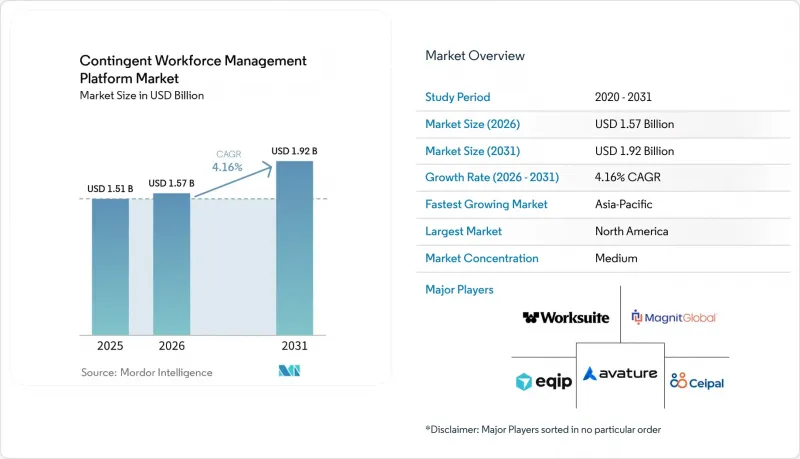
本報告按元件(軟體、服務)、功能(供應商管理系統[VMS]等)、部署方式(雲端等)、組織規模(大型企業等)、最終用戶產業(IT與電信、零售與電子商務等)以及地區進行細分。市場預測以美元計價。
全球臨時勞動力管理平台市場趨勢及洞察
企業越來越依賴靈活且企劃為基礎的員工隊伍。
靈活的勞動力如今已成為計劃性業務營運模式不可或缺的一部分。在那些截止日期、技術需求和成本壓力變化速度遠超傳統員工招募週期的產業,這一點尤其明顯。這種轉變提升了能夠透過通用的管治層管理員工類型、供應商利用率、批准、入職、合約管理和支付流程的系統的價值。隨著企業需要專案層面的可視性和一致的政策執行,而非透過電子郵件和電子表格進行在局部的承包商管理,臨時勞動力管理平台市場正從中受益。此外,高價值的外部人才,例如臨時領導和專業顧問,也需要對稅務處理、智慧財產權、合約金額和特定國家/地區的合約規則進行更嚴格的控制。因此,買家更傾向於能夠管理整個外部人才流程並跨多個人才管道維護可審計記錄的平台。 Beeline 於 2025 年 6 月收購 MBO Partners,正反映了在單一合規環境下涵蓋更廣泛的外部人才(包括獨立承包商、顧問、零工人員和依賴薪資核算的專業)的需求。
人工智慧驅動的可視化、匹配和消費最佳化
在臨時勞動力管理平台市場,人工智慧已從單純的產品差異化因素轉變為基本需求。如今,企業需要更快的匹配速度、更清晰的支出可見度、薪酬水平基準、工作流程提案以及更準確的預測,所有這些都需要直接整合到日常專案管理中。 2025年4月,Beeline推出了基於其臨時勞動力數據平台的“Beeline AI”,該平台具備技能接近性評分、代理功能和自動化合規政策管理等特性。 SAP Fieldglass在2026年5月發布的版本中進一步強化了這一趨勢,其人工智慧驅動的簡歷評估、人工智慧驅動的協作式工作說明書(SOW)創建以及基於SOW詳細資訊的自動化員工角色提案功能,都為這一趨勢提供了有力支撐。這些工具雖然減少了人才招募過程中的摩擦,但也提高了採購方對外部人才招募決策的可解釋性、監督性和清晰審計追蹤的期望。由於採購、人力資源和法務團隊既需要速度又不希望放棄控制權,因此將自動化與人工審核結合的供應商正日益受到青睞。
與人力資源資訊系統、企業資源規劃系統、採購系統和薪資核算系統進行複雜整合。
在臨時工管理平台市場,整合仍是推廣應用的最大障礙。臨時工專案通常涉及獨立建構的人力資源、採購、財務和薪資核算系統,這些系統往往對員工類型、成本中心、供應商資料和計費規則採用不同的定義。 Beeline 表示,其平台支援 845 種 HCM 和 ERP 整合,其中包括 500 種 Oracle 整合、440 種 SAP 整合和 405 種 Workday 整合,體現了廣泛的技術格局。文件指出,儘管買家期望 API 能夠即時回應,但傳統的批次架構仍可能存在時間偏差和檢驗問題。整合的成本和複雜性可能會延遲企業的採用決策,尤其是在企業需要協調特定國家/地區的本地稅收、計費、供應商和員工規則時。那些仍然推遲自動化的企業最終往往會累積大量零散的記錄,並削弱審計應對力,這可能會使後續的遷移更加困難。
細分市場分析
截至2025年,軟體在臨時工管理平台市場中佔據67.22%的佔有率,而服務業預計到2031年將以6.72%的複合年成長率成長。軟體仍然是收入的核心,因為買家仍然需要一個“記錄系統”,將職位發布、員工資料、供應商清單、核准規則、工時表、發票和報告集中在一個統一的營運層級中。此外,可設定的軟體為公司提供了一種切實可行的方法,使其能夠在不同的業務部門(外部人才管理方法可能有所不同)中強制執行有關任期限制、入職流程、角色核准和薪酬管理等方面的政策。因此,軟體持續佔據高權重反映了其作為正式臨時工專案營運支柱的作用,尤其是在那些支出管理不善的大型跨國公司中。然而,服務業的快速成長表明,許多公司不願意在內部管理複雜的部署、整合和政策協調工作。
對於那些面臨全球專案和系統複雜性的買家而言,部署、整合和託管支援正逐漸成為採購包中的標準組成部分。服務配置也正從一次性設定任務轉向持續支持,包括合規性監控、供應商績效管理、分析審查、使用者管理和專案最佳化。這種轉變在臨時勞動力管理平台產業意義重大,因為隨著平台投入運作和內部問責制的完善,服務團隊通常在日常管治中發揮至關重要的作用。這不僅鞏固了收入基礎,鼓勵了軟體的持續使用,也使買家更容易適應難以快速標準化的跨國營運模式。因此,端到端供應商及其合作夥伴正在擴展其託管服務能力,不再僅依賴授權收入成長,尤其對於那些尋求可衡量結果(例如合規性、採用率和支出可見度)的買家而言。
儘管VMS在2025年仍維持了35.66%的市場佔有率,但人才招募和直接招募的整合預計將以5.99%的複合年成長率成長至2031年。 VMS仍然是基礎層,它將職位發布、供應商、核准、工時表、發票和報告整合到一個統一的、管治的工作流程中,避免了分散在多個工具和電子郵件通訊中。大型企業專案仍依賴此核心功能來管理支出,並在眾多地區、成本中心和人力資源合作夥伴中執行政策。因此,鑑於單一解決方案仍然無法取代VMS平台提供的廣泛管理功能,其佔據主導地位的市場佔有率反映的是其持續的重要性,而不僅僅是買家的慣性思維。同時,直接招聘的加速成長表明,買家現在要求平台能夠更好地存取和管理人才。
企業正尋求降低招聘機構的利潤率,並在向更廣泛的供應商網路開放需求之前,提高預篩選人才庫的重複利用率。 2026年5月,SAP Fieldglass新增了人工智慧驅動的協作式工作範圍定義(SOW)創建功能和自動化員工角色提案功能。這表明,採購職能不再孤立,而是與計畫和驗收工作流程更加緊密地整合。隨著分類規則日益嚴格,買家要求提供更有力的證據來證明合約決策得到了持續執行,合規性和風險管理模組的重要性也日益凸顯。由於企業希望更清楚了解各業務部門的承包商定價、利潤率和供應商績效,支出管理和費用基準工具正受到財務部門的關注。隨著外部人才組成現在包括透過AOR(代理商)和EOR(雇主)模式參與的獨立專業人士,承包商生命週期管理也在不斷擴展。同時,DEI(多元化、公平性和包容性)追蹤和行動優先的現場工作人員支援等其他模組表明,臨時勞動力管理平台行業正在超越傳統VMS(供應商管理系統)的核心功能。
區域分析
到2025年,北美仍將維持其最大區域收入來源的地位,佔據臨時勞動力管理平台市場佔有率的37.65%。美國是需求中心,因為該地區許多大型公司已經經營正式的臨時僱用項目,這些項目將採購、人力資源、財務、法律和供應商管理整合到一個統一的營運模式中。該地區的採購方也面臨複雜的分類和共同僱用風險,因此,管治職能被列為採購優先事項,從而支持對正式記錄保存系統的持續投資。加州的AB5法案指南在2026年繼續強調需要對承包商身分進行書面認定,並採用一致的分類工作流程。隨著跨國公司轉向在整個北美地區應用通用管治標準,而不是基於特定國家/地區的例外情況進行管理,加拿大和墨西哥在專案設計中也扮演著越來越重要的角色。
歐洲正成為臨時勞動力管理平台市場中受監管主導的成長區域。歐盟《平台工作指令》引入了一項可證偽的推定,即在允許指導和監督的情況下,存在僱傭關係,成員國必須在2026年12月2日前將此規則納入本國法律。這項法律壓力推動了對能夠跨不同國家法規和法律實體監控分類、任期、核准和員工身分的平台的需求。英國仍然是一個重要的市場,因為供應商除了遵守歐盟框架外,還必須遵守其自身的非薪資名冊合規要求。另一方面,德國以其注重合規的臨時工作環境和對受控外部勞動力流程的強勁需求而脫穎而出。
預計到2031年,亞太地區將以6.31%的複合年成長率成長,成為臨時勞動力管理平台市場所有區域中成長最快的地區。在中國、印度、日本和東南亞,對企劃為基礎和平台型工作的需求不斷成長,促使當地企業和跨國公司加強對正式管治結構和技術的投資。印度作為主要成長中心脫穎而出,因為全球公司在IT和數位服務交付領域持續管理大量合約工,因此需要提高供應商和服務合約的透明度。雖然中東地區的應用仍處於起步階段,但隨著阿拉伯聯合大公國和沙烏地阿拉伯在多元化措施下擴大外籍勞工計劃,兩國正在建立針對外部勞動力的系統性監管結構。南美洲和非洲的市場發展尚未成熟,但巴西和南非正成為跨國公司尋求更統一的臨時勞動力管理和更清晰的審計追蹤的關鍵區域中心。
其他好處:
- Excel格式的市場預測(ME)表
- 3個月的分析師支持
目錄
第1章:引言
- 市場分析與定義的前提條件
- 分析範圍
第2章 分析方法
第3章執行摘要
第4章 市場狀況
- 市場概覽
- 市場促進因素
- 企業越來越依賴靈活且企劃為基礎的員工隊伍。
- 更嚴格的工人分類和勞動合規要求
- 人工智慧驅動的可視化、匹配和消費最佳化
- 需要加快獲得專業數位技能和專業技能。
- 擴大直接採購和私有人才庫策略
- 服務採購和臨時工工作流程的整合
- 市場限制因素
- 與人力資源資訊系統、企業資源規劃系統、採購系統和薪資系統進行複雜整合。
- 資料隱私、網路安全和跨境資料傳輸的風險
- 遠端招聘中身份詐騙增加,員工身份驗證負擔加重
- 人力資源、採購、法律和財務等相關人員之間的管治摩擦。
- 產業價值鏈分析
- 監理情勢
- 技術展望
- 宏觀經濟因素對市場的影響
- 波特五力分析
第5章:預測市場規模與成長率
- 按組件
- 軟體
- 服務
- 部署與整合
- 支援與維護
- 按功能
- 供應商管理系統(VMS)
- 承包商生命週期管理
- 人才招募與直接訂單結合
- 合規與風險管理
- 費用管理和收費基準分析
- 其他功能
- 透過部署方法
- 基於雲端的
- 現場
- 按組織規模
- 大公司
- 小型企業
- 按最終用戶行業分類
- IT/通訊
- 銀行、金融服務和保險業 (BFSI)
- 醫學與生命科學
- 製造業
- 零售與電子商務
- 其他終端用戶產業
- 按地區
- 北美洲
- 美國
- 加拿大
- 墨西哥
- 南美洲
- 巴西
- 阿根廷
- 其他南美國家
- 歐洲
- 英國
- 德國
- 法國
- 義大利
- 西班牙
- 俄羅斯
- 其他歐洲國家
- 亞太地區
- 中國
- 日本
- 印度
- 韓國
- 澳洲
- 其他亞太國家
- 中東
- 沙烏地阿拉伯
- 阿拉伯聯合大公國
- 土耳其
- 其他中東國家
- 非洲
- 南非
- 奈及利亞
- 其他非洲國家
- 北美洲
第6章 競爭情勢
- 市場集中度
- 策略趨勢
- 市佔率分析
- 公司簡介
- Beeline
- Magnit, LLC
- Avature Limited
- CXC Global
- Worksuite Inc.
- VectorVMS1 LLC
- Pixid
- Eqip AG
- Netive VMS
- Prosperix
- Ceipal Corp.
- Flextrack Inc.
- Simplify Workforce
- StafferLink
- Trio Workforce Solutions
- Flentis Corporation
- DirectSkills
- Worksome ApS
- MBO Partners
- 3 Story Software LLC
- i-Resource Inc.
第7章 市場機會與未來展望
According to Mordor Intelligence, the contingent workforce management platform market size is projected to be USD 1.51 billion in 2025, USD 1.57 billion in 2026, and reach USD 1.92 billion by 2031, growing at a CAGR of 4.16% from 2026 to 2031.
This report is Segmented by Component (Software, and Services), Functionality (Vendor Management System [VMS], and More), Deployment Mode (Cloud-Based, and More), Organization Size (Large Enterprises, and More), End-User Industry (Information Technology and Telecommunications, Retail and E-Commerce, and More), and Geography. The Market Forecasts are Provided in Terms of Value (USD).
Global Contingent Workforce Management Platform Market Trends and Insights
Rising Enterprise Reliance on Flexible and Project-Based Labor
Flexible labor is now part of planned operating models, especially in sectors where delivery timelines, technology needs, and cost pressures change faster than permanent hiring cycles can adjust. That change raises the value of systems that can manage worker type, supplier use, approvals, onboarding, contract controls, and payment workflows with a common governance layer. The contingent workforce management (WFM) platform market benefits because enterprises want program-level visibility and consistent policy enforcement, rather than local contractor administration handled via email and spreadsheets. Higher-value external roles, including interim leaders and specialist consultants, also require stronger controls around tax treatment, intellectual property, contract value, and country-specific engagement rules. Buyers are therefore favoring platforms that can manage the full external worker journey and maintain auditable records across multiple talent channels. Beeline's June 2025 acquisition of MBO Partners reflected this need for broader external talent coverage, including independent contractors, consultants, gig workers, and payrolled professionals, within a single, compliant environment.
AI-Enabled Visibility, Matching, and Spend Optimization
AI has moved from optional product differentiation to a baseline expectation in the contingent workforce management platform market. Enterprises now want faster matching, cleaner spend visibility, rate benchmarking, workflow suggestions, and better forecasting built directly into everyday program management. Beeline introduced Beeline AI in April 2025 with skills-proximity scoring, agentic capabilities, and automated compliance policy management built on its contingent labor data foundation. SAP Fieldglass strengthened the same direction in its May 2026 release through AI-assisted resume assessment, AI-enhanced statement-of-work collaboration, and automated worker role suggestions from SOW details. These tools reduce sourcing and intake friction, but they also raise buyer expectations around explainability, oversight, and clear audit trails for decisions that affect external talent engagement. Vendors that combine automation with human review are gaining ground because procurement, HR, and legal teams want speed without giving up control.
Complex Integration with HRIS, ERP, Procurement, and Payroll Stacks
Integration remains the most persistent adoption barrier in the contingent workforce management platform market. Contingent labor programs usually cut across HR, procurement, finance, and payroll systems that were built separately and often use different definitions for worker type, cost center, supplier data, and invoicing rules. Beeline states that its platform supports 845 HCM and ERP integrations, including 500 Oracle, 440 SAP, and 405 Workday connections, which shows how broad the technical landscape has become. The same material notes that legacy batch-processing architectures can still create timing gaps and validation issues when buyers expect real-time API behavior. Integration cost and complexity can delay deployment decisions, especially when enterprises also need local tax, billing, supplier, and worker rules aligned across countries. Even so, organizations that postpone automation often continue to accumulate fragmented records and weaker auditability, which can make later transitions even harder.
Other drivers and restraints analyzed in the detailed report include:
- Tightening Worker Classification and Labor Compliance Requirements
- Need for Faster Access to Specialized Digital and Professional Skills
- Data Privacy, Cybersecurity, and Cross-Border Data Transfer Risk
For complete list of drivers and restraints, kindly check the Table Of Contents.
Segment Analysis
Software held 67.22% of the contingent workforce management platform market share in 2025, while services are projected to expand at a 6.72% CAGR through 2031. Software remains the core revenue engine because buyers still want a system of record that centralizes requisitions, worker data, supplier lists, approval rules, timesheets, invoices, and reporting within a single operating layer. Configurable software also gives enterprises a practical way to enforce policies around tenure limits, onboarding steps, role approvals, and rate controls across business units that may otherwise manage external talent differently. The continued weight of software therefore reflects its role as the operational backbone of formal contingent labor programs, especially in global organizations with large spend under management. Yet the faster growth in services shows that many enterprises do not want to manage complex rollouts, integrations, and policy alignment on their own.
Implementation, integration, and managed support are becoming part of the standard buying package for buyers with global programs and cross-system complexity. The services mix is also moving beyond one-time setup work toward recurring support around compliance monitoring, supplier performance, analytics review, user administration, and program optimization. That change matters in the contingent workforce management platform industry because service teams often become part of day-to-day governance after the platform goes live and internal ownership matures. It creates a stickier revenue profile, with services reinforcing software retention and helping buyers handle multi-country operating models that are difficult to standardize quickly. The result is that end-to-end vendors and their partners are broadening their managed-service capabilities rather than relying solely on license growth, especially where buyers want measurable outcomes tied to compliance, fill rates, and spend visibility.
VMS retained a 35.66% share in 2025, while talent sourcing and direct sourcing integration are set to expand at a 5.99% CAGR through 2031. VMS remains the foundational layer because it connects requisitions, suppliers, approvals, timesheets, invoicing, and reporting into a single, governed workflow, rather than leaving them spread across several tools and email chains. Large enterprise programs still depend on this core capability to control spend and enforce policy across many geographies, cost centers, and staffing partners. Its leading share, therefore, reflects continued relevance rather than simple buyer inertia, since point solutions still struggle to replace the breadth of control that VMS platforms provide. At the same time, the faster growth of direct sourcing shows that buyers now want platforms to improve talent access and administration.
Enterprises are trying to reduce agency markup and improve reuse of pre-vetted talent pools before opening demand to the wider supplier network. SAP Fieldglass added AI-enhanced statement-of-work collaboration and automated worker role suggestions in May 2026, showing how sourcing features are moving closer to planning and intake workflows rather than staying separate from them. Compliance and risk management modules are also gaining weight as classification rules tighten and buyers want stronger evidence that engagement decisions were applied consistently. Spend management and rate benchmarking tools are attracting more finance attention as enterprises seek clearer visibility into contractor pricing, markups, and supplier performance across business lines. Contractor lifecycle management is expanding as external talent mixes now include independent professionals engaged through AOR and EOR models, while other modules, such as DEI tracking and mobile-first field labor support, show how the contingent workforce management platform industry is broadening beyond the historic VMS core.
Geography Analysis
North America held 37.65% of the contingent workforce management platform market share in 2025 and remained the largest regional revenue base. The United States anchors demand because many large enterprises in the region already run formal contingent programs that integrate procurement, HR, finance, legal, and supplier management into a single operating model. Buyers in this region also face complex classification and co-employment exposures, which keep governance features high on the purchase agenda and support continued investment in formal systems of record. California's AB5 guidance continued to reinforce the need for documented contractor tests and consistent classification workflows in 2026. Canada and Mexico are also becoming more relevant to program design as multinational employers extend common governance standards across North America instead of managing each country through local exceptions.
Europe is becoming a regulation-led growth area for the contingent workforce management platform market. The EU Platform Work Directive introduced a rebuttable presumption of employment where direction and control are found, and member states must transpose the rules by December 2, 2026. That legal pressure supports demand for platforms that can monitor classification, tenure, approvals, and worker status across different national rules and corporate entities. The United Kingdom remains important as vendors must support separate off-payroll compliance needs alongside the EU framework, while Germany stands out for its compliance-heavy temporary labor environment and strong demand for governed external workforce processes.
Asia-Pacific is forecast to grow at a 6.31% CAGR through 2031, the fastest regional rate in the contingent workforce management platform market. China, India, Japan, and Southeast Asia are expanding the pool of project-based and platform-mediated work, which is drawing more formal governance and technology investment from local firms and multinational employers. India stands out as a major growth point because global enterprises continue to manage large contractor populations in IT and digital services delivery, and need better visibility across suppliers and engagements. The Middle East is still early in adoption, but the UAE and Saudi Arabia are creating space for structured oversight of external workforces as non-national labor programs expand under diversification efforts. South America and Africa remain less mature, yet Brazil and South Africa serve as the main regional anchors for multinational buyers seeking more consistent contingent workforce control and clearer audit trails.
- Beeline
- Magnit, LLC
- Avature Limited
- CXC Global
- Worksuite Inc.
- VectorVMS1 LLC
- Pixid
- Eqip AG
- Netive VMS
- Prosperix
- Ceipal Corp.
- Flextrack Inc.
- Simplify Workforce
- StafferLink
- Trio Workforce Solutions
- Flentis Corporation
- DirectSkills
- Worksome ApS
- MBO Partners
- 3 Story Software LLC
- i-Resource Inc.
Additional Benefits:
- The market estimate (ME) sheet in Excel format
- 3 months of analyst support
TABLE OF CONTENTS
1 INTRODUCTION
- 1.1 Study Assumptions and Market Definition
- 1.2 Scope of the Study
2 RESEARCH METHODOLOGY
3 EXECUTIVE SUMMARY
4 MARKET LANDSCAPE
- 4.1 Market Overview
- 4.2 Market Drivers
- 4.2.1 Rising Enterprise Reliance on Flexible and Project-Based Labor
- 4.2.2 Tightening Worker Classification and Labor Compliance Requirements
- 4.2.3 AI-Enabled Visibility, Matching, and Spend Optimization
- 4.2.4 Need for Faster Access to Specialized Digital and Professional Skills
- 4.2.5 Expansion of Direct Sourcing and Private Talent Pool Strategies
- 4.2.6 Convergence of Services Procurement and Contingent Labor Workflows
- 4.3 Market Restraints
- 4.3.1 Complex Integration With HRIS, ERP, Procurement, and Payroll Stacks
- 4.3.2 Data Privacy, Cybersecurity, and Cross-Border Data Transfer Risk
- 4.3.3 Rising Identity Fraud and Worker Verification Burden in Remote Hiring
- 4.3.4 Governance Friction Across HR, Procurement, Legal, and Finance Stakeholders
- 4.4 Industry Value Chain Analysis
- 4.5 Regulatory Landscape
- 4.6 Technological Outlook
- 4.7 Impact of Macroeconomic Factors on the Market
- 4.8 Porter's Five Forces Analysis
- 4.8.1 Bargaining Power of Buyers
- 4.8.2 Bargaining Power of Suppliers
- 4.8.3 Threat of New Entrants
- 4.8.4 Threat of Substitutes
- 4.8.5 Intensity of Competitive Rivalry
5 MARKET SIZE AND GROWTH FORECASTS (VALUE)
- 5.1 By component
- 5.1.1 Software
- 5.1.2 Services
- 5.1.2.1 Implementation and Integration
- 5.1.2.2 Support and Maintenance
- 5.2 By Functionality
- 5.2.1 Vendor Management System (VMS)
- 5.2.2 Contractor Lifecycle Management
- 5.2.3 Talent Sourcing and Direct Sourcing Integration
- 5.2.4 Compliance and Risk Management
- 5.2.5 Spend Management and Rate Benchmarking
- 5.2.6 Other Functionalities
- 5.3 By Deployment Mode
- 5.3.1 Cloud-Based
- 5.3.2 On-Premises
- 5.4 By Organization Size
- 5.4.1 Large Enterprises
- 5.4.2 Small and Medium-sized Enterprises
- 5.5 By End-User Industry
- 5.5.1 Information Technology and Telecommunications
- 5.5.2 Banking, Financial Services, and Insurance
- 5.5.3 Healthcare and Life Sciences
- 5.5.4 Manufacturing
- 5.5.5 Retail and E-commerce
- 5.5.6 Other End-User Industries
- 5.6 By Geography
- 5.6.1 North America
- 5.6.1.1 United States
- 5.6.1.2 Canada
- 5.6.1.3 Mexico
- 5.6.2 South America
- 5.6.2.1 Brazil
- 5.6.2.2 Argentina
- 5.6.2.3 Rest of South America
- 5.6.3 Europe
- 5.6.3.1 United Kingdom
- 5.6.3.2 Germany
- 5.6.3.3 France
- 5.6.3.4 Italy
- 5.6.3.5 Spain
- 5.6.3.6 Russia
- 5.6.3.7 Rest of Europe
- 5.6.4 Asia-Pacific
- 5.6.4.1 China
- 5.6.4.2 Japan
- 5.6.4.3 India
- 5.6.4.4 South Korea
- 5.6.4.5 Australia
- 5.6.4.6 Rest of Asia-Pacific
- 5.6.5 Middle East
- 5.6.5.1 Saudi Arabia
- 5.6.5.2 United Arab Emirates
- 5.6.5.3 Turkey
- 5.6.5.4 Rest of Middle East
- 5.6.6 Africa
- 5.6.6.1 South Africa
- 5.6.6.2 Nigeria
- 5.6.6.3 Rest of Africa
- 5.6.1 North America
6 COMPETITIVE LANDSCAPE
- 6.1 Market Concentration
- 6.2 Strategic Moves
- 6.3 Market Share Analysis
- 6.4 Company Profiles (includes Global Level Overview, Market Level Overview, Core Segments, Financials as available, Strategic Information, Market Rank/Share, Products and Services, Recent Developments)
- 6.4.1 Beeline
- 6.4.2 Magnit, LLC
- 6.4.3 Avature Limited
- 6.4.4 CXC Global
- 6.4.5 Worksuite Inc.
- 6.4.6 VectorVMS1 LLC
- 6.4.7 Pixid
- 6.4.8 Eqip AG
- 6.4.9 Netive VMS
- 6.4.10 Prosperix
- 6.4.11 Ceipal Corp.
- 6.4.12 Flextrack Inc.
- 6.4.13 Simplify Workforce
- 6.4.14 StafferLink
- 6.4.15 Trio Workforce Solutions
- 6.4.16 Flentis Corporation
- 6.4.17 DirectSkills
- 6.4.18 Worksome ApS
- 6.4.19 MBO Partners
- 6.4.20 3 Story Software LLC
- 6.4.21 i-Resource Inc.
7 MARKET OPPORTUNITIES AND FUTURE OUTLOOK
- 7.1 White-space and unmet-need assessment

 勞動力追蹤軟體市場分析及預測(至2035年):依類型、產品、服務、技術、組件、應用、部署模式、最終用戶、模組及功能分類
 神經多樣性勞動力管理市場預測至2034年—按管理解決方案、人才管理職能、支援職能、人才分析、最終用戶和地區分類的全球分析
 中東和非洲(MEA)勞動力管理軟體:市場佔有率分析、行業趨勢和統計數據以及成長預測(2026-2031 年)物流人力資源管理軟體:市場佔有率分析、產業趨勢與統計、成長預測(2026-2031)歐洲勞動力管理軟體:市場佔有率分析、產業趨勢與統計及成長預測(2026-2031 年)勞動力管理軟體:市場佔有率分析、行業趨勢和統計數據、成長預測(2026-2031 年)
 勞動力管理軟體市場:按組件、部署類型、組織規模和產業分類-2026-2032年全球市場預測
 2026年全球員工敬業度管理領域的成長機會
 2026-2030年全球人力資源管理軟體市場旅館業勞動力管理(WFM):市場佔有率分析、產業趨勢與統計、成長預測(2026-2031)