


 |
市場調查報告書
商品編碼
2064530
旅館業勞動力管理(WFM):市場佔有率分析、產業趨勢與統計、成長預測(2026-2031)Workforce Management (WFM) In Hospitality - Market Share Analysis, Industry Trends & Statistics, Growth Forecasts (2026 - 2031) |
||||||

※ 本網頁內容可能與最新版本有所差異。詳細情況請與我們聯繫。
據 Mordor Intelligence 稱,2025 年酒店業勞動力管理 (WFM) 市場價值為 5.1 億美元,預計到 2031 年將從 2026 年的 5.7 億美元成長至 10.4 億美元,預測期(2026-2031 年)的複合年成長率為 12.78%。
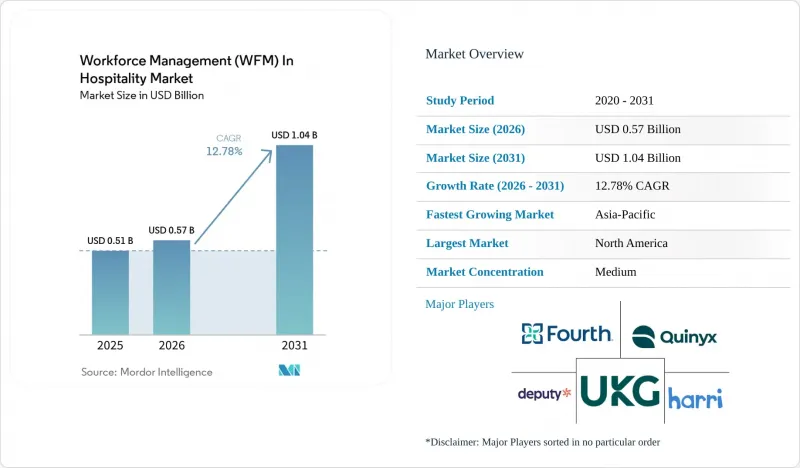
本報告按組件(軟體[例如考勤管理]、服務)、部署方式(雲端、本地部署、混合部署)、企業規模(大型企業、中小企業)、最終用戶(酒店、餐廳、度假村、賭場、郵輪)和地區進行細分。市場預測以價值(美元)表示。
全球酒店業勞動力管理市場趨勢及洞察。
最佳化人事費用和加班費的壓力越來越大
在飯店業實施勞動力管理 (WFM) 的過程中,人事費用管理仍然是最顯而易見的因素。這是因為它使運營商能夠直接解決問題並快速衡量其效果。在旅館業,人事費用通常佔營收的 28% 到 40%,因此人員配置最佳化是管理決策的核心。將每週 220 小時的工作分配給 5 到 8 名員工,每人輪班工作 44 小時,可以減少 20 小時的加班時間,根據中位數工資標準,每個地點每周可節省 170 到 250 美元。對於擁有多家分店的營運機構而言,這項計算更為重要,因為同樣的排班效率低下問題會在更多不同的場所重複出現。因此,飯店勞動力管理市場的負責人正在尋找超越基本排班功能的人力資源管理工具,這些工具能夠將人員配置決策與運轉率、服務時長和加班風險連結起來。因此,人事費用和加班管理的透明度已成為飯店勞動力管理市場採購決策中的首要考慮因素之一。
透過人工智慧驅動的需求預測和進度最佳化來提高勞動生產力。
在飯店業勞動力管理 (WFM) 市場,人工智慧驅動的排班系統正從試點階段邁向日常營運。目前,該平台每週處理 16 億個資料點,訓練 30 萬個模型,並產生 120 萬個班次,這表明預測性主導正在運作環境中迅速擴展。使用員工互動套件的客戶發現,第一線員工的留任率平均提高了 33%。此外,研究表明,雖然 65% 的英國經理認為人工智慧將簡化排班流程,但目前只有 19% 的人在使用此類工具,這表明該領域仍有巨大的應用空間。在 2025 年推出的公開測試版中,基於代理的系統展示了其利用員工可用性和歷史銷售模式來阻止排班不一致並提案工作分配的能力。這些功能正在推動酒店業勞動力管理市場從靜態預測輔助轉向即時排班干預和自動化合規管理。
將 PMS、POS、薪資核算和考勤管理系統等舊有系統整合起來的複雜性。
飯店和餐飲集團在短期內最大的限制因素仍然是系統整合的複雜性。飯店和餐飲集團通常經營著多年來建造的各種技術環境。只有三分之一的飯店業者信任其現有系統產生的數據,這導致即使在開始最佳化員工隊伍之前,預測的準確性也較低。即使是單一機構,也可能依賴在營運週期不同階段選擇的獨立PMS、薪資核算、人力資源、POS和考勤管理系統。這減緩了飯店員工管理系統的普及,在整個飯店業全面實施通常需要6到12個月的時間。一些供應商正試圖透過將大型顧問公司和技術公司納入其合作夥伴生態系統來緩解這種阻力。然而,對於大規模的、擁有多家機構的集團和加盟網路而言,整合過程仍然會延遲飯店員工管理系統市場價值的實現。
細分市場分析
到2025年,軟體將佔據飯店勞動力管理(WFM)市場74.23%的佔有率,成為整體部署的核心組成部分。在軟體領域,考勤管理將在2025年佔據軟體細分市場的25.22%,屆時,準確的考勤記錄在加班管理、薪資核算核算和合規記錄管理方面的重要性將持續凸顯。在飯店勞動力管理市場,排班、勞動力最佳化和分析功能正從單純的報告輔助工具轉變為日常決策工具。在多部門飯店環境中,休假、缺勤和任務管理日益受到關注,因為任何一次人員短缺都可能同時影響多個團隊。員工自助服務和溝通模組也越來越普及,因為員工保留計畫高度依賴輪班可見性、柔軟性和行動存取。
預計到2031年,服務業將以13.12%的複合年成長率成長,成為飯店業勞動力管理市場中成長最快的細分領域。這一成長不僅反映了軟體需求,也反映了整合、培訓、變更管理和持續支援等方面的工作量。飯店業者通常需要6到12個月的支援才能將PMS、POS、薪資核算和考勤資料整合起來,並使其轉化為可執行的工作流程。因此,服務是飯店勞動力管理(WFM)的實用差異化優勢,尤其是在營運商尋求快速部署、順利實施和更可靠的設施級營運時。
到2025年,基於雲端的部署將佔酒店業勞動力管理(WFM)的69.41%,這反映了集中式勞動力管理在分散設施中的吸引力。這種模式非常適合酒店業勞動力管理,因為它允許管理人員透過行動儀表板和共用資料層在輪班期間調整人員配置。服務供應商為遍布100多個國家/地區數十萬個職場的數百萬員工提供服務,而2025年下半年部署的新基礎設施增加了人工智慧功能。自動化的合規性更新和降低的基礎設施負擔繼續推動企業擺脫完全本地部署模式。這些優勢解釋了為什麼在當前的採購週期中,酒店業勞動力管理仍然作為SaaS產品備受青睞。
混合部署預計到2031年將以14.37%的複合年成長率成長,成為飯店業勞動力管理領域成長最快的部署模式。即使排班和分析功能已遷移到雲端,大規模飯店和賭場仍需要本地硬體進行生物識別和安全時間戳工作流程。一些供應商正透過結合現場人臉辨識認證和雲端預測(與飯店管理系統運轉率資料關聯)的架構來推廣這種模式。因此,混合設計正成為酒店業勞動力管理市場的遷移路徑,該市場需要兼顧本地控制和雲端柔軟性。
區域分析
到2025年,北美將佔據酒店業勞動力管理(WFM)市場41.02%的佔有率,成為重要的區域叢集。該地區受益於密集的餐廳和酒店特許加盟網路,標準化的勞動規則和統一的排班工具有助於減少不同地點之間的差異。合規壓力也成為強勁的推動力,因為美國勞工部在2024年從餐飲服務業追回了3,470萬美元的未付工資,而且公平工作週的要求在主要城市持續擴大。此外,北美也聚集了旅館業勞動力管理市場眾多知名供應商,包括UKG、Fourth、Legion、Harri和7shifts。供應商的集中推動了產品的快速改進,並使該地區持續處於酒店業人力資源管理市場企業系統更新周期的前沿。
歐洲在酒店業勞動力管理市場佔據第二大市場佔有率,其中英國和德國是最活躍的市場。在英國,2026年4月起分階段實施的勞動法規變更,提升了能夠處理工時保障、強制性病假福利和突發性排班調整的系統的價值。歐盟資料居住要求的預期也影響採購行為,能夠提供合規託管和可審計管理架構的供應商更受青睞。 ATOSS 公佈的2025年營收為1.893億歐元(1.987億美元),其中雲端服務和訂閱收入年增28%,顯示歐洲對合規的雲端勞動力管理工具的需求強勁。
預計到2031年,亞太地區將以15.21%的複合年成長率成長,成為旅館業勞動力管理市場成長最快的地區。在日本,為遵守工作方式改革規定,雲端考勤和排班管理系統正在被廣泛採用,面向旅遊業的SaaS平台預計將在2026年1月前涵蓋171家飯店。在中國,各大飯店集團應用人工智慧技術,排班效率提升了20%,調整時間縮短了25%。在印度和澳大利亞,飯店供應量的增加和複雜的排班規則推動了市場成長;而在中東和非洲,國際連鎖飯店主導旅遊設施的擴張,帶動了市場選擇性需求。在南美洲,都市區連鎖飯店和特許經營餐廳網路正在推動市場穩步成長,但外匯波動和本地供應商基礎的脆弱性仍然限制著酒店業勞動力管理市場的應用範圍擴大。
其他好處:
- Excel格式的市場預測(ME)表
- 3個月的分析師支持
目錄
第1章:引言
- 市場分析與定義的前提條件
- 分析範圍
第2章 分析方法
第3章執行摘要
第4章 市場狀況
- 市場概覽
- 市場促進因素
- 最佳化人事費用和加班時間的壓力越來越大
- 雲端和行動裝置 WFM 平台的廣泛應用。
- 更嚴格的勞動法規和可預測的工作時間表要求
- 透過人工智慧驅動的需求預測和調度最佳化來提高勞動生產力。
- 由於顧客數量和一天中不同時段的客流量波動,白天人員配備的精確性變得越來越重要。
- 在不同物業之間共用人員以及內部調動的市場正在擴大服務範圍的柔軟性。
- 市場限制因素
- 與員工資料相關的資料隱私和網路安全風險
- 將舊有系統整合到 PMS、POS、薪資核算和考勤管理系統中的複雜性。
- 基於特許經營和管理協議的營運模式正在減緩整個產品組合的標準化進程。
- 離職率率高和現場工作人員會說多種語言可能會擾亂日常系統使用的規範性。
- 宏觀經濟因素對市場的影響
- 產業價值鏈分析
- 監理情勢
- 技術展望
- 波特五力分析
第5章:預測市場規模與成長率
- 按組件
- 軟體
- 員工工作日程管理與勞動力最佳化
- 考勤管理
- 勞動力分析與預測
- 休假和缺勤管理
- 任務與執行管理
- 員工自助溝通
- 服務
- 軟體
- 透過部署方法
- 基於雲端的
- 現場
- 混合
- 按最終用戶公司規模分類
- 大公司
- 小型企業
- 最終用戶
- 飯店
- 餐廳
- 採取
- 賭場
- 郵輪
- 按地區
- 北美洲
- 美國
- 加拿大
- 墨西哥
- 南美洲
- 巴西
- 阿根廷
- 其他南美國家
- 歐洲
- 德國
- 英國
- 法國
- 義大利
- 西班牙
- 其他歐洲國家
- 亞太地區
- 中國
- 日本
- 印度
- 澳洲
- 韓國
- 其他亞太國家
- 中東
- 沙烏地阿拉伯
- 阿拉伯聯合大公國
- 土耳其
- 其他中東國家
- 非洲
- 南非
- 奈及利亞
- 其他非洲國家
- 北美洲
第6章 競爭情勢
- 市場集中度
- 策略趨勢
- 市佔率分析
- 公司簡介。
- UKG Inc.
- Fourth Enterprises LLC
- Harri(US)LLC
- Quinyx AB
- Deputy Corporation
- TimeClock Plus, LLC
- Humanforce Pty Ltd
- Legion Technologies, Inc.
- Unifocus Inc.
- Planday A/S
- 7shifts Employee Scheduling Software Inc.
- Agendrix Inc.
- Push Technologies
- Bizimply Limited
- When I Work, Inc.
- Schedulefly, Inc.
- Findmyshift BV
- Nowsta, Inc.
- Nesto Software GmbH
- ATOSS Software SE
- Alkimii Ltd
- Synerion North America Inc.
- Rotaready Limited
- ZoomShift, Inc.
第7章 市場機會與未來展望
According to Mordor Intelligence, the workforce management (WFM) in hospitality market was valued at USD 0.51 billion in 2025 and estimated to grow from USD 0.57 billion in 2026 to reach USD 1.04 billion by 2031, at a CAGR of 12.78% during the forecast period (2026-2031).
This report is Segmented by Component (Software [Time and Attendance Management, and More], and Services), Deployment Mode (Cloud-Based, On-Premise, and Hybrid), Enterprise Size (Large Enterprises, and Small and Medium Enterprises), End User (Hotels, Restaurants, Resorts, Casinos, and Cruise Lines), and Geography. The Market Forecasts are Provided in Terms of Value (USD).
Global Workforce Management (WFM) In Hospitality Market Trends and Insights
Rising Pressure To Optimize Labor Costs And Overtime
Labor cost management remains the clearest adoption trigger in the workforce management (WFM) in hospitality market because operators can act on it directly and measure the outcome quickly. Labor typically accounts for 28% to 40% of revenue in hospitality, keeping staffing discipline at the center of operating decisions. Shifting 220 weekly labor hours from 5 employees working 44 hours each to 8 employees can remove 20 overtime hours and save USD 170 to USD 250 per week per location at median wage rates. That arithmetic becomes more important in multi-unit operations because the same scheduling leakage repeats across a larger estate. Buyers in the workforce management in hospitality market are therefore moving past basic roster creation and are asking for labor tools that connect staffing decisions to occupied rooms, service periods, and overtime exposure. This is keeping labor-cost visibility and overtime control near the front of procurement decisions across the hospitality workforce management market.
AI-Driven Forecasting And Schedule Optimization Improving Labor Productivity
AI-driven scheduling is moving from the pilot stage to daily operations in the workforce management (WFM) in hospitality market. Platforms are now processing 1.6 billion data points weekly, training 300,000 models, and generating 1.2 million shifts per week, which shows how forecast-led scheduling is scaling in live environments. Customers using employee engagement suites have recorded an average 33% improvement in frontline retention. Surveys also show that 65% of managers in the UK believe AI could simplify scheduling, while only 19% currently use such tools, leaving ample room for further adoption. Open beta launches in 2025 have demonstrated how agentic systems can block non-compliant rosters and suggest assignments using availability and historical sales patterns. These capabilities are raising expectations in the hospitality workforce management market from static forecast support to real-time schedule intervention and automated compliance controls.
Legacy Integration Complexity Across PMS, POS, Payroll, And Time Clocks
Integration complexity remains the most material near-term drag on workforce management in the hospitality market, as hotel and restaurant groups often run mixed technology estates built over many years. Only 1 in 3 hospitality operators trusts the data produced by their current systems, which weakens forecast quality before labor optimization even begins. A single property can still rely on separate PMS, payroll, HR, POS, and time-capture systems that were chosen at different points in the operating cycle. This slows rollouts in the workforce management market for hospitality and stretches implementation programs to 6 to 12 months for full hospitality deployments. Some vendors have tried to reduce that friction by expanding their partner ecosystems to include major consulting and technology firms. Even so, integration work continues to delay time-to-value in the hospitality workforce management market for large multi-property groups and franchise networks.
Other drivers and restraints analyzed in the detailed report include:
- Growing Adoption Of Cloud-Based And Mobile WFM Platforms
- Tightening Labor Compliance And Predictive Scheduling Requirements
- Data Privacy And Cybersecurity Risks Around Employee Data
For complete list of drivers and restraints, kindly check the Table Of Contents.
Segment Analysis
Software held 74.23% of the workforce management (WFM) in hospitality market share in 2025, making it a core component across deployments. Within software, time and attendance management accounted for 25.22% of the software sub-segment in 2025, underscoring the continued importance of precise time capture for overtime control, payroll accuracy, and compliance recordkeeping. Scheduling, labor optimization, and analytics are moving from reporting support to everyday decision-making tools in the hospitality workforce management market. Leave, absence, and task management are gaining traction in multi-department hotel environments, where a single staffing gap can affect several teams simultaneously. Employee self-service and communication modules are also gaining ground because retention plans depend more on shift visibility, flexibility, and mobile access.
Services are projected to expand at a 13.12% CAGR through 2031, making them the faster-moving component of the WFM in the hospitality market. This growth reflects the workload associated with integration, training, change management, and ongoing support, rather than just software demand. Hospitality operators often need 6 to 12 months of support to connect PMS, POS, payroll, and time data into a usable operating flow. That makes services a practical differentiator in the workforce management in the hospitality market, especially when operators want faster adoption, cleaner implementation, and more reliable use at the property level.
Cloud-based deployment accounted for 69.41% of the workforce management (WFM) in hospitality market in 2025, reflecting the appeal of centralized labor control across distributed properties. The model suits workforce management in the hospitality market because managers can adjust staffing mid-shift via mobile dashboards and shared data layers. Providers serve millions of workers across hundreds of thousands of workplaces in over 100 countries, and new infrastructure launches in late 2025 added support for AI capability. Automatic compliance updates and lower infrastructure burden are also continuing to pull operators away from fully local deployment models. These advantages explain why the workforce management in the hospitality market still leans heavily toward SaaS delivery in current buying cycles.
Hybrid deployment is projected to grow at a 14.37% CAGR through 2031, the fastest pace among deployment modes in the workforce management in hospitality market. Large hotels and casino properties still need local hardware for biometric capture and secure clock-in workflows, even when scheduling and analytics move to the cloud. Some vendors have highlighted this model through architectures that combine on-site Face ID verification with cloud forecasting linked to PMS occupancy data. As a result, hybrid designs are becoming the transition path in the workforce management market in the hospitality industry, where on-site control and cloud flexibility must coexist.
Geography Analysis
North America held 41.02% of the workforce management (WFM) in the hospitality market share in 2025, making it the leading regional cluster. The region benefits from dense franchise networks in restaurants and hotels, where standardized labor rules and consistent scheduling tools help reduce variance across locations. Compliance pressure is another strong tailwind because the U.S. Department of Labor recovered USD 34.7 million in back wages from the food-service industry in 2024, while Fair Workweek requirements continue to spread across major cities. North America also hosts many of the best-known vendors in the hospitality workforce management market, including UKG, Fourth, Legion, Harri, and 7shifts. That vendor density supports faster product iteration and keeps the region at the forefront of enterprise replacement cycles in the hospitality workforce management market.
Europe held the second-largest share of the hospitality workforce management market, with the United Kingdom and Germany as active deployment centers. In the UK, phased labor rule changes from April 2026 are increasing the value of systems that can handle guaranteed hours, sick pay obligations, and short-notice schedule changes. EU data-residency expectations are also shaping buying behavior, supporting vendors that can demonstrate compliant hosting and audit-ready controls. ATOSS reported FY2025 revenue of EUR 189.3 million (USD 198.7 million), with cloud and subscription revenue growing 28% year over year, indicating healthy demand for compliant cloud workforce tools in Europe.
Asia-Pacific is projected to expand at a 15.21% CAGR through 2031, making it the fastest-growing geography in the workforce management in hospitality market. In Japan, compliance with Work Style Reform rules is supporting the adoption of cloud attendance and shift systems, and tourism SaaS platforms had expanded to 171 hotel facilities by January 2026. In China, AI-driven deployments across hotel groups increased scheduling efficiency by 20% and reduced coordination time by 25%. India and Australia are adding momentum through hotel supply growth and complex shift-loading rules, while the Middle East and Africa are seeing selective demand from tourism build-outs led by international hotel chains. South America contributes incremental growth through urban hotel chains and franchise restaurant networks, but currency volatility and a thinner local vendor base still limit faster adoption in the hospitality workforce management market.
- UKG Inc.
- Fourth Enterprises LLC
- Harri (US) LLC
- Quinyx AB
- Deputy Corporation
- TimeClock Plus, LLC
- Humanforce Pty Ltd
- Legion Technologies, Inc.
- Unifocus Inc.
- Planday A/S
- 7shifts Employee Scheduling Software Inc.
- Agendrix Inc.
- Push Technologies
- Bizimply Limited
- When I Work, Inc.
- Schedulefly, Inc.
- Findmyshift B.V.
- Nowsta, Inc.
- Nesto Software GmbH
- ATOSS Software SE
- Alkimii Ltd
- Synerion North America Inc.
- Rotaready Limited
- ZoomShift, Inc.
Additional Benefits:
- The market estimate (ME) sheet in Excel format
- 3 months of analyst support
TABLE OF CONTENTS
1 INTRODUCTION
- 1.1 Study Assumptions and Market Definition
- 1.2 Scope of the Study
2 RESEARCH METHODOLOGY
3 EXECUTIVE SUMMARY
4 MARKET LANDSCAPE
- 4.1 Market Overview
- 4.2 Market Drivers
- 4.2.1 Rising Pressure to Optimize Labor Costs and Overtime
- 4.2.2 Growing Adoption of Cloud-Based and Mobile WFM Platforms
- 4.2.3 Tightening Labor Compliance and Predictive Scheduling Requirements
- 4.2.4 AI-Driven Forecasting and Schedule Optimization Improving Labor Productivity
- 4.2.5 Occupancy and Daypart Volatility Is Raising the Value of Intra-Day Staffing Precision
- 4.2.6 Cross-Property Labor Sharing and Internal Shift Marketplaces Are Expanding Coverage Flexibility
- 4.3 Market Restraints
- 4.3.1 Data Privacy and Cybersecurity Risks Around Employee Data
- 4.3.2 Legacy Integration Complexity Across PMS, POS, Payroll, and Time Clocks
- 4.3.3 Franchise and Management-Contract Operating Models Slow Portfolio-Wide Standardization
- 4.3.4 High-Churn, Multilingual Frontline Workforces Can Limit Daily System Adoption Discipline
- 4.4 Impact of Macroeconomic Factors on the Market
- 4.5 Industry Value Chain Analysis
- 4.6 Regulatory Landscape
- 4.7 Technological Outlook
- 4.8 Porter's Five Forces Analysis
- 4.8.1 Threat of New Entrants
- 4.8.2 Bargaining Power of Suppliers
- 4.8.3 Bargaining Power of Buyers
- 4.8.4 Threat of Substitutes
- 4.8.5 Intensity of Competitive Rivalry
5 MARKET SIZE AND GROWTH FORECASTS (VALUE)
- 5.1 By Component
- 5.1.1 Software
- 5.1.1.1 Employee Scheduling and Labor Optimization
- 5.1.1.2 Time and Attendance Management
- 5.1.1.3 Workforce Analytics and Forecasting
- 5.1.1.4 Leave and Absence Management
- 5.1.1.5 Task and Execution Management
- 5.1.1.6 Employee Self-service and Communication
- 5.1.2 Services
- 5.1.1 Software
- 5.2 By Deployment Mode
- 5.2.1 Cloud-Based
- 5.2.2 On-Premise
- 5.2.3 Hybrid
- 5.3 By End User Enterprise Size
- 5.3.1 Large Enterprises
- 5.3.2 Small and Medium Enterprises
- 5.4 By End User
- 5.4.1 Hotels
- 5.4.2 Restaurants
- 5.4.3 Resorts
- 5.4.4 Casinos
- 5.4.5 Cruise Lines
- 5.5 By Geography
- 5.5.1 North America
- 5.5.1.1 United States
- 5.5.1.2 Canada
- 5.5.1.3 Mexico
- 5.5.2 South America
- 5.5.2.1 Brazil
- 5.5.2.2 Argentina
- 5.5.2.3 Rest of South America
- 5.5.3 Europe
- 5.5.3.1 Germany
- 5.5.3.2 United Kingdom
- 5.5.3.3 France
- 5.5.3.4 Italy
- 5.5.3.5 Spain
- 5.5.3.6 Rest of Europe
- 5.5.4 Asia-Pacific
- 5.5.4.1 China
- 5.5.4.2 Japan
- 5.5.4.3 India
- 5.5.4.4 Australia
- 5.5.4.5 South Korea
- 5.5.4.6 Rest of Asia-Pacific
- 5.5.5 Middle East
- 5.5.5.1 Saudi Arabia
- 5.5.5.2 United Arab Emirates
- 5.5.5.3 Turkey
- 5.5.5.4 Rest of Middle East
- 5.5.6 Africa
- 5.5.6.1 South Africa
- 5.5.6.2 Nigeria
- 5.5.6.3 Rest of Africa
- 5.5.1 North America
6 COMPETITIVE LANDSCAPE
- 6.1 Market Concentration
- 6.2 Strategic Moves
- 6.3 Market Share Analysis
- 6.4 Company Profiles (includes Global Level Overview, Market Level Overview, Core Segments, Financials as available, Strategic Information, Market Rank/Share, Products and Services, Recent Developments).
- 6.4.1 UKG Inc.
- 6.4.2 Fourth Enterprises LLC
- 6.4.3 Harri (US) LLC
- 6.4.4 Quinyx AB
- 6.4.5 Deputy Corporation
- 6.4.6 TimeClock Plus, LLC
- 6.4.7 Humanforce Pty Ltd
- 6.4.8 Legion Technologies, Inc.
- 6.4.9 Unifocus Inc.
- 6.4.10 Planday A/S
- 6.4.11 7shifts Employee Scheduling Software Inc.
- 6.4.12 Agendrix Inc.
- 6.4.13 Push Technologies
- 6.4.14 Bizimply Limited
- 6.4.15 When I Work, Inc.
- 6.4.16 Schedulefly, Inc.
- 6.4.17 Findmyshift B.V.
- 6.4.18 Nowsta, Inc.
- 6.4.19 Nesto Software GmbH
- 6.4.20 ATOSS Software SE
- 6.4.21 Alkimii Ltd
- 6.4.22 Synerion North America Inc.
- 6.4.23 Rotaready Limited
- 6.4.24 ZoomShift, Inc.
7 MARKET OPPORTUNITIES AND FUTURE OUTLOOK
- 7.1 White-Space and Unmet-Need Assessment

 勞動力追蹤軟體市場分析及預測(至2035年):依類型、產品、服務、技術、組件、應用、部署模式、最終用戶、模組及功能分類
 神經多樣性勞動力管理市場預測至2034年—按管理解決方案、人才管理職能、支援職能、人才分析、最終用戶和地區分類的全球分析
 中東和非洲(MEA)勞動力管理軟體:市場佔有率分析、行業趨勢和統計數據以及成長預測(2026-2031 年)物流人力資源管理軟體:市場佔有率分析、產業趨勢與統計、成長預測(2026-2031)歐洲勞動力管理軟體:市場佔有率分析、產業趨勢與統計及成長預測(2026-2031 年)勞動力管理軟體:市場佔有率分析、行業趨勢和統計數據、成長預測(2026-2031 年)
 勞動力管理軟體市場:按組件、部署類型、組織規模和產業分類-2026-2032年全球市場預測
 2026年全球員工敬業度管理領域的成長機會
 2026-2030年全球人力資源管理軟體市場臨時勞動力管理平台:市場佔有率分析、產業趨勢與統計、成長預測(2026-2031)