


 |
市場調查報告書
商品編碼
2121632
中東潤滑油市場:市場佔有率分析、產業趨勢與統計及成長預測(2026-2031 年)Middle East Lubricants - Market Share Analysis, Industry Trends & Statistics, Growth Forecasts (2026 - 2031) |
||||||

※ 本網頁內容可能與最新版本有所差異。詳細情況請與我們聯繫。
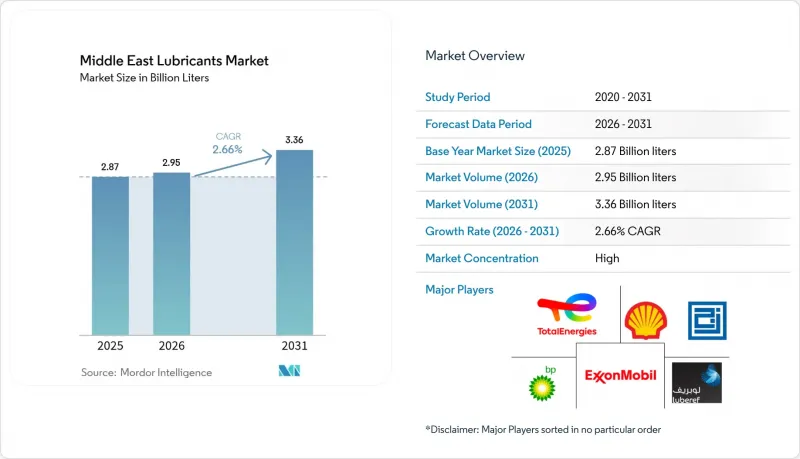
據 Mordor Intelligence 稱,2025 年中東潤滑油市場價值為 28.7 億公升,預計到 2031 年將達到 33.6 億公升,而 2026 年為 29.5 億公升,預測期(2026-2031 年)複合年成長率為 2.66%。
本報告按組別(I組、II組、III組、其他)、基料(生物基、礦物油、合成、半合成)、產品類型(引擎油、變速箱和液壓油、金屬加工液等)、最終用戶業(發電、汽車和其他運輸設備、重型機械等)和地區(沙烏地阿拉伯、阿拉伯聯合大公國、伊朗等)進行分類。
中東潤滑油市場趨勢與洞察
海灣合作理事會地區石化和製造地的工業擴張。
新型石化聯合企業、金屬加工廠和下游加工企業的湧現,正推動該地區對壓縮機油、導熱油和金屬加工潤滑油的需求。投資110億美元的阿米拉爾計畫於2024年運作,該計畫包含一套年產165萬噸的乙烯裂解裝置,需要能夠承受200 度C排氣溫度的合成加工油。沙烏地基礎工業公司(SABIC)朱拜勒工廠和卡達拉斯拉凡工廠的擴建計畫也加劇了類似的需求。一體化生產商通常指定使用II類或III類基礎油,因為更高的黏度指數和氧化穩定性可以減少意外停機時間,這對於高產能聚合物設備至關重要。高工業密度也降低了最後一公里物流成本,使經銷商能夠實施供應商管理庫存(VMI),從而在保持設備正常運作的同時,實現更精簡的工廠潤滑油儲存。這種良性循環支撐著中東潤滑油市場優質產品銷售量的持續成長。
汽車保有量的增加和售後市場需求的激增
隨著收入成長推動汽車保有量增加,以及電子商務加速了「最後一公里」物流運輸,輕型車輛的新車註冊量持續成長。沙烏地阿拉伯的汽車保有量預計將在2024年超過800萬輛,而商用車市場正以兩位數的速度成長,以滿足NEOM、Diriya和其他大型企劃的需求。阿拉伯聯合大公國作為轉口貿易中心,吸引了大量重型卡車,這些卡車在海灣合作理事會跨大陸走廊上行駛里程很高,從而推動了對符合API CK-4和低SAPs歐VI標準的高TBN引擎油的需求。雖然合成油配方已將換油週期延長至75,000英里,但由於單價上漲和添加劑使用量的增加,每輛車的實際潤滑成本正在上升。 OEM廠商對API SN PLUS和ILSAC GF-6等級的保固要求正在擴大高階市場,這有助於在中東潤滑油市場保持利潤率,儘管換油量趨於平穩。
基礎油價格的波動與原油價格的波動密切相關。
由於布蘭特原油價格在一個季度內頻繁波動,像Luberef這樣的煉油商不得不每月調整其I類和II類燃料的標價。同時,獨立調和商面臨利潤率壓力,因為基礎油成本佔調和成本的75%之多。此外,固定服務套餐的市場模式也使得彈性的零售定價難以實現。因此,原油價格上漲會擠壓毛利,迫使企業採取更嚴格的庫存管理和避險策略,進而增加資金籌措成本。反之,原油價格暴跌則迫使經銷商降低庫存降價,導致估價損失。此類價格波動為規劃帶來不確定性,導致旨在解決產能瓶頸的資本支出(CAPEX)減少,並阻礙了中東潤滑油市場的短期成長。
細分市場分析
2025年,I類基礎油在中東潤滑油市場佔有46.62%的佔有率。這是因為許多工業用戶仍傾向於選擇價格較低的I類基礎油,用於飛濺潤滑輸送機、活塞式空氣壓縮機以及在中等熱負載下運作的發電機組。該細分市場的成功源自於數十年來傳統的煉油技術和成熟的添加劑配方,這些都確保了供應的穩定性。然而,2025年發布的OEM技術指令建議新型往復式壓縮機使用II類基礎油,並強制要求在持續環境溫度為50 度C的條件下運作的渦輪增壓和增壓冷卻引擎使用III類基礎油,從而鼓勵終端用戶過渡到更高品質的基礎油。
性能優勢顯而易見。與I類潤滑油相比,III類潤滑油的揮發性降低30%,黏度指數提高20%,從而延長了抗氧化壽命並減少了更換頻率。沙烏地阿美公司的「Luberef第二期」維修計畫包括新增一條專門設計的II類潤滑油產品線,以適應這一轉變。利雅德和吉達的經銷商已經開始將40-60%的II類潤滑油與多級潤滑油混合,以滿足SAE XW-30不斷變化的黏度要求。雖然單價有所上漲,但車隊採用500小時換油週期正在降低總擁有成本,加速了中東潤滑油市場的普及。
礦物油目前仍佔總消費量的69.58%,這得益於該地區豐富的煉油產能、成本優勢以及與多種添加劑的兼容性。然而,主要物流公司和石化生產商簽署的永續性章程承諾到2030年將生命週期碳排放量減少30%。因此,生物基潤滑油(主要是植物性酯類液壓油和可生物分解的金屬成型液)正日益受到關注,其複合年成長率達3.12%,優於整體市場表現。
生物酯在28天內可分解率超過90%,並具有優異的邊界潤滑性能,可降低鋁壓機生產線上15%的刀具磨損。然而,其氧化穩定性仍是一項挑戰,需要添加抗氧化劑,從而增加配方成本。將20-30%的生物基油與礦物載體油混合的半合成潤滑油,提供了一種兼顧ISO 11158性能和降低環境影響的實用方案。此類創新正逐步削弱礦物基產品的市場主導地位,並拓展中東潤滑油市場的產品範圍。
其他好處:
- Excel格式的市場預測(ME)表
- 3個月的分析師支持
目錄
第1章:引言
- 研究假設和市場定義
- 調查範圍
第2章:調查方法
第3章執行摘要
第4章 市場狀況
- 市場概覽
- 市場促進因素
- 海灣合作理事會國家石化與製造地的產業擴張
- 汽車保有量的增加和售後市場需求的激增
- 大型基礎設施和發電工程規劃
- 過渡到能夠承受惡劣氣候條件的高性能合成材料
- 在地採購要求(例如沙烏地阿拉伯 2030 願景)正在促進國內混合生產。
- 市場限制因素
- 原油價格波動導致基礎油價格波動
- 排水週期的延長導致排水量需求下降。
- 由於清真認證,添加劑的化學成分受到限制
- 價值鏈分析
- 監理情勢
- 波特五力模型
第5章 市場規模與成長預測
- 按分組
- 第一組
- 第二組
- 第三組
- 第四組(PAO)
- 萘
- 依基料
- 生物性潤滑劑
- 礦物油性潤滑劑
- 合成潤滑油
- 半合成潤滑油
- 依產品類型
- 機油
- 傳動和液壓油
- 金屬加工用潤滑液
- 通用工業油
- 齒輪油
- 潤滑脂
- 加工油
- 其他類型(渦輪機、冷凍、航空航太、船舶、變壓器)
- 按最終用戶行業分類
- 發電
- 汽車和其他運輸設備
- 重型機械
- 食品/飲料
- 冶金/金屬加工
- 化學製造
- 其他行業(造船、紡織、一般製造業、石油和天然氣)
- 按地區
- 沙烏地阿拉伯
- 阿拉伯聯合大公國
- 伊朗
- 伊拉克
- 科威特
- 卡達
- 阿曼
- 巴林
- 其他中東國家
第6章 競爭情勢
- 市場集中度
- 策略趨勢
- 市佔率** / 排名分析
- 公司簡介
- Aljomaih and Shell Lubricating Oil Company Limited
- Behran Oil Co.
- BP plc
- Chevron USA .Inc
- Emarat
- Exxon Mobil Corporation
- FUCHS
- GP Global MAG LLC
- Gulf Oil Middle East Limited(Gulf Oil International Ltd)
- Idemitsu Kosan Co., Ltd.
- IRANOL(LLP)
- Lubrex FZC
- Motul
- Pars Oil Company
- Petromin
- Saudi Aramco Base Oil Company-Luberef
- Sepahan Oil Company
- SK Lubricants
- TotalEnergies
第7章 市場機會與未來展望
According to Mordor Intelligence, the Middle East lubricants market size was valued at 2.87 billion liters in 2025 and estimated to grow from 2.95 billion liters in 2026 to reach 3.36 billion liters by 2031, at a CAGR of 2.66% during the forecast period (2026-2031).
This report is Segmented by Group (Group I, Group II, Group III, and More), Base Stock (Bio-Based, Mineral Oil, Synthetic, Semi-Synthetic), Product Type (Engine Oil, Transmission and Hydraulic Fluid, Metalworking Fluid, and More), End-User Industry (Power Generation, Automotive and Other Transportation, Heavy Equipment, and More), and Geography (Saudi Arabia, United Arab Emirates, Iran, and More).
Middle East Lubricants Market Trends and Insights
Industrial Expansion Across GCC Petrochemical and Manufacturing Hubs
New petrochemical complexes, metals plants, and downstream converters are raising localized demand for compressor oils, heat-transfer fluids, and metalworking lubricants. The USD 11 billion Amiral project started up in 2024 with a 1.65 million ton ethylene cracker that relies on synthetic process oils able to tolerate 200 °C discharge temperatures. Additions at SABIC Jubail and Qatar's Ras Laffan extend the same requirement profile. Integrated producers typically specify Group II or Group III base stocks because higher viscosity index and oxidation stability reduce unplanned shutdowns, a critical metric in high-throughput polymer assets. Dense industrial clustering also lowers last-mile logistics costs, allowing distributors to implement vendor-managed inventories that keep plant lube rooms lean while guaranteeing uptime. This virtuous cycle underpins sustained uplift in premium-grade volumes across the Middle East lubricants market.
Automotive Fleet Growth and Aftermarket Demand Surge
Light-duty registrations continue to rise as income growth boosts vehicle ownership and e-commerce accelerates last-mile trucking. Saudi Arabia's vehicle parc crossed 8 million units in 2024, and commercial segments are expanding at double-digit rates to serve NEOM, Diriyah, and other megaprojects. The UAE's re-export hub status pulls in heavy-duty trucks that clock high annual mileage on trans-GCC corridors, driving demand for high-TBN engine oils meeting API CK-4 and low-SAPs Euro VI standards. Although synthetic formulations stretch change intervals to 75,000 miles, per-vehicle lube spend actually climbs because of higher unit prices and additive treat rates. OEM warranty requirements for API SN PLUS and ILSAC GF-6 classes are widening the premium tier, and this helps safeguard margins in the Middle East lubricants market despite plateauing drain volumes.
Base Oil Price Volatility Tied to Crude Fluctuations
Due to frequent fluctuations in Brent crude prices within a single quarter, refiners like Luberef are compelled to adjust their posted prices for Group I and Group II fuels every month. Meanwhile, independent blenders face squeezed margins, as base stocks account for as much as 75% of their formulation costs. Additionally, flexible retail pricing is challenging in markets that offer fixed service-package menus. Gross profit therefore compresses when crude rallies, prompting stocking discipline and hedging strategies that add financing costs. Conversely, rapid crude drops compel distributors to mark down inventories, triggering valuation losses. Such oscillations create planning uncertainty and trimmed CAPEX for capacity debottlenecks, restraining near-term growth within the Middle East lubricants market.
Other drivers and restraints analyzed in the detailed report include:
- Mega Infrastructure and Power Generation Projects Pipeline
- Local Content Mandates Spurring Domestic Blending
- Longer Drain Intervals Reducing Volumetric Demand
For complete list of drivers and restraints, kindly check the Table Of Contents.
Segment Analysis
Group I held a 46.62% slice of the Middle East lubricants market share in 2025 because many industrial buyers still favor its lower cost for splash-lubed conveyors, piston-type air compressors, and gensets operating under moderate thermal stress. The segment's installed base derives from decades of conventional refining and well-established additive treat recipes that assure supply continuity. However, OEM technical bulletins released in 2025 recommend Group II for new reciprocating compressor models and mandate Group III for turbocharged, charge-cooled engines running in sustained 50 °C ambient conditions, nudging end users toward higher-quality basestocks.
The performance narrative is compelling. Group III lubricants show 30% lower volatility and 20% higher viscosity index than Group I, extending oxidation life and reducing top-up rates. Saudi Aramco's Luberef Phase II revamp adds Group II lines specifically targeting this migration. Distributors across Riyadh and Jeddah are already blending multigrades with 40-60% Group II cut to meet evolving SAE XW-30 viscosity demands. Although unit prices climb, total cost of ownership sinks as fleets adopt 500-hour drain cycles, boosting adoption within the Middle East lubricants market.
Mineral oils still represent 69.58% of total consumption, underpinned by abundant regional refining capacity, cost advantage, and broad additive compatibility. Yet, sustainability charters signed by top logistics operators and petrochemicals producers commit to 30% life-cycle carbon reduction by 2030. Bio-based lubricants-mainly vegetable-ester hydraulic oils and biodegradable metal-forming fluids-therefore attract attention and record a 3.12% CAGR, outpacing the wider market.
Bio-esters deliver greater than 90% biodegradability within 28 days and exhibit superior boundary lubrication, reducing tool wear in aluminum stamping lines by 15%. Nonetheless, oxidative stability lags, necessitating anti-oxidant boosters that increase formulation cost. Semi-synthetic blends combining mineral carriers with 20-30% bio-base strike a practical compromise, retaining ISO 11158 performance while lowering environmental exposure. Such innovations slowly chip away at mineral dominance and broaden the offering landscape inside the Middle East lubricants market.
Complete Report Scope:
- By Group
- Group I
- Group II
- Group III
- Group IV (PAO)
- Naphthenics
- By Base Stock
- Bio-based Lubricant
- Mineral Oil Lubricant
- Synthetic Lubricant
- Semi-synthetic Lubricant
- By Product Type
- Engine Oil
- Transmission and Hydraulic Fluid
- Metalworking Fluid
- General Industrial Oil
- Gear Oil
- Greases
- Process Oils
- Other Types (Turbine, Refrigeration, Aviation, Marine, Transformer)
- By End-user Industry
- Power Generation
- Automotive and Other Transportation
- Heavy Equipment
- Food and Beverage
- Metallurgy and Metalworking
- Chemical Manufacturing
- Other Industries (Marine, Textiles, General Manufacturing, Oil and Gas)
- By Geography
- Saudi Arabia
- United Arab Emirates
- Iran
- Iraq
- Kuwait
- Qatar
- Oman
- Bahrain
- Rest of Middle-East
List of Companies Covered in this Report:
- Aljomaih and Shell Lubricating Oil Company Limited
- Behran Oil Co.
- BP p.l.c
- Chevron USA .Inc
- Emarat
- Exxon Mobil Corporation
- FUCHS
- GP Global MAG LLC
- Gulf Oil Middle East Limited (Gulf Oil International Ltd)
- Idemitsu Kosan Co., Ltd.
- IRANOL (LLP)
- Lubrex FZC
- Motul
- Pars Oil Company
- Petromin
- Saudi Aramco Base Oil Company - Luberef
- Sepahan Oil Company
- SK Lubricants
- TotalEnergies
Additional Benefits:
- The market estimate (ME) sheet in Excel format
- 3 months of analyst support
TABLE OF CONTENTS
1 Introduction
- 1.1 Study Assumptions and Market Definition
- 1.2 Scope of the Study
2 Research Methodology
3 Executive Summary
4 Market Landscape
- 4.1 Market Overview
- 4.2 Market Drivers
- 4.2.1 Industrial expansion across GCC petrochemical and manufacturing hubs
- 4.2.2 Automotive-fleet growth and aftermarket demand surge
- 4.2.3 Mega infrastructure and power-generation projects pipeline
- 4.2.4 Shift toward high-performance synthetics for harsh climates
- 4.2.5 Local-content mandates (e.g., Saudi Vision 2030) spurring domestic blending
- 4.3 Market Restraints
- 4.3.1 Base-oil price volatility tied to crude fluctuations
- 4.3.2 Longer drain-intervals reducing volumetric demand
- 4.3.3 Halal-certification limits on additive chemistries
- 4.4 Value Chain Analysis
- 4.5 Regulatory Landscape
- 4.6 Porter's Five Forces
- 4.6.1 Bargaining Power of Suppliers
- 4.6.2 Bargaining Power of Buyers
- 4.6.3 Threat of New Entrants
- 4.6.4 Threat of Substitutes
- 4.6.5 Degree of Competition
5 Market Size and Growth Forecasts (Volume)
- 5.1 By Group
- 5.1.1 Group I
- 5.1.2 Group II
- 5.1.3 Group III
- 5.1.4 Group IV (PAO)
- 5.1.5 Naphthenics
- 5.2 By Base Stock
- 5.2.1 Bio-based Lubricant
- 5.2.2 Mineral Oil Lubricant
- 5.2.3 Synthetic Lubricant
- 5.2.4 Semi-synthetic Lubricant
- 5.3 By Product Type
- 5.3.1 Engine Oil
- 5.3.2 Transmission and Hydraulic Fluid
- 5.3.3 Metalworking Fluid
- 5.3.4 General Industrial Oil
- 5.3.5 Gear Oil
- 5.3.6 Greases
- 5.3.7 Process Oils
- 5.3.8 Other Types (Turbine, Refrigeration, Aviation, Marine, Transformer)
- 5.4 By End-user Industry
- 5.4.1 Power Generation
- 5.4.2 Automotive and Other Transportation
- 5.4.3 Heavy Equipment
- 5.4.4 Food and Beverage
- 5.4.5 Metallurgy and Metalworking
- 5.4.6 Chemical Manufacturing
- 5.4.7 Other Industries (Marine, Textiles, General Manufacturing, Oil and Gas)
- 5.5 By Geography
- 5.5.1 Saudi Arabia
- 5.5.2 United Arab Emirates
- 5.5.3 Iran
- 5.5.4 Iraq
- 5.5.5 Kuwait
- 5.5.6 Qatar
- 5.5.7 Oman
- 5.5.8 Bahrain
- 5.5.9 Rest of Middle-East
6 Competitive Landscape
- 6.1 Market Concentration
- 6.2 Strategic Moves
- 6.3 Market Share**/Ranking Analysis
- 6.4 Company Profiles (includes Global level Overview, Market level overview, Core Segments, Financials as available, Strategic Information, Market Rank/Share for key companies, Products and Services, and Recent Developments)
- 6.4.1 Aljomaih and Shell Lubricating Oil Company Limited
- 6.4.2 Behran Oil Co.
- 6.4.3 BP p.l.c
- 6.4.4 Chevron USA .Inc
- 6.4.5 Emarat
- 6.4.6 Exxon Mobil Corporation
- 6.4.7 FUCHS
- 6.4.8 GP Global MAG LLC
- 6.4.9 Gulf Oil Middle East Limited (Gulf Oil International Ltd)
- 6.4.10 Idemitsu Kosan Co., Ltd.
- 6.4.11 IRANOL (LLP)
- 6.4.12 Lubrex FZC
- 6.4.13 Motul
- 6.4.14 Pars Oil Company
- 6.4.15 Petromin
- 6.4.16 Saudi Aramco Base Oil Company - Luberef
- 6.4.17 Sepahan Oil Company
- 6.4.18 SK Lubricants
- 6.4.19 TotalEnergies
7 Market Opportunities and Future Outlook
- 7.1 White-space and Unmet-need Assessment

 玻璃潤滑劑市場:全球市場預測,2026-2032年鏈條脫脂潤滑劑市場-2026年至2032年全球市場預測
 2026年全球礦物油基潤滑劑市場報告
 潤滑油市場(截至2034年)
 北美潤滑油市場:市場佔有率分析、產業趨勢與統計、成長預測(2026-2031)防銹潤滑劑氣霧劑:市場佔有率分析、行業趨勢和統計數據以及成長預測(2026-2031 年)法國潤滑油市場:市場佔有率分析、產業趨勢與統計及成長預測(2026-2031)
 2026-2030年全球潤滑油市場中國潤滑油市場:市場佔有率分析、產業趨勢與統計、成長預測(2026-2031年)印尼潤滑油市場:市場佔有率分析、產業趨勢與統計、成長預測(2026-2031)