


 |
市場調查報告書
商品編碼
2121610
義大利風力發電:市場佔有率分析、產業趨勢與統計及成長預測(2026-2031 年)Italy Wind Energy - Market Share Analysis, Industry Trends & Statistics, Growth Forecasts (2026 - 2031) |
||||||

※ 本網頁內容可能與最新版本有所差異。詳細情況請與我們聯繫。
根據 Mordor Intelligence 預測,義大利風電市場規模(以裝置容量計算)預計將從 2025 年的 13.33 吉瓦擴大到 2026 年的 13.73 吉瓦,然後從 2026 年到 2031 年以 3.02% 的複合成長率成長,達到 2031 年 20.3195.503 年。
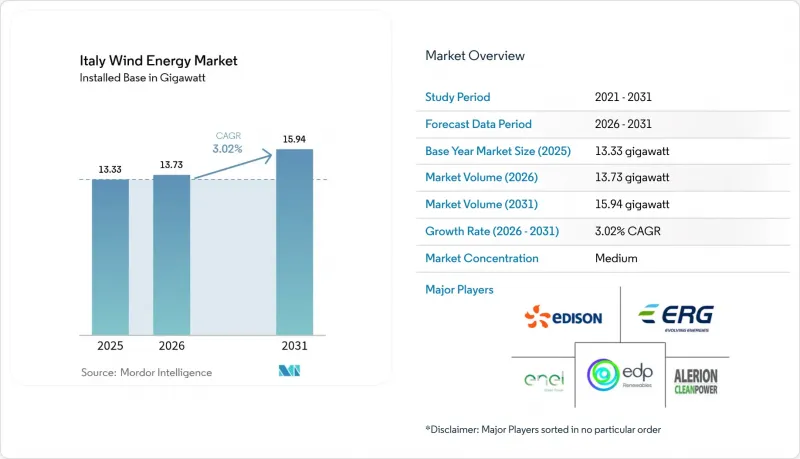
本報告按位置(陸上和海上)、渦輪機功率(小於3兆瓦、3-6兆瓦和大於6兆瓦)和應用(公用事業規模、商業/工業和社區項目)進行細分。市場規模和預測以裝置容量(吉瓦)表示。
義大利風電市場趨勢與洞察
擴大可再生能源競標機會
義大利的FER2法規引入了雙向差價合約(CfD),離岸風力發電的執行價格為185歐元/兆瓦時(199.8美元/兆瓦時),旨在消除市場價格的不確定性,並為專案提供債務融資便利。歐盟委員會已批准一項355億歐元(383億美元)的計劃,涵蓋4.59吉瓦的新增可再生能源裝置容量,其中包括亞得里亞海和愛奧尼亞海的吉瓦級浮體式電項目,該計劃將於2028年完成。隨著「Agnes-1-2」(700兆瓦)和「Energia Wind 2020」(330兆瓦)計畫獲得環境核准,這些計畫正從規劃階段進入準備階段。在2024年下半年完成競標後,每個項目將在2025年至2026年間動工。
符合國家就業和就業協調計劃(NECP)的授權改革勢頭強勁
第190/2024號法令及《可再生能源統一法》引入了一站式服務體系和標準化環境評估,將平均核准週期從14年縮短至5年以內。 「能源釋放2.0」措施加快了併網程序,同時在公共利益優先的前提下限制了法律異議。 2024年10月通過的《海洋空間規劃》最終明確了近海區域的邊界分類。
地方政府冗長的授權程序和鄰避運動
儘管國家層級努力簡化程序,但由於對景觀和旅遊業的擔憂,一些地區的專案進度仍然被延誤或停滯。撒丁島的臨時禁令導致2.5吉瓦的已經過核准但尚未建造的裝置容量,延長了開發商的持有成本,並擴大了競標與實際運作之間的差距。
細分市場分析
陸域風電場在義大利風電市場佔據主導地位,到2025年裝置容量將達到13.3吉瓦,佔總裝置容量的99.78%。然而,預計到2031年,新增離岸風電裝置容量將增加至約4.9%,年複合成長率高達71.6%,成為該產業的主要成長引擎。隨著浮體式基礎技術克服了半島陡峭大陸棚的挑戰,義大利風電市場正在經歷一場顯著的變革,使得在60至200公尺深的水域部署兆瓦級風力渦輪機成為可能。
早期離岸風電項目,例如Med Wind、Krimisa和Messapia,採用15-18兆瓦的風力渦輪機,減少了基礎數量,降低了電站基礎設施(BOP)成本,並縮短了建設週期。海洋空間計畫和FER2競標定價提供的監管確定性,加上歐盟復甦基金的支持,使得債務資金籌措成為可能。儘管普利亞和Calabria的陸上風電透過改造計畫持續成長,但新的建設用地卻日益稀缺,這凸顯了離岸風電在義大利風電市場中日益成長的重要性。
其他好處:
- Excel格式的市場預測(ME)表
- 3個月的分析師支持
目錄
第1章:引言
- 研究假設和市場定義
- 調查範圍
第2章:調查方法
第3章執行摘要
第4章 市場狀況
- 市場概覽
- 市場促進因素
- 擴大可再生能源競標項目儲備
- 符合國家就業和就業協調計劃(NECP)的授權製度改革勢頭強勁
- 難以減少排放的產業對購電協議的需求。
- 利用浮體式海上風能資源
- 電網數位化與儲能的綜效。
- 市場限制因素
- 地方政府冗長的授權審核程序和鄰避運動(NIMBY,即「不要建在我家後院」)
- 太陽能光電發電(Solar-PV)成本競爭力面臨壓力
- 歐洲風力發電機供應鏈的通貨膨脹
- 供應鏈分析
- 監理情勢
- 技術展望
- 波特五力模型
- PESTLE分析
第5章 市場規模與成長預測
- 按位置
- 陸上
- 離岸
- 按渦輪機輸出
- 3兆瓦或以下
- 3~6 MW
- 6兆瓦或以上
- 透過使用
- 公用事業規模
- 商業和工業用途
- 社區計畫
- 按成分(定性分析)
- 機艙/渦輪機
- 刀刃
- 塔
- 發電機和齒輪箱
- 其他輔助設施和系統
第6章 競爭情勢
- 市場集中度
- 策略趨勢(併購、聯盟、購電協議)
- 市場佔有率分析(主要公司的市場排名和佔有率)
- 公司簡介
- Enel Green Power
- ERG SpA
- Edison SpA
- EDP Renovaveis
- Alerion Clean Power SpA
- PLT Energia Srl
- Renvico Holding
- Italian Vento Power Corp. Srl
- GreenIT(Plenitude/CDP Equity)
- Falck Renewables-BlueFloat
- Renexia SpA
- Terna Rete Elettrica Nazionale
- General Electric Co.
- Siemens Gamesa Renewable Energy SA
- Vestas Wind Systems AS
- Nordex SE
- MingYang Smart Energy
- Hitachi Energy Ltd.
- Prysmian Group
- Senvion GmbH
第7章 市場機會與未來展望
According to Mordor Intelligence, the Italy wind energy market size in terms of installed base is expected to grow from 13.33 gigawatt in 2025 to 13.73 gigawatt in 2026 and is forecast to reach 15.94 gigawatt by 2031 at 3.02% CAGR over 2026-2031.
This report is Segmented by Location (Onshore and Offshore), Turbine Capacity (Less Than 3 MW, 3 To 6 MW, and Above 6 MW), and Application (Utility-Scale, Commercial and Industrial, and Community Projects). The Market Size and Forecasts are Provided in Terms of Installed Capacity (GW).
Italy Wind Energy Market Trends and Insights
Renewable-energy auction pipeline expansion
Italy's FER2 decree establishes two-way CfDs with a EUR 185/MWh (USD 199.8/MWh) strike price for offshore wind, eliminating merchant revenue uncertainty and facilitating project debt financing. The European Commission approved a EUR 35.5 billion (USD 38.3 billion) scheme spanning 2028 that encompasses 4.59 GW of new renewable capacity, including gigawatt-scale floating projects in the Adriatic and Ionian Seas. Environmental approvals for Agnes-1-2 (700 MW) and Energia Wind 2020 (330 MW) show the funnel converting from intent to shovel-ready status, with late-2024 auctions moving projects toward 2025-2026 construction starts
NECP-aligned permitting reform momentum
Legislative Decree 190/2024 and the Testo Unico Rinnovabili introduce a single-window system and standardized environmental assessments, trimming the average approval cycle from fourteen to under five years. The Energy Release 2.0 measure accelerates grid-connection procedures, while a presumption of overriding public interest limits legal challenges. Adoption of maritime spatial plans in October 2024 finally brings certainty to offshore zone delimitation.
Lengthy local-permitting & NIMBY pushback
Despite national streamlining efforts, several regions slow or halt projects due to concerns over landscape and tourism. Sardinia's temporary moratorium leaves 2.5 GW of authorized but unbuilt capacity, extending carrying costs for developers and widening the gap between tender awards and actual commissioning.
Other drivers and restraints analyzed in the detailed report include:
- Corporate-PPA pull from hard-to-abate industries
- Floating-offshore wind resource unlock
- Solar-PV cost-competitiveness pressure
For complete list of drivers and restraints, kindly check the Table Of Contents.
Segment Analysis
Onshore assets dominated the Italian wind energy market, accounting for 13.3 GW in 2025, which is equivalent to 99.78% of the installed capacity. Yet offshore additions are forecast to lift the location's share to about 4.9% by 2031 on a 71.6% CAGR, making it the sector's prime growth engine. The Italy wind energy market is tracking a clear pivot as floating foundations overcome the peninsula's steep continental shelf, bringing multi-megawatt turbines to waters 60-200 meters deep.
Early offshore projects, such as Med Wind, Krimisa, and Messapia, leverage 15- to 18-MW machines that reduce foundation counts, lower balance-of-plant costs, and shorten construction timelines. Regulatory certainty from maritime spatial plans and FER2 auction pricing aligns with EU recovery funds to unlock debt financing. Onshore growth continues through repowering in Puglia and Calabria; yet, incremental sites are scarcer, underscoring the rising importance of offshore wind for the Italian wind energy market.
Complete Report Scope:
- By Location
- Onshore
- Offshore
- By Turbine Capacity
- Up to 3 MW
- 3 to 6 MW
- Above 6 MW
- By Application
- Utility-scale
- Commercial and Industrial
- Community Projects
- By Component (Qualitative Analysis)
- Nacelle/Turbine
- Blade
- Tower
- Generator and Gearbox
- Balance-of-System
List of Companies Covered in this Report:
- Enel Green Power
- ERG SpA
- Edison SpA
- EDP Renovaveis
- Alerion Clean Power SpA
- PLT Energia Srl
- Renvico Holding
- Italian Vento Power Corp. Srl
- GreenIT (Plenitude/CDP Equity)
- Falck Renewables-BlueFloat
- Renexia SpA
- Terna Rete Elettrica Nazionale
- General Electric Co.
- Siemens Gamesa Renewable Energy SA
- Vestas Wind Systems AS
- Nordex SE
- MingYang Smart Energy
- Hitachi Energy Ltd.
- Prysmian Group
- Senvion GmbH
Additional Benefits:
- The market estimate (ME) sheet in Excel format
- 3 months of analyst support
TABLE OF CONTENTS
1 Introduction
- 1.1 Study Assumptions & Market Definition
- 1.2 Scope of the Study
2 Research Methodology
3 Executive Summary
4 Market Landscape
- 4.1 Market Overview
- 4.2 Market Drivers
- 4.2.1 Renewable-energy auction pipeline expansion
- 4.2.2 NECP-aligned permitting reform momentum
- 4.2.3 Corporate-PPA pull from hard-to-abate industries
- 4.2.4 Floating-offshore wind resource unlock
- 4.2.5 Grid-digitalisation & storage synergy
- 4.3 Market Restraints
- 4.3.1 Lengthy local-permitting & NIMBY pushback
- 4.3.2 Solar-PV cost-competitiveness pressure
- 4.3.3 Euro-wind-turbine supply-chain inflation
- 4.4 Supply-Chain Analysis
- 4.5 Regulatory Landscape
- 4.6 Technological Outlook
- 4.7 Porter's Five Forces
- 4.7.1 Threat of New Entrants
- 4.7.2 Bargaining Power of Suppliers
- 4.7.3 Bargaining Power of Buyers
- 4.7.4 Threat of Substitutes
- 4.7.5 Competitive Rivalry
- 4.8 PESTLE Analysis
5 Market Size & Growth Forecasts
- 5.1 By Location
- 5.1.1 Onshore
- 5.1.2 Offshore
- 5.2 By Turbine Capacity
- 5.2.1 Up to 3 MW
- 5.2.2 3 to 6 MW
- 5.2.3 Above 6 MW
- 5.3 By Application
- 5.3.1 Utility-scale
- 5.3.2 Commercial and Industrial
- 5.3.3 Community Projects
- 5.4 By Component (Qualitative Analysis)
- 5.4.1 Nacelle/Turbine
- 5.4.2 Blade
- 5.4.3 Tower
- 5.4.4 Generator and Gearbox
- 5.4.5 Balance-of-System
6 Competitive Landscape
- 6.1 Market Concentration
- 6.2 Strategic Moves (M&A, Partnerships, PPAs)
- 6.3 Market Share Analysis (Market Rank/Share for key companies)
- 6.4 Company Profiles (includes Global level Overview, Market level overview, Core Segments, Financials as available, Strategic Information, Products & Services, and Recent Developments)
- 6.4.1 Enel Green Power
- 6.4.2 ERG SpA
- 6.4.3 Edison SpA
- 6.4.4 EDP Renovaveis
- 6.4.5 Alerion Clean Power SpA
- 6.4.6 PLT Energia Srl
- 6.4.7 Renvico Holding
- 6.4.8 Italian Vento Power Corp. Srl
- 6.4.9 GreenIT (Plenitude/CDP Equity)
- 6.4.10 Falck Renewables-BlueFloat
- 6.4.11 Renexia SpA
- 6.4.12 Terna Rete Elettrica Nazionale
- 6.4.13 General Electric Co.
- 6.4.14 Siemens Gamesa Renewable Energy SA
- 6.4.15 Vestas Wind Systems AS
- 6.4.16 Nordex SE
- 6.4.17 MingYang Smart Energy
- 6.4.18 Hitachi Energy Ltd.
- 6.4.19 Prysmian Group
- 6.4.20 Senvion GmbH
7 Market Opportunities & Future Outlook
- 7.1 White-space & Unmet-Need Assessment

 2026-2030年全球風力發電市場
 風力發電單樁市場規模、佔有率和成長分析:按單樁類型、水深、基礎直徑、應用、最終用戶和地區分類-2026-2033年產業預測
 英國風力發電:市場佔有率分析、產業趨勢與統計及成長預測(2026-2031)日本風力發電:市場佔有率分析、產業趨勢與統計及成長預測(2026-2031)泰國風力發電:市場佔有率分析、產業趨勢與統計及成長預測(2026-2031)美國風力發電:市場佔有率分析、產業趨勢與統計及成長預測(2026-2031)
 2034年離岸風力發電基礎市場預測-以固定式基礎、浮體式基礎、安裝/物流和區域分類的全球分析印度風力發電:市場佔有率分析、產業趨勢與統計及成長預測(2026-2031)
 全球風電市場規模、佔有率、趨勢和成長分析報告(2026-2034年)
 風力發電基礎市場規模、佔有率和成長分析:按基礎類型、渦輪機朝向、安裝類型、應用和地區分類-2026-2033年產業預測