

 |
市場調查報告書
商品編碼
2120779
日本風力發電:市場佔有率分析、產業趨勢與統計及成長預測(2026-2031)Japan Wind Energy - Market Share Analysis, Industry Trends & Statistics, Growth Forecasts (2026 - 2031) |
||||||

※ 本網頁內容可能與最新版本有所差異。詳細情況請與我們聯繫。
根據 Mordor Intelligence 估計,到 2026 年,日本風電市場規模將達到 8.96 吉瓦,高於 2025 年的 6.95 吉瓦。
此外,預計到 2031 年,發電量將達到 31.83 吉瓦,並且預計從 2026 年到 2031 年的複合年成長率將達到 28.87%。
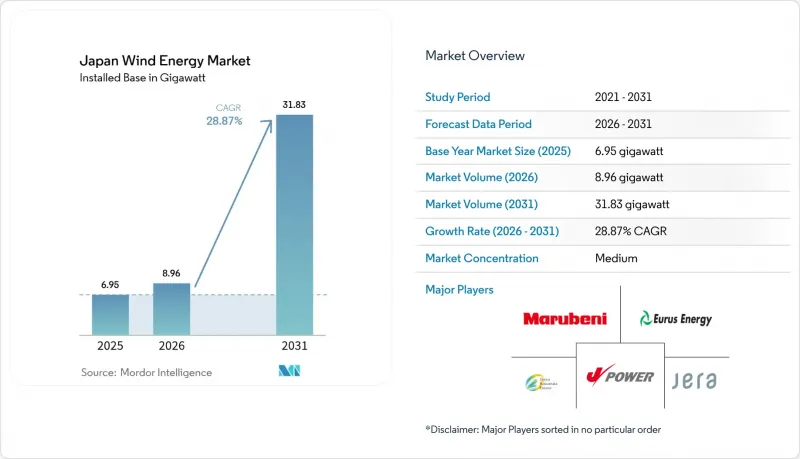
本報告按位置(陸上和海上)、渦輪機功率(小於3兆瓦、3-6兆瓦和大於6兆瓦)和應用(公用事業規模、商業/工業和區域項目)進行細分。市場規模和預測以裝置容量(吉瓦)表示。
日本風電市場趨勢與洞察
離岸風力發電競標輪次激增
在2024年12月舉行的第三次競標中,青森南區和吉田區共獲得1吉瓦的裝機容量,價格為3日元/千瓦時,並強制要求在2030年6月前投入運作。 2025年1月修訂的競標規則引入了物價指數掛鉤機制和提前運作獎勵,以抵銷成本上漲風險。這些調整體現了監管的柔軟性,既擴大了競標的範圍,也保持了價格的競爭力。計劃於2025年舉行的第四次競標將檢驗規則修訂能否在不影響國內發電需求的前提下,加速已訂購訂單的擴張。這種模式已使競標制度成為日本風電市場可預測成長的驅動力。
陸域風電:降低平準化電成本及升級風扇
裝置容量147兆瓦的阿武隈風電場由46台通用電氣Vernova 3.2兆瓦風力發電機組成,計畫於2025年4月投入運作。該專案展示了更大功率的風力發電機如何降低每兆瓦的輔助設備成本。維斯塔斯、三菱電機和富士電機在國內開關設備和半導體領域的合作正在加強供應鏈,降低對進口的依賴。由新能源產業技術綜合開發機構(NEDO)資助的浮體式垂直軸風力發電機原型機即使在深海域也能降低成本,從而推動其更廣泛應用。這些因素共同提高了專案的內部報酬率(IRR),加速了向更大、更有效率的風力發電機的過渡,並促進了日本風電市場的發展。
東北和北海道電網擁塞和限電風險
2023會計年度,可再生能源棄風量達1.76太瓦時(TWh),其中九州地區的棄風率為6.7%。風能資源豐富的北海道和東北地區遠離電力需求中心,高壓輸電網路延伸至本州的工程預計要到2030年才能完成。優先保障核能發電廠供電,導致風電高峰期可用容量緊張。儘管丸紅株式會社在北海道安裝的25兆瓦/103.7兆瓦時電池儲能系統在一定程度上緩解了這個問題,但北海道的總儲能需求仍超過2吉瓦(GW)。長期存在的輸電網擁塞威脅電力收入的穩定性,並導致新參與企業日本風電市場的企業資金籌措延遲。
細分市場分析
預計到2031年,日本離岸風電裝置容量將從幾乎為零成長至約12.1吉瓦,日本風電市場佔有率預計將從2025年的4.88%成長至2030年代末的近39%。在第三次競標中,共確定了1065吉瓦的市電平價價格,並選定了15兆瓦的風力發電機,使系統平衡成本降低了約五分之一。隨著《專屬經濟區法》於2025年3月生效,商業化浮動式風力發電將獲得法律支持,從而釋放日本海和太平洋海溝中150吉瓦的深海域開發潛力。
開發商仍然優先考慮陸上風電的升級改造。無需購置新土地,即可以4-5兆瓦的設備取代上世紀90年代安裝的1.2吉瓦風力發電機,而且併網也已就緒。然而,秋田縣和青森縣的臨時開發禁令,以及與候鳥遷徙路線相關的環境評估,限制了陸域風電的規劃裝置容量,使其僅為800兆瓦。離岸風力發電計畫面臨國內重型起吊船短缺的挑戰。國內僅有三艘此類船舶可用,而歐洲則有25艘,迫使開發商以高昂的日租金從韓國和中國租用船舶。
其他好處:
- Excel格式的市場預測(ME)表
- 3個月的分析師支持
目錄
第1章:引言
- 研究假設和市場定義
- 調查範圍
第2章:調查方法
第3章執行摘要
第4章 市場狀況
- 市場概覽
- 市場促進因素
- 離岸風力發電競標輪次激增。
- 陸域風力發電的平準化電成本降低,渦輪機性能提高
- 透過發行綠色債券流入的資金
- 資料中心與半導體叢集之間的購電協定(PPA)
- 日本開放專屬經濟區(EEZ)用於浮體式海上風力發電
- 政府的氫能和氨能戰略正在提振風力發電的需求。
- 市場限制因素
- 根據GX藍圖擴建燃氣發電設施
- 東北和北海道電網擁塞和限電風險
- 颱風導致營運維護成本增加
- 由於相關人員和當地相關人員的反對,許可證的發放被推遲了。
- 供應鏈分析
- 監理情勢
- 技術趨勢(浮體式基礎,15MW級風力渦輪機)
- 波特五力模型
- PESTLE分析
第5章 市場規模與成長預測
- 地點
- 陸上
- 離岸
- 按渦輪機容量
- 3兆瓦或以下
- 3~6 MW
- 6兆瓦或以上
- 透過使用
- 公用事業規模
- 商業和工業用途
- 社區計畫
- 按成分(定性分析)
- 機艙/渦輪機
- 刀刃
- 塔
- 發電機和齒輪箱
- 系統平衡
第6章 競爭情勢
- 市場集中度
- 策略趨勢(併購、聯盟、購電協議)
- 市場佔有率分析(主要公司的市場排名和佔有率)
- 公司簡介
- Vestas A/S
- Siemens Gamesa Renewable Energy
- Mitsubishi Heavy Industries
- GE Vernova
- Hitachi Energy
- JERA
- Eurus Energy Holdings
- Electric Power Development(J-Power)
- Sumitomo Corp.
- Marubeni Corp.
- Japan Renewable Energy(JRE)
- Cosmo Eco Power
- Toshiba Energy Systems
- Pattern Energy Japan
- Northland Power Japan
- Orsted Japan
- RWE Renewables Japan
- BP Offshore Wind Japan
- Shell Japan Renewables
- Inpex Renewable Energy
第7章 市場機會與未來展望
According to Mordor Intelligence, Japan wind energy market size in 2026 is estimated at 8.96 gigawatt, growing from 2025 value of 6.95 gigawatt with 2031 projections showing 31.83 gigawatt, growing at 28.87% CAGR over 2026-2031.
This report is Segmented by Location (Onshore and Offshore), Turbine Capacity (Less Than 3 MW, 3 To 6 MW, and Above 6 MW), and Application (Utility-Scale, Commercial and Industrial, and Community Projects). The Market Size and Forecasts are Provided in Terms of Installed Capacity (GW).
Japan Wind Energy Market Trends and Insights
Surge in Offshore-Wind Auction Rounds
Round 3 auctions in December 2024 awarded 1 GW across Aomori South and Yuza at JPY 3/kWh with mandated start-up by June 2030. Revised auction rules in January 2025 introduced price-indexation and early-operation incentives to offset cost-inflation risk.These changes signal regulatory agility that preserves competitive pricing while broadening bidder participation. Round 4, slated for 2025, will test whether rule refinements can accelerate capacity awards without compromising local-content requirements. The approach positions auctions as a predictable growth engine for the Japan wind energy market.
Declining Onshore LCOE and Turbine Upgrades
The 147 MW Abukuma wind farm, commissioned in April 2025 with 46 GE Vernova 3.2 MW units, shows how larger turbines cut balance-of-plant costs per megawatt. Domestic switchgear and semiconductor tie-ups between Vestas, Mitsubishi Electric, and Fuji Electric deepen the supply chain and lower import exposure. NEDO-funded floating vertical-axis prototypes extend cost reductions into deep-water environments, supporting broader deployment. Together, these factors lift project internal rates of return and quicken the shift toward larger, more efficient machines, advancing the Japan wind energy market.
Grid Congestion & Curtailment Risk in Tohoku/Hokkaido
Renewable curtailment reached 1.76 TWh in FY 2023, with Kyushu recording a 6.7% rate. Wind-rich Hokkaido and Tohoku lie far from demand hubs, and high-voltage upgrades to Honshu will not finish before 2030. Priority dispatch for nuclear reactors squeezes available capacity in peak-wind seasons. Although Marubeni's 25 MW/103.7 MWh battery system in Hokkaido offers partial relief, statewide storage needs exceed 2 GW. Persistent congestion threatens revenue stability and delays financing for new entrants in the Japan wind energy market.
Other drivers and restraints analyzed in the detailed report include:
- Capital Inflows from Green-Bond Issuances
- Corporate PPAs from Data-Centre & Semiconductor Clusters
- Typhoon-Driven O&M Cost Inflation
For complete list of drivers and restraints, kindly check the Table Of Contents.
Segment Analysis
Offshore capacity is forecast to climb from a negligible base to roughly 12.1 GW by 2031, raising its Japan wind energy market share from 4.88% in 2025 to nearly 39% at the end of the decade. Round 3 awards totaling 1.065 GW cleared at grid-parity prices and specified 15 MW turbines that compress balance-of-system costs by roughly one-fifth. Commercial floating wind receives a legal boost from March 2025 EEZ legislation, which unlocks 150 GW of deep-water potential in the Sea of Japan and Pacific trenches.
Developers still prize onshore repowering opportunities: 1.2 GW of 1990s-era turbines can be swapped for 4-5 MW machines without adding new land footprints, and grid taps are already in place. Yet local moratoriums in Akita and Aomori and environmental reviews on migratory-bird routes hold the onshore pipeline at 800 MW. Offshore projects must contend with a domestic shortage of heavy-lift jack-up vessels; only 3 are available versus 25 in Europe, pushing developers to charter Korean or Chinese assets at premium day rates.
Complete Report Scope:
- By Location
- Onshore
- Offshore
- By Turbine Capacity
- Up to 3 MW
- 3 to 6 MW
- Above 6 MW
- By Application
- Utility-scale
- Commercial and Industrial
- Community Projects
- By Component (Qualitative Analysis)
- Nacelle/Turbine
- Blade
- Tower
- Generator and Gearbox
- Balance-of-System
List of Companies Covered in this Report:
- Vestas A/S
- Siemens Gamesa Renewable Energy
- Mitsubishi Heavy Industries
- GE Vernova
- Hitachi Energy
- JERA
- Eurus Energy Holdings
- Electric Power Development (J-Power)
- Sumitomo Corp.
- Marubeni Corp.
- Japan Renewable Energy (JRE)
- Cosmo Eco Power
- Toshiba Energy Systems
- Pattern Energy Japan
- Northland Power Japan
- Orsted Japan
- RWE Renewables Japan
- BP Offshore Wind Japan
- Shell Japan Renewables
- Inpex Renewable Energy
Additional Benefits:
- The market estimate (ME) sheet in Excel format
- 3 months of analyst support
TABLE OF CONTENTS
1 Introduction
- 1.1 Study Assumptions & Market Definition
- 1.2 Scope of the Study
2 Research Methodology
3 Executive Summary
4 Market Landscape
- 4.1 Market Overview
- 4.2 Market Drivers
- 4.2.1 Surge in offshore-wind auction rounds
- 4.2.2 Declining onshore LCOE and turbine upgrades
- 4.2.3 Capital inflows from green-bond issuances
- 4.2.4 Corporate PPAs from data-centre & semiconductor clusters
- 4.2.5 Opening of Japan's EEZ for floating wind
- 4.2.6 National hydrogen-ammonia strategy boosting wind demand
- 4.3 Market Restraints
- 4.3.1 Gas-fired capacity additions under the GX roadmap
- 4.3.2 Grid congestion & curtailment risk in Tohoku/Hokkaido
- 4.3.3 Typhoon-driven O&M cost inflation
- 4.3.4 Fishery & local-stakeholder opposition delaying permits
- 4.4 Supply-Chain Analysis
- 4.5 Regulatory Landscape
- 4.6 Technological Outlook (floating foundations, 15-MW turbines)
- 4.7 Porters Five Forces
- 4.7.1 Threat of New Entrants
- 4.7.2 Bargaining Power of Suppliers
- 4.7.3 Bargaining Power of Buyers
- 4.7.4 Threat of Substitutes
- 4.7.5 Competitive Rivalry
- 4.8 PESTLE Analysis
5 Market Size & Growth Forecasts
- 5.1 By Location
- 5.1.1 Onshore
- 5.1.2 Offshore
- 5.2 By Turbine Capacity
- 5.2.1 Up to 3 MW
- 5.2.2 3 to 6 MW
- 5.2.3 Above 6 MW
- 5.3 By Application
- 5.3.1 Utility-scale
- 5.3.2 Commercial and Industrial
- 5.3.3 Community Projects
- 5.4 By Component (Qualitative Analysis)
- 5.4.1 Nacelle/Turbine
- 5.4.2 Blade
- 5.4.3 Tower
- 5.4.4 Generator and Gearbox
- 5.4.5 Balance-of-System
6 Competitive Landscape
- 6.1 Market Concentration
- 6.2 Strategic Moves (M&A, Partnerships, PPAs)
- 6.3 Market Share Analysis (Market Rank/Share for key companies)
- 6.4 Company Profiles (includes Global level Overview, Market level overview, Core Segments, Financials as available, Strategic Information, Products & Services, and Recent Developments)
- 6.4.1 Vestas A/S
- 6.4.2 Siemens Gamesa Renewable Energy
- 6.4.3 Mitsubishi Heavy Industries
- 6.4.4 GE Vernova
- 6.4.5 Hitachi Energy
- 6.4.6 JERA
- 6.4.7 Eurus Energy Holdings
- 6.4.8 Electric Power Development (J-Power)
- 6.4.9 Sumitomo Corp.
- 6.4.10 Marubeni Corp.
- 6.4.11 Japan Renewable Energy (JRE)
- 6.4.12 Cosmo Eco Power
- 6.4.13 Toshiba Energy Systems
- 6.4.14 Pattern Energy Japan
- 6.4.15 Northland Power Japan
- 6.4.16 Orsted Japan
- 6.4.17 RWE Renewables Japan
- 6.4.18 BP Offshore Wind Japan
- 6.4.19 Shell Japan Renewables
- 6.4.20 Inpex Renewable Energy
7 Market Opportunities & Future Outlook
- 7.1 White-space & Unmet-need Assessment
- 7.2 Floating wind in deep-water EEZ blocks
- 7.3 Green-hydrogen coupling & coastal ammonia hubs
- 7.4 Repowering ageing onshore fleets (Greater than 20 yrs)
- 7.5 Co-location with battery storage & data centres

 2026-2030年全球風力發電市場
 風力發電單樁市場規模、佔有率和成長分析:按單樁類型、水深、基礎直徑、應用、最終用戶和地區分類-2026-2033年產業預測
 義大利風力發電:市場佔有率分析、產業趨勢與統計及成長預測(2026-2031 年)英國風力發電:市場佔有率分析、產業趨勢與統計及成長預測(2026-2031)泰國風力發電:市場佔有率分析、產業趨勢與統計及成長預測(2026-2031)美國風力發電:市場佔有率分析、產業趨勢與統計及成長預測(2026-2031)
 2034年離岸風力發電基礎市場預測-以固定式基礎、浮體式基礎、安裝/物流和區域分類的全球分析印度風力發電:市場佔有率分析、產業趨勢與統計及成長預測(2026-2031)
 全球風電市場規模、佔有率、趨勢和成長分析報告(2026-2034年)
 風力發電基礎市場規模、佔有率和成長分析:按基礎類型、渦輪機朝向、安裝類型、應用和地區分類-2026-2033年產業預測