


 |
市場調查報告書
商品編碼
2119823
歐洲食品冷鏈物流:市場佔有率分析、產業趨勢與統計及成長預測(2026-2031)Europe Food Cold Chain Logistics - Market Share Analysis, Industry Trends & Statistics, Growth Forecasts (2026 - 2031) |
||||||

※ 本網頁內容可能與最新版本有所差異。詳細情況請與我們聯繫。
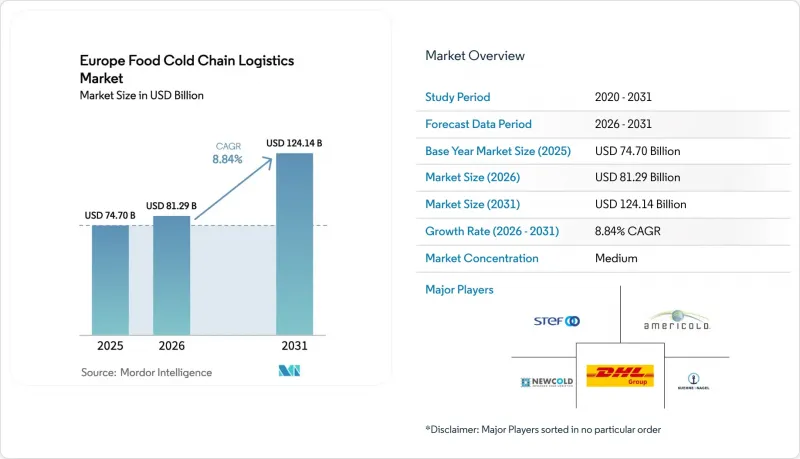
據 Mordor Intelligence 稱,歐洲食品冷鏈物流市場預計到 2026 年價值將達到 812.9 億美元,高於 2025 年的 747 億美元,預計到 2031 年將達到 1,241.4 億美元。
預計從 2026 年到 2031 年,其複合年成長率將達到 8.84%。
本報告按產品類型(冷凍肉類和家禽、魚貝類、乳製品和冰淇淋、其他)、服務類型(冷庫、冷藏運輸、附加價值服務)、溫度類型(冷藏(0-5°C)、冷凍(-18-0°C)、常溫)和國家(英國、德國、法國、義大利、其他國家)進行分類。市場預測以美元計價。
歐洲食品冷鏈物流市場趨勢與洞察
向覆蓋整個歐洲的全通路食品分銷網路轉型
歐洲食品零售商正在拓展「線上訂購線下取貨」和「快速配送」模式,利用密集分佈在市中心附近的微型倉配中心叢集,而非單一的大型倉庫。營運商正透過建造模組化建築來應對這項挑戰,這些建築將冷凍區、冷藏區和常溫區集中在同一屋簷下,並利用先進的能源管理軟體,根據電價訊號平衡製冷負載。丹麥引入機器人清晰地表明了托盤搬運自動化的趨勢,在不增加員工的情況下縮短了訂單到出貨的周期。目前成功的關鍵在於獲取稀缺的都市區地產,並整合物聯網(IoT)感測器,從而實現對溫度控制合規性的近即時監控。隨著這些分散式網路的日趨成熟,第三方物流供應商正透過數據驅動的路線最佳化來提升自身競爭力,從而在當日送達過程中保障產品品質。
歐盟的「綠色交易」強制要求採用天然冷媒,從而加快了這一進程。
逐步減少氟碳化合物(F-氣體)的使用,迫使倉庫業主停止使用全球暖化潛勢值(GWP)高的冷媒,並重新設計系統以適應氨和二氧化碳。雖然初期資本投入較高,但業者報告稱,一旦實施蓄熱式熱回收和變速壓縮機,電力消耗量就會降低。 ICCEE計畫的目標是每年初級能源,並進行6,400萬歐元的相關投資,這充分體現了產業的決心。大型企業正透過綠色債券市場資金籌措,而隨著監管合規期限的臨近,中小企業正面臨併購壓力。經驗豐富的天然冷媒技術人員短缺,導致人事費用上升,增加了專案預算,但與此同時,一群專業人才正在形成,這將增強長期的技術韌性。
歐洲各地駕駛人,導致運輸成本上升。
預計2028年,歐洲將面臨駕駛人,佔所需運輸能力的17%。目前,只有5%的駕駛人年齡在25歲以下,而且由於跨國路線額外的行政負擔,人員供應不穩定。根據國際道路運輸聯盟(IRU)的數據,目前已有42.6萬個職缺,這推高了工資水平,並迫使托運人比以往提前數週預訂運輸時段。由於需要專門的許可證和更嚴格的休息時間規定,冷藏運輸路線的現貨運費溢價高於常溫運輸路線。雖然人們對模式轉換鐵路運輸的興趣日益濃厚,但冷藏貨車和多式聯運連接車的短缺阻礙了大規模轉型,並導致道路運輸成本居高不下。
細分市場分析
在歐洲食品冷鏈物流市場,冷凍肉類和家禽市場預計到2025年將佔據31.05%的市場佔有率,儘管成長放緩,仍將是最大的收入來源。到2031年,調理食品和其他產品預計將以8.93%的複合年成長率高速成長,這主要得益於雙薪家庭優先選擇方便快捷的「加熱即食」食品,以縮短用餐時間。 「魚貝類」領域的需求強勁,這得益於水產養殖產量的擴大以及零售商對omega-3脂肪酸健康益處的宣傳。同時,「乳製品和冰淇淋」領域的訂單繼續保持穩定的消費模式,這與既定的零售促銷活動密切相關。在蔬果領域,全年供應策略正在推動冷鏈滲透到以往受季節限制的品類,並促進採用減少乙烯釋放的小袋來保持長途運輸過程中的新鮮度。
在烘焙和糖果甜點行業,快速冷凍技術實現了集中式半成品生產,產品在-18°C下運輸並在現場完成最終加工,從而減少了每日冷藏運輸量。肉品的快速加熱保鮮試驗表明,它們可以在室溫下保存長達5天,這意味著未來某些肉類產品對冷鏈的依賴性可能會降低。植物來源產品通常含有分離蛋白和功能性脂肪,其溫度特性與以往不同,需要企業重新調整多功能倉儲設施內的儲存區域。隨著消費者偏好的不斷變化,能夠滿足特定溫度控制需求的靈活且高效的第三方物流供應商(3PL)正在不斷拓展業務收益來源,涵蓋日益融合的產品系列。
其他好處
- Excel格式的市場預測(ME)表
- 3個月的分析師支持
目錄
第1章:引言
- 研究假設和市場定義
- 調查範圍
第2章:調查方法
第3章執行摘要
第4章 市場狀況
- 市場概覽
- 市場促進因素
- 歐洲向全通路食品分銷網路轉型(特別是「點擊提貨」模式)
- 歐盟的「綠色交易」要求加快在食品倉庫中採用天然冷媒(NH3、CO2)。
- 隨著農產品對北歐出口不斷擴大,伊比利半島的生產能力也迅速提高。
- 植物來源肉替代品對超低溫儲存的需求激增
- 由於英國脫歐後海關摩擦加劇,加萊和鹿特丹附近的越庫作業冷藏樞紐的需求不斷增加。
- 市場限制因素
- 歐洲司機短缺導致冷藏卡車運輸的現貨運費上漲。
- 為遵守現有設施中氟碳氣體分階段減排的規定(歐盟 517/2014),需要大量資本投資。
- 德國和義大利電力價格的波動給第三方物流公司的利潤率帶來了壓力。
- 主要港口(費利克斯托、安特衛普、漢堡)附近A級冷藏倉庫的土地供應有限。
- 價值供應鏈分析
- 監管和技術展望
- 波特五力模型
第5章 市場規模與成長預測
- 依產品類型
- 冷凍肉類/家禽
- 魚貝類
- 乳製品和冰淇淋
- 水果和蔬菜
- 麵包糖果甜點
- 調理食品及其他
- 按服務類型
- 冷藏倉庫
- 冷藏運輸
- 路
- 鐵路
- 海
- 航空
- 附加價值服務
- 按溫度類型
- 冷藏(0-5°C)
- 冰點(-18 至 0°C)
- 室溫
- 國家
- 英國
- 德國
- 法國
- 義大利
- 西班牙
- 荷蘭
- 北歐的
- 波蘭
- 其他歐洲國家
第6章 競爭情勢
- 市場集中度
- 策略趨勢
- 市佔率分析
- 公司簡介
- Lineage Logistics Holdings, LLC
- STEF SA
- Americold Logistics, LLC(AGRO Merchants Europe)
- DHL Supply Chain(Deutsche Post DHL Group)
- Kuehne+Nagel International AG
- NewCold Advanced Cold Logistics
- Constellation Cold Logistics
- DSV
- Nagel-Group
- Culina Group
- Rhenus Logistics
- ID Logistics
- Dachser SE
- Tippmann Group
- Bring Frigo(Posten Bring)
- Gist Ltd.
- DFDS Logistics
- Yusen Logistics Co., Ltd.
- Girteka Logistics
- Norfrig Logistics A/S*
第7章 市場機會與未來展望
According to Mordor Intelligence, Europe food cold chain logistics market size in 2026 is estimated at USD 81.29 billion, growing from 2025 value of USD 74.70 billion with 2031 projections showing USD 124.14 billion, growing at 8.84% CAGR over 2026-2031.
This report is Segmented by Product Type (Frozen Meat & Poultry, Fish & Seafood, Dairy & Ice-Cream and More), by Service Type (Refrigerated Storage, Refrigerated Transportation and Value-Added Services), by Temperature Type (Chilled (0-5 °C), Frozen (-18-0 °C) and Ambient) and by Country (United Kingdom, Germany, France, Italy, and More). The Market Forecasts are Provided in Terms of Value (USD).
Europe Food Cold Chain Logistics Market Trends and Insights
Europe-wide Shift Toward Omni-Channel Grocery Distribution Networks
European grocers scale click-and-collect and rapid-delivery models that replace single mega-warehouses with dense clusters of micro-fulfilment hubs positioned near city centres. Operators respond by deploying modular buildings with frozen, chilled and ambient zones under one roof, supported by advanced energy-management software that balances refrigeration loads against power-price signals. Robotics adoption in Denmark illustrates the push toward automated pallet handling that compresses order-to-ship cycles without expanding headcount. Success now hinges on securing scarce urban real estate and integrating Internet-of-Things (IoT) sensors that certify temperature compliance in near real time. As these distributed networks mature, third-party logistics providers differentiate through data-driven route optimisation that protects product integrity during same-day deliveries.
Mandatory EU Green Deal Targets Accelerating Natural Refrigerant Adoption
The F-gas phasedown forces warehouse owners to retire high-GWP refrigerants and redesign systems for ammonia or CO2. Initial capital intensity is high, yet operators report lower electricity use once regenerative heat reclaim and variable-speed compressors are in place. The ICCEE programme illustrates industry commitment by targeting 118 GWh of annual primary-energy savings and EUR 64 million of related investments. Larger companies absorb the expense by refinancing on green-bond markets, while smaller firms face merger pressure as compliance deadlines approach. A scarcity of engineers experienced with natural refrigerants adds wage inflation to project budgets but also seeds a specialised labour pool that bolsters long-run technical resilience.
Continental Driver Shortage Inflating Transportation Costs
Europe faces 745,000 unfilled truck-driver slots by 2028, equal to 17% of required capacity. The talent pipeline falters as only 5% of current drivers are under 25 and cross-border routes carry extra administrative burden. IRU data notes 426,000 vacant positions already, pushing wages up and forcing shippers to book capacity weeks earlier than before. Spot-rate premiums on refrigerated lanes have widened relative to ambient lanes due to specialised licence needs and stricter rest-period rules. Modal shift to rail garners interest, yet cold-capable wagons and intermodal plugs are scarce, delaying large-scale migration and keeping road costs elevated.
Other drivers and restraints analyzed in the detailed report include:
- Rapid Capacity Additions in Iberian Peninsula Driven by Export Growth
- Surge in Demand for Ultra-Low-Temperature Storage for Plant-Based Alternatives
- High CAPEX for F-Gas Phasedown Compliance
For complete list of drivers and restraints, kindly check the Table Of Contents.
Segment Analysis
The Europe food cold chain logistics market size for Frozen Meat & Poultry reached the equivalent of 31.05% share in 2025 and remains the largest revenue contributor despite slower incremental growth. Ready Meals & Others posts the highest 8.93% CAGR to 2031, propelled by dual-income households that value heat-and-eat foods compatible with shorter mealtimes. Fish & Seafood maintains resilient demand as aquaculture output scales and retailers promote omega-3 benefits, while Dairy & Ice-cream bookings continue to follow stable consumption patterns tied to established retail promotions. In fruits and vegetables, year-round supply strategies extend cold-chain penetration into previously seasonal categories, stimulating uptake of ethylene-control sachets that preserve freshness during long-haul moves.
Flash-freezing techniques in the Bakery & Confectionery segment allow centralised par-bake production shipped at -18 °C and finished on-site, shifting volume away from daily chilled deliveries. Flash-heat preservation trials for meat products indicate shelf-stable windows of up to 5 days, hinting at future attenuation of cold-chain reliance in selected cuts. Plant-based SKUs, which often blend protein isolates with functional fats, introduce atypical thermal profiles that force operators to recalibrate storage zoning within multi-use chambers. As consumer preferences evolve, agile 3PLs able to match niche temperature regimes widen their service revenue bases across converging product groups.
Complete Report Scope:
- By Product Type
- Frozen Meat & Poultry
- Fish & Seafood
- Dairy & Ice-cream
- Fruits & Vegetables
- Bakery & Confectionery
- Ready Meals & Others
- By Service Type
- Refrigerated Storage
- Refrigerated Transportation
- Road
- Rail
- Sea
- Air
- Value-Added Services
- By Temperature Type
- Chilled (0-5 °C)
- Frozen (-18-0 °C)
- Ambient
- By Country
- United Kingdom
- Germany
- France
- Italy
- Spain
- Netherlands
- Nordics
- Poland
- Rest of Europe
List of Companies Covered in this Report:
- Lineage Logistics Holdings, LLC
- STEF SA
- Americold Logistics, LLC (AGRO Merchants Europe)
- DHL Supply Chain (Deutsche Post DHL Group)
- Kuehne + Nagel International AG
- NewCold Advanced Cold Logistics
- Constellation Cold Logistics
- DSV
- Nagel-Group
- Culina Group
- Rhenus Logistics
- ID Logistics
- Dachser SE
- Tippmann Group
- Bring Frigo (Posten Bring)
- Gist Ltd.
- DFDS Logistics
- Yusen Logistics Co., Ltd.
- Girteka Logistics
- Norfrig Logistics A/S*
Additional Benefits:
- The market estimate (ME) sheet in Excel format
- 3 months of analyst support
TABLE OF CONTENTS
1 Introduction
- 1.1 Study Assumptions & Market Definition
- 1.2 Scope of the Study
2 Research Methodology
3 Executive Summary
4 Market Landscape
- 4.1 Market Overview
- 4.2 Market Drivers
- 4.2.1 Europe-wide shift toward omni-channel grocery distribution networks (esp. click-and-collect formats)
- 4.2.2 Mandatory EU Green Deal targets accelerating adoption of natural refrigerants (NH3, CO2) in food warehouses
- 4.2.3 Rapid capacity additions in Iberian Peninsula driven by agri-food export growth to Northern Europe
- 4.2.4 Surge in demand for ultra-low-temperature storage for plant-based meat analogues
- 4.2.5 Post-Brexit customs friction boosting demand for cross-docking cold hubs near Calais & Rotterdam
- 4.3 Market Restraints
- 4.3.1 Continental driver shortage inflating refrigerated road freight spot rates
- 4.3.2 High CAPEX for F-gas phasedown compliance across legacy facilities (EU 517/2014)
- 4.3.3 Power-price volatility in Germany & Italy squeezing 3PL margins
- 4.3.4 Limited availability of Class-A refrigerated warehouse sites near Tier-1 ports (Felixstowe, Antwerp, Hamburg)
- 4.4 Value / Supply-Chain Analysis
- 4.5 Regulatory & Technological Outlook
- 4.6 Porter's Five Forces
- 4.6.1 Bargaining Power of Buyers
- 4.6.1.1 Bargaining Power of Suppliers
- 4.6.1.2 Threat of New Entrants
- 4.6.1.3 Threat of Substitutes
- 4.6.1.4 Competitive Rivalry
- 4.6.1 Bargaining Power of Buyers
5 Market Size & Growth Forecasts (Value)
- 5.1 By Product Type
- 5.1.1 Frozen Meat & Poultry
- 5.1.2 Fish & Seafood
- 5.1.3 Dairy & Ice-cream
- 5.1.4 Fruits & Vegetables
- 5.1.5 Bakery & Confectionery
- 5.1.6 Ready Meals & Others
- 5.2 By Service Type
- 5.2.1 Refrigerated Storage
- 5.2.2 Refrigerated Transportation
- 5.2.2.1 Road
- 5.2.2.2 Rail
- 5.2.2.3 Sea
- 5.2.2.4 Air
- 5.2.3 Value-Added Services
- 5.3 By Temperature Type
- 5.3.1 Chilled (0-5 °C)
- 5.3.2 Frozen (-18-0 °C)
- 5.3.3 Ambient
- 5.4 By Country
- 5.4.1 United Kingdom
- 5.4.2 Germany
- 5.4.3 France
- 5.4.4 Italy
- 5.4.5 Spain
- 5.4.6 Netherlands
- 5.4.7 Nordics
- 5.4.8 Poland
- 5.4.9 Rest of Europe
6 Competitive Landscape
- 6.1 Market Concentration
- 6.2 Strategic Moves
- 6.3 Market Share Analysis
- 6.4 Company Profiles (includes Global level Overview, Market level overview, Core Segments, Financials as available, Strategic Information, Market Rank/Share for key companies, Products & Services, and Recent Developments)
- 6.4.1 Lineage Logistics Holdings, LLC
- 6.4.2 STEF SA
- 6.4.3 Americold Logistics, LLC (AGRO Merchants Europe)
- 6.4.4 DHL Supply Chain (Deutsche Post DHL Group)
- 6.4.5 Kuehne + Nagel International AG
- 6.4.6 NewCold Advanced Cold Logistics
- 6.4.7 Constellation Cold Logistics
- 6.4.8 DSV
- 6.4.9 Nagel-Group
- 6.4.10 Culina Group
- 6.4.11 Rhenus Logistics
- 6.4.12 ID Logistics
- 6.4.13 Dachser SE
- 6.4.14 Tippmann Group
- 6.4.15 Bring Frigo (Posten Bring)
- 6.4.16 Gist Ltd.
- 6.4.17 DFDS Logistics
- 6.4.18 Yusen Logistics Co., Ltd.
- 6.4.19 Girteka Logistics
- 6.4.20 Norfrig Logistics A/S*
7 Market Opportunities & Future Outlook

 食品低溫運輸市場報告:趨勢、預測與競爭分析(至2035年)
 食品物流市場:2026-2032年全球市場預測(依溫度分類、運輸方式、服務類型、食品類型及最終用戶分類)
 食品低溫運輸:市場佔有率分析、產業趨勢與統計、成長預測(2026-2031)美國食品物流:市場佔有率分析、產業趨勢與統計、成長預測(2026-2031)德國食品物流:市場佔有率分析、產業趨勢與統計及成長預測(2026-2031)法國食品物流:市場佔有率分析、產業趨勢與統計及成長預測(2026-2031)
 食品物流市場機會、成長要素、產業趨勢分析及2026-2035年預測。中東食品物流:市場佔有率分析、產業趨勢與統計及成長預測(2026-2031)英國食品物流:市場佔有率分析、產業趨勢與統計、成長預測(2026-2031)日本食品物流:市場佔有率分析、產業趨勢與統計、成長預測(2026-2031)