


 |
市場調查報告書
商品編碼
2062023
亞太地區食品物流:市場佔有率分析、產業趨勢與統計及成長預測(2026-2031)Asia-Pacific Food Logistics - Market Share Analysis, Industry Trends & Statistics, Growth Forecasts (2026 - 2031) |
||||||

※ 本網頁內容可能與最新版本有所差異。詳細情況請與我們聯繫。
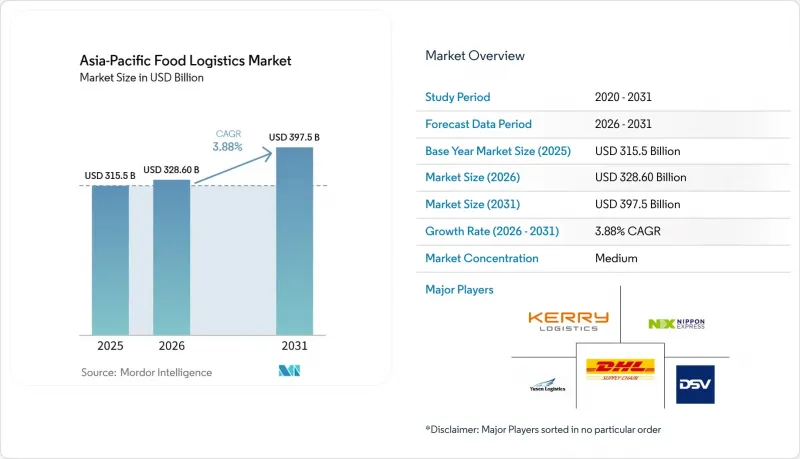
根據 Mordor Intelligence 預測,亞太食品物流市場規模將從 2025 年的 3,155 億美元成長到 2026 年的 3,286 億美元,到 2031 年將達到 3,975 億美元,2026 年至 2031 年的複合年成長率為 3.88%。
本報告按服務(運輸、倉儲、附加價值服務)、溫控類型(低溫運輸、非低溫運輸)、最終產品類別(肉類和魚貝類、乳製品、水果和蔬菜、食品和飲料、其他)以及地區(中國、日本、印度、韓國、澳洲、東南亞及其他亞太地區)進行細分。市場預測以美元計價。
亞太地區食品物流市場趨勢及洞察。
外商投資與物流現代化
越南國家發展藍圖將物流定位為經濟基礎部門,優先發展農產品冷藏保管,並以長期發展清潔能源綠色物流為重點,支持農產品價值鏈。新加坡的「餐飲服務業數位化規劃」概述了人工智慧驅動的文件匹配和物流控制塔的實施流程,這將有助於中小企業以更高的透明度和安全性管理溫控物流。同時,該規劃旨在協調該行業的技能和網路安全需求。中國的跨部會規劃目標是到2027年實現大型企業管理80%的數位化和關鍵流程75%的數位化控制,並透過試點計畫和典型應用場景加以支持,這些舉措正逐步推廣到物流運營領域。這些國家級項目表明,亞太食品物流市場在溫度遙測、安全資料交換和倉庫自動化方面的投資方向一致。這項現代化措施也將有助於縮小先進樞紐和新興走廊之間的產能差距,尤其是在小規模企業面臨資金籌措的情況下。隨著採用的推進,人們對該服務的期望也在不斷變化,包括可審計的低溫運輸記錄和整合的異常處理,從而增強買家對需要溫度控制的跨境運輸的信心。
電子商務與快速貿易的快速發展
線上生鮮和餐飲平台的迅速發展縮短了配送時限,並更加重視短途冷藏配送。在新加坡,電子商務預計在2023年至2030年間加倍,而生鮮食品低溫運輸市場預計到2034年也將翻倍。這進一步增加了在轉口貿易活躍的進口樞紐地區對強大的冷藏和冷凍儲存能力的需求。數位化控制塔和自動化訂購系統正在改善採購、生產和分銷之間的協調,從而在整個亞太食品物流市場中,在嚴格的配送時限內確保可靠性。此外,到2028年,區域入口網站的航空貨運能力提升和低溫運輸能力的擴展將推動跨境電子商務的成長,使對時間要求較高的食品能夠以更高的服務水準送達消費者手中。快速商務模式正在改變網路設計。業者正在微型倉配中心預先部署冷藏和冷凍庫存,以涵蓋人口密集都市區3公里範圍內的配送區域。這些變化使得能夠將溫度控制、可視性和最後一公里配送整合到單一服務層級的供應商在亞太食品物流市場中獲得了競爭優勢。
分散的低溫運輸基礎設施
印度的低溫運輸僅能滿足部分生鮮食品的需求,其約四分之三的大型倉儲能力集中在專門用於單一作物(馬鈴薯)的設施中,無法容納多種園藝作物。農場缺乏預冷設備和包裝廠,導致農產品在進入正規物流網路之前承受的熱壓力增加,從而提高了旺季的損失風險。許多老舊的設施依賴低效率的系統和不足的隔熱措施,導致電力供應有限的地區能源消耗增加,並限制了其精確控溫的能力。在泰國,道路運輸仍是農產品運輸的主要方式,鐵路和河川水運利用率不足。這導致泰國的物流成本持續高於國際標準,長途運輸過程中溫度波動的風險也更高。由於缺乏一體化的網路和運輸能力分佈不均,出口商不得不在「第一公里」(收集)、幹線運輸、倉儲和跨境流程中與多家供應商合作。這種反覆的人工交接會增加停留時間和溫度風險,從而阻礙亞太食品物流市場的品質保證。
細分市場分析
截至2025年,運輸業將佔亞太地區食品物流市場佔有率的61.34%,預計到2031年,附加價值服務和其他物流解決方案的複合年成長率將達到5.41%。在泰國,儘管鐵路運輸每噸公里成本具有優勢,但其利用率仍然很低,大部分農產品運輸依賴道路運輸,並且仍然依賴靈活的「最後一公里」運輸來進行頻繁的小批量補貨。在印度,一條連接坎普爾內陸貨櫃場(ICD Kanpur)和蒙德拉港的專用冷藏快遞服務於2026年3月開通。這條鐵路走廊能夠實現更嚴格的溫度控制,並降低長途國內運輸的燃料成本,從而確保可靠的出口交接。為了支援全通路履約,倉庫位置正在擴大,區域樞紐的溫控空間將滿足區域內和跨境配送中多品類貨物流的成長需求。加值解決方案如今融合了預冷、分裝、貼標和自動化文件檢查等功能,旨在減少交接環節,提高透明度,從而滿足亞太食品物流市場買家對一體化低溫運輸管理的需求。 ISO 9001 和 ISO 22000 等認證正逐漸成為跨國買家的常見要求,促使供應商規範品質流程,並在所有服務領域維護完善的文件系統。
航空貨運滿足了高價值生鮮產品快速國際運輸的需求,而諸如DHL擴展其航空貨運低溫運輸網路等網路升級,已將30多個符合GDP(貨物儲存和交付)標準的樞紐與更多面向亞洲的航線連接起來。預計到2028年,區域航空貨運量將持續成長,這將縮短易腐和冷藏產品的跨境運輸週期。海運在散裝貨物運輸中繼續發揮核心作用,2025年初香港的食品和飲料進口量證實了對海運的穩定需求。在東協海關過境制度下,跨境卡車運輸正在不斷改進,德迅集團已增加其在泰國的拖車和貨櫃車隊,以降低成本和邊境停留時間,同時滿足電子商務和高科技產品的需求。新加坡正在開發的數位化控制塔能夠實現對路線和溫度控制的即時管理,這將減少異常情況,並增強托運人在亞太食品物流市場的合規能力。
其他好處:
- Excel格式的市場預測(ME)表
- 3個月的分析師支持
目錄
第1章:引言
- 研究假設和市場定義
- 調查範圍
第2章:調查方法
第3章執行摘要
第4章 市場狀況
- 市場概覽
- 市場促進因素
- 外商投資與物流現代化
- 電子商務和快速貿易的蓬勃發展
- 低溫運輸基礎設施建設
- 有組織零售和現代零售的成長
- 跨境食品貿易的擴張
- 食品安全和品質標準
- 市場限制因素
- 分散的低溫運輸基礎設施
- 高資本投資及營運成本
- 法規的複雜性與不一致性
- 基礎設施和連接性挑戰
- 價值供應鏈分析
- 監理情勢
- 技術展望
- 波特五力模型
- 一種能夠適應多樣性的混合分佈模型
- 政府主導的低溫運輸走廊的興起
第5章 市場規模與成長預測
- 按服務
- 運輸
- 路
- 鐵路
- 水
- 航空
- 倉儲業
- 附加價值服務及其他
- 運輸
- 溫度控制方法
- 低溫運輸
- 室溫(15-25 度C)
- 冷藏(2-8 度C)
- 冷凍(低於0°C)
- 非低溫運輸
- 低溫運輸
- 按最終產品類別
- 肉類和水產品
- 乳製品和冷凍甜點
- 水果和蔬菜
- 食品/飲料
- 其他
- 國家
- 中國
- 日本
- 印度
- 韓國
- 澳洲
- 印尼
- 馬來西亞
- 菲律賓
- 新加坡
- 泰國
- 越南
- 其他亞太國家
第6章 競爭情勢
- 市場集中度
- 策略趨勢
- 市佔率分析
- 公司簡介
- DHL Group
- Nippon Express Holdings
- Kerry Logistics Network
- Yusen Logistics(Part of NYK Line)
- DSV
- Toll Group
- SF Express
- AIT Worldwide Logistics
- CEVA Logistics
- Kuehne+Nagel
- Kintetsu World Express
- Geodis
- Hellmann Worldwide Logistics
- JWD InfoLogistics
- SEKO Logistics
- Sagawa Express
- Crane Worldwide Logistics
- CWT PTE. LIMITED
- Nichirei Logistics Group
- CJ Rokin Logistic
第7章 市場機會與未來展望
According to Mordor Intelligence, the asia-Pacific food logistics market size is expected to increase from USD 315.5 billion in 2025 to USD 328.60 billion in 2026 and reach USD 397.5 billion by 2031, growing at a CAGR of 3.88% over 2026-2031.
This report is Segmented by Services (Transportation, Warehousing, and Value-Added Services), by Temperature-Control Type (Cold Chain, Non Cold Chain), by End-Product Category (Meat & Seafood, Dairy, Fruits & Vegetables, Food and Beverages, and Others), and by Geography (China, Japan, India, South Korea, Australia, Southeast Asia, and Rest of Asia-Pacific). Market Forecasts are Provided in Value (USD).
Asia-Pacific Food Logistics Market Trends and Insights
Foreign Investment and Logistics Modernization
Vietnam's national roadmap elevates logistics to a foundational economic sector and prioritizes cold storage for agricultural outputs, with a long-term focus on green logistics that uses clean energy to support the agri-food value chain. Singapore's Food Services Industry Digital Plan provides adoption tracks for AI-enabled document reconciliation and logistics control towers that help SMEs manage temperature-controlled flows with higher visibility and security, while aligning skills and cybersecurity needs for the sector. China's cross-ministry plan targets 80% digitalization for business management and 75% digital control over key processes in large food enterprises by 2027, backed by demonstration projects and typical application scenarios that cascade into logistics operations. These national programs set a consistent direction for investment in temperature telemetry, secure data exchanges, and warehouse automation across the Asia-Pacific food logistics market. The push to modernize also narrows capability gaps between advanced hubs and emerging corridors where smaller operators face financing constraints. As uptake increases, service expectations now include auditable cold chain records and integrated exception handling that reinforce buyer confidence in temperature-sensitive movements across borders.
E-commerce and Quick Commerce Boom
Rapid adoption of online grocery and meal platforms is compressing delivery windows and placing a premium on short-radius cold distribution. In Singapore, e-commerce is projected to double between 2023 and 2030, and the cold chain perishables market is expected to double by 2034, reinforcing the need for robust chilled and frozen capacity in importer hubs with significant re-export activity. Digital control towers and automated ordering are improving coordination between procurement, production, and distribution to support reliability at narrow delivery intervals across the Asia-Pacific food logistics market. Cross-border e-commerce growth also benefits from rising air cargo capacity and expanded cool-chain capability at regional gateways through 2028, helping time-sensitive food products reach consumers with higher service levels. Quick commerce models are changing network design as operators pre-position chilled and frozen inventory in micro-fulfillment centers to meet three-kilometer delivery radii in dense urban areas. These shifts reward integrated providers that can orchestrate temperature, visibility, and last-mile handoffs in one service layer across the Asia-Pacific food logistics market.
Fragmented Cold Chain Infrastructure
India's cold chain supports only a small portion of the fresh produce needs, and roughly three-quarters of the bulk storage capacity is concentrated in single-commodity potato facilities that cannot flex for diversified horticulture. Sparse assets at the farmgate, such as pre-cooling units and packhouses, increase thermal stress before produce enters formal networks and raise the risk of losses during peak seasons. Many older facilities rely on inefficient systems and poor insulation, which heighten energy intensity in power-constrained regions and limit the ability to maintain precise temperature controls. In Thailand, agricultural freight remains dominated by road, while rail and inland water transport options are underused, which keeps logistics costs elevated relative to international benchmarks and increases exposure to temperature excursions on longer routes. The lack of integrated networks and uneven capacity distribution forces exporters to stitch together multiple providers across the first mile, line-haul, storage, and border processes. These handoffs increase both dwell time and temperature risk, which limits quality outcomes in the Asia-Pacific food logistics market.
Other drivers and restraints analyzed in the detailed report include:
- Cold Chain Infrastructure Development
- Organized Retail and Modern Trade Growth
- High Capital and Operating Costs
For complete list of drivers and restraints, kindly check the Table Of Contents.
Segment Analysis
Transportation commanded 61.34% of the Asia-Pacific food logistics market share in 2025, and value-added services and other logistics solutions are projected to expand at 5.41% CAGR through 2031 for the Asia-Pacific food logistics market size. Road carries the majority of agricultural loads in Thailand, where rail is underused despite per-ton-kilometer advantages, which sustains reliance on flexible last-mile assets for frequent, small-batch replenishment. India's dedicated Reefer Express service connecting ICD Kanpur and Mundra Port was launched in March 2026 to provide a rail corridor with tighter temperature controls and fuel savings on long domestic legs with reliable export handoffs. Warehousing footprints are growing to support omnichannel fulfillment, including temperature-controlled space in regional hubs that can scale multi-category flows for regional and cross-border distribution. Value-added solutions now bundle pre-cooling, portioning, labeling, and automated document checks to reduce handoffs and increase visibility, which aligns with buyer expectations for integrated cold chain orchestration in the Asia-Pacific food logistics market. Certifications such as ISO 9001 and ISO 22000 are becoming common prerequisites for multinational buyers, which push providers to formalize quality procedures and maintain robust documentation across all service lines.
Air freight supports high-value perishables that require rapid international connections, and network upgrades like DHL's expanded Airfreight Cold Chain Network connect more than 30 GDP-compliant hubs with additional routes targeted in Asia. Regional air cargo volumes are projected to rise through 2028, which supports shorter cycles for cross-border shipments of fresh and chilled products. Maritime routes remain central for bulk commodity movements, and Hong Kong's inbound food and beverage volumes in early 2025 confirm stable demand for seaborne distribution. Cross-border trucking is improving under the ASEAN Customs Transit System, and Kuehne+Nagel has added prime movers and containers in Thailand to meet e-commerce and high-tech demand while lowering cost and dwell time at borders. Digital control towers promoted in Singapore enable real-time management of routes and temperature performance, which reduces exception handling and strengthens compliance readiness for shippers across the Asia-Pacific food logistics market.
List of Companies Covered in this Report:
- DHL Group
- Nippon Express Holdings
- Kerry Logistics Network
- Yusen Logistics (Part of NYK Line)
- DSV
- Toll Group
- SF Express
- AIT Worldwide Logistics
- CEVA Logistics
- Kuehne + Nagel
- Kintetsu World Express
- Geodis
- Hellmann Worldwide Logistics
- JWD InfoLogistics
- SEKO Logistics
- Sagawa Express
- Crane Worldwide Logistics
- CWT PTE. LIMITED
- Nichirei Logistics Group
- CJ Rokin Logistic
Additional Benefits:
- The market estimate (ME) sheet in Excel format
- 3 months of analyst support
TABLE OF CONTENTS
1 Introduction
- 1.1 Study Assumptions & Market Definition
- 1.2 Scope of the Study
2 Research Methodology
3 Executive Summary
4 Market Landscape
- 4.1 Market Overview
- 4.2 Market Drivers
- 4.2.1 Foreign Investment and Logistics Modernization
- 4.2.2 E-commerce and Quick Commerce Boom
- 4.2.3 Cold Chain Infrastructure Development
- 4.2.4 Organized Retail and Modern Trade Growth
- 4.2.5 Cross-Border Food Trade Expansion
- 4.2.6 Food Safety and Quality Standards
- 4.3 Market Restraints
- 4.3.1 Fragmented Cold Chain Infrastructure
- 4.3.2 High Capital and Operating Costs
- 4.3.3 Regulatory Complexity and Inconsistency
- 4.3.4 Infrastructure and Connectivity Challenges
- 4.4 Value / Supply-Chain Analysis
- 4.5 Regulatory Landscape
- 4.6 Technological Outlook
- 4.7 Porter's Five Forces
- 4.7.1 Bargaining Power of Suppliers
- 4.7.2 Bargaining Power of Buyers
- 4.7.3 Threat of New Entrants
- 4.7.4 Threat of Substitutes
- 4.7.5 Competitive Rivalry
- 4.8 Hybrid Distribution Models Addressing Diversity
- 4.9 Government-Led Cold Chain Corridors Emerging
5 Market Size & Growth Forecasts
- 5.1 By Services
- 5.1.1 Transportation
- 5.1.1.1 Road
- 5.1.1.2 Rail
- 5.1.1.3 Water
- 5.1.1.4 Air
- 5.1.2 Warehousing
- 5.1.3 Value-Added Services and Others
- 5.1.1 Transportation
- 5.2 By Temperature-Control Type
- 5.2.1 Cold Chain
- 5.2.1.1 Ambient (15-25 °C)
- 5.2.1.2 Chilled (2-8 °C)
- 5.2.1.3 Frozen (Less than 0 °C)
- 5.2.2 Non Cold Chain
- 5.2.1 Cold Chain
- 5.3 By End-Product Category
- 5.3.1 Meat & Seafood
- 5.3.2 Dairy & Frozen Desserts
- 5.3.3 Fruits & Vegetables
- 5.3.4 Food and Beverages
- 5.3.5 Others
- 5.4 By Country (Value, USD)
- 5.4.1 China
- 5.4.2 Japan
- 5.4.3 India
- 5.4.4 South Korea
- 5.4.5 Australia
- 5.4.6 Indonesia
- 5.4.7 Malaysia
- 5.4.8 Philippines
- 5.4.9 Singapore
- 5.4.10 Thailand
- 5.4.11 Vietnam
- 5.4.12 Rest of Asia-Pacific
6 Competitive Landscape
- 6.1 Market Concentration
- 6.2 Strategic Moves
- 6.3 Market Share Analysis
- 6.4 Company Profiles (includes Global level Overview, Market level overview, Core Segments, Financials as available, Strategic Information, Market Rank/Share for key companies, Products & Services, and Recent Developments)
- 6.4.1 DHL Group
- 6.4.2 Nippon Express Holdings
- 6.4.3 Kerry Logistics Network
- 6.4.4 Yusen Logistics (Part of NYK Line)
- 6.4.5 DSV
- 6.4.6 Toll Group
- 6.4.7 SF Express
- 6.4.8 AIT Worldwide Logistics
- 6.4.9 CEVA Logistics
- 6.4.10 Kuehne + Nagel
- 6.4.11 Kintetsu World Express
- 6.4.12 Geodis
- 6.4.13 Hellmann Worldwide Logistics
- 6.4.14 JWD InfoLogistics
- 6.4.15 SEKO Logistics
- 6.4.16 Sagawa Express
- 6.4.17 Crane Worldwide Logistics
- 6.4.18 CWT PTE. LIMITED
- 6.4.19 Nichirei Logistics Group
- 6.4.20 CJ Rokin Logistic
7 Market Opportunities & Future Outlook

 食品低溫運輸市場報告:趨勢、預測與競爭分析(至2035年)
 食品物流市場:2026-2032年全球市場預測(依溫度分類、運輸方式、服務類型、食品類型及最終用戶分類)
 食品低溫運輸:市場佔有率分析、產業趨勢與統計、成長預測(2026-2031)美國食品物流:市場佔有率分析、產業趨勢與統計、成長預測(2026-2031)德國食品物流:市場佔有率分析、產業趨勢與統計及成長預測(2026-2031)法國食品物流:市場佔有率分析、產業趨勢與統計及成長預測(2026-2031)
 食品物流市場機會、成長要素、產業趨勢分析及2026-2035年預測。中東食品物流:市場佔有率分析、產業趨勢與統計及成長預測(2026-2031)英國食品物流:市場佔有率分析、產業趨勢與統計、成長預測(2026-2031)日本食品物流:市場佔有率分析、產業趨勢與統計、成長預測(2026-2031)