


 |
市場調查報告書
商品編碼
2073433
食品低溫運輸:市場佔有率分析、產業趨勢與統計、成長預測(2026-2031)Food Cold Chain - Market Share Analysis, Industry Trends & Statistics, Growth Forecasts (2026 - 2031) |
||||||

※ 本網頁內容可能與最新版本有所差異。詳細情況請與我們聯繫。
根據 Mordor Intelligence 預測,食品低溫運輸市場規模將從 2025 年的 705.5 億美元成長到 2026 年的 785.5 億美元,然後在 2031 年達到 1,344 億美元,2026 年至 2031 年的複合年成長率為 11.34%。
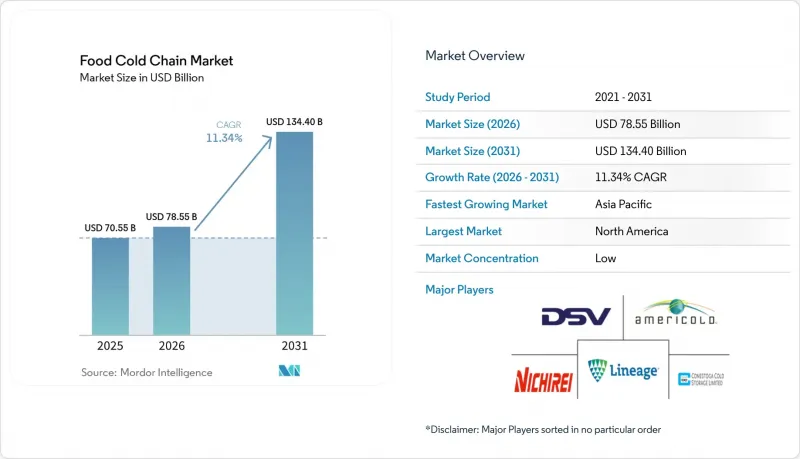
本報告按「類型」(例如,低溫運輸儲存)、「溫度範圍」(例如,冷藏(0–4 度C))、「運輸方式」(例如,陸路冷藏卡車和拖車、海運冷藏集裝箱)、「應用」(例如,水果和蔬菜、肉類和魚貝類)、「技術」(例如,RFID 和即時監控)以及「地區」對行業進行分類。市場預測以美元(USD)計價。
全球食品低溫運輸市場趨勢與洞察
全球對冷凍和生鮮食品的需求不斷成長
冷凍食品消費量的成長正在改變全球低溫運輸的產能需求,尤其對倉儲、運輸和配送網路產生影響。這種成長推動了對冷藏倉儲基礎設施的需求增加,以彌合供需缺口,從而促使企業對冷藏倉庫、溫控車輛和先進監控系統進行大量投資。疫情期間消費者行為的轉變使冷凍食品從便利食品轉變為必需品,導致包括蒸餾食品、蔬菜、肉類和魚貝類在內的各類冷凍食品銷售均有所成長。這形成了長期需求模式,需要對基礎設施進行永久性擴建。低溫運輸營運商強調,在整個供應鏈(從生產設施到物流中心中心和零售店)中保持穩定的溫度控制至關重要。溫度波動會導致產品損失、食品安全受損、代價高昂的召回、違反監管規定。溫度控制的複雜性也延伸至最後一公里配送,需要專用設備和精確的監控程序來確保產品品質。
國際食品貿易和跨境食品運輸的成長
跨境食品運輸正演變為高度協調的溫控物流系統。作為加強現代商業分銷體系計畫的一部分,中國商務部設定了2027年蔬果低溫運輸配送佔25%、肉類冷鏈配送佔比達到45%的目標。這項監管措施體現了國際貿易在食品安全方面的關鍵作用,尤其是在氣候變遷和地緣政治緊張局勢擾亂傳統供應鏈的情況下。在多個司法管轄區維持適當的溫度控制的複雜性,為能夠確保產品品質並滿足各種監管要求的專業物流業者創造了新的商機。區塊鏈技術和物聯網感測器的整合對於提供進口國所需的端到端可追溯性至關重要,這使得跨境食品貿易從單純的物流挑戰轉變為技術驅動的競爭優勢。溫控貨櫃運輸正成為一個重要的瓶頸,配備先進監控系統的專用冷藏貨櫃的運費更高。
冷藏倉庫設施和冷藏運輸車輛需要較高的初始投資。
低溫運輸基礎設施的資本密集特性構成了一道重要的進入障礙。專用建築材料和節能設計成本高昂,有時甚至比傳統倉庫高出300%至400%。建造冷藏設施需要複雜的隔熱系統、專用地板材料和先進的冷凍設備,這些設備即使在極端溫度條件下也必須可靠運作,這將推高了初始投資和持續維護成本。冷藏運輸車輛也面臨類似的成本壓力,冷藏卡車和拖車的貨運量需要兩位數的成長才能證明其擴張的合理性。此外,低溫運輸資產的特殊性也進一步加劇了資金籌措的挑戰,因為這些資產用途有限,且需要專業的維護技術。
細分市場分析
到2025年,低溫運輸倉儲將佔據最大的市場佔有率,達到55.21%,這反映了所有食品類別對溫控物流的基本基礎設施需求。該領域的主導地位源於冷藏倉庫的資本密集特性,因為配備先進隔熱材料、自動化貨架系統和節能冷卻技術的專用設施是低溫運輸生態系統中最大的成本組成部分。
儘管監控設備目前市佔率較小,但預計到2031年,其複合年成長率將達到14.2%,成為成長最快的細分市場。這主要得益於FSMA 204等監管要求以及物聯網溫度追蹤系統的進步。監控設備領域的快速擴張反映了技術變革的趨勢:被動式溫度記錄正被能夠預測設備故障並最佳化能耗的即時預測分析系統所取代。像Rivercity Innovations這樣的公司正在部署具備「早期關鍵故障檢測(ECFD)」功能的物聯網自動化溫度監控解決方案,該方案能夠預測壓縮機故障,從而實現及時維護並防止代價高昂的產品損失。
預計到2025年,冷藏溫度範圍(0–4 度C )將佔據59.62%的市場佔有率,並繼續引領市場。這反映了該溫度範圍廣泛應用於新鮮生鮮食品消費量最大的產品,例如生鮮食品、乳製品和已調理食品。同時,冷凍食品(-18 度C )市場呈現強勁成長勢頭,預計到2031年將以15.18%的年複合成長率(CAGR),這主要得益於消費者對冷凍加工食品偏好的轉變以及全球冷凍食品產能的擴張。
受冷凍食品市場成長勢頭的推動,各大零售商正投資建設雙溫區設施,以便在同一設施內高效管理冷藏和冷凍產品,從而最佳化空間利用率並降低營運複雜性。由阿拉伯聯合大公國航空貨運部和其他領先物流運營商支持的「邁向-15 度C」聯盟,是一項旨在最佳化冷凍食品運輸的行業行動,其目標是將標準溫度從-18 度C調整至-15 度C,從而在保證產品質量的同時降低能耗。此措施表明,最佳化溫度範圍能夠透過降低營運成本和環境影響,同時確保食品安全標準,從而帶來競爭優勢。
區域分析
預計到2025年,北美將佔據40.10%的市場佔有率,這反映了全球最完善的低溫運輸生態系統的形成,而這得益於數十年的基礎設施投資和監管發展。然而,該地區目前正面臨現代化挑戰,因為老舊的設施已無法滿足電子商務和永續性的要求。大型零售商正透過對自動化設施進行策略性投資來應對這些挑戰,例如沃爾瑪和克羅格在城市中心建設的冷庫,這些冷庫縮短了運輸距離,並提高了永續性指標。儘管該地區受益於完善的法律規範以及消費者願意為品質保證支付更高價格,但也面臨著基礎設施老化以及需要大量資本投資以滿足現代營運要求等不利因素。
亞太地區低溫運輸市場預計到2031年將以16.21%的複合年成長率成長,成為全球成長最快的市場之一。這一成長主要得益於各國政府旨在減少食物廢棄物和提高供應鏈效率的支持政策。中國、印度和印尼等國的快速都市化正在推動對溫控倉儲和運輸服務需求的成長。在印度,截至2025年2月,總理農民財富計畫(Pradhan Mantri Kisan Sampada Yojana)已批准了394個低溫運輸計畫。這些項目致力於開發綜合低溫運輸設施,包括冷藏運輸、冷藏倉庫和加工中心。該計劃透過改善生鮮食品的保鮮、減少收穫後損失和確保食品安全標準,支持印度不斷發展的食品加工業。此外,該計劃還鼓勵私營部門投資低溫運輸基礎設施建設,有助於建立更強大、更有效率的食品分銷體系。
在歐洲,由於嚴格的食品安全法規、跨境貿易便利化以及正在改變整個歐洲大陸低溫運輸營運的永續性發展舉措,冷鏈產業持續穩定成長。該地區對永續性的重視正在加速先進數位化技術的應用,包括排放冷藏拖車和用於即時數據管理的數位雙胞胎系統,從而最佳化能源消耗和營運效率。該地區成熟的法規環境以及消費者對新鮮本地食品的偏好,並持續推動著對能夠在最大限度減少環境影響的同時保持產品品質的先進低溫運輸解決方案的需求。
其他好處:
- Excel格式的市場預測(ME)表
- 3個月的分析師支持
目錄
第1章:引言
- 研究假設和市場定義
- 調查範圍
第2章:調查方法
第3章執行摘要
第4章 市場狀況
- 市場概覽
- 市場促進因素
- 全球對冷凍食品和生鮮食品的需求正在成長。
- 國際食品貿易與跨境食品運輸的擴張
- 消費者越來越偏好新鮮、即食的簡便食品。
- 有組織的零售和餐飲服務業的擴張
- 冷凍和溫度監測系統的技術進步
- 嚴格執行食品安全法規和品質標準
- 市場限制因素
- 冷藏倉庫和冷藏運輸車輛需要大量的初始投資。
- 新興市場電力供應的波動性
- 運輸和儲存過渡階段溫度控制面臨的挑戰。
- 與其他保藏方法的競爭
- 供應鏈分析
- 監理情勢
- 技術展望
- 波特五力模型
第5章 市場規模與成長預測
- 按類型
- 低溫運輸儲存
- 低溫運輸運輸
- 監控組件
- 按溫度範圍
- 冷藏(0-4 度C)
- 冷凍(-18 度C)
- 深度冷凍/超低溫(-40 度C或更低)
- 透過交通工具
- 道路運輸-冷藏卡車和拖車
- 海運——冷藏貨櫃
- 鐵路 - 冷藏貨車
- 空運
- 透過使用
- 水果和蔬菜
- 肉類和水產品
- 乳製品和冷凍甜點
- 麵包糖果甜點
- 可立即食用的餐食
- 其他用途
- 透過技術
- RFID和即時監控
- 物聯網賦能的遠端資訊處理
- 自動化倉庫系統
- 按地區
- 北美洲
- 美國
- 加拿大
- 墨西哥
- 其他北美國家
- 歐洲
- 德國
- 英國
- 義大利
- 法國
- 西班牙
- 荷蘭
- 其他歐洲國家
- 亞太地區
- 中國
- 印度
- 日本
- 澳洲
- 韓國
- 其他亞太國家
- 南美洲
- 巴西
- 阿根廷
- 其他南美國家
- 中東和非洲
- 南非
- 沙烏地阿拉伯
- 阿拉伯聯合大公國
- 其他中東和非洲國家
- 北美洲
第6章 競爭情勢
- 市場集中度
- 策略趨勢
- 市場排名分析
- 公司簡介
- Lineage, Inc.
- Americold Logistics, Inc.
- Nichirei Corporation
- DSV A/S
- Conestoga Cold Storage Limited
- STEF
- RLS Logistics
- NewCold Cooperatief UA
- Burris Logistics
- Congebec Logistics Inc.
- John Swire & Sons(HK)Limited
- Frialsa Frigorificos SA de CV
- XPO, Inc
- China COSCO Shipping Corporation Limited
- AP Moller-Marsk A/S
- Gateway Distriparks Limited
- SCGJWD Logistics Public Company Limited
- Florida Freezer LP
- DP World
- Raben Group
第7章 市場機會與未來展望
According to Mordor Intelligence, the food cold chain market size is expected to grow from USD 70.55 billion in 2025 to USD 78.55 billion in 2026 and is forecast to reach USD 134.4 billion by 2031 at 11.34% CAGR over 2026-2031.
This report Segments the Industry Into Type (Cold-Chain Storage, and More), Temperature Range (Chilled (0-4 °C), and More), Transport Mode (Road - Reefer Trucks and Trailers, Sea - Reefer Containers, and More), Application (Fruits and Vegetables, Meat and Seafood, and More), Technology (RFID and Real-Time Monitoring, and More) and Geography. The Market Forecasts are Provided in Terms of Value (USD).
Global Food Cold Chain Market Trends and Insights
Rising Demand for Frozen and Perishable Food Products Globally
The increase in frozen food consumption has changed cold chain capacity requirements globally, with particular impact on warehousing, transportation, and distribution networks. This growth has created high demand for cold storage infrastructure to address supply-demand gaps, leading to significant investments in refrigerated warehouses, temperature-controlled vehicles, and advanced monitoring systems. Consumer behavior changes during the pandemic transformed frozen foods from convenience items to essential products, driving increased purchases across categories including ready meals, vegetables, meat, and seafood, thereby establishing long-term demand patterns that necessitate permanent infrastructure expansion. Cold chain operators emphasize that maintaining consistent temperature controls throughout the supply chain is essential, from production facilities through distribution centers to retail locations, as temperature variations can cause product losses, compromise food safety, trigger costly recalls, and result in regulatory non-compliance. The complexity of temperature management extends to last-mile delivery, where maintaining product integrity requires specialized equipment and precise monitoring protocols.
Growth in International Food Trade and Cross-Border Food Transportation
Cross-border food transportation has evolved into a sophisticated orchestration of temperature-controlled logistics, with China's Ministry of Commerce targeting 25% cold chain circulation rates for fruits and vegetables and 45% for meat by 2027 under its modern commercial circulation system enhancement plan . This regulatory push reflects the critical role of international trade in food security, particularly as climate change and geopolitical tensions disrupt traditional supply chains. The complexity of maintaining temperature integrity across multiple jurisdictions has created opportunities for specialized logistics providers who can navigate varying regulatory requirements while ensuring product quality. The integration of blockchain technology and IoT sensors has become essential for providing end-to-end traceability required by importing countries, transforming cross-border food trade from a logistics challenge into a technology-enabled competitive advantage. Temperature-controlled container shipping has emerged as a critical bottleneck, with specialized reefer containers commanding premium rates due to their sophisticated monitoring and control systems.
High Initial Capital Investment Requirements for Cold Storage Facilities and Refrigerated Transport Vehicles
The capital intensity of cold chain infrastructure creates significant barriers to entry, with specialized construction materials and energy-efficient designs commanding premium costs that can exceed conventional warehousing by 300-400%. The construction of cold facilities requires sophisticated insulation systems, specialized flooring, and advanced refrigeration equipment that must operate reliably in extreme temperature conditions, driving up both initial investment and ongoing maintenance costs. Refrigerated transport vehicles face similar cost pressures, with reefer trucks and trailers requiring double-digit rate increases to justify equipment expansion. The financing challenge is compounded by the specialized nature of cold chain assets, which have limited alternative uses and require specialized maintenance expertise.
Other drivers and restraints analyzed in the detailed report include:
- Increasing Consumer Preference for Fresh and Ready-to-Eat Convenience Foods
- Expansion of Organized Retail and Food Service Sectors
- Competition from Alternative Preservation Methods
For complete list of drivers and restraints, kindly check the Table Of Contents.
Segment Analysis
Cold-chain storage commands the largest market share at 55.21% in 2025, reflecting the fundamental infrastructure requirements for temperature-controlled logistics across all food categories. The segment's dominance stems from the capital-intensive nature of refrigerated warehousing, where specialized facilities with advanced insulation, automated racking systems, and energy-efficient cooling technologies represent the largest cost component in the cold chain ecosystem.
Monitoring components, despite representing a smaller absolute market share, exhibit the fastest growth trajectory at 14.2% CAGR through 2031, driven by regulatory mandates such as FSMA 204 and the increasing sophistication of IoT-enabled temperature tracking systems. The monitoring components segment's rapid expansion reflects a technological inflection point where passive temperature logging is being replaced by real-time, predictive analytics systems that can anticipate equipment failures and optimize energy consumption. Companies like Rivercity Innovations have introduced IoT automated temperature monitoring solutions featuring Early Catastrophic Failure Detection (ECFD) capabilities that predict compressor failures, allowing for timely maintenance and preventing costly product losses.
The chilled temperature range (0-4°C) maintains market leadership with a 59.62% share in 2025, reflecting the broad applicability of this temperature zone across fresh produce, dairy products, and prepared foods that constitute the majority of perishable food consumption. However, the frozen segment (-18°C) demonstrates superior growth momentum with a 15.18% CAGR through 2031, driven by changing consumer preferences toward frozen convenience foods and the expansion of frozen food manufacturing capacity globally.
The frozen segment's growth trajectory has prompted major retailers to invest in dual-temperature facilities that can efficiently manage both chilled and frozen products within the same operation, optimizing space utilization and reducing operational complexity. The Move to -15°C coalition, supported by Emirates SkyCargo and other major logistics providers, represents an industry-wide effort to optimize frozen food transportation by adjusting standard temperatures from -18°C to -15°C, potentially reducing energy consumption while maintaining product quality. This initiative demonstrates how temperature range optimization can create competitive advantages through reduced operational costs and environmental impact, while maintaining food safety standards.
Complete Report Scope:
- By Type
- Cold-chain Storage
- Cold-chain Transport
- Monitoring Components
- By Temperature Range
- Chilled (0-4 °C)
- Frozen (-18 °C)
- Deep-Frozen/Ultra-low (<-40 °C)
- By Transport Mode
- Road - Reefer Trucks and Trailers
- Sea - Reefer Containers
- Rail - Refrigerated Railcars
- Air Cargo
- By Application
- Fruits and Vegetables
- Meat and Seafood
- Dairy and Frozen Dessert
- Bakery and Confectionery
- Ready-to-Eat Meals
- Other Applications
- By Technology
- RFID and Real-time Monitoring
- IoT-Enabled Telematics
- Automated Storage and Retrieval Systems
- By Geography
- North America
- United States
- Canada
- Mexico
- Rest of North America
- Europe
- Germany
- United Kingdom
- Italy
- France
- Spain
- Netherlands
- Rest of Europe
- Asia-Pacific
- China
- India
- Japan
- Australia
- South Korea
- Rest of Asia-Pacific
- South America
- Brazil
- Argentina
- Rest of South America
- Middle East and Africa
- South Africa
- Saudi Arabia
- United Arab Emirates
- Rest of Middle East and Africa
- North America
Geography Analysis
North America's 40.10% market share in 2025 reflects decades of infrastructure investment and regulatory development that created the world's most sophisticated cold chain ecosystem, yet the region now confronts modernization challenges as legacy facilities struggle with e-commerce demands and sustainability requirements. Major retailers are responding with strategic investments in automated facilities, exemplified by Walmart and Kroger's development of urban-centric cold storage facilities that reduce transportation distances and improve sustainability metrics. The region benefits from established regulatory frameworks and consumer willingness to pay premium prices for quality assurance, yet faces headwinds from aging infrastructure and the need for substantial capital investment to meet modern operational requirements.
The Asia-Pacific cold chain market is projected to grow at a CAGR of 16.21% through 2031, representing the highest growth rate globally. This expansion is primarily driven by supportive government policies aimed at reducing food waste and improving supply chain efficiency. The rapid urbanization across countries like China, India, and Indonesia has increased demand for temperature-controlled storage and transportation services. In India, the Pradhan Mantri Kisan Sampada Yojana has approved 394 cold chain projects as of February 2025. These projects focus on establishing integrated cold chain facilities, including refrigerated transportation, cold storage units, and processing centers. The initiative supports India's expanding food processing industry by enabling better preservation of perishable goods, reducing post-harvest losses, and ensuring food safety standards. The program also promotes private sector investment in cold chain infrastructure development, creating a more robust and efficient food distribution system.
Europe maintains steady growth supported by stringent food safety regulations, cross-border trade facilitation, and sustainability initiatives that are reshaping cold chain operations across the continent. The region's focus on sustainability has accelerated the adoption of emission-free refrigerated trailers and advanced digitalization technologies, including digital twin systems for real-time data management that optimize energy consumption and operational efficiency. The region's mature regulatory environment and consumer preferences for fresh, locally sourced foods continue to drive demand for sophisticated cold chain solutions that can maintain product quality while minimizing environmental impact.
- Lineage, Inc.
- Americold Logistics, Inc.
- Nichirei Corporation
- DSV A/S
- Conestoga Cold Storage Limited
- STEF
- RLS Logistics
- NewCold Cooperatief UA
- Burris Logistics
- Congebec Logistics Inc.
- John Swire & Sons (H.K.) Limited
- Frialsa Frigorificos S.A. de C.V.
- XPO, Inc
- China COSCO Shipping Corporation Limited
- A.P. Moller - Marsk A/S
- Gateway Distriparks Limited
- SCGJWD Logistics Public Company Limited
- Florida Freezer LP
- DP World
- Raben Group
Additional Benefits:
- The market estimate (ME) sheet in Excel format
- 3 months of analyst support
TABLE OF CONTENTS
1 INTRODUCTION
- 1.1 Study Assumptions and Market Definition
- 1.2 Scope of the Study
2 RESEARCH METHODOLOGY
3 EXECUTIVE SUMMARY
4 MARKET LANDSCAPE
- 4.1 Market Overview
- 4.2 Market Drivers
- 4.2.1 Rising demand for frozen and perishable food products globally
- 4.2.2 Growth in international food trade and cross-border food transportation
- 4.2.3 Increasing consumer preference for fresh and ready-to-eat convenience foods
- 4.2.4 Expansion of organized retail and food service sectors
- 4.2.5 Technological advancements in refrigeration and temperature monitoring systems
- 4.2.6 Implementation of strict food safety regulations and quality standards
- 4.3 Market Restraints
- 4.3.1 High initial capital investment requirements for cold storage facilities and refrigerated transport vehicles
- 4.3.2 Power-supply volatility in emerging markets
- 4.3.3 Temperature control challenges during transportation and storage transitions
- 4.3.4 Competition from alternative preservation methods
- 4.4 Supply Chain Analysis
- 4.5 Regulatory Landscape
- 4.6 Technological Outlook
- 4.7 Porter's Five Forces
- 4.7.1 Threat of New Entrants
- 4.7.2 Bargaining Power of Buyers
- 4.7.3 Bargaining Power of Suppliers
- 4.7.4 Threat of Substitutes
- 4.7.5 Competitive Rivalry
5 MARKET SIZE AND GROWTH FORECASTS (VALUE)
- 5.1 By Type
- 5.1.1 Cold-chain Storage
- 5.1.2 Cold-chain Transport
- 5.1.3 Monitoring Components
- 5.2 By Temperature Range
- 5.2.1 Chilled (0-4 °C)
- 5.2.2 Frozen (-18 °C)
- 5.2.3 Deep-Frozen/Ultra-low (<-40 °C)
- 5.3 By Transport Mode
- 5.3.1 Road - Reefer Trucks and Trailers
- 5.3.2 Sea - Reefer Containers
- 5.3.3 Rail - Refrigerated Railcars
- 5.3.4 Air Cargo
- 5.4 By Application
- 5.4.1 Fruits and Vegetables
- 5.4.2 Meat and Seafood
- 5.4.3 Dairy and Frozen Dessert
- 5.4.4 Bakery and Confectionery
- 5.4.5 Ready-to-Eat Meals
- 5.4.6 Other Applications
- 5.5 By Technology
- 5.5.1 RFID and Real-time Monitoring
- 5.5.2 IoT-Enabled Telematics
- 5.5.3 Automated Storage and Retrieval Systems
- 5.6 By Geography
- 5.6.1 North America
- 5.6.1.1 United States
- 5.6.1.2 Canada
- 5.6.1.3 Mexico
- 5.6.1.4 Rest of North America
- 5.6.2 Europe
- 5.6.2.1 Germany
- 5.6.2.2 United Kingdom
- 5.6.2.3 Italy
- 5.6.2.4 France
- 5.6.2.5 Spain
- 5.6.2.6 Netherlands
- 5.6.2.7 Rest of Europe
- 5.6.3 Asia-Pacific
- 5.6.3.1 China
- 5.6.3.2 India
- 5.6.3.3 Japan
- 5.6.3.4 Australia
- 5.6.3.5 South Korea
- 5.6.3.6 Rest of Asia-Pacific
- 5.6.4 South America
- 5.6.4.1 Brazil
- 5.6.4.2 Argentina
- 5.6.4.3 Rest of South America
- 5.6.5 Middle East and Africa
- 5.6.5.1 South Africa
- 5.6.5.2 Saudi Arabia
- 5.6.5.3 United Arab Emirates
- 5.6.5.4 Rest of Middle East and Africa
- 5.6.1 North America
6 COMPETITIVE LANDSCAPE
- 6.1 Market Concentration
- 6.2 Strategic Moves
- 6.3 Market Ranking Analysis
- 6.4 Company Profiles (includes Global-level Overview, Market-level Overview, Core Segments, Financials as available, Strategic Information, Market Rank/Share, Products and Services, Recent Developments)
- 6.4.1 Lineage, Inc.
- 6.4.2 Americold Logistics, Inc.
- 6.4.3 Nichirei Corporation
- 6.4.4 DSV A/S
- 6.4.5 Conestoga Cold Storage Limited
- 6.4.6 STEF
- 6.4.7 RLS Logistics
- 6.4.8 NewCold Cooperatief UA
- 6.4.9 Burris Logistics
- 6.4.10 Congebec Logistics Inc.
- 6.4.11 John Swire & Sons (H.K.) Limited
- 6.4.12 Frialsa Frigorificos S.A. de C.V.
- 6.4.13 XPO, Inc
- 6.4.14 China COSCO Shipping Corporation Limited
- 6.4.15 A.P. Moller - Marsk A/S
- 6.4.16 Gateway Distriparks Limited
- 6.4.17 SCGJWD Logistics Public Company Limited
- 6.4.18 Florida Freezer LP
- 6.4.19 DP World
- 6.4.20 Raben Group
7 MARKET OPPORTUNITIES AND FUTURE OUTLOOK

 歐洲食品冷鏈物流:市場佔有率分析、產業趨勢與統計及成長預測(2026-2031)
 食品低溫運輸市場報告:趨勢、預測與競爭分析(至2035年)
 食品物流市場:2026-2032年全球市場預測(依溫度分類、運輸方式、服務類型、食品類型及最終用戶分類)美國食品物流:市場佔有率分析、產業趨勢與統計、成長預測(2026-2031)德國食品物流:市場佔有率分析、產業趨勢與統計及成長預測(2026-2031)法國食品物流:市場佔有率分析、產業趨勢與統計及成長預測(2026-2031)
 食品物流市場機會、成長要素、產業趨勢分析及2026-2035年預測。中東食品物流:市場佔有率分析、產業趨勢與統計及成長預測(2026-2031)英國食品物流:市場佔有率分析、產業趨勢與統計、成長預測(2026-2031)日本食品物流:市場佔有率分析、產業趨勢與統計、成長預測(2026-2031)