


 |
市場調查報告書
商品編碼
2119687
義大利施工機械市場:市場佔有率分析、產業趨勢與統計及成長預測(2026-2031)Italy Construction Equipment - Market Share Analysis, Industry Trends & Statistics, Growth Forecasts (2026 - 2031) |
||||||

※ 本網頁內容可能與最新版本有所差異。詳細情況請與我們聯繫。
據 Mordor Intelligence 稱,義大利施工機械市場預計到 2026 年價值 58.8 億美元,高於 2025 年的 56.4 億美元,預計到 2031 年將達到 72.4 億美元。
預計從 2026 年到 2031 年,其複合年成長率將達到 4.26%。
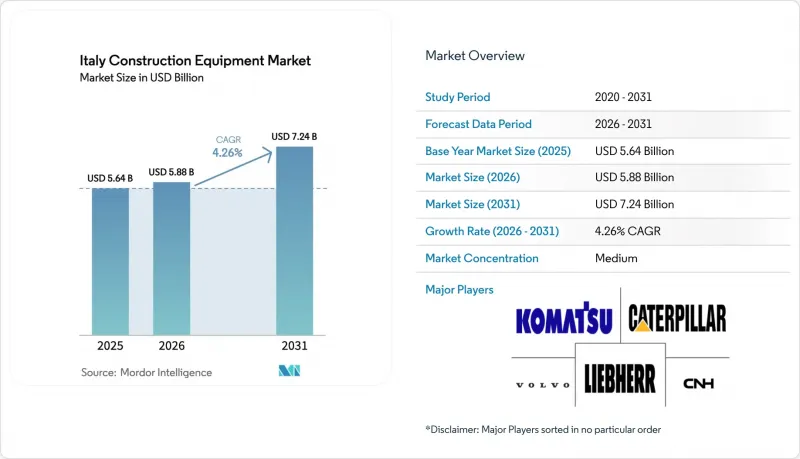
本報告按機器類型(挖土機、裝載機和後鏟、起重機等)、驅動系統(內燃機、電力等)、功率輸出(小於75馬力、75-149馬力、150-300馬力及其他)、應用領域(住宅建築等)和地區(義大利北部等)進行細分。市場預測以貨幣價值(美元)和銷售(台)兩種形式呈現。
義大利施工機械市場趨勢與洞察
國家基礎建設計劃和歐盟復甦基金支出
國家復甦與重建計畫 (PNRR) 承諾投資 1,944 億歐元用於交通、能源和數位走廊建設,其中 39% 用於應對氣候變化,使其成為全國重型設備需求的最大單一促進因素。時速超過 280 公里的高速鐵路走廊和公路改善工程帶動了挖土機、平土機和隧道鑽掘機的大規模訂單。分階段的資金投入(僅 2024 年就批准了 110 億歐元)正在建立一個可靠的多年專案儲備,穩定經銷商和租賃營運商的收入前景。該項目嚴格遵守環保標準,促使建築商越來越傾向於低排放車型,並在大規模公共競標中加快電氣化。物流改善的連鎖效應也降低了原始設備製造商 (OEM) 和零件供應商的供應鏈成本,並增強了本地組裝基地的實力。
住宅維修獎勵(超級獎金 110%)
曾經高達110%的稅額扣抵引發了2,190億歐元的房屋翻新熱潮,導致小型挖土機、滑移裝載機和混凝土泵的使用率創下歷史新高。截至2024年5月,約有49.6萬個節能維修工程登記在冊,造成工程積壓,迫使承包商使用租賃設備來準時完工。儘管2025年的預算將主要住宅的稅收抵免比例降至50%,但由於住宅爭相獲得更高的退稅,過渡期的需求激增仍在持續。這種短期需求激增推高了售後零件和維修服務的收入,但隨著該計劃的逐步縮減,也將促使承包商調整業務重心,轉向基礎設施和商業項目。
租賃設備產業的快速擴張
全國租賃公司設備數量的兩位數成長,使承包商能夠靈活地使用新技術,而無需承擔額外的財務負擔。對於原始設備製造商 (OEM) 而言,雖然客戶群更大、更集中,但價格和更換週期談判的收緊正在擠壓設備利潤率。小規模經銷商正將業務重心轉向服務包和認證二手設備項目,以彌補批發量的下降。租賃雖然促進了先進遠端資訊處理技術的普及,但卻減緩了中小企業全面購置設備的步伐,從而在短期內抑制了新銷售的成長。
細分市場分析
2025年,挖土機佔義大利施工機械市場的39.78%。這主要得益於大規模鐵路和公路走廊建設對強大土方作業能力的需求。履帶式挖土機在重型機械領域佔據主導地位,而小型挖土機則活躍於人口密集的城市改造項目,這些項目受到歷史建築保護法規的限制。伸縮臂堆高機是成長最快的細分市場,複合年成長率達6.25%,其應用領域涵蓋倉庫自動化、農業物流和模組化建築,體現了其業務從純粹的土木工程朝向多元化發展。裝載機和後鏟用於市政維護和骨材搬運,儘管住宅開工量放緩,但市場需求仍然強勁。起重機在米蘭和羅馬的高層建築專案中需求出現高峰,但較長的更換週期限制了其整體成長。
隨著傾斜旋轉器、快速連接器和3D機器控制套件逐漸成為標配,屬附件系統的同步變革進一步推動了挖土機的銷售。建築公司越來越重視現場數位整合和操作員安全輔助功能,而非單純的馬力。因此,配備整合式坡度輔助功能的高階機型能夠更快地收回投資,增強品牌忠誠度,並提高低成本進口競爭對手的進入門檻。
即使到了2025年,內燃機仍將佔據義大利施工機械市場82.61%的佔有率,這得益於完善的加油網和專業的服務系統。然而,電動工程機械正以13.86%的複合年成長率快速成長,主要目標市場是小型裝載機、小型挖土機和高空作業平台,這些設備的日常運作週期與夜間充電時間重合。電池能量密度的提升以及大型建築工地快速充電站的部署,正在縮小電動工程機械與柴油工程機械之間的生產力差距。
混合動力系統提供了一種過渡方案,在走走停停的駕駛模式下可降低15-20%的油耗,並緩解人們對續航里程的擔憂。然而,為滿足第五階段排放標準而不斷增加的成本持續削弱內燃機的價格優勢,預計在包含怠速減少條款的都市區項目中,總擁有成本(TCO)的趨同進程最早將於2028年加速。此外,多家汽車製造商(OEM)推出的「電池組即服務」(BaaS)方案降低了小規模車隊營運商開展試點部署的門檻。
其他好處:
- Excel格式的市場預測(ME)表
- 3個月的分析師支持
目錄
第1章:引言
- 研究假設和市場定義
- 調查範圍
第2章:調查方法
第3章執行摘要
第4章 市場狀況
- 市場概覽
- 市場促進因素
- 國家基礎建設計劃和歐盟復甦基金支出
- 住宅裝修補貼措施(超級獎勵110%)
- 數位化(BIM)的進步正在推動智慧機械的廣泛應用。
- OEM電氣化藍圖降低整體擁有成本
- 葡萄園和果園的自動化正在推動對專業設備的需求。
- 擴大回收設施:循環經濟政策
- 市場限制因素
- 租賃設備產業的快速擴張
- 更嚴格的第五階段排放氣體法規正在推動資本投資的增加。
- 中小承包商基礎設施分散,限制了預算。
- 鋼材價格波動推高了設備成本。
- 供應鏈分析
- 監理情勢
- 技術展望
- 波特五力分析
第5章 市場規模與成長預測
- 按機器類型
- 挖土機
- 履帶式挖土機
- 帶輪鏟
- 迷你/緊湊型鏟子
- 裝載機和後鏟
- 輪式裝載機
- 滑移裝載機
- 後鏟式裝載機
- 起重機
- 塔式起重機
- 移動式起重機
- 伸縮臂堆高機
- 平土機機
- 瀝青鋪築機和壓路機
- 挖土和打樁鑽機
- 挖土機
- 透過推進力
- 內燃機
- 電的
- 混合
- 依輸出類型
- 低於75馬力
- 75~149 HP
- 150~300 HP
- 300馬力或以上
- 透過使用
- 住宅
- 商業建築
- 工業和製造業
- 基礎建設(公路、鐵路、港口、機場)
- 採礦和採石
- 農業和林業
- 按地區
- 義大利北部
- Lombardia
- 威尼托
- Piemonte
- Emilia-Romagna
- 義大利中部
- Lazio
- 托斯卡納
- Marche
- 翁布里亞
- 義大利南部和島嶼
- Campania
- 普利亞
- 西西里島
- 撒丁島
- Calabria
- 義大利北部
第6章 競爭情勢
- 市場集中度
- 策略趨勢
- 市佔率分析
- 公司簡介
- Caterpillar Inc.
- Komatsu Ltd.
- CNH Industrial NV
- Liebherr Group
- Hitachi Construction Machinery Co., Ltd.
- Deere and Company
- AB Volvo(Volvo CE)
- Hyundai Doosan Infracore Co., Ltd.
- JC Bamford Excavators Ltd(JCB)
- Wirtgen Group
- Manitowoc Company Inc.
- Takeuchi Mfg Co., Ltd.
- Yanmar Holdings Co., Ltd.
- Kubota Corporation
- SANY Group
- XCMG Group
- Fiori Group SpA
- Bomag GmbH(Fayat Group)
- Terex Corporation
- Atlas Copco AB
第7章 市場機會與未來展望
According to Mordor Intelligence, the Italy construction equipment market size in 2026 is estimated at USD 5.88 billion, growing from 2025 value of USD 5.64 billion with 2031 projections showing USD 7.24 billion, growing at 4.26% CAGR over 2026-2031.
This report is Segmented by Machinery Type (Excavators, Loaders and Backhoes, Cranes, and More), and Propulsion (Internal Combustion Engine, Electric and More), Power Output (Below 75 HP, 75 To 149 HP, 150 To 300 HP, and More), Application (Residential Construction and More), and Region (Northern Italy and More). The Market Forecasts are Provided in Terms of Value (USD) and Volume (Units).
Italy Construction Equipment Market Trends and Insights
National Infrastructure Plan and EU Recovery Fund Outlays
The PNRR commits EUR 194.4 billion to transport, energy and digital corridors, with 39% earmarked for climate action, making it the single largest catalyst for heavy equipment demand nationwide. High-speed rail corridors exceeding 280 km and highway upgrades stimulate extensive orders for excavators, graders and tunneling rigs. Rolling disbursements, EUR 11 billion approved in 2024 alone, create a dependable multiyear project pipeline, smoothing revenue visibility for dealers and rental fleets. As projects observe strict environmental criteria, contractors increasingly favor low-emission models, accelerating electrification across sizeable public tenders. The multiplier effect of logistics improvements also lowers supply-chain costs for OEMs and parts suppliers, reinforcing local assembly footprints.
Residential Renovation Incentives (Superbonus 110%)
Fiscal deductions that once peaked at 110% unleashed a EUR 219 billion renovation boom, driving record utilization rates for mini-excavators, skid-steer loaders and concrete pumps. Nearly 496,000 energy-upgrade projects registered by May 2024 created scheduling backlogs that pushed contractors toward rental fleets to meet delivery dates. While the 2025 budget cuts incentives to 50% for principal dwellings, a transitional surge persists as homeowners rush to lock in higher rebates. This near-term spike boosts aftermarket parts and maintenance revenue but also prompts contractors to rebalance toward infrastructure and commercial jobs once the program tapers.
Rapid Expansion of Rental Equipment Industry
Double-digit fleet growth among national rental firms offers contractors flexible access to new technology without balance-sheet strain. For OEMs, this means larger but more concentrated customers who negotiate harder on price and refresh cycles, compressing equipment margins. Smaller dealers pivot toward service packages and certified used-equipment programs to offset lower wholesale volumes. While rentals uplift utilization of advanced telematics, they delay outright ownership in the SME segment, moderating net new unit sales in the short run.
Other drivers and restraints analyzed in the detailed report include:
- Digitalization Mandates (BIM) Boosting Smart Machinery
- OEM Electrification Roadmaps Lower Total Cost of Ownership (TCO)
- Stricter Stage V Emission Norms Raising Capex
For complete list of drivers and restraints, kindly check the Table Of Contents.
Segment Analysis
Excavators generated 39.78% of the Italy construction equipment market in 2025 as large-scale rail and road corridors demanded robust earthmoving capacities. Crawler variants dominate heavy civil lots, whereas mini-excavators thrive in dense city-center refits backed by heritage preservation codes. Telescopic handlers, the fastest climber at 6.25% CAGR, support warehouse automation, farm logistics and modular construction, reflecting diversification away from purely civil works. Loaders and backhoe units serve municipal maintenance and aggregates handling, holding steady despite slower housing starts. Cranes see selective demand peaks in high-rise schemes in Milan and Rome, yet longer replacement cycles limit their headline growth.
A parallel transition in attachment ecosystems further spurs excavator turnover, as tiltrotators, quick-couplers and 3D machine-control kits become standard inclusions. Contractors increasingly weigh digital job-site integration and operator safety aids over raw horsepower. As a result, premium-priced models with integrated grade-assist achieve quicker payback, reinforcing brand loyalty and raising barriers for low-cost import challengers.
Internal combustion engines still accounted for 82.61% of the Italy construction equipment market in 2025 due to entrenched refueling networks and established service know-how. Yet electric variants compound at 13.86% CAGR, targeting compact loaders, mini-excavators and access platforms where daily cycles align with overnight charging. Battery density improvements and the rollout of fast-charge depots at major worksites narrow productivity gaps versus diesel peers.
Hybrid drivetrains provide an interim step, cutting fuel burn 15-20% in stop-start duty without range anxiety. Stage V compliance costs continue to erode ICE price superiority, accelerating total cost-of-ownership parity as early as 2028 on urban projects with idle-reduction clauses. OEM announcements of dedicated battery Pack-As-a-Service options also lower entry barriers for smaller fleets exploring pilot deployments.
Complete Report Scope:
- By Machinery Type
- Excavators
- Crawler Excavators
- Wheeled Excavators
- Mini/Compact Excavators
- Loaders and Backhoes
- Wheel Loaders
- Skid-Steer Loaders
- Backhoe Loaders
- Cranes
- Tower Cranes
- Mobile Cranes
- Telescopic Handlers
- Motor Graders
- Asphalt Pavers and Compactors
- Drilling and Piling Rigs
- Excavators
- By Propulsion
- Internal Combustion Engine
- Electric
- Hybrid
- By Power Output
- Below 75 HP
- 75 to 149 HP
- 150 to 300 HP
- Above 300 HP
- By Application
- Residential Construction
- Commercial Construction
- Industrial and Manufacturing
- Infrastructure (Road, Rail, Ports, Airports)
- Mining and Quarrying
- Agriculture and Forestry
- By Region
- Northern Italy
- Lombardy
- Veneto
- Piedmont
- Emilia-Romagna
- Central Italy
- Lazio
- Tuscany
- Marche
- Umbria
- Southern Italy and Islands
- Campania
- Apulia
- Sicily
- Sardinia
- Calabria
- Northern Italy
List of Companies Covered in this Report:
- Caterpillar Inc.
- Komatsu Ltd.
- CNH Industrial N.V.
- Liebherr Group
- Hitachi Construction Machinery Co., Ltd.
- Deere and Company
- AB Volvo (Volvo CE)
- Hyundai Doosan Infracore Co., Ltd.
- J.C. Bamford Excavators Ltd (JCB)
- Wirtgen Group
- Manitowoc Company Inc.
- Takeuchi Mfg Co., Ltd.
- Yanmar Holdings Co., Ltd.
- Kubota Corporation
- SANY Group
- XCMG Group
- Fiori Group S.p.A.
- Bomag GmbH (Fayat Group)
- Terex Corporation
- Atlas Copco AB
Additional Benefits:
- The market estimate (ME) sheet in Excel format
- 3 months of analyst support
TABLE OF CONTENTS
1 Introduction
- 1.1 Study Assumptions and Market Definition
- 1.2 Scope of the Study
2 Research Methodology
3 Executive Summary
4 Market Landscape
- 4.1 Market Overview
- 4.2 Market Drivers
- 4.2.1 National Infrastructure Plan and EU Recovery Fund outlays
- 4.2.2 Residential renovation incentives (Superbonus 110%)
- 4.2.3 Digitalization mandates (BIM) boosting smart machinery
- 4.2.4 OEM electrification roadmaps lowering TCO
- 4.2.5 Vineyard and orchard automation driving niche equipment
- 4.2.6 Circular-economy policies expanding recycling facilities
- 4.3 Market Restraints
- 4.3.1 Rapid expansion of rental equipment industry
- 4.3.2 Stricter Stage V emission norms raising capex
- 4.3.3 Fragmented SME contractor base limiting budgets
- 4.3.4 Volatile steel prices inflating equipment costs
- 4.4 Supply-Chain Analysis
- 4.5 Regulatory Landscape
- 4.6 Technological Outlook
- 4.7 Porter's Five Forces Analysis
- 4.7.1 Threat of New Entrants
- 4.7.2 Bargaining Power of Buyers
- 4.7.3 Bargaining Power of Suppliers
- 4.7.4 Threat of Substitutes
- 4.7.5 Intensity of Competitive Rivalry
5 Market Size and Growth Forecasts (Value (USD) and Volume (Units))
- 5.1 By Machinery Type
- 5.1.1 Excavators
- 5.1.1.1 Crawler Excavators
- 5.1.1.2 Wheeled Excavators
- 5.1.1.3 Mini/Compact Excavators
- 5.1.2 Loaders and Backhoes
- 5.1.2.1 Wheel Loaders
- 5.1.2.2 Skid-Steer Loaders
- 5.1.2.3 Backhoe Loaders
- 5.1.3 Cranes
- 5.1.3.1 Tower Cranes
- 5.1.3.2 Mobile Cranes
- 5.1.4 Telescopic Handlers
- 5.1.5 Motor Graders
- 5.1.6 Asphalt Pavers and Compactors
- 5.1.7 Drilling and Piling Rigs
- 5.1.1 Excavators
- 5.2 By Propulsion
- 5.2.1 Internal Combustion Engine
- 5.2.2 Electric
- 5.2.3 Hybrid
- 5.3 By Power Output
- 5.3.1 Below 75 HP
- 5.3.2 75 to 149 HP
- 5.3.3 150 to 300 HP
- 5.3.4 Above 300 HP
- 5.4 By Application
- 5.4.1 Residential Construction
- 5.4.2 Commercial Construction
- 5.4.3 Industrial and Manufacturing
- 5.4.4 Infrastructure (Road, Rail, Ports, Airports)
- 5.4.5 Mining and Quarrying
- 5.4.6 Agriculture and Forestry
- 5.5 By Region
- 5.5.1 Northern Italy
- 5.5.1.1 Lombardy
- 5.5.1.2 Veneto
- 5.5.1.3 Piedmont
- 5.5.1.4 Emilia-Romagna
- 5.5.2 Central Italy
- 5.5.2.1 Lazio
- 5.5.2.2 Tuscany
- 5.5.2.3 Marche
- 5.5.2.4 Umbria
- 5.5.3 Southern Italy and Islands
- 5.5.3.1 Campania
- 5.5.3.2 Apulia
- 5.5.3.3 Sicily
- 5.5.3.4 Sardinia
- 5.5.3.5 Calabria
- 5.5.1 Northern Italy
6 Competitive Landscape
- 6.1 Market Concentration
- 6.2 Strategic Moves
- 6.3 Market Share Analysis
- 6.4 Company Profiles (Includes Global Level Overview, Market Level Overview, Core Segments, Financials as Available, Strategic Information, Market Rank/Share for Key Companies, Products and Services, and Recent Developments)
- 6.4.1 Caterpillar Inc.
- 6.4.2 Komatsu Ltd.
- 6.4.3 CNH Industrial N.V.
- 6.4.4 Liebherr Group
- 6.4.5 Hitachi Construction Machinery Co., Ltd.
- 6.4.6 Deere and Company
- 6.4.7 AB Volvo (Volvo CE)
- 6.4.8 Hyundai Doosan Infracore Co., Ltd.
- 6.4.9 J.C. Bamford Excavators Ltd (JCB)
- 6.4.10 Wirtgen Group
- 6.4.11 Manitowoc Company Inc.
- 6.4.12 Takeuchi Mfg Co., Ltd.
- 6.4.13 Yanmar Holdings Co., Ltd.
- 6.4.14 Kubota Corporation
- 6.4.15 SANY Group
- 6.4.16 XCMG Group
- 6.4.17 Fiori Group S.p.A.
- 6.4.18 Bomag GmbH (Fayat Group)
- 6.4.19 Terex Corporation
- 6.4.20 Atlas Copco AB
7 Market Opportunities and Future Outlook

 泰國施工機械市場:市場佔有率分析、產業趨勢與統計及成長預測(2026-2031)
 2026-2030年全球挖溝機市場
 2026-2030年全球施工機械市場歐洲施工機械:市場佔有率分析、產業趨勢與統計、成長預測(2026-2031)
 2035年前施工機械輪胎市場分析和預測:按類型、產品、技術、組件、應用、材料類型、製程、最終用戶和安裝方法進行分析和預測。對 2035 年前施工機械引擎市場進行分析和預測:按類型、產品、服務、技術、組件、應用、材料類型、製程、最終用戶和功能分類。
 輪式挖溝機市場規模、佔有率和成長分析:按產品類型、動力來源、應用、最終用戶、銷售管道和地區分類-2026-2033年產業預測
 道路堆垛機市場規模、佔有率和成長分析:按產品類型、負載容量、應用、最終用戶、分銷管道和地區分類-2026-2033年產業預測中國施工機械市場:市場佔有率分析、產業趨勢與統計及成長預測(2026-2031年)
 施工機械市場-2026-2032年全球市場預測