

 |
市場調查報告書
商品編碼
2125691
泰國施工機械市場:市場佔有率分析、產業趨勢與統計及成長預測(2026-2031)Thailand Construction Equipment - Market Share Analysis, Industry Trends & Statistics, Growth Forecasts (2026 - 2031) |
||||||

※ 本網頁內容可能與最新版本有所差異。詳細情況請與我們聯繫。
根據 Mordor Intelligence 預測,泰國施工機械市場規模將從 2025 年的 16.5 億美元和 2026 年的 13.1 億美元成長到 2031 年的 16.5 億美元,2026 年至 2031 年的年複合成長率(CAGR)為 4.75%。
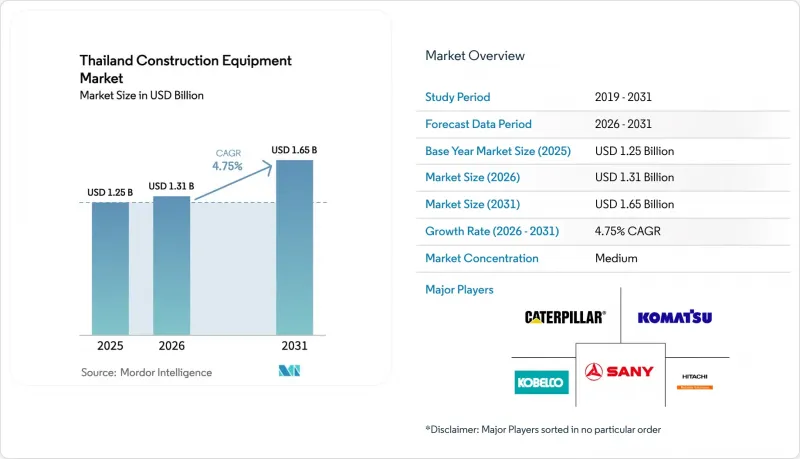
本報告按機器類型(起重機及其他)、動力方式(內燃機、電動/混合動力)、功率輸出(100馬力以下及其他)、最終用戶(基礎設施及其他)、應用領域(土方工程及其他)和地區進行細分。市場預測以價值(美元)和數量(台)為單位,並基於現有數據呈現。
泰國施工機械市場趨勢與洞察
東部經濟走廊(EEC)大型企劃激增
多個大型EEC二期專案推動了中大型挖土機、履帶式桁架臂起重機和兩棲打樁機的需求。在關鍵基礎設施建設項目中,例如航空樞紐擴建、港口現代化改造以及連接多個機場的高鐵走廊建設,設備運轉率已顯著高於疫情前水準。建築公司越來越傾向於使用具備遠端資訊處理功能的機械設備,這些設備能夠將運轉率數據傳輸給貸款機構和保險公司,從而大幅降低資金籌措成本。在一些地區,二手設備租賃市場正在興起,使中小型建築公司能夠轉租閒置設備,並抓住更多專案機會。日本原始設備製造商(OEM)正在將預測性維護訂閱服務納入長期服務契約,以確保穩定的售後市場收入並延長設備運作。
透過官民合作關係加速基礎建設
運輸部宣布了大規模官民合作關係(PPP)計劃。此外,政府也為幾項計劃在近期啟動的新舉措追加了資金。採用建造-營運-移交(BOT)模式的主要高速公路設有排放上限,並鼓勵使用節能型平土機和壓路機。雄心勃勃的南部陸橋基礎設施項目將涉及大量重型機械,預計將於下一個十年的後半期投入運作。 PPP協議中包含有關專案延誤處罰的條款,這鼓勵採用整合BIM的機械設備,從而實現即時合規性追蹤。為了滿足大型特許經營競標帶來的資金需求,中小企業正在策略性地轉型,轉向利基分包業務,並發展短期租賃業務。
建築材料價格飆升給承包商的資本投資帶來了壓力。
2024年,受鋼鐵、水泥和柴油價格持續上漲的影響,泰國建築成本指數小幅上漲。人事費用也大幅增加,進一步擠壓了分包商本已捉襟見肘的利潤空間。因此,中小型建築公司紛紛推遲設備升級,轉而從東部經濟走廊的剩餘庫存中購買二手設備。儘管政府已實施價格上限,但效果有限,專案預算仍容易受到全球大宗商品價格波動的影響。除非價格趨於穩定或透過價格上調條款進行價格調整,否則預計向微型承包商銷售新設備的需求仍將低迷。
細分市場分析
到2025年,挖土機將佔泰國施工機械市場佔有率的47.16%。這反映了挖土機在東部經濟走廊(EEC)大型企劃的樁基和溝槽作業中發揮的關鍵作用。受連接三個機場和烏塔堡航空樞紐的高速鐵路專案採購需求激增的推動,光是這一領域就佔據了泰國施工機械市場近一半的佔有率。中國品牌在盡可能減少價格折扣的同時提高了銷量,而老牌日本製造商則透過先進的遠端資訊處理技術和五年服務合約維持了利潤率。
預計到2031年,裝載機和後鏟的複合年成長率將達到4.77%,這主要得益於農村道路建設、灌溉管道和農產品加工綜合體對能夠在土方作業和物料輸送之間切換的多功能機械的需求不斷成長。租賃公司正在透過擴展產品線,將滑移裝載機和鉸接式裝載機納入其中,從而實現木薯物流的現代化,目標客戶是小規模農業合作社。伸縮臂堆高機和平地平土機雖然銷量仍然較低,但在公私合營(PPP)高速公路建設工地上,由於橫坡精度至關重要,它們的應用越來越廣泛。
2025年,儘管柴油燃料在全國範圍內供應充足,但充電基礎設施仍然不足,內燃機仍佔泰國工程機械銷售的88.71%。然而,預計電動和混合動力工程機械的銷量將超過內燃機,到2031年將以4.88%的複合年成長率成長,從而擴大泰國施工機械市場低碳細分市場的規模。曼谷的豪華連鎖飯店和企業總部被要求使用電池驅動的小型挖土機,以滿足LEED認證的要求,這使得原始設備製造商(OEM)有機會測試專為高濕度環境設計的磷酸鋰鐵鋰電池組。
在起重機領域,混合動力系統結合了柴油發電機和電池緩衝器,可將擁擠作業現場的怠速排放量減少近30%。在可快速更換的電池組容量達到300千瓦時之前,內燃機預計仍將在採石場和礦場中佔據主導地位。儘管政府對零排放機械免徵消費稅降低了總擁有成本,但由於續航里程有限以及二手車流動性方面的不確定性,其廣泛應用仍然受到阻礙。
其他好處
- Excel格式的市場預測(ME)表
- 3個月的分析師支持
目錄
第1章:引言
- 研究假設和市場定義
- 調查範圍
第2章:調查方法
第3章執行摘要
第4章 市場狀況
- 市場概覽
- 市場促進因素
- 東部經濟走廊(EEC)大型企劃激增
- 透過官民合作關係加速基礎建設
- 旅遊業帶動商業和酒店建設的復甦。
- 可再生能源(太陽能發電廠、儲能系統)的擴張正在推動對起重機和土木工程機具。
- 電動車供應鏈工廠的本地化需要待開發區工廠
- 機器控制和BIM整合設備的快速普及減少了專案工期。
- 市場限制因素
- 建築材料價格飆升給承包商的資本投資帶來了壓力。
- 由於熟練操作人員短缺,需求從購買轉向租賃。
- 高額進口關稅和充電基礎設施不足正在減緩電動重型機械的普及。
- 中小企業貸款環境收緊,導致設備更新換代週期放緩。
- 價值供應鏈分析
- 監理情勢
- 技術展望
- 波特五力模型
第5章 市場規模與成長預測
- 按機器類型
- 起重機
- 伸縮臂堆高機
- 挖土機
- 裝載機後鏟
- 平土機機
- 其他機器類型
- 透過推進力
- 內燃機
- 電動和混合動力
- 依輸出類型
- 100馬力或以下
- 101~200HP
- 超過200馬力
- 最終用戶
- 基礎設施
- 住宅/商業建築
- 採礦和工業
- 農業
- 能源與公共產業
- 透過使用
- 土方工程
- 物料輸送
- 道路建設
- 起吊裝置
- 按地區
- 曼谷大都會區
- 泰國中部
- 泰國北部
- 泰國東北部
- 泰國南部
第6章 競爭情勢
- 市場集中度
- 策略趨勢
- 市佔率分析
- 公司簡介
- Caterpillar Inc.
- Komatsu Ltd.
- Hitachi Construction Machinery Co. Ltd.
- Kobelco Construction Machinery Co. Ltd.
- SANY Group
- XCMG Group
- Zoomlion Heavy Industry Science & Technology Co. Ltd.
- Hyundai Construction Equipment Co. Ltd.
- Liebherr Group
- CNH Industrial NV
- JC Bamford Excavators Ltd(JCB)
- Volvo Construction Equipment
- Doosan Bobcat
- Wirtgen Group(John Deere)
- Yanmar Holdings Co. Ltd.
- Takeuchi Mfg. Co. Ltd.
- Kubota Corporation
- Sumitomo Construction Machinery Co. Ltd.
- Terex Corporation
- Manitowoc Company Inc.
第7章 市場機會與未來展望
According to Mordor Intelligence, the Thailand construction equipment market size is projected to expand from USD 1.25 billion in 2025 and USD 1.31 billion in 2026 to USD 1.65 billion by 2031, registering a CAGR of 4.75% between 2026 to 2031.
This report is Segmented by Machinery Type (Cranes and More), Propulsion (Internal Combustion Engine and Electric & Hybrid), Power Output (Below 100 HP and More), End-User (Infrastructure and More), Application (Earth-Moving and More), and Geography. The Market Forecasts are Provided in Terms of Value (USD) and Volume (Units), Based On Availability.
Thailand Construction Equipment Market Trends and Insights
Surge in Megaprojects Under Eastern Economic Corridor
Several EEC Phase 2 projects, valued at a significant amount, are driving demand for medium- to large-excavators, lattice-boom crawler cranes, and amphibious pile drivers. Important infrastructure developments, including an aviation hub expansion, a port upgrade, and a high-speed rail corridor connecting multiple airports, are operating at fleet capacities well above pre-pandemic levels. Contractors are increasingly favoring telematics-enabled machines that transmit utilization data to lenders and insurers, enabling notable reductions in financing costs. In certain regions, secondary leasing markets have emerged, allowing smaller contractors to sub-lease idle equipment and capitalize on additional project opportunities. Japanese OEMs are incorporating predictive-maintenance subscriptions into long-term service contracts, ensuring steady aftermarket revenue and extending equipment's operational lifespan.
Public-Private Partnerships Accelerating Infrastructure Roll-Outs
The Ministry of Transport has unveiled a significant public-private partnership (PPP) docket encompassing numerous projects. In addition, additional funding has been allocated for several new initiatives set to launch in the near future. Key motorways operating under a build-operate-transfer model impose emissions ceilings, promoting the use of fuel-efficient graders and compactors. The ambitious Southern Land Bridge, a significant infrastructure project, is set to deploy a substantial number of heavy machines, with operations expected to commence later in the decade. Embedded in PPP contracts are provisions for liquidated damages in the event of schedule delays. This has spurred the adoption of BIM-integrated machinery, which ensures real-time compliance tracking. In response to the capital demands of primary concession bids, smaller firms are strategically shifting towards subcontracting niche roles and pursuing short-term rentals.
Construction-Input Inflation Squeezing Contractor CAPEX
In 2024, Thailand's construction cost index rose moderately, driven by ongoing inflationary pressures on steel, cement, and diesel. Labor costs also rose significantly, further squeezing subcontractors' already tight margins. As a result, smaller builders are postponing fleet upgrades, turning instead to used equipment from EEC surplus inventories. While government price caps have been implemented, their impact is limited, leaving project budgets vulnerable to fluctuations in global commodity prices. Without a return to price stability or a rise in escalator clauses, sales of new equipment to micro-contractors are expected to remain subdued.
Other drivers and restraints analyzed in the detailed report include:
- Tourism-Led Rebound in Commercial and Hospitality Construction
- Renewable-Energy Build-Out Lifting Demand for Cranes and Earth-Moving Gear
- Skilled-Operator Shortages Pushing Renters Over Buyers
For complete list of drivers and restraints, kindly check the Table Of Contents.
Segment Analysis
Excavators accounted for 47.16% of the Thailand construction equipment market share in 2025, reflecting their indispensable role in pile foundations and trenching across the EEC megaproject lattice. This segment alone accounted for nearly half of Thailand's construction equipment market, driven by a procurement surge for the three-airport high-speed rail and the U-Tapao aviation hub. Chinese brands gained volume with minimal price discounts, but Japanese incumbents defended margins through advanced telematics and five-year service pacts.
Loaders and backhoes are forecast to register a 4.77% CAGR through 2031 as provincial roadworks, irrigation canals, and agriprocessing complexes demand multi-function machines that toggle between earth-moving and material-handling roles. Rental yards diversify into skid-steer and articulated loaders to serve smallholder cooperatives, modernizing cassava logistics. Telescopic handlers and motor graders, although smaller in volume, are increasingly deployed on PPP motorway sites where cross-slope precision is prioritized.
Internal combustion engines retained 88.71% of revenue in 2025, underpinned by diesel's national availability and the absence of universal charging. Nevertheless, electric and hybrid units are predicted to outpace, expanding at a 4.88% CAGR through 2031 and lifting the Thailand construction equipment market size in the low-carbon segment. Luxury hotel chains and corporate headquarters in Bangkok contractually require battery-electric mini-excavators for LEED credits, enabling OEMs to trial lithium-iron-phosphate packs rated for humid environments.
Hybrid drivetrains marry diesel generators to battery buffers on cranes, cutting idle emissions by nearly 30% on congested sites. ICE will stay entrenched in quarrying and mining until fast-swap battery skids reach 300 kWh capacities. Government waivers on excise for zero-emission machinery narrow the total cost of ownership, but uptake remains gated by range constraints and resale liquidity uncertainties.
Complete Report Scope:
- By Machinery Type
- Cranes
- Telescopic Handlers
- Excavators
- Loaders & Backhoe
- Motor Graders
- Other Machinery Types
- By Propulsion
- Internal Combustion Engine
- Electric & Hybrid
- By Power Output
- Below 100 HP
- 101 - 200 HP
- Above 200 HP
- By End-user
- Infrastructure
- Residential and Commercial Construction
- Mining and Industrial
- Agriculture
- Energy and Utilities
- By Application
- Earth-moving
- Material Handling
- Road Construction
- Lifting & Hoisting
- By Region
- Bangkok Metropolitan Area
- Central Thailand
- Northern Thailand
- Northeastern Thailand
- Southern Thailand
List of Companies Covered in this Report:
- Caterpillar Inc.
- Komatsu Ltd.
- Hitachi Construction Machinery Co. Ltd.
- Kobelco Construction Machinery Co. Ltd.
- SANY Group
- XCMG Group
- Zoomlion Heavy Industry Science & Technology Co. Ltd.
- Hyundai Construction Equipment Co. Ltd.
- Liebherr Group
- CNH Industrial N.V.
- JC Bamford Excavators Ltd (JCB)
- Volvo Construction Equipment
- Doosan Bobcat
- Wirtgen Group (John Deere)
- Yanmar Holdings Co. Ltd.
- Takeuchi Mfg. Co. Ltd.
- Kubota Corporation
- Sumitomo Construction Machinery Co. Ltd.
- Terex Corporation
- Manitowoc Company Inc.
Additional Benefits:
- The market estimate (ME) sheet in Excel format
- 3 months of analyst support
TABLE OF CONTENTS
1 Introduction
- 1.1 Study Assumptions & Market Definition
- 1.2 Scope of the Study
2 Research Methodology
3 Executive Summary
4 Market Landscape
- 4.1 Market Overview
- 4.2 Market Drivers
- 4.2.1 Surge In Megaprojects Under Eastern Economic Corridor (EEC)
- 4.2.2 Public-Private Partnerships Accelerating Infrastructure Roll-Outs
- 4.2.3 Tourism-Led Rebound in Commercial and Hospitality Construction
- 4.2.4 Renewable-Energy Build-Out (Solar Farms, BESS) Lifting Demand for Cranes and Earth-Moving Gear
- 4.2.5 Localization of EV Supply-Chain Plants Requiring Green-Field Factory Construction
- 4.2.6 Rapid Adoption of Machine-Control & BIM-Integrated Equipment to Cut Project Over-Runs
- 4.3 Market Restraints
- 4.3.1 Construction-Input Inflation Squeezing Contractor CAPEX
- 4.3.2 Skilled-Operator Shortages Pushing Renters Over Buyers
- 4.3.3 High Import Duties and Sparse Charging Infra Delaying Electric Heavy Machinery Uptake
- 4.3.4 Tight Credit Conditions for SMEs Slowing Fleet Renewal Cycles
- 4.4 Value / Supply-Chain Analysis
- 4.5 Regulatory Landscape
- 4.6 Technological Outlook
- 4.7 Porter's Five Forces
- 4.7.1 Threat of New Entrants
- 4.7.2 Bargaining Power of Suppliers
- 4.7.3 Bargaining Power of Buyers
- 4.7.4 Threat of Substitutes
- 4.7.5 Competitive Rivalry
5 Market Size & Growth Forecasts (Value (USD) and Volume (Units))
- 5.1 By Machinery Type
- 5.1.1 Cranes
- 5.1.2 Telescopic Handlers
- 5.1.3 Excavators
- 5.1.4 Loaders & Backhoe
- 5.1.5 Motor Graders
- 5.1.6 Other Machinery Types
- 5.2 By Propulsion
- 5.2.1 Internal Combustion Engine
- 5.2.2 Electric & Hybrid
- 5.3 By Power Output
- 5.3.1 Below 100 HP
- 5.3.2 101 - 200 HP
- 5.3.3 Above 200 HP
- 5.4 By End-user
- 5.4.1 Infrastructure
- 5.4.2 Residential and Commercial Construction
- 5.4.3 Mining and Industrial
- 5.4.4 Agriculture
- 5.4.5 Energy and Utilities
- 5.5 By Application
- 5.5.1 Earth-moving
- 5.5.2 Material Handling
- 5.5.3 Road Construction
- 5.5.4 Lifting & Hoisting
- 5.6 By Region
- 5.6.1 Bangkok Metropolitan Area
- 5.6.2 Central Thailand
- 5.6.3 Northern Thailand
- 5.6.4 Northeastern Thailand
- 5.6.5 Southern Thailand
6 Competitive Landscape
- 6.1 Market Concentration
- 6.2 Strategic Moves
- 6.3 Market Share Analysis
- 6.4 Company Profiles (Includes Global Level Overview, Market Level Overview, Core Segments, Financials as Available, Strategic Information, Market Rank/Share for Key Companies, Products and Services, SWOT Analysis, and Recent Developments)
- 6.4.1 Caterpillar Inc.
- 6.4.2 Komatsu Ltd.
- 6.4.3 Hitachi Construction Machinery Co. Ltd.
- 6.4.4 Kobelco Construction Machinery Co. Ltd.
- 6.4.5 SANY Group
- 6.4.6 XCMG Group
- 6.4.7 Zoomlion Heavy Industry Science & Technology Co. Ltd.
- 6.4.8 Hyundai Construction Equipment Co. Ltd.
- 6.4.9 Liebherr Group
- 6.4.10 CNH Industrial N.V.
- 6.4.11 JC Bamford Excavators Ltd (JCB)
- 6.4.12 Volvo Construction Equipment
- 6.4.13 Doosan Bobcat
- 6.4.14 Wirtgen Group (John Deere)
- 6.4.15 Yanmar Holdings Co. Ltd.
- 6.4.16 Takeuchi Mfg. Co. Ltd.
- 6.4.17 Kubota Corporation
- 6.4.18 Sumitomo Construction Machinery Co. Ltd.
- 6.4.19 Terex Corporation
- 6.4.20 Manitowoc Company Inc.
7 Market Opportunities & Future Outlook
- 7.1 White-space & unmet-need assessment

 義大利施工機械市場:市場佔有率分析、產業趨勢與統計及成長預測(2026-2031)
 2026-2030年全球挖溝機市場
 2026-2030年全球施工機械市場歐洲施工機械:市場佔有率分析、產業趨勢與統計、成長預測(2026-2031)
 2035年前施工機械輪胎市場分析和預測:按類型、產品、技術、組件、應用、材料類型、製程、最終用戶和安裝方法進行分析和預測。對 2035 年前施工機械引擎市場進行分析和預測:按類型、產品、服務、技術、組件、應用、材料類型、製程、最終用戶和功能分類。
 輪式挖溝機市場規模、佔有率和成長分析:按產品類型、動力來源、應用、最終用戶、銷售管道和地區分類-2026-2033年產業預測
 道路堆垛機市場規模、佔有率和成長分析:按產品類型、負載容量、應用、最終用戶、分銷管道和地區分類-2026-2033年產業預測中國施工機械市場:市場佔有率分析、產業趨勢與統計及成長預測(2026-2031年)
 施工機械市場-2026-2032年全球市場預測