


 |
市場調查報告書
商品編碼
2119286
石膏板襯紙:市場佔有率分析、產業趨勢與統計、成長預測(2026-2031)Plasterboard Liner Paper - Market Share Analysis, Industry Trends & Statistics, Growth Forecasts (2026 - 2031) |
||||||

※ 本網頁內容可能與最新版本有所差異。詳細情況請與我們聯繫。
據 Mordor Intelligence 稱,2025 年石膏板襯紙的市場規模估計為 51.9 億美元,預計在預測期(2026-2031 年)內將以 5.67% 的複合年成長率成長,從 2026 年的 54.5 億美元成長到 2031 億美元的 71.99。
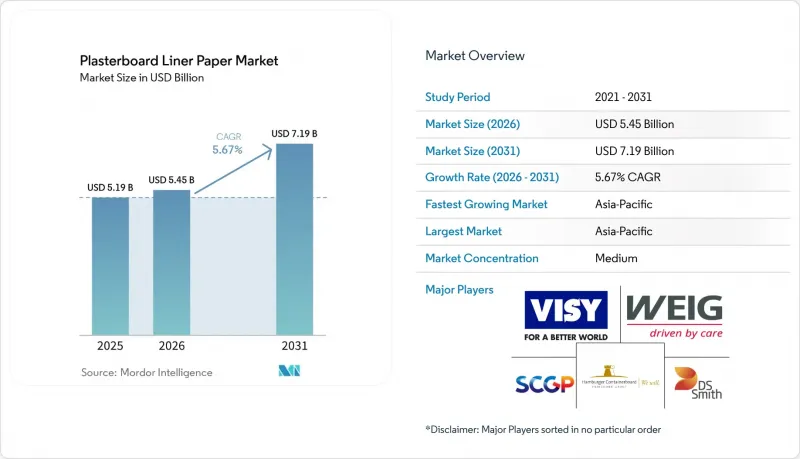
本報告按產品類型(例如,表面襯紙)、纖維類型(例如,再生纖維紙)、石膏板類型(例如,標準石膏板)、應用領域(例如,牆體系統)和地區(亞太地區、北美地區、歐洲地區、南美地區、中東和非洲地區)進行細分。市場預測以美元(USD)計價。
石膏板襯紙的全球市場趨勢與洞察
住宅和商業石膏板的需求
隨著亞太地區住宅的擴張,石膏板大規模生產線的普及推動了對石膏板襯紙的需求成長。中國的《綠色建築評估標準》規定,自2025年起,新建商業項目至少需獲得一星級認證,這鼓勵石膏板生產商使用含有檢驗的再生纖維的襯紙材料。印度的《2025年國家建築標準》也強化了防火牆結構的使用,從而增加了對高性能襯紙的需求。高速石膏板生產線的運作速度超過每分鐘120米,對紙張的成型均勻性提出了更高的要求,限制了低等級材料的使用。因此,能夠在亞洲石膏板襯紙市場快速成長的生產速度下維持產品品質的供應商具有競爭優勢。
防火、防潮、隔音板的規格
由於防火、防潮和隔音等方面的要求日益嚴格,紙張在石膏板結構中的技術作用也變得越來越重要。繼2024年高層建築火災之後,香港和新加坡的筒倉法規更加嚴格,X型石膏板正逐漸成為多用戶住宅和商業項目的標準配置。防火石膏板需要使用紙張重量更高、表面施膠更穩定的面襯紙,以控制石膏漿的流動並在火災中保持黏合力。此外,EN 520標準根據面襯紙黏合力要求的不同,對石膏板進行了分類。能夠以單一面襯紙化學成分滿足多種功能的供應商,有助於減少加工商需要採購的紙張等級數量。這使得技術更先進的供應商能夠在石膏板面襯紙市場佔據更有利的地位,尤其是在石膏板製造商需要滿足多種受監管應用需求的情況下。
施工週期的影響
石膏板襯紙的需求與住宅開工量和商業建築許可密切相關,因此該市場對建築業的波動十分敏感。 2024年和2025年充滿挑戰的利率環境導致美國住宅開工量下降,進而引發加拿大和部分歐洲市場的信貸緊縮。當建設活動放緩時,板材製造商通常會在減少襯紙訂單之前先動用現有的安全庫存。這可能導致襯紙需求在兩到三個季度內比建築市場整體需求下降得更為劇烈。此外,襯紙市場的復甦可能比建築市場的復甦滯後六到九個月,因此製造商在此期間需要謹慎管理其營運資金。由於終端市場選擇有限且供應鏈緩衝較小,獨立造紙廠往往比一體化造紙集團更容易受到風險的影響。
細分市場分析
到2025年,面襯紙將佔據石膏板襯紙市場52.37%的佔有率,預計到2031年將以5.87%的複合年成長率成長。這種紙張需要可控的孔隙率,以確保機械黏合,避免石膏漿料不均勻地滲透到紙張中。光滑的表面也對於塗漆、壁紙和黏合劑粘合至關重要。預裝飾板和防火板進一步提高了面襯紙的規格要求,因為這些產品需要使用表面處理流程能夠滿足其性能要求的襯紙。由於該細分市場的規模較大,面襯紙在石膏板襯紙的整體需求中佔據核心地位。
背襯紙滿足了剩餘的產品需求,並在滿足不同的性能要求方面發揮重要作用。對於這種等級的紙板,縱向和橫向的抗張強度比表面外觀更為重要。因此,背襯紙已成為降低紙張重量,可以減少纖維消耗,並提高加工經濟性。由於客戶現在不僅專注於每平方公尺石膏板的紙張性能,還專注於供應噸位,因此供應商正在努力提高兩種等級紙板的成型性和密度控制。
預計到2025年,再生纖維紙將佔石膏板襯紙市場佔有率的58.15%,並將在2031年之前以6.73%的複合年成長率成長。雖然成本仍然是關鍵考慮因素,但經認證的再生纖維含量正日益成為一項重要的商業性要求。 SCG Packaging在泰國經營一家石膏板襯紙生產廠,該廠使用100%再生紙漿,並已獲得「碳足跡減少標籤」。此類認證有助於紙張供應商充分滿足建設產業買家的需求,這些買家將再生纖維含量納入其資格標準。因此,在循環採購體係正在建立的石膏板襯紙市場中,再生纖維的角色日益重要。
原生紙漿在對紙張抗張強度和防潮性能要求極高的應用中仍然發揮著至關重要的作用。防火防潮紙板對這些要求特別嚴格,因為再生纖維成分的差異可能會造成黏合風險。對於希望提高再生纖維含量並同時滿足高要求紙板應用認證標準的製造商而言,混紡纖維紙提供了折衷方案。隨著加工和清潔技術的進步,這種方法可以逐步調整纖維組成。
區域分析
預計到2025年,亞太地區將佔據石膏板襯紙市場38.14%的佔有率,並在2031年之前以6.09%的複合年成長率成長。中國仍然是該地區最大的消費國,這得益於277億美元的基礎設施投資以及新建商業項目對綠建築認證的要求。印度的「2025年國家建築標準」預計將推動對防火牆結構和高性能襯紙的需求。在越南、印尼和泰國,隨著都市區建築從傳統磚石結構轉向石膏板,乾牆的使用量正在增加。這些區域成長趨勢正在使亞太地區成為石膏板襯紙市場的主要擴張區域。
北美是第二大區域市場,主要由住宅、商業維修以及工業和物流發展所驅動。克瑙夫集團(Knauff Group)在加拿大亞伯達惠特蘭縣開設了一家價值1.3億歐元(1.43億美元)的牆板工廠。產能的提升正在擴大加拿大西部地區的牆板需求。 2025年2月,CGC公司推出了Sheetrock UltraLight PRO面板,該面板比同等厚度的半英寸面板輕8.9%,並且與行業平均水平相比,每1000平方英尺(MSF)的生命週期溫室氣體排放量最多可減少37%。墨西哥也透過近岸外包相關的工業建設和商業室內裝修工程為市場做出貢獻,自2024年以來,這些業務一直在成長。
歐洲對石膏板的需求主要受維修需求和成熟的再生纖維系統所推動。歐盟指令2024/1275/EU要求各國在2026年5月前製定國家維修計劃,這將促進石膏板在歐洲主要市場的長期使用。南美洲市場規模仍然小規模,巴西和阿根廷被認為是主要的需求來源。中東和非洲地區具有長期成長潛力,這主要得益於沙烏地阿拉伯的「2030願景」計畫以及南非都市區的住宅短缺問題。
其他好處:
- Excel格式的市場預測(ME)表
- 3個月的分析師支持
目錄
第1章:引言
- 研究假設和市場定義
- 調查範圍
第2章:調查方法
第3章執行摘要
第4章 市場狀況
- 市場概覽
- 市場促進因素
- 住宅和商業建築對石膏板的需求
- 防火、防潮、隔音板的規格
- 再生材料含量與循環建築採購
- 維修和節能維修
- 輕質石膏板和襯墊的紙張重量
- 石膏板紙的閉合迴路回收
- 市場限制因素
- 建築業的敏感性
- 再生纖維的品質和供應限制
- 將雜質引入密封基板回收中
- 與乾旱、能源和水質相關的風險
- 價值鏈分析
- 波特五力分析
第5章 市場規模與成長預測
- 依產品類型
- 臉部襯紙
- 背襯紙
- 依纖維類型
- 再生纖維紙
- 原生纖維紙
- 其他(混紡纖維紙)
- 不同類型的石膏板
- 標準石膏板
- 防潮石膏板
- 耐火石膏板
- 其他(隔音、抗衝擊、特種石膏板)
- 透過使用
- 牆體系統
- 天花板系統
- 其他(隔間系統、地板材料和底層地板系統)
- 按地區
- 亞太地區
- 中國
- 印度
- 日本
- 韓國
- 東南亞國協
- 其他亞太國家
- 北美洲
- 美國
- 加拿大
- 墨西哥
- 歐洲
- 德國
- 英國
- 法國
- 義大利
- 北歐國家
- 其他歐洲國家
- 南美洲
- 巴西
- 阿根廷
- 其他南美國家
- 中東和非洲
- 沙烏地阿拉伯
- 南非
- 其他中東和非洲國家
- 亞太地區
第6章 競爭情勢
- 市場集中度
- 策略趨勢
- 市佔率和排名分析
- 公司簡介
- Alier SA
- American Gypsum Company, LLC
- ASIA PAPER MFG.CO.,LTD
- DS Smith
- Georgia-Pacific Gypsum LLC
- International Paper
- Knauf Gips KG
- PAPCEL, as
- Republic Paperboard Company, LLC
- SCG PACKAGING
- Sure Paper Co., Ltd.
- Visy
- W. Hamburger GmbH
- WEIG Group
- Yoshino Gypsum Co., Ltd.
第7章 市場機會與未來展望
According to Mordor Intelligence, the plasterboard liner paper market size was estimated at USD 5.19 billion in 2025 and is estimated to grow from USD 5.45 billion in 2026 to USD 7.19 billion by 2031, at a CAGR of 5.67% during the forecast period (2026-2031).
This report is Segmented by Product Type (Face Liner Paper and More), Fiber Type (Recycled Fiber Paper and More), Plasterboard Type (Standard Plasterboard and More), Application (Wall Systems and More), and Geography (Asia-Pacific, North America, Europe, South America, and Middle-East and Africa). The Market Forecasts are Provided in Terms of Value (USD).
Global Plasterboard Liner Paper Market Trends and Insights
Residential and Commercial Drywall Demand
Residential construction in Asia-Pacific is increasing demand for plasterboard liner paper across high-volume gypsum board production lines. China's Evaluation Standard for Green Buildings requires new commercial projects to achieve at least one certification star from 2025, encouraging board manufacturers to use liner formulations with verified recycled content. India's National Building Code 2025 strengthened the use of fire-rated wall assemblies and increased demand for performance-grade liner. High-speed board lines operating above 120 meters per minute require more consistent paper formation, which limits the use of lower-specification grades. As a result, the plasterboard liner paper market favors suppliers that can maintain quality at the production speeds used in expanding Asian board plants.
Fire, Moisture, and Acoustic Board Specifications
Fire, moisture, and acoustic requirements are increasing the technical role of paper in gypsum board construction. Compartmentation rules in Hong Kong and Singapore became stricter following high-rise fire incidents in 2024, and Type X board is becoming a baseline specification in multi-family and commercial projects. Fire-rated board requires face liners with higher grammage and stable surface sizing to control gypsum slurry movement and maintain adhesion during fire exposure. EN 520 classifications also distinguish gypsum board types based on different liner-bonding requirements. Suppliers that support multiple functions with a single liner chemistry can help converters reduce the number of paper grades they must source. This gives technically qualified suppliers a stronger position in the plasterboard liner paper market, particularly where board makers serve multiple regulated applications.
Construction-Cycle Sensitivity
Demand for plasterboard liner paper is closely linked to housing starts and commercial construction permits, making the market sensitive to construction cycles. Restrictive interest-rate conditions during 2024 and 2025 reduced housing starts in the United States and created related credit pressure in Canada and several European markets. When construction activity declines, board producers typically draw on existing safety stocks before reducing liner orders, which can cause liner demand to decline more sharply than the underlying construction market for 2 to 3 quarters. Recovery can also lag a construction rebound by 6 to 9 months, requiring producers to manage working capital during this period. Independent mills tend to be more exposed than integrated paper groups due to narrower end-market options and smaller supply-chain buffers.
Other drivers and restraints analyzed in the detailed report include:
- Recycled-Content and Circular Construction Procurement
- Renovation and Energy-Efficiency Upgrades
- Recovered Fiber Quality and Availability Constraints
For complete list of drivers and restraints, kindly check the Table Of Contents.
Segment Analysis
Face liner paper held 52.37% of the plasterboard liner paper market share in 2025 and is projected to grow at a CAGR of 5.87% through 2031. It requires controlled porosity so that the gypsum slurry can achieve mechanical interlock without passing unevenly through the sheet. It also requires a smooth external surface for painting, wallpapering, and adhesive bonding. Pre-decorated boards and fire-rated panels add to the specification requirements for face liner, as these products require paper with surface chemistry tailored to the intended board performance. The segment's scale makes face liner central to demand across the plasterboard liner paper market.
Back liner paper accounts for the balance of product demand and serves different performance requirements. Tensile strength in both the machine and cross directions is more important than surface appearance for this grade. This makes back liner a major focus for grammage-reduction efforts, as board producers seek to reduce material use without sacrificing strength. A lighter back liner can reduce fiber consumption and improve conversion economics if it maintains the required physical properties. Across both grades, suppliers are moving toward better formation and density control as customers compare paper performance by square meters of board covered rather than by tons supplied alone.
Recycled fiber paper held 58.15% of the plasterboard liner paper market share in 2025 and is forecast to grow at a CAGR of 6.73% through 2031. Cost remains a key consideration, but certified recycled content is becoming an additional commercial requirement. SCG Packaging operates a plasterboard liner production facility in Thailand that uses 100% recycled pulp and holds the Carbon Footprint Reduction Label. This type of documentation helps paper suppliers respond to construction buyers who include recycled content in their qualification criteria. Recycled fiber is therefore gaining a stronger role in the plasterboard liner paper market, where circular procurement is established.
Virgin fiber paper remains important in applications where tensile uniformity and moisture resistance are essential. These requirements are most stringent for fire-rated and moisture-resistant boards, where variability in recovered fiber can pose an adhesion risk. Blended fiber paper offers an intermediate option for producers seeking to increase recycled content without losing qualification for demanding board applications. This approach allows gradual changes in fiber composition as processing and cleaning methods improve.
Complete Report Scope:
- By Product Type
- Face Liner Paper
- Back Liner Paper
- By Fiber Type
- Recycled Fiber Paper
- Virgin Fiber Paper
- Others (Blended Fiber Paper)
- By Plasterboard Type
- Standard Plasterboard
- Moisture-Resistant Plasterboard
- Fire-Resistant Plasterboard
- Others (Acoustic, Impact-Resistant and Specialty Plasterboard)
- By Application
- Wall Systems
- Ceiling Systems
- Others (Partition Systems, Floor and Underlayment Systems)
- By Geography
- Asia-Pacific
- China
- India
- Japan
- South Korea
- ASEAN Countries
- Rest of Asia-Pacific
- North America
- United States
- Canada
- Mexico
- Europe
- Germany
- United Kingdom
- France
- Italy
- NORDIC Countries
- Rest of Europe
- South America
- Brazil
- Argentina
- Rest of South America
- Middle-East and Africa
- Saudi Arabia
- South Africa
- Rest of Middle-East and Africa
- Asia-Pacific
Geography Analysis
Asia-Pacific held 38.14% of the plasterboard liner paper market share in 2025 and is forecast to grow at a CAGR of 6.09% through 2031. China remains the largest national consumer in the region, supported by a USD 27.7 billion infrastructure allocation and green-building certification requirements for new commercial projects. India's National Building Code 2025 is expected to support fire-rated wall assemblies and demand for higher-performance liners. Vietnam, Indonesia, and Thailand are increasing drywall use as urban construction shifts from traditional masonry systems. This regional growth profile positions Asia-Pacific as the primary region of expansion for the plasterboard liner paper market.
North America is the second-largest regional market, supported by residential construction, commercial retrofits, and industrial and logistics development. Knauf Group opened a EUR 130 million (USD 143 million) wallboard plant in Wheatland County, Alberta, Canada. The added board capacity extends contracted liner demand in Western Canada. CGC Inc. launched Sheetrock UltraLight PRO Panels in February 2025, which are up to 8.9% lighter than comparable half-inch panels and reduce lifecycle greenhouse gas emissions by up to 37% per thousand square feet (MSF) versus the industry average. Mexico also contributes through nearshoring-related industrial construction and commercial interior fit-outs that have increased since 2024.
Europe's liner demand is shaped by renovation requirements and established recovered-fiber systems. Directive 2024/1275/EU requires national renovation trajectories by May 2026 and supports the long-term use of drywall across major European markets. South America remains a smaller market, with Brazil and Argentina identified as the main sources of demand. The Middle-East and Africa present longer-term potential through Saudi Arabia's Vision 2030 program and South Africa's urban housing shortfall.
- Alier S.A.
- American Gypsum Company, LLC
- ASIA PAPER MFG.CO.,LTD
- DS Smith
- Georgia-Pacific Gypsum LLC
- International Paper
- Knauf Gips KG
- PAPCEL, a.s.
- Republic Paperboard Company, LLC
- SCG PACKAGING
- Sure Paper Co., Ltd.
- Visy
- W. Hamburger GmbH
- WEIG Group
- Yoshino Gypsum Co., Ltd.
Additional Benefits:
- The market estimate (ME) sheet in Excel format
- 3 months of analyst support
TABLE OF CONTENTS
1 Introduction
- 1.1 Study Assumptions and Market Definition
- 1.2 Scope of the Study
2 Research Methodology
3 Executive Summary
4 Market Landscape
- 4.1 Market Overview
- 4.2 Market Drivers
- 4.2.1 Residential and Commercial Drywall Demand
- 4.2.2 Fire, Moisture and Acoustic Board Specifications
- 4.2.3 Recycled-Content and Circular Construction Procurement
- 4.2.4 Renovation and Energy-Efficiency Upgrades
- 4.2.5 Lightweighting of Gypsum Boards and Liner Grammage
- 4.2.6 Closed-Loop Recovery of Gypsum Board Paper
- 4.3 Market Restraints
- 4.3.1 Construction-Cycle Sensitivity
- 4.3.2 Recovered Fibre Quality and Availability Constraints
- 4.3.3 Contaminant Carryover in Closed-Loop Board Recycling
- 4.3.4 Drying-Energy and Water-Quality Exposure
- 4.4 Value Chain Analysis
- 4.5 Porter's Five Forces Analysis
- 4.5.1 Bargaining Power of Suppliers
- 4.5.2 Bargaining Power of Buyers
- 4.5.3 Threat of New Entrants
- 4.5.4 Threat of Substitutes
- 4.5.5 Competitive Rivalry
5 Market Size and Growth Forecasts (Value)
- 5.1 By Product Type
- 5.1.1 Face Liner Paper
- 5.1.2 Back Liner Paper
- 5.2 By Fiber Type
- 5.2.1 Recycled Fiber Paper
- 5.2.2 Virgin Fiber Paper
- 5.2.3 Others (Blended Fiber Paper)
- 5.3 By Plasterboard Type
- 5.3.1 Standard Plasterboard
- 5.3.2 Moisture-Resistant Plasterboard
- 5.3.3 Fire-Resistant Plasterboard
- 5.3.4 Others (Acoustic, Impact-Resistant and Specialty Plasterboard)
- 5.4 By Application
- 5.4.1 Wall Systems
- 5.4.2 Ceiling Systems
- 5.4.3 Others (Partition Systems, Floor and Underlayment Systems)
- 5.5 By Geography
- 5.5.1 Asia-Pacific
- 5.5.1.1 China
- 5.5.1.2 India
- 5.5.1.3 Japan
- 5.5.1.4 South Korea
- 5.5.1.5 ASEAN Countries
- 5.5.1.6 Rest of Asia-Pacific
- 5.5.2 North America
- 5.5.2.1 United States
- 5.5.2.2 Canada
- 5.5.2.3 Mexico
- 5.5.3 Europe
- 5.5.3.1 Germany
- 5.5.3.2 United Kingdom
- 5.5.3.3 France
- 5.5.3.4 Italy
- 5.5.3.5 NORDIC Countries
- 5.5.3.6 Rest of Europe
- 5.5.4 South America
- 5.5.4.1 Brazil
- 5.5.4.2 Argentina
- 5.5.4.3 Rest of South America
- 5.5.5 Middle-East and Africa
- 5.5.5.1 Saudi Arabia
- 5.5.5.2 South Africa
- 5.5.5.3 Rest of Middle-East and Africa
- 5.5.1 Asia-Pacific
6 Competitive Landscape
- 6.1 Market Concentration
- 6.2 Strategic Moves
- 6.3 Market Share (%)/Ranking Analysis
- 6.4 Company Profiles (includes Global Overview, Market Overview, Core Segments, Financials as available, Strategic Information, Products and Services, and Recent Developments)
- 6.4.1 Alier S.A.
- 6.4.2 American Gypsum Company, LLC
- 6.4.3 ASIA PAPER MFG.CO.,LTD
- 6.4.4 DS Smith
- 6.4.5 Georgia-Pacific Gypsum LLC
- 6.4.6 International Paper
- 6.4.7 Knauf Gips KG
- 6.4.8 PAPCEL, a.s.
- 6.4.9 Republic Paperboard Company, LLC
- 6.4.10 SCG PACKAGING
- 6.4.11 Sure Paper Co., Ltd.
- 6.4.12 Visy
- 6.4.13 W. Hamburger GmbH
- 6.4.14 WEIG Group
- 6.4.15 Yoshino Gypsum Co., Ltd.
7 Market Opportunities and Future Outlook
- 7.1 White-Space and Unmet-Need Assessment

 歐洲石膏板:市場佔有率分析、產業趨勢與統計、成長預測(2026-2031)石膏板襯裡:市場佔有率分析、行業趨勢和統計數據、成長預測(2026-2031)中東和非洲石膏板市場:市場佔有率分析、行業趨勢和統計數據以及成長預測(2026-2031 年)亞太地區石膏板市場:市場佔有率分析、產業趨勢與統計及成長預測(2026-2031)
 石膏板市場:全球市場預測(2026-2032年)石膏板:市場佔有率分析、產業趨勢與統計、成長預測(2026-2031)石膏板市場-2026-2032年全球市場預測
 石膏板市場規模、佔有率和成長分析:按產品類型、最終用途、分銷管道、厚度、表面處理和地區分類-2026-2033年產業預測
 石膏板市場-全球產業規模、佔有率、趨勢、機會、預測:按類型、厚度、應用、地區和競爭格局分類,2021-2031年
 2026年全球石膏板懸吊天花板市場報告