


 |
市場調查報告書
商品編碼
2119284
石膏板襯裡:市場佔有率分析、行業趨勢和統計數據、成長預測(2026-2031)Plaster Board Liner - Market Share Analysis, Industry Trends & Statistics, Growth Forecasts (2026 - 2031) |
||||||

※ 本網頁內容可能與最新版本有所差異。詳細情況請與我們聯繫。
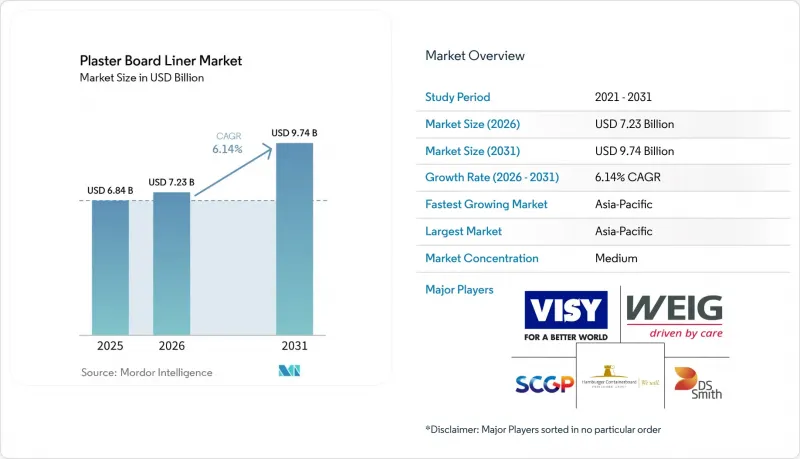
根據 Mordor Intelligence 預測,石膏板襯裡市場規模預計在 2025 年達到 68.4 億美元,到 2026 年成長至 72.3 億美元,到 2031 年成長至 97.4 億美元,在預測期(2026-2031 年)內預計複合成長率 6.14%。
本報告按類型(石膏板襯墊的表面和背襯材料)、材料(再生纖維、原生纖維等)、應用(牆體/隔間、天花板等)和地區(亞太地區、北美地區、歐洲地區、南美地區、中東和非洲地區)進行細分。市場預測以美元計價。
全球石膏板襯裡市場趨勢及洞察
輕質石膏板施工方法的推廣
輕質石膏板系統的普及對性能提出了更高的要求,即其抗張強度必須高於標準襯板。更輕的板材需要更高的尺寸穩定性和更強的黏結力,同時也要降低體積重量。這些因素共同推動了對基紙張重量控制更精確的工程襯板的需求。輕質板材在結構荷載受限的維修工程中尤其重要。在這些項目中,乾式施工方法更受青睞,因為它可以減輕現有建築結構的負擔。因此,隨著板材製造商透過採用輕質設計來豐富產品差異化,石膏板襯板市場將從中受益。
某些輕質配方已被證明可使板材重量減輕20%至30%。中空微球骨材是市售板材設計中所採用的一種方法。這些變化凸顯了板材表面及石膏芯周圍襯紙性能的重要性。面紙必須能夠直接進行表面處理,並在整個生產過程中保持穩定的黏合力。即使板材重量減輕,背襯紙也必須保持與芯材的黏合力。這為能夠在不增加材料用量的情況下滿足技術規範的供應商創造了新的商機。
板材製造商可以利用輕量產品滿足住宅翻新、租戶維修和公共建築維修。與新建結構工程相比,這些項目的限制通常較少。項目性質的變化可能會增加對強度和表面性能更佳的襯紙的需求。板材創新與襯紙選擇之間的連結也將更加緊密。擁有測試能力和穩定纖維來源的供應商能夠更好地應對這些變化。隨著技術性能成為一項規範要求,而不僅僅是購買通用紙張,襯紙市場的價值將會增加。
對可回收和低碳建築材料的需求日益成長
再生纖維是石膏板襯紙生產的核心,它平衡了資源回收與建築業永續性的要求。再生紙漿佔全球石膏板襯紙纖維投入量的58%,每年可減少超過180萬噸廢紙掩埋。這些數據清楚地展現了再生纖維在石膏板襯紙市場中的重要角色。然而,由於回收原料的品質會因廢紙種類而異,製造商仍需品管。襯紙級纖維需要具備穩定的強度、成型性和表面性能,以確保板材生產的可靠性。
2026年發表於《科學報告》(Scientific Reports)期刊的一項研究表明,再生紙纖維能夠改變石膏複合材料的斷裂行為,使其由脆性轉變為韌性。研究報告稱,測試複合材料的承載能力得到了顯著提升,其效果與玻璃纖維增強材料相當。這項發現解決了長期以來人們對高再生材料性能的擔憂,並支持在需要機械可靠性的產品設計中使用再生纖維。此外,它還提升了能夠有效清洗、分類和混合回收材料的造紙廠的商業性價值。因此,只要透過製程控制確保功能性能,石膏板襯裡市場就能從再生材料含量的提升中獲益。
在歐洲,再生石膏和循環材料流的重要性日益凸顯。一家法國石膏板製造商計劃在2025年回收23.7萬噸石膏廢棄物,年增15%,並接近39.5萬噸的處理上限。這些趨勢使得襯板採購成為更廣泛的循環建築體系的一部分。買家越來越要求提供文件,證明產品的再生材料含量、可回收性和生命週期性能。這項要求有利於那些擁有可追溯纖維系統和可靠環境產品資訊的供應商。
再生紙價格波動與能源成本
原料成本波動一直是襯紙製造商面臨的持續挑戰。再生纖維紙的原料68%依賴天然氣。 2025年第二季歐洲天然氣價格較2024年第二季上漲了18%。能源價格波動會同時影響製漿、乾燥和運輸成本。此外,回收率的變化以及紙板需求的競爭也會導致再生纖維成本的快速波動。對於缺乏有效採購管理系統的供應商而言,這些波動使得定價和利潤率管理變得困難。
每兆瓦時電價上漲10歐元,受影響較大的紙張類型,其變動生產成本可能每噸上漲高達20歐元。此類商業風險會影響產能、品管系統以及產品研發投資能力。生產商可能會尋求能源價格對沖合約或提高工廠營運效率來減輕這種影響。然而,並非所有公司的規模或合約地位都相同。如果成本飆升,小規模的通用供應商可能面臨更大的壓力。因此,襯紙市場仍然對投入成本管理和建築需求都非常敏感。
再生紙漿的供應是造紙廠面臨的另一個大不確定性因素。北美瓦楞紙板產能將於2025年下降,導致再生紙漿供應趨緊,廢舊瓦楞紙板(OCC)價格波動加劇。面紙生產商正與其他紙張和包裝級紙品生產商爭奪有限的原料。此外,纖維品質也可能存在差異,尤其是在回收系統不堪重負的情況下。如果沒有先進的分類和清洗技術,提高再生紙含量的目標可能難以實現。這使得擁有完善回收網路和技術加工能力的綜合供應商更具優勢。
細分市場分析
預計到2025年,石膏板襯紙面層紙將佔據55.56%的市場佔有率,並預計到2031年將以6.83%的複合年成長率成長。面層紙佔據如此重要的市場佔有率,是因為每塊石膏板都需要面層紙和背襯紙。此外,面層紙本身也具有裝飾作用,因此面層品質是影響其商業性的重要因素。面層紙的抗張強度超過7 kN/m,高於標準等級的5.8 kN/m。為了滿足這項要求,可能需要採用多層牛皮紙工藝和更嚴格的紙張重量公差。這些不斷提高的技術要求正在推動石膏板襯紙市場轉型為工程面層紙。
防火、隔音和防潮板材的出現,拓展了高規格面紙的應用範圍。板材製造商正利用面紙層來提升成品質量,並使產品脫穎而出。美國國家石膏公司(National Gipsum)的「2025 EVOLVE」系列,在所有三種規格中均採用100%再生紙作為面紙,其中包括防黴防潮產品。這個例子表明,面紙的選擇如何成為板材產品提案中不可或缺的一部分。因此,面紙在整個行業中扮演著主導的角色,並為更高價值規格的板材鋪平了道路。
雖然石膏板的襯紙(即底紙)不如正面紙那麼引人注目,但它在技術上仍然至關重要。為了減輕紙張重量意味著減少纖維用量,但同時也提高了對強度和機械性能一致性的要求。隨著板材製造商在不影響產品可靠性的前提下努力減輕重量,襯紙供應商的角色依然舉足輕重。
區域分析
預計到2025年,亞太地區將佔全球石膏板襯墊市場的45.31%,並在2031年之前以7.12%的複合年成長率成長。中國的高密度都市區和印度常規建築的擴張是該地區的主要成長要素。印度的強制性標誌和中國的甲醛釋放限制正在推動認證襯墊產品的市場需求成長。缺乏品質保證記錄的供應商在指定板材項目中可能面臨更激烈的訂單競爭。因此,在強勁的基本需求和不斷提高的產品保固要求的雙重支撐下,亞太地區石膏板襯墊市場規模的成長得益於板材產能的擴大和認證產品應用的日益普及。
北美和歐洲合計構成第二大需求區域,其需求趨勢與房屋翻新活動和監管主導的優質化密切相關。美國每年的維修和維修支出超過4000億美元,即使住宅開工量放緩,也支撐著石膏板更換和室內維修。歐洲市場在全球襯墊價值鏈中擁有最高的再生材料含量,這使得具有再生纖維加工能力、技術性能穩定且擁有環保認證的供應商更具優勢。
法國預計2025年回收23.7萬噸再生石膏,比前一年增加15%。德國計劃在2038年逐步淘汰煤炭,這將減少排煙脫硫(FGD石膏)的供應,而FGD石膏此前一直是重要的原料來源。這種情況促使人們更加關注循環材料系統和可追溯的原料供應。環境產品聲明(EPD)可能會影響歐洲公共部門競標的參與情況,而擁有可靠數據和回收網路的襯裡製造商在這種採購模式下處於有利地位。
南美洲、中東和非洲是受建築項目主導的需求區域,但國內襯板產量有限。隨著巴西石膏板市場的擴張,乾式安裝方法逐漸取代傳統的濕式安裝方法,為南美地區創造了新的機會。聖戈班正在巴伊亞州費拉迪桑塔納投資興建新的生產線,建成後產能將提升75%,成為拉丁美洲最大的石膏板生產基地。這項投資凸顯了本地石膏板產能對襯板需求的重要性。如果新工廠需要可靠的紙張原料和技術支持,區域供應商也將從中受益。
其他好處:
- Excel格式的市場預測(ME)表
- 3個月的分析師支持
目錄
第1章:引言
- 研究假設和市場定義
- 調查範圍
第2章:調查方法
第3章執行摘要
第4章 市場狀況
- 市場概覽
- 市場促進因素
- 輕質石膏板結構的普及
- 對可回收和低碳建築材料的需求日益成長
- 擴大防火隔音板的規格範圍
- 加速翻新和室內維修活動
- 石膏板生產商整合了自有品牌襯墊的供應。
- 市場限制因素
- 再生紙價格和能源成本的波動
- 建築週期對住宅量的敏感度
- 添加再生纖維及其性能差異
- 價值鏈分析
- 波特五力分析
第5章 市場規模與成長預測
- 按類型
- 石膏板襯裡裡面
- 石膏板襯裡背面
- 材料
- 再生纖維
- 原生纖維基
- 混合纖維基料
- 其他
- 透過使用
- 牆壁和隔間
- 天花板
- 其他(覆材、隔音材質、裝飾及特殊用途)
- 按地區
- 亞太地區
- 中國
- 印度
- 日本
- 韓國
- 東南亞國協
- 其他亞太國家
- 北美洲
- 美國
- 加拿大
- 墨西哥
- 歐洲
- 德國
- 英國
- 法國
- 義大利
- 北歐國家
- 其他歐洲國家
- 南美洲
- 巴西
- 阿根廷
- 其他南美國家
- 中東和非洲
- 沙烏地阿拉伯
- 南非
- 其他中東和非洲國家
- 亞太地區
第6章 競爭情勢
- 市場集中度
- 策略趨勢
- 市佔率和排名分析
- 公司簡介
- Alier SA
- ASIA PAPER MFG.CO.,LTD
- DS Smith
- Gulf Ply
- INDEVCO Paper Making
- National Gypsum Services Company
- PABCO Gypsum
- Republic Paperboard Company, LLC
- Saint-Gobain
- SCG PACKAGING
- Sure Paper Co., Ltd.
- Visy
- W. Hamburger GmbH
- WEIG Group
- Yoshino Gypsum Co., Ltd.
第7章 市場機會與未來展望
According to Mordor Intelligence, the plaster board liner market size was estimated at USD 6.84 billion in 2025 and is estimated to grow from USD 7.23 billion in 2026 to USD 9.74 billion by 2031, at a CAGR of 6.14% during the forecast period (2026-2031).
This report is Segmented by Type (Plasterboard Liner Face and Plasterboard Liner Back), Material (Recycled Fiber-Based, Virgin Fiber-Based, and More), Application (Walls and Partitions, Ceilings, and More), and Geography (Asia-Pacific, North America, Europe, South America, and Middle-East and Africa). The Market Forecasts are Provided in Terms of Value (USD).
Global Plaster Board Liner Market Trends and Insights
Expansion of Lightweight Drywall Construction
The shift toward lightweight gypsum board systems raises performance requirements beyond standard liner tensile strength. Lower board weight requires greater dimensional stability and stronger bonding at reduced grammage. This combination supports demand for engineered face papers with tighter control over basis weight. Lightweight boards are especially relevant in renovation projects with structural load limits. Such projects favor dry construction because it reduces pressure on existing building structures. The plasterboard liner market, therefore, benefits when board makers use lightweight designs to differentiate their products.
Panel-weight reductions of 20% to 30% have been recorded in certain lightweight formulations. Hollow-microsphere aggregates represent one approach used in commercial board designs. These changes increase the importance of liner performance at the board surface and around the gypsum core. Face paper must support direct decoration while maintaining consistent adhesion during manufacture. The back paper must continue to support core adhesion even where board weight is reduced. This creates opportunities for suppliers that can meet technical specifications without unnecessarily increasing material use.
Board makers can use lightweight products in residential upgrades, tenant improvements, and institutional refurbishment. These projects often face restrictions that are less relevant in new-build shell construction. A change in project mix can lift demand for liner grades with improved strength and surface characteristics. It also creates a stronger link between board innovation and liner selection. Suppliers with testing capability and stable fiber inputs are better positioned to respond. The liner market gains value when technical performance becomes a specified requirement rather than a generic paper purchase.
Rising Demand for Recycled and Low-Carbon Building Materials
Recycled fiber has become central to liner production because it aligns material recovery with building sustainability requirements. Recycled pulp represented 58% of global gypsum-facing paper fiber input, diverting more than 1.8 million tons of waste paper from landfills each year. These figures illustrate the role of recovered fiber in the plasterboard liner market. Producers must still control fiber quality because recycled furnish can vary across collection streams. Liner grades require consistent strength, formation, and surface properties to ensure reliable board production.
A 2026 Scientific Reports study found that recycled paper fibers changed the fracture behavior of gypsum composites from brittle to ductile. The study reported improved load resistance comparable to that of glass-fiber reinforcement in the tested composites. This evidence addresses a longstanding performance concern regarding the use of high-recycled-content materials. It supports the use of recovered fiber where product designs require mechanical reliability. It also reinforces the commercial value of mills capable of effectively cleaning, sorting, and blending recovered inputs. The plasterboard liner market can therefore benefit from recycled content when process control protects functional performance.
The growing importance of recycled gypsum and circular material flows in Europe is highlighted by French plasterboard manufacturers reintegrating 237,000 tons of gypsum waste in 2025, reflecting a 15% year-over-year increase toward a processing ceiling of 395,000 tons. These developments place liner procurement within a wider circular construction system. Buyers increasingly require documentation showing recycled content, recyclability, and lifecycle performance. This requirement favors suppliers with traceable fiber systems and credible environmental product information.
Volatility in Recovered Paper and Energy Costs
Input cost volatility is a persistent challenge for liner manufacturers. Recycled-fiber paper grades have a 68% dependence on natural gas. European natural gas prices rose 18% in the second quarter of 2025 compared with the second quarter of 2024. Energy price changes can affect pulping, drying, and transport costs simultaneously. Recovered fiber costs can also move quickly when collection rates or competing board demand change. These movements make pricing and margin management difficult for suppliers without effective purchasing controls.
Each EUR 10 per MWh increase could add up to EUR 20 per ton in variable production costs for highly exposed grades. This operational exposure affects the ability to invest in capacity, quality systems, and product development. Producers may seek hedged energy contracts or more efficient mill operations to reduce this effect. However, not every company has the same scale or contracting position. Smaller merchant suppliers can face greater pressure when costs rise rapidly. The liner market, therefore, remains sensitive to both input cost management and construction demand.
Recovered fiber availability is another source of uncertainty for mills. North American containerboard capacity closures in 2025 tightened recovered-fiber supply and increased Old Corrugated Containers (OCC) price swings. Liner producers compete with other paper and packaging grades for usable material. Fiber quality also varies, especially when collection systems are under pressure. Higher recycled-content targets can become harder to meet without advanced sorting and cleaning. This creates an advantage for integrated suppliers with established recovery networks and technical processing capability.
Other drivers and restraints analyzed in the detailed report include:
- Growth of Fire-Rated and Acoustic Board Specifications
- Accelerating Renovation and Interior Retrofit Activity
- Construction-Cycle and Housing-Start Sensitivity
For complete list of drivers and restraints, kindly check the Table Of Contents.
Segment Analysis
Plasterboard liner face paper held 55.56% of the plasterboard liner market share in 2025 and is projected to grow at a 6.83% CAGR through 2031. Each gypsum board requires a face sheet and a back sheet, which supports the basic share position of face paper. Face paper also serves as direct decoration, making surface quality commercially important. Face paper tensile strength exceeded 7 kN/m, compared with 5.8 kN/m for standard grades. This requirement can call for multilayer kraft technology and tighter basis-weight tolerances. Higher technical requirements support the shift toward engineered face paper grades in the plasterboard liner market.
Fire-rated, acoustic, and moisture-resistant boards expand the use of high-specification face paper. Board makers use the outer paper layer to support finish quality and product differentiation. National Gypsum's 2025 EVOLVE line uses 100% recycled paper encasing across three variants, including a mold- and moisture-resistant product. This example shows how liner selection can form part of a board's product proposition. Face paper, therefore, combines shared leadership with a path toward higher-value specifications.
Plasterboard liner back paper remains technically important despite receiving less attention than face paper. Back paper is increasingly specified at reduced grammage to contain board weight. It must preserve core adhesion while supporting a lighter finished board. This creates a separate development path for suppliers serving back paper grades. Reduced grammage can lower fiber use but also increases requirements for consistent strength and machine performance. Back paper suppliers remain relevant as board makers seek to reduce weight without compromising product reliability.
Complete Report Scope:
- By Type
- Plasterboard Liner Face
- Plasterboard Liner Back
- By Material
- Recycled Fiber-Based
- Virgin Fiber-Based
- Mixed Fiber-Based
- Others
- By Application
- Walls and Partitions
- Ceilings
- Others (External Sheathing, Acoustic Assemblies, Decorative and Specialty Applications)
- By Geography
- Asia-Pacific
- China
- India
- Japan
- South Korea
- ASEAN Countries
- Rest of Asia-Pacific
- North America
- United States
- Canada
- Mexico
- Europe
- Germany
- United Kingdom
- France
- Italy
- NORDIC Countries
- Rest of Europe
- South America
- Brazil
- Argentina
- Rest of South America
- Middle-East and Africa
- Saudi Arabia
- South Africa
- Rest of Middle-East and Africa
- Asia-Pacific
Geography Analysis
Asia-Pacific held 45.31% of the plasterboard liner market share in 2025 and is forecast to grow at a 7.12% CAGR through 2031. China's urban densification and India's formal construction expansion are key regional drivers. Indian marking mandates and Chinese formaldehyde emission limits are shaping procurement toward certified liner products. Suppliers without verified quality records may find it harder to compete for specified board programs. Asia-Pacific, therefore, combines high base demand with growing product assurance requirements. The plasterboard liner market size in the region is supported by growth in board capacity and wider adoption of certified products.
North America and Europe form the second-largest combined demand area, with a demand profile more closely linked to renovation activity and regulatory-driven premiumization. U.S. improvement and repair spending exceeds USD 400 billion annually, supporting drywall replacement and interior upgrades even when housing starts soften. European markets have the highest recycled-content intensity in the global liner value chain, favoring suppliers with recovered-fiber capability, stable technical performance, and environmental documentation.
France reintegrated 237,000 tons of secondary gypsum material in 2025, representing a 15% year-over-year increase. Germany's coal phase-out by 2038 is reducing the availability of flue gas desulfurization (FGD) gypsum, a historically significant input source. These conditions are increasing attention to circular material systems and traceable input supplies. Environmental product declarations can influence access to public-sector tenders across European markets, and liner producers with credible data and recycling links are better positioned for this procurement approach.
South America, the Middle-East, and Africa are construction-program-led demand areas with limited domestic liner production. Brazil's drywall expansion is creating opportunities in South America as dry construction systems replace traditional wet methods. Saint-Gobain is investing in a new production line in Feira de Santana, Bahia, designed to increase capacity by 75% and become Latin America's largest drywall facility upon completion. This investment underscores the importance of local board capacity for liner demand. Regional suppliers may benefit where new board plants require reliable paper inputs and technical support.
- Alier S.A.
- ASIA PAPER MFG.CO.,LTD
- DS Smith
- Gulf Ply
- INDEVCO Paper Making
- National Gypsum Services Company
- PABCO Gypsum
- Republic Paperboard Company, LLC
- Saint-Gobain
- SCG PACKAGING
- Sure Paper Co., Ltd.
- Visy
- W. Hamburger GmbH
- WEIG Group
- Yoshino Gypsum Co., Ltd.
Additional Benefits:
- The market estimate (ME) sheet in Excel format
- 3 months of analyst support
TABLE OF CONTENTS
1 Introduction
- 1.1 Study Assumptions and Market Definition
- 1.2 Scope of the Study
2 Research Methodology
3 Executive Summary
4 Market Landscape
- 4.1 Market Overview
- 4.2 Market Drivers
- 4.2.1 Expansion of Lightweight Drywall Construction
- 4.2.2 Rising Demand for Recycled and Low-Carbon Building Materials
- 4.2.3 Growth of Fire-Rated and Acoustic Board Specifications
- 4.2.4 Accelerating Renovation and Interior Retrofit Activity
- 4.2.5 Captive Liner Supply Integration by Gypsum Board Producers
- 4.3 Market Restraints
- 4.3.1 Volatility in Recovered Paper and Energy Costs
- 4.3.2 Construction-Cycle and Housing-Start Sensitivity
- 4.3.3 Recycled-Fiber Contamination and Performance Variability
- 4.4 Value Chain Analysis
- 4.5 Porter's Five Forces Analysis
- 4.5.1 Threat of New Entrants
- 4.5.2 Bargaining Power of Suppliers
- 4.5.3 Bargaining Power of Buyers
- 4.5.4 Threat of Substitutes
- 4.5.5 Competitive Rivalry
5 Market Size and Growth Forecasts (Value)
- 5.1 By Type
- 5.1.1 Plasterboard Liner Face
- 5.1.2 Plasterboard Liner Back
- 5.2 By Material
- 5.2.1 Recycled Fiber-Based
- 5.2.2 Virgin Fiber-Based
- 5.2.3 Mixed Fiber-Based
- 5.2.4 Others
- 5.3 By Application
- 5.3.1 Walls and Partitions
- 5.3.2 Ceilings
- 5.3.3 Others (External Sheathing, Acoustic Assemblies, Decorative and Specialty Applications)
- 5.4 By Geography
- 5.4.1 Asia-Pacific
- 5.4.1.1 China
- 5.4.1.2 India
- 5.4.1.3 Japan
- 5.4.1.4 South Korea
- 5.4.1.5 ASEAN Countries
- 5.4.1.6 Rest of Asia-Pacific
- 5.4.2 North America
- 5.4.2.1 United States
- 5.4.2.2 Canada
- 5.4.2.3 Mexico
- 5.4.3 Europe
- 5.4.3.1 Germany
- 5.4.3.2 United Kingdom
- 5.4.3.3 France
- 5.4.3.4 Italy
- 5.4.3.5 NORDIC Countries
- 5.4.3.6 Rest of Europe
- 5.4.4 South America
- 5.4.4.1 Brazil
- 5.4.4.2 Argentina
- 5.4.4.3 Rest of South America
- 5.4.5 Middle-East and Africa
- 5.4.5.1 Saudi Arabia
- 5.4.5.2 South Africa
- 5.4.5.3 Rest of Middle-East and Africa
- 5.4.1 Asia-Pacific
6 Competitive Landscape
- 6.1 Market Concentration
- 6.2 Strategic Moves
- 6.3 Market Share (%)/Ranking Analysis
- 6.4 Company Profiles (includes Global Overview, Market Overview, Core Segments, Financials as available, Strategic Information, Products and Services, and Recent Developments)
- 6.4.1 Alier S.A.
- 6.4.2 ASIA PAPER MFG.CO.,LTD
- 6.4.3 DS Smith
- 6.4.4 Gulf Ply
- 6.4.5 INDEVCO Paper Making
- 6.4.6 National Gypsum Services Company
- 6.4.7 PABCO Gypsum
- 6.4.8 Republic Paperboard Company, LLC
- 6.4.9 Saint-Gobain
- 6.4.10 SCG PACKAGING
- 6.4.11 Sure Paper Co., Ltd.
- 6.4.12 Visy
- 6.4.13 W. Hamburger GmbH
- 6.4.14 WEIG Group
- 6.4.15 Yoshino Gypsum Co., Ltd.
7 Market Opportunities and Future Outlook
- 7.1 White-Space and Unmet-Need Assessment

 歐洲石膏板:市場佔有率分析、產業趨勢與統計、成長預測(2026-2031)石膏板襯紙:市場佔有率分析、產業趨勢與統計、成長預測(2026-2031)中東和非洲石膏板市場:市場佔有率分析、行業趨勢和統計數據以及成長預測(2026-2031 年)亞太地區石膏板市場:市場佔有率分析、產業趨勢與統計及成長預測(2026-2031)
 石膏板市場:全球市場預測(2026-2032年)石膏板:市場佔有率分析、產業趨勢與統計、成長預測(2026-2031)石膏板市場-2026-2032年全球市場預測
 石膏板市場規模、佔有率和成長分析:按產品類型、最終用途、分銷管道、厚度、表面處理和地區分類-2026-2033年產業預測
 石膏板市場-全球產業規模、佔有率、趨勢、機會、預測:按類型、厚度、應用、地區和競爭格局分類,2021-2031年
 2026年全球石膏板懸吊天花板市場報告