


 |
市場調查報告書
商品編碼
2114380
亞太地區石膏板市場:市場佔有率分析、產業趨勢與統計及成長預測(2026-2031)Asia-Pacific Gypsum Board - Market Share Analysis, Industry Trends & Statistics, Growth Forecasts (2026 - 2031) |
||||||

※ 本網頁內容可能與最新版本有所差異。詳細情況請與我們聯繫。
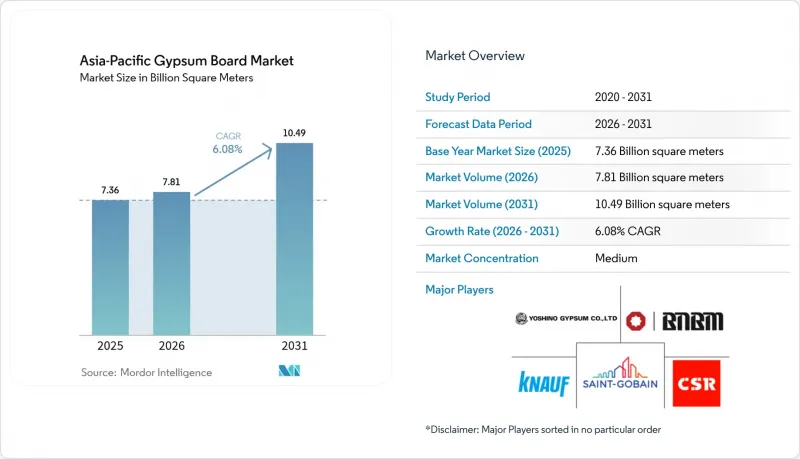
據 Mordor Intelligence 稱,亞太地區石膏板市場預計到 2026 年將達到 78.1 億平方公尺,高於 2025 年的 73.6 億平方公尺,預計到 2031 年將達到 104.9 億平方公尺。
預計 2026 年至 2031 年的複合年成長率為 6.08%。
本報告按板材類型(牆板、天花板板、預裝飾板及其他)、厚度(1/2英寸、5/8英寸及其他)、最終用途建築類型(住宅、商業、公共、工業)和地區(中國、印度、日本、韓國、泰國、菲律賓、越南及其他)進行細分。市場預測以體積(平方公尺)為單位。
亞太地區石膏板市場趨勢及洞察
快速的都市化與住宅建設熱潮
在中國、印度、越南和印度尼西亞,城市人口每年持續成長數百萬,由此產生的多用戶住宅需求推動了室內隔間用石膏板的大規模採購。開發商傾向於採用標準化的石膏板系統,因為它們可以減輕結構荷載,並縮短逐層施工的工期。中國城市的地方政府優先考慮垂直密度的提升,而非無序的水平擴張,需求主要集中在交通樞紐附近,因為這些區域需要防火牆體結構。胡志明市和雅加達也出現了類似的高層建築開發趨勢,在這些城市,快速建造的高層公寓縮短了工期,以應對不斷飆升的地價。隨著建築商逐步淘汰勞動密集的砌磚工藝以緩解熟練抹灰工的短缺,石膏板的應用也日益普及。長期人口預測表明,人口將持續向郊區遷移,這將支撐亞太地區石膏板市場的穩定成長。
政府主導的低收入住宅和基礎設施發展計劃
在中國和印度,政府資助的低成本住宅配套計畫確保了即使商業地產週期放緩,也能保證一定數量的住宅開工使用通用石膏板。補貼計畫通常會設定每平方公尺材料成本的上限,迫使供應商簡化生產和物流流程。雖然預算上限限制了高檔飾面材料的供應,但安全標準強制要求在走廊、樓梯間和潮濕區域使用防火防潮板。綠建築要求規定,2025年後中國所有新計畫必須至少達到ESGB系統的一星級標準,這推動了對符合成本上限的低排放配方產品的需求。在泰國和菲律賓,與疫情後復甦相關的經濟獎勵策略正在加速學校和醫院計畫指定使用經認證的石膏解決方案。
在潮濕氣候下容易受潮發黴
在吉隆坡,大部分月份的平均相對濕度都超過80%,在這種濕度下,未經處理的石膏很容易吸收水蒸氣,從而促進黴菌滋生。出於對室內空氣品質的擔憂,東南亞的一些開發商開始指定使用氧化鎂板或水泥板來建造浴室和廚房,從而減少了對標準石膏產品的需求。製造商正在嘗試使用防水添加劑和玻璃纖維表面材料,但由於其成本高且安裝難度高,難以在低成本住宅中廣泛應用。這些不利因素在全部區域普遍存在,例如漫長的季風季節和不穩定的電力供應,這些都會阻礙水分的排出。
細分市場分析
隨著日本和澳洲大都會圈的翻新工程加速推進,預計到2031年,預裝飾石膏板的複合年成長率將達到6.78%。到2025年,牆板將佔亞太地區石膏板市場佔有率的39.62%,成為大規模住宅和辦公大樓建設的基礎材料。天花板則受益於開放式校園日益成長的聲學需求,而防潮板在酒店業的衛生間中也越來越受歡迎。
數位印刷覆膜和UV固化塗層的技術進步使得工廠預製的石膏板表面能夠承受租戶更迭帶來的磨損。承包商可以減少現場所需的專業工種數量,並最大限度地減少因交貨前缺陷修正而造成的延誤,這一優勢足以抵消單塊石膏板30-40%的溢價。諸如抗衝擊、含鉛和防黴等特種板材,滿足了醫院和資料中心等細分市場的需求,為亞太石膏板市場的供應商拓展了收入來源。
其他好處
- Excel格式的市場預測(ME)表
- 3個月的分析師支持
目錄
第1章:引言
- 研究假設和市場定義
- 調查範圍
第2章:調查方法
第3章執行摘要
第4章 市場狀況
- 市場概覽
- 市場促進因素
- 快速的都市化與住宅建設熱潮
- 政府主導的經濟適用住宅和基礎設施發展計劃
- 採用輕型乾式施工方法
- 對具有節能和防火性能的內部裝潢建材的需求
- 翻新工程顯著增加
- 市場限制因素
- 在潮濕氣候下容易受潮發黴
- 石膏價格波動和能源成本
- 潛在替代品帶來的競爭
- 價值鏈分析
- 波特五力模型
- 價格分析
第5章 市場規模與成長預測
- 依電路板類型
- 牆板
- 天花板
- 預裝飾板
- 其他
- 按厚度
- 1/2 英寸
- 5/8 英寸
- 其他
- 依最終用途建築類型分類
- 住宅
- 商業
- 公共設施
- 產業
- 按地區
- 中國
- 印度
- 日本
- 韓國
- 泰國
- 菲律賓
- 越南
- 印尼
- 馬來西亞
- 澳洲和紐西蘭
- 亞太其他地區
第6章 競爭情勢
- 市場集中度
- 策略趨勢
- 市佔率和排名分析
- 公司簡介
- Beijing New Building Material(BNBM)
- China National Building Material(CNBM)
- CHIYODA UTE Co., Ltd.
- CSR Ltd
- Eagle Materials Inc.
- Etex Group
- Georgia-Pacific Gypsum LLC
- India Gypsum Pvt Ltd
- Jason Plasterboard(Jiaxing)Co. Ltd
- KCC Corporation
- Knauf Group
- National Gypsum Co.(Saudi)
- Saint-Gobain
- Taishan Gypsum Co., Ltd.
- United Mining Industries
- USG Boral
- VANS Gypsum
- Yoshino Gypsum Co., Ltd.
第7章 市場機會與未來展望
According to Mordor Intelligence, Asia-Pacific gypsum board market size in 2026 is estimated at 7.81 billion square meters, growing from 2025 value of 7.36 billion square meters with 2031 projections showing 10.49 billion square meters, growing at 6.08% CAGR over 2026-2031.
This report is Segmented by Board Type (Wall Board, Ceiling Board, Pre-Decorated Board, and Others), Thickness (1/2-inch, 5/8-inch, and Other Thicknesses), End-Use Building Type (Residential, Commercial, Institutional, and Industrial), and Geography (China, India, Japan, South Korea, Thailand, Philippines, Vietnam, and More). The Market Forecasts are Provided in Terms of Volume (Square Meters).
Asia-Pacific Gypsum Board Market Trends and Insights
Rapid Urbanization and Residential Construction Boom
China, India, Vietnam, and Indonesia continue to add millions of urban residents every year, and the resulting demand for multifamily housing sustains bulk procurement of gypsum board for interior partitions. Developers prefer standardized dry-wall systems because they cut structural loads and accelerate floor turnover. Local authorities in secondary Chinese cities promote vertical density rather than horizontal sprawl, concentrating demand around transit hubs that rely on fire-rated wall assemblies. Similar verticalization appears in Ho Chi Minh City and Jakarta, where quick-build apartment towers shorten delivery cycles amid land-price inflation. Gypsum board adoption benefits as contractors phase out labor-intensive brickwork to mitigate skilled-mason shortages. Long-term demographic forecasts point to continued migration into peri-urban zones, supporting steady volume growth in the Asia-Pacific gypsum board market.
Government-Led Affordable Housing and Infrastructure Programs
Public spending packages earmarked for low-cost housing in China and India guarantee a baseline of unit starts that consume commodity wallboard even when commercial real-estate cycles soften. Subsidy frameworks typically fix maximum material cost per square meter, forcing suppliers to optimize production and logistics efficiencies. While budget ceilings limit penetration of premium finishes, safety clauses require fire- and moisture-resistant panels in corridors, stairwells, and wet areas. Green building mandates that all new Chinese projects meet at least one star under the ESGB system from 2025 onward, raising demand for low-emission formulations that satisfy cost caps. In Thailand and the Philippines, stimulus packages linked to post-pandemic recovery accelerate school and hospital projects that specify certified gypsum solutions.
Susceptibility to Moisture and Mould in Humid Climates
Average relative humidity in Kuala Lumpur exceeds 80% for most months, a level at which untreated gypsum readily absorbs water vapor and supports mould colonies. Indoor air-quality concerns have led several Southeast Asian developers to specify magnesium-oxide panels or cement boards for bathrooms and kitchens, diverting demand from standard gypsum. Manufacturers respond with hydrophobic additives and fiberglass facers, yet price premiums and installation learning curves slow adoption in budget housing. Persistent monsoon seasons and intermittent power supply, which curtail de-humidification, sustain this restraint across tropical geographies.
Other drivers and restraints analyzed in the detailed report include:
- Adoption of Lightweight Dry-Construction Techniques
- Demand for Energy-Efficient and Fire-Resistant Interiors
- Volatile Gypsum and Energy Costs
For complete list of drivers and restraints, kindly check the Table Of Contents.
Segment Analysis
Pre-decorated boards captured 6.78% CAGR growth prospects through 2031 as renovation schedules tighten across metro Japan and Australia. Wall board retained 39.62% Asia-Pacific gypsum board market share in 2025, anchoring bulk residential and office builds. Ceiling boards benefit from heightened acoustic requirements in open-plan campuses, while moisture-resistant panels gain favor in hospitality restrooms.
Advances in digital-print laminates and UV-cured coatings enable factory finishes that withstand abrasion during tenant turnover. Contractors reduce trades on site and cut punch-list delays, an advantage that offsets panels' 30-40% higher unit price. Specialty boards-impact-resistant, lead-lined, or mold-inhibiting-address hospital and data-center niches, extending revenue diversity for suppliers active in the Asia-Pacific gypsum board market.
Complete Report Scope:
- By Board Type
- Wall Board
- Ceiling Board
- Pre-decorated Board
- Others
- By Thickness
- 1/2-inch
- 5/8-inch
- Other Thicknesses
- By End-use Building Type
- Residential
- Commercial
- Institutional
- Industrial
- By Geography
- China
- India
- Japan
- South Korea
- Thailand
- Philippines
- Vietnam
- Indonesia
- Malaysia
- Australia and New Zealand
- Rest of Asia-Pacific
List of Companies Covered in this Report:
- Beijing New Building Material (BNBM)
- China National Building Material (CNBM)
- CHIYODA UTE Co., Ltd.
- CSR Ltd
- Eagle Materials Inc.
- Etex Group
- Georgia-Pacific Gypsum LLC
- India Gypsum Pvt Ltd
- Jason Plasterboard (Jiaxing) Co. Ltd
- KCC Corporation
- Knauf Group
- National Gypsum Co. (Saudi)
- Saint-Gobain
- Taishan Gypsum Co., Ltd.
- United Mining Industries
- USG Boral
- VANS Gypsum
- Yoshino Gypsum Co., Ltd.
Additional Benefits:
- The market estimate (ME) sheet in Excel format
- 3 months of analyst support
TABLE OF CONTENTS
1 Introduction
- 1.1 Study Assumptions & Market Definition
- 1.2 Scope of the Study
2 Research Methodology
3 Executive Summary
4 Market Landscape
- 4.1 Market Overview
- 4.2 Market Drivers
- 4.2.1 Rapid urbanisation and residential construction boom
- 4.2.2 Government-led affordable-housing and infrastructure programs
- 4.2.3 Adoption of lightweight dry-construction techniques
- 4.2.4 Demand for energy-efficient and fire-resistant interiors
- 4.2.5 Notable growth in renovation projects
- 4.3 Market Restraints
- 4.3.1 Susceptibility to moisture and mould in humid climates
- 4.3.2 Volatile gypsum and energy costs
- 4.3.3 Competition from potential alternatives
- 4.4 Value Chain Analysis
- 4.5 Porter's Five Forces
- 4.5.1 Bargaining Power of Suppliers
- 4.5.2 Bargaining Power of Buyers
- 4.5.3 Threat of New Entrants
- 4.5.4 Threat of Substitutes
- 4.5.5 Degree of Competition
- 4.6 Price Analysis
5 Market Size and Growth Forecasts (Volume)
- 5.1 By Board Type
- 5.1.1 Wall Board
- 5.1.2 Ceiling Board
- 5.1.3 Pre-decorated Board
- 5.1.4 Others
- 5.2 By Thickness
- 5.2.1 1/2-inch
- 5.2.2 5/8-inch
- 5.2.3 Other Thicknesses
- 5.3 By End-use Building Type
- 5.3.1 Residential
- 5.3.2 Commercial
- 5.3.3 Institutional
- 5.3.4 Industrial
- 5.4 By Geography
- 5.4.1 China
- 5.4.2 India
- 5.4.3 Japan
- 5.4.4 South Korea
- 5.4.5 Thailand
- 5.4.6 Philippines
- 5.4.7 Vietnam
- 5.4.8 Indonesia
- 5.4.9 Malaysia
- 5.4.10 Australia and New Zealand
- 5.4.11 Rest of Asia-Pacific
6 Competitive Landscape
- 6.1 Market Concentration
- 6.2 Strategic Moves
- 6.3 Market Share(%)/Ranking Analysis
- 6.4 Company Profiles (includes Global level Overview, Market level overview, Core Segments, Financials as available, Strategic Information, Market Rank/Share for key companies, Products and Services, and Recent Developments)
- 6.4.1 Beijing New Building Material (BNBM)
- 6.4.2 China National Building Material (CNBM)
- 6.4.3 CHIYODA UTE Co., Ltd.
- 6.4.4 CSR Ltd
- 6.4.5 Eagle Materials Inc.
- 6.4.6 Etex Group
- 6.4.7 Georgia-Pacific Gypsum LLC
- 6.4.8 India Gypsum Pvt Ltd
- 6.4.9 Jason Plasterboard (Jiaxing) Co. Ltd
- 6.4.10 KCC Corporation
- 6.4.11 Knauf Group
- 6.4.12 National Gypsum Co. (Saudi)
- 6.4.13 Saint-Gobain
- 6.4.14 Taishan Gypsum Co., Ltd.
- 6.4.15 United Mining Industries
- 6.4.16 USG Boral
- 6.4.17 VANS Gypsum
- 6.4.18 Yoshino Gypsum Co., Ltd.
7 Market Opportunities and Future Outlook
- 7.1 White-space and Unmet-need Assessment

 歐洲石膏板:市場佔有率分析、產業趨勢與統計、成長預測(2026-2031)石膏板襯紙:市場佔有率分析、產業趨勢與統計、成長預測(2026-2031)石膏板襯裡:市場佔有率分析、行業趨勢和統計數據、成長預測(2026-2031)中東和非洲石膏板市場:市場佔有率分析、行業趨勢和統計數據以及成長預測(2026-2031 年)
 石膏板市場:全球市場預測(2026-2032年)石膏板:市場佔有率分析、產業趨勢與統計、成長預測(2026-2031)石膏板市場-2026-2032年全球市場預測
 石膏板市場規模、佔有率和成長分析:按產品類型、最終用途、分銷管道、厚度、表面處理和地區分類-2026-2033年產業預測
 石膏板市場-全球產業規模、佔有率、趨勢、機會、預測:按類型、厚度、應用、地區和競爭格局分類,2021-2031年
 2026年全球石膏板懸吊天花板市場報告