


 |
市場調查報告書
商品編碼
2117261
歐洲石膏板:市場佔有率分析、產業趨勢與統計、成長預測(2026-2031)Europe Gypsum Board - Market Share Analysis, Industry Trends & Statistics, Growth Forecasts (2026 - 2031) |
||||||

※ 本網頁內容可能與最新版本有所差異。詳細情況請與我們聯繫。
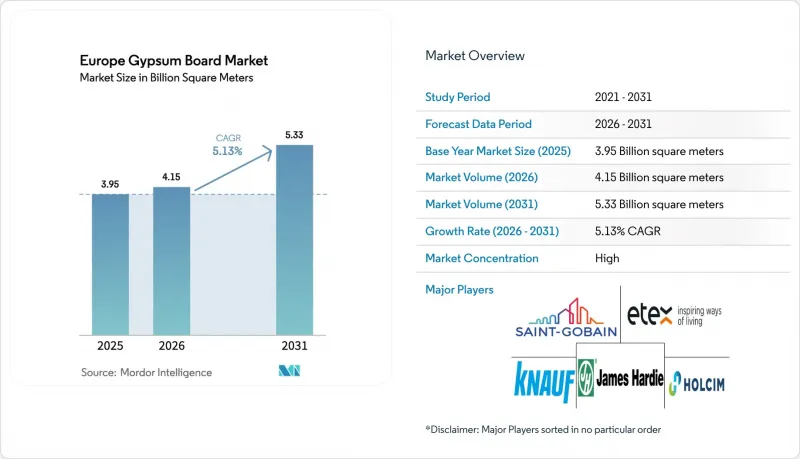
根據 Mordor Intelligence 預測,歐洲石膏板市場規模預計到 2025 年將達到 39.5 億平方公尺,到 2026 年將達到 41.5 億平方公尺,到 2031 年將達到 53.3 億平方公尺,2026 年至 2031 年的複合年成長率為 5.13%。
本報告按產品類型(牆板、天花板、預製板)、終端用戶產業(住宅、商業、公共、工業)和地區(德國、英國、法國、義大利、西班牙、北歐國家和其他歐洲國家)進行細分。市場預測以體積單位(平方公尺)表示。
歐洲石膏板市場趨勢與洞察
歐盟綠色新政下的維修獎勵
「翻新浪潮」計畫旨在2030年維修3,500萬棟建築,成員國須在2026年12月前提交最終的「國家建築維修計畫」。將補貼與生命週期全球暖化潛勢(GWP)上限掛鉤,正加速維修需求,因為業主試圖提前避免未來的處罰。德國5000億歐元的「氣候與轉型基金」清楚展現了公共資金的規模,但截至2024年11月,建築許可數量下降18.9%,顯示僅靠資金不足以促進私人住宅開工。計劃於2026年推出的交易成本降低措施(一站式服務和技術支援中心)預計將刺激小規模業主開展項目,這些項目通常以石膏板作為室內維修的主要材料。截至2024年11月,西班牙「復甦基金」的支出使建築產出年增9.8%,支持了「優先維修」的趨勢。到 2025 年,羅馬尼亞的建築投資將成長 21%,這凸顯了歐盟資金如何塑造國家層級的成長軌跡。
歐盟對輕質隔牆制定了更嚴格的防火和隔音標準
《建築能源性能指令》(EPBD) 的修正案強制要求成員國在更換隔牆時必須參考歐洲防火等級和 ISO 717 聲學基準值,並將性能要求納入所有維修工程。一些國家已經強制要求對整棟建築進行生命週期評估,冰島的目標是到 2030 年將碳排放量減少 43%,並以 A2 級輕質石膏系統作為標準。若要使用木板達到相同的防火和隔音性能,則需要更厚的結構,這會增加初始成本和內部碳含量。克瑙夫的多功能板材「GB-WRTX」代表了符合多項標準的整合產品的趨勢,但每增加一項認證,相關的測試成本就會增加,當地生產商難以承擔這筆費用。
標準板材在高濕度地區的防水性能脆弱性
標準板材吸水率超過自身重量的10%,導致沿海地區浴室和地下室三年內膨脹和黴菌滋生。儘管西班牙、義大利和希臘的建築規範中沒有強制性的H1標準,且保險理賠範圍不斷擴大,但防潮產品的普及率仍低於25%。根據Etex發布的2024年廢棄物數據,與潮濕相關的損壞造成了大量的更換,阻礙了循環經濟目標的實現。雖然這個問題目前僅限於特定地區,但其對聲譽的連鎖反應凸顯了石膏在潮濕環境中適用性的挑戰。
細分市場分析
預計到2025年,牆板將佔石膏板出貨量的61.28%,並預計在2031年之前以7.85%的年成長率持續成長。這表明,歐洲石膏板市場的擴張將繼續強烈偏向適用於維修的石膏板。由於新建辦公大樓的需求持續疲軟,天花板板材市場表現不佳。同時,除高收入的斯堪地那維亞國家和德國以外,預裝飾板材仍屬於小眾產品。製造商正日益專注於生產符合EPBD(歐洲建築能源性能指令)標準的保溫牆板,這些牆板集隔熱、防火和隔音功能於一體。牆板佔克瑙夫沃斯-蘇爾-梅爾工廠總產量的85%,充分體現了該細分市場的強勁成長動能。
儘管市場已趨於成熟,但牆板仍是歐洲石膏板市場的創新中心。預製牆體模組可減少40%的現場施工,這在時薪超過40歐元的地區至關重要。嵌入牆板的數位護照符合EPBD(環境影響評估指示)的記錄簿要求,並有助於在報廢後進行回收。天花板的改進主要集中在混合辦公空間的聲學調整上,但租戶決策緩慢阻礙了其發展。在需要採用單一技能室內裝修方案以縮短工期的建築項目中,預裝飾板材的需求日益成長。
其他好處:
- Excel格式的市場預測(ME)表
- 3個月的分析師支持
目錄
第1章:引言
- 研究假設和市場定義
- 調查範圍
第2章:調查方法
第3章執行摘要
第4章 市場狀況
- 市場概覽
- 市場促進因素
- 基於歐盟綠色新政的維修支援措施
- 歐盟對輕質隔牆的防火和隔音標準正變得越來越嚴格。
- 預製室內系統的快速普及
- 沿海地區擴大採用防潮防黴板材。
- 混合辦公模式正在推動可拆卸隔間牆的需求。
- 市場限制因素
- 高濕度地區標準基板因水分而變得脆弱
- 石膏和襯紙價格波動
- 新興的生物基牆板在永續發展領域引起了廣泛關注。
- 價值鏈分析
- 波特五力模型
第5章 市場規模與成長預測
- 依產品類型
- 牆板
- 天花板
- 預裝飾板
- 按最終用戶行業分類
- 住宅
- 商業的
- 公共機構
- 產業
- 按地區
- 德國
- 英國
- 法國
- 義大利
- 西班牙
- 北歐國家
- 其他歐洲國家
第6章 競爭情勢
- 市場集中度
- 策略趨勢
- 市佔率和排名分析
- 公司簡介
- BNBM
- CertainTeed, LLC
- Etex Group
- Georgia-Pacific
- Gyptec Iberica
- Holcim
- James Hardie Europe GmbH
- Knauf Group
- Mada Gypsum Company
- National Gypsum Services Company
- Pabco
- Pladur Gypsum, SAU
- Saint-Gobain
- SG RIGIPS
- VANS Gypsum
- Volma
- YOSHINO GYPSUM CO.,LTD.
第7章 市場機會與未來展望
According to Mordor Intelligence, the european gypsum board market size is projected to be 3.95 billion square meters in 2025, 4.15 billion square meters in 2026, and reach 5.33 billion square meters by 2031, growing at a CAGR of 5.13% from 2026 to 2031.
This report is Segmented by Product Type (Wall Board, Ceiling Board, and Pre-Decorated Board), End-User Industry (Residential, Commercial, Institutional, and Industrial), and Geography (Germany, United Kingdom, France, Italy, Spain, NORDIC Countries, and Rest of Europe). The Market Forecasts are Provided in Terms of Volume (Square Meters).
Europe Gypsum Board Market Trends and Insights
EU Green-Deal Backed Renovation Incentives
The Renovation Wave aims to upgrade 35 million buildings by 2030, with Member States obliged to submit final National Building Renovation Plans by December 2026. Tying subsidies to life-cycle global-warming-potential limits pulls retrofit demand forward as owners pre-empt future penalties. Germany's EUR 500 billion Climate and Transformation Fund illustrates the scale of public capital, yet its 18.9% drop in building permits through November 2024 shows that finance alone cannot lift private housing starts. Transaction-cost reductions-one-stop shops and technical-assistance centers-due in 2026 are expected to unlock small-owner projects where gypsum board dominates internal upgrades. Spain's Recovery Fund outlays already lifted construction output 9.8% year-on-year by November 2024, reinforcing the renovation-first dynamic. Romania's 21% jump in construction investment in 2025 underlines how EU funding determines country-level growth trajectories.
Stricter EU Fire and Acoustic Codes for Lightweight Partitions
The EPBD recast requires Member States to reference Euroclass fire ratings and ISO 717 acoustic thresholds when partitions are replaced, embedding performance mandates into every retrofit. Several countries already compel whole-building life-cycle assessments, and Iceland targets 43% emissions cut by 2030, making lightweight A2-rated gypsum systems the baseline. Achieving similar fire and acoustic performance with timber panels needs thicker assemblies that raise upfront cost and embodied carbon. Knauf's multi-attribute GB-WRTX board epitomizes the product drift toward bundled compliance, though each added certification inflates testing overheads that regional producers struggle to absorb.
Standard Boards' Water Vulnerability in High-Humidity Zones
Standard boards absorb more than 10% water by weight, causing swelling and mold within three years in coastal bathrooms and basements. Codes in Spain, Italy and Greece still lack mandatory H1 specifications, limiting moisture-resistant uptake to below 25% despite rising insurance exclusions. Etex's 2024 waste data show moisture failures drive substantial replacement tonnage, undercutting circularity goals. While the issue is geographically limited, reputational spillover challenges gypsum's suitability in any damp location.
Other drivers and restraints analyzed in the detailed report include:
- Rapid Uptake of Prefabricated Interior Systems
- Growing Adoption of Moisture- and Mold-Resistant Boards in Coastal Areas
- Volatility in Gypsum and Liner-Paper Prices
For complete list of drivers and restraints, kindly check the Table Of Contents.
Segment Analysis
Wall board accounted for 61.28% of deliveries in 2025 and is forecast to grow 7.85% annually to 2031, keeping the Europe gypsum board market size expansion solidly tilted toward retrofit-friendly formats. Ceiling board trails because office new-build remains muted, while pre-decorated board stays niche outside high-wage Scandinavia and Germany. Manufacturers increasingly favor insulated wall boards that combine thermal, fire and acoustic performance in one sheet, aligning with EPBD thresholds. Knauf's Fos-sur-Mer line produces 85% wall board, underscoring the segment's pull.
Despite maturity, wall board remains the innovation hub of the Europe gypsum board market. Prefabricated wall modules reduce on-site labor by 40%, critical where wage rates exceed EUR 40 hourly. Digital passports embedded in wall boards support EPBD logbook requirements, facilitating recycling at end-of-life. Ceiling board upgrades focus mainly on acoustic tuning for hybrid offices, yet delayed tenant decisions cap growth. Pre-decorated boards gain traction where construction programs demand single-trade interior packages to compress schedules.
Complete Report Scope:
- By Product Type
- Wall Board
- Ceiling Board
- Pre-decorated Board
- By End-User Industry
- Residential
- Commercial
- Institutional
- Industrial
- By Geography
- Germany
- United Kingdom
- France
- Italy
- Spain
- NORDIC Countries
- Rest of Europe
List of Companies Covered in this Report:
- BNBM
- CertainTeed, LLC
- Etex Group
- Georgia-Pacific
- Gyptec Iberica
- Holcim
- James Hardie Europe GmbH
- Knauf Group
- Mada Gypsum Company
- National Gypsum Services Company
- Pabco
- Pladur Gypsum, S.A.U.
- Saint-Gobain
- SG RIGIPS
- VANS Gypsum
- Volma
- YOSHINO GYPSUM CO.,LTD.
Additional Benefits:
- The market estimate (ME) sheet in Excel format
- 3 months of analyst support
TABLE OF CONTENTS
1 Introduction
- 1.1 Study Assumptions and Market Definition
- 1.2 Scope of the Study
2 Research Methodology
3 Executive Summary
4 Market Landscape
- 4.1 Market Overview
- 4.2 Market Drivers
- 4.2.1 EU Green-Deal Backed Renovation Incentives
- 4.2.2 Stricter EU Fire and Acoustic Codes for Lightweight Partitions
- 4.2.3 Rapid Uptake of Prefabricated Interior Systems
- 4.2.4 Growing Adoption of Moisture- and Mold-Resistant Boards in Coastal Areas
- 4.2.5 Hybrid-Work Boosts Demand for Demountable Walls
- 4.3 Market Restraints
- 4.3.1 Standard Boards' Water Vulnerability in High-Humidity Zones
- 4.3.2 Volatility in Gypsum and Liner-Paper Prices
- 4.3.3 Emerging Bio-Based Wall Panels Stealing Sustainability Mindshare
- 4.4 Value Chain Analysis
- 4.5 Porter's Five Forces
- 4.5.1 Bargaining Power of Suppliers
- 4.5.2 Bargaining Power of Buyers
- 4.5.3 Threat of New Entrants
- 4.5.4 Threat of Substitutes
- 4.5.5 Degree of Competition
5 Market Size and Growth Forecasts (Volume)
- 5.1 By Product Type
- 5.1.1 Wall Board
- 5.1.2 Ceiling Board
- 5.1.3 Pre-decorated Board
- 5.2 By End-User Industry
- 5.2.1 Residential
- 5.2.2 Commercial
- 5.2.3 Institutional
- 5.2.4 Industrial
- 5.3 By Geography
- 5.3.1 Germany
- 5.3.2 United Kingdom
- 5.3.3 France
- 5.3.4 Italy
- 5.3.5 Spain
- 5.3.6 NORDIC Countries
- 5.3.7 Rest of Europe
6 Competitive Landscape
- 6.1 Market Concentration
- 6.2 Strategic Moves
- 6.3 Market Share(%)/Ranking Analysis
- 6.4 Company Profiles {(includes Global level Overview, Market level overview, Core Segments, Financials as available, Strategic Information, Market Rank/Share for key companies, Products and Services, and Recent Developments)}
- 6.4.1 BNBM
- 6.4.2 CertainTeed, LLC
- 6.4.3 Etex Group
- 6.4.4 Georgia-Pacific
- 6.4.5 Gyptec Iberica
- 6.4.6 Holcim
- 6.4.7 James Hardie Europe GmbH
- 6.4.8 Knauf Group
- 6.4.9 Mada Gypsum Company
- 6.4.10 National Gypsum Services Company
- 6.4.11 Pabco
- 6.4.12 Pladur Gypsum, S.A.U.
- 6.4.13 Saint-Gobain
- 6.4.14 SG RIGIPS
- 6.4.15 VANS Gypsum
- 6.4.16 Volma
- 6.4.17 YOSHINO GYPSUM CO.,LTD.
7 Market Opportunities and Future Outlook
- 7.1 White-space and Unmet-need Assessment
- 7.2 Carbon-border-adjustment (CBAM) Favouring Low Footprint FGD Boards

 石膏板襯紙:市場佔有率分析、產業趨勢與統計、成長預測(2026-2031)石膏板襯裡:市場佔有率分析、行業趨勢和統計數據、成長預測(2026-2031)中東和非洲石膏板市場:市場佔有率分析、行業趨勢和統計數據以及成長預測(2026-2031 年)亞太地區石膏板市場:市場佔有率分析、產業趨勢與統計及成長預測(2026-2031)
 石膏板市場:全球市場預測(2026-2032年)石膏板:市場佔有率分析、產業趨勢與統計、成長預測(2026-2031)石膏板市場-2026-2032年全球市場預測
 石膏板市場規模、佔有率和成長分析:按產品類型、最終用途、分銷管道、厚度、表面處理和地區分類-2026-2033年產業預測
 石膏板市場-全球產業規模、佔有率、趨勢、機會、預測:按類型、厚度、應用、地區和競爭格局分類,2021-2031年
 2026年全球石膏板懸吊天花板市場報告