

 |
市場調查報告書
商品編碼
2118154
基於人工智慧的步行和移動能力分析:市場佔有率分析、行業趨勢和統計數據以及成長預測(2026-2031 年)AI-Powered Gait and Mobility Analytics - Market Share Analysis, Industry Trends & Statistics, Growth Forecasts (2026 - 2031) |
||||||

※ 本網頁內容可能與最新版本有所差異。詳細情況請與我們聯繫。
根據 Mordor Intelligence 預測,人工智慧驅動的步態和移動性分析市場預計將從 2025 年的 8.5 億美元成長到 2026 年的 9.4 億美元,然後在 2031 年達到 17.2 億美元,2026 年至 2031 年的複合年成長率為 12.85%。
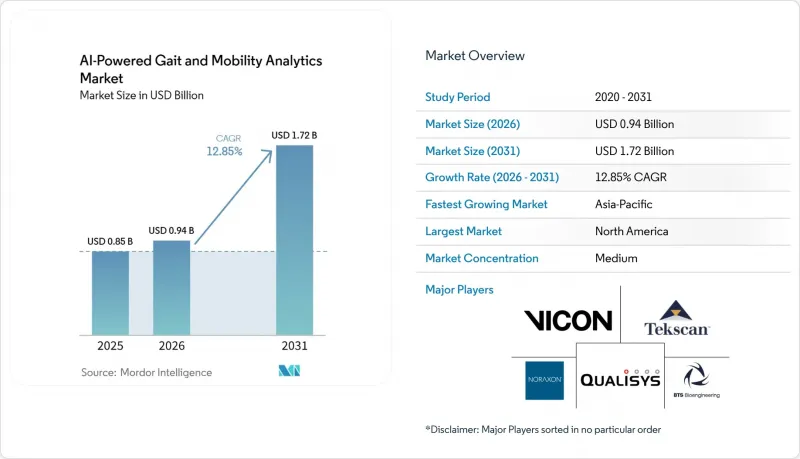
本報告按組件(軟體、硬體、服務)、部署模式(雲端、本地部署、混合部署)、技術(電腦視覺分析及其他)、移動性評估類型(步態分析及其他)、應用(神經病變及其他)、最終用戶(醫院及其他)和地區(北美、歐洲、亞太及其他)進行細分。市場預測以美元計價。
全球人工智慧驅動的步行和移動性分析市場趨勢及洞察
人工智慧驅動的動態診斷的廣泛應用
人工智慧驅動的步態和運動分析市場正受益於動態評估從專業檢查室轉向常規臨床環境的轉變。人工智慧降低了提取有效步態參數所需的專業知識,使高階評估在醫院和門診診所中更加實用。 2026年1月,Qualisys推出了OnTraq,這是一款無需標記的評估系統,能夠在30分鐘內評估20名運動員,且不會中斷訓練。此產品案例表明,除了準確性之外,處理能力也是一項商業性優勢。這種無需標記的方法降低了診所的准入門檻,使那些以前無法負擔全套運動捕捉系統的診所也能使用人工智慧驅動的步態和運動分析市場,從而擴大了潛在基本客群。隨著醫療機構逐漸拋棄人工觀察工具,能夠證明其臨床效果與基於測力台的系統相當的供應商,有望贏得更多來自醫院的訂單。
擴展遠距復健和家庭監測工作流程
人工智慧驅動的步態和活動能力分析市場也受到遠距復健模式快速普及的推動。醫療服務提供者正在建立基於持續運動數據的護理方案,這為能夠在正規實驗室和診所環境之外追蹤患者的軟體提供了支援。 Net Health 於 2026 年 2 月擴展了 Limber Health 的功能,使其成為復健服務提供者的遠端醫療監測平台,這表明數位化復健管道正逐漸成為穩定的市場需求管道,而非曇花一現的試點趨勢。這項轉變意義重大,因為隨著居家監測的增加,整個人工智慧驅動的步態和活動能力分析市場對標準化評分、時間序列報告和工作流程導向的儀表板的需求日益成長。隨著數位化復健模式的成熟,能夠將活動能力指標與保險公司和醫療服務提供者的文件需求相匹配的平台,有望保持結構性優勢。
高昂的硬體投資和校準負擔
人工智慧驅動的步態和運動分析市場仍然面臨一個實際障礙:臨床級設備的成本。測力板、多攝影機系統和高密度慣性測量單元(IMU)裝置對於二級以下醫療機構而言仍然價格昂貴,這限制了其應用範圍,使其僅限於資金雄厚的醫院和專科中心。 2024 年在加泰隆尼亞進行的一項技術經濟調查顯示,專為步態設計的穿戴式醫療物聯網系統的總資本成本存在 ±20% 至 ±30% 的不確定性,這增加了預算有限的醫療機構的總擁有成本風險。負擔不僅限於購買價格;為了維持臨床準確性,還需要定期重新校準和維護,這進一步阻礙了小規模醫療機構進入人工智慧驅動的步態和運動分析市場。雖然穿戴式替代方案正在不斷改進,但許多買家仍然認為它們在高級關節運動學和診斷應用方面無法完全取代實驗室系統。
細分市場分析
預計到2025年,軟體銷售額將佔總銷售額的49.37%,仍將是人工智慧驅動的步態和運動分析市場中最大的組成部分。這一地位反映了價值創造的所在,因為臨床效用更依賴數據處理、評分和報告,而非原始訊號的收集本身。此外,與僅銷售硬體相比,基於訂閱的軟體模式能夠帶來更高的經常性收入和更強的客戶維繫。因此,與僅銷售設備相比,人工智慧驅動的步態和運動分析市場在臨床解讀層面實現了更有效的獲利。
預計硬體將成為成長最快的細分市場,到2031年複合年成長率將達到12.94%,這一成長表明了人工智慧驅動的步態和移動性分析市場的新資本流向。推動需求成長的因素包括感測器尺寸的縮小、設定難度的降低以及需要透過穿戴式裝置進行資料收集的本地化監測工作流程的普及。儘管軟體是主要的收入來源,但服務仍然扮演著重要的中間角色,因為在許多部署地點仍然需要部署、校準和人員培訓。
預計到2025年,雲端採用將佔總收入的51.27%,使其成為整個人工智慧驅動的步態和行動性分析市場的領先平台。此主導地位源自於其易於擴展、降低本地IT負擔以及與SaaS(軟體即服務)營運模式的高度親和性。此外,雲端系統支援對患者進行多次隨訪的時間序列追蹤,這對於臨床醫生需要輕鬆存取來自臨床環境和家庭使用的數據至關重要。
混合部署預計將成為成長最快的模式,到2031年複合年成長率將達到13.12%,這反映了人工智慧驅動的步態和移動性分析市場中存在的營運限制,而這些限制並非總是能透過純雲端服務來解決。即時生物回饋療法、低延遲處理以及各國特定的資料居住法規都推動了本地邊緣處理與選擇性雲端聚合相結合的模式。在學術醫療中心和需要高安全性的專業項目中,本地部署環境仍然佔據一定地位,但隨著託管平台管治標準的提高,其整體作用正在減弱。
區域分析
預計到2025年,北美將佔據43.42%的市場佔有率,繼續保持其在人工智慧驅動的步態和移動性分析市場中最大區域的地位。該地區受益於資金充足的醫院基礎設施、成熟的遠端醫療監測管道以及對數位化臨床工作流程更強的適應能力。此外,美國食品藥物管理局(FDA)於2026年1月發布的臨床決策支援指南,在一定程度上緩解了圍繞「可解釋人工智慧」軟體的監管不確定性,使臨床醫生能夠獨立檢驗其產品,並支援更快的商業化週期。儘管加拿大和墨西哥在全部區域規模仍然相對較小,但它們正透過公共和私人醫療保健管道擴大北美整體的需求基礎。
由於人口老化和復健需求不斷成長,公共醫療保健系統面臨持續壓力,歐洲仍然是人工智慧驅動的步態和移動能力分析的重要市場。與北美相比,歐洲的報銷制度更具國家針對性,導致供應商合約和部署方式存在差異。儘管英國、德國、法國、義大利和西班牙仍是主要的收入來源,但各國在復健領域推廣定量移動能力評估的進程卻不盡相同。因此,歐洲的商業機會更取決於在證據、工作流程相容性和採購標準確立之後進行的系統級實施,而非單一機構的採購。
預計到2031年,亞太地區將以16.13%的複合年成長率成長,成為人工智慧驅動的步態和移動性分析市場成長最快的地區。在日本,人口老化推動了對跌倒風險追蹤和長期移動性監測的強勁需求;而在韓國和中國,對數位醫療和本土創新的廣泛投資正在促進市場發展。印度也是一個關鍵市場,因為該國跌倒負擔沉重,因此長期實施高度可擴展的篩檢和復健工具將日益重要。該地區的成長並非單一因素所致,成熟的醫療保健體系、快速擴張的門診病人網路以及注重成本的消費者都是其潛在促進因素。南美洲以及中東和非洲的市場規模仍然較小,且處於應用初期,目前主要集中在私立醫院系統和高階醫療網路。
其他好處
- Excel格式的市場預測(ME)表
- 3個月的分析師支持
目錄
第1章:引言
- 研究假設和市場定義
- 調查範圍
第2章:調查方法
第3章執行摘要
第4章 市場狀況
- 市場概覽
- 市場促進因素
- 人工智慧驅動的動態診斷的廣泛應用
- 擴展遠距復健和家庭監測的工作流程。
- 穿戴式慣性測量單元 (IMU) 和鞋墊式步態評估設備的需求日益成長
- 在老年護理的各個階段擴大跌倒風險篩檢範圍
- 需要追蹤康復期後患者的病情進展。
- 臨床上對可解釋的移動能力評分和審計追蹤的偏好
- 市場限制因素
- 高昂的硬體投資和校準負擔
- 嚴格的臨床檢驗和資料隱私要求
- 電子健康記錄(EHR) 與復健軟體之間互通性的挑戰。
- 用於模型訓練的標註多樣性較差的步行資料集。
- 供應鏈/價值鏈分析
- 監理情勢
- 技術展望
- 波特五力分析
第5章 市場規模與成長預測
- 按組件
- 軟體
- 硬體
- 服務
- 部署模式
- 基於雲端的
- 現場
- 混合
- 透過技術
- 電腦視覺分析
- 穿戴式感測器分析
- 利用機器學習進行預測分析
- 深度學習
- 其他
- 按類型進行流動性評估
- 步態分析
- 平衡評估
- 跌倒風險評估
- 姿勢分析
- 聯合變異分析
- 功能性活動能力評估
- 其他移動能力評估類型
- 透過使用
- 神經病變
- 整形外科復健
- 老年護理
- 運動醫學與運動表現
- 帕金森氏症的治療
- 其他
- 最終用戶
- 醫院
- 復健中心
- 長期照護機構
- 運動表現中心
- 其他
- 按地區
- 北美洲
- 美國
- 加拿大
- 墨西哥
- 歐洲
- 德國
- 英國
- 法國
- 義大利
- 西班牙
- 其他歐洲國家
- 亞太地區
- 中國
- 日本
- 印度
- 澳洲
- 韓國
- 其他亞太國家
- 中東和非洲
- GCC
- 南非
- 其他中東和非洲國家
- 南美洲
- 巴西
- 阿根廷
- 其他南美國家
- 北美洲
第6章 競爭情勢
- 市場集中度
- 市佔率分析
- 公司簡介
- Bertec Corporation
- BioSensics LLC
- BTS Bioengineering Corp.
- Delsys Inc.
- Gait Up SA
- Hocoma AG
- Kistler Group
- Moticon GmbH
- Motion Analysis Corporation
- NaturalPoint Inc.
- Noraxon Inc.
- ProtoKinetics LLC
- Qualisys AB
- ReWalk Robotics Ltd.
- Sensoria Health Inc.
- Simi Reality Motion Systems GmbH
- Tekscan Inc.
- Vicon Motion Systems Ltd
- Xsens Technologies BV
- Zebris Medical GmbH
第7章 市場機會與未來展望
According to Mordor Intelligence, the AI-powered gait and mobility analytics market is expected to grow from USD 0.85 billion in 2025 to USD 0.94 billion in 2026 and is forecasted to reach USD 1.72 billion by 2031 at 12.85% CAGR over 2026-2031.
This report is Segmented by Component (Software, Hardware, Services), Deployment (Cloud-Based, Hybrid, On-Premises), Technology (Computer Vision-Based Analytics, and More), Assessment (Gait Analysis, and More), Application (Neurological Disorders, and More), End-User (Hospitals, and More), Geography (North America, Europe, Asia-Pacific, and More). The Market Forecasts are Provided in Value (USD).
Global AI-Powered Gait and Mobility Analytics Market Trends and Insights
Rising Adoption of AI-Assisted Biomechanical Diagnostics
The AI-powered gait and mobility analytics market is benefiting from a shift in biomechanical assessment from specialist labs into normal clinical use. AI is lowering the skill burden required to extract useful gait parameters, which makes advanced assessment more practical for hospitals and outpatient settings. Qualisys launched OnTraq in January 2026 with a markerless functional assessment that can evaluate 20 athletes in 30 minutes without interrupting training, and that product example shows how throughput has become a commercial advantage alongside accuracy. The same markerless approach also lowers the entry barrier for clinics that could not previously justify a full motion capture installation, which broadens the addressable base for the AI-powered gait and mobility analytics market. Vendors that can prove clinical equivalence against force-plate-based systems are likely to win more hospital demand as providers move away from manual observational tools.
Expansion of Remote Rehabilitation and Home Monitoring Workflows
The AI-powered gait and mobility analytics market is also being lifted by the fast buildout of remote rehabilitation models. Providers are structuring care around continuous movement data, and that supports software that can follow patients outside formal lab or clinic settings. Net Health expanded Limber Health in February 2026 as a remote therapeutic monitoring platform for rehabilitation providers, and this shows that digital rehab pathways are becoming a stable demand channel rather than a temporary pilot trend. This shift matters because home-based monitoring increases the need for standard scores, longitudinal reporting, and workflow-ready dashboards across the AI-powered gait and mobility analytics market. Platforms that align mobility metrics with payer and provider documentation needs are likely to hold a structural advantage as digital rehab models mature.
High Hardware Capex and Calibration Burden
The AI-powered gait and mobility analytics market still faces a practical barrier in the cost of clinical-grade equipment. Force plates, multi-camera systems, and dense IMU setups remain expensive for providers below the secondary-care level, which limits adoption outside well-funded hospitals and specialty centers. A 2024 technoeconomic study in Catalonia found that full gait-oriented wearable medical IoT systems carried capital cost uncertainty of +-20% to +-30%, and that raised total ownership risk for care facilities working with tight budgets. The burden is not only the purchase price because recurring recalibration and maintenance are also required to preserve clinical accuracy, and that adds friction for the AI-powered gait and mobility analytics market in smaller sites. Wearable alternatives are improving, but many buyers still view them as not fully equivalent to lab systems for advanced joint kinematics and diagnostic use.
Other drivers and restraints analyzed in the detailed report include:
- Growth in Fall-Risk Screening Across Aging Care Pathways
- Clinical Preference for Explainable Mobility Scoring and Audit Trails
- Limited Diverse Annotated Gait Datasets for Model Training
For complete list of drivers and restraints, kindly check the Table Of Contents.
Segment Analysis
Software held 49.37% of revenue in 2025, which kept it as the largest component in the AI-powered gait and mobility analytics market. That position reflects where value is created, since clinical usefulness depends more on data processing, scoring, and reporting than on raw signal capture alone. Subscription-based software models also support recurring revenue and tighter customer retention than hardware-only sales. The AI-powered gait and mobility analytics industry is therefore monetizing clinical interpretation layers more effectively than device sales alone.
Hardware is expected to be the fastest-growing component at a 12.94% CAGR through 2031, and that rise shows where fresh capital is moving inside the AI-powered gait and mobility analytics market. Demand is being lifted by smaller sensors, lower setup burden, and the spread of community-based monitoring workflows that need wearable capture. Services continue to fill the middle ground because deployment, calibration, and staff training remain necessary in many installations, even when software remains the main revenue anchor.
Cloud deployment accounted for 51.27% of revenue in 2025, which gave it the lead across the AI-powered gait and mobility analytics market. Its advantage comes from easier scaling, lower local IT burden, and better fit with software-as-a-service operating models. Cloud systems also support longitudinal patient tracking across repeated sessions, which matters when clinicians need easy access to data from both clinical and home-based use.
Hybrid deployment is anticipated to be the fastest-growing model at a 13.12% CAGR through 2031, and that reflects operational limits that pure cloud delivery cannot always solve in the AI-powered gait and mobility analytics market. Real-time biofeedback, low-latency processing, and country-specific data residency rules all support a mix of local edge processing with selective cloud aggregation. On-premises setups still hold a place in high-security academic medical centers and specialized programs, but their overall role is narrowing as hosted platforms improve their governance standards.
Complete Report Scope:
- By Component
- Software
- Hardware
- Services
- By Deployment Mode
- Cloud-Based
- On-Premises
- Hybrid
- By Technology
- Computer Vision-Based Analytics
- Wearable Sensor Analytics
- Machine Learning-Based Predictive Analytics
- Deep Learning
- Other Technologies
- By Mobility Assessment Type
- Gait Analysis
- Balance Assessment
- Fall Risk Assessment
- Posture Analysis
- Joint Movement Analysis
- Functional Mobility Assessment
- Other Mobility Assessment Types
- By Application
- Neurological Disorders
- Orthopedic Rehabilitation
- Geriatric Care
- Sports Medicine & Performance
- Parkinson's Disease Management
- Other Applications
- By End-User
- Hospitals
- Rehabilitation Centers
- Long-Term Care Facilities
- Sports Performance Centers
- Other End-Users
- By Geography
- North America
- United States
- Canada
- Mexico
- Europe
- Germany
- United Kingdom
- France
- Italy
- Spain
- Rest of Europe
- Asia-Pacific
- China
- Japan
- India
- Australia
- South Korea
- Rest of Asia-Pacific
- Middle East and Africa
- GCC
- South Africa
- Rest of Middle East and Africa
- South America
- Brazil
- Argentina
- Rest of South America
- North America
Geography Analysis
North America held 43.42% share in 2025, which kept it as the largest regional block in the AI-powered gait and mobility analytics market. The region benefits from well-funded hospital infrastructure, established remote therapeutic monitoring pathways, and stronger readiness for digital clinical workflows. The FDA's January 2026 clinical decision support guidance also reduced some regulatory uncertainty for explainable AI software that clinicians can independently review and that supports faster commercialization cycles. Canada and Mexico remain smaller within the regional total, but they add to the broader North American demand base through public and private care channels.
Europe remains an important part of the AI-powered gait and mobility analytics market because public health systems are under steady pressure from aging populations and rising rehabilitation needs. Reimbursement structures are more national in character than in North America, which changes how vendors approach contracting and rollout. The United Kingdom, Germany, France, Italy, and Spain remain the main revenue contributors, though they are moving at different speeds in formalizing quantitative mobility assessment in rehabilitation pathways. Europe's opportunity is therefore tied less to single-facility purchasing and more to system-level adoption once evidence, workflow fit, and procurement standards align.
Asia-Pacific is projected to expand at 16.13% CAGR through 2031, which makes it the fastest-growing region in the AI-powered gait and mobility analytics market. Japan's aging population supports strong demand for fall-risk and longitudinal mobility tracking, while South Korea and China add momentum through broader digital health investment and local innovation activity. India also matters because the country's fall burden is high, which strengthens the case for scalable screening and rehabilitation tools over time. The region's growth is not coming from a single pattern, since mature health systems, rapidly scaling outpatient networks, and cost-sensitive buyers are all part of the story. South America, the Middle East, and Africa remain smaller and earlier-stage, with adoption concentrated in private hospital systems and premium care networks.
- Bertec Corporation
- BioSensics LLC
- BTS Bioengineering Corp.
- Delsys Inc.
- Gait Up SA
- Hocoma
- Kistler Group
- Moticon GmbH
- Motion Analysis Corporation
- NaturalPoint Inc.
- Noraxon Inc.
- ProtoKinetics LLC
- Qualisys AB
- ReWalk Robotics
- Sensoria Health Inc.
- Simi Reality Motion Systems GmbH
- Tekscan Inc.
- Vicon Motion Systems Ltd
- Xsens Technologies B.V.
- Zebris Medical GmbH
Additional Benefits:
- The market estimate (ME) sheet in Excel format
- 3 months of analyst support
TABLE OF CONTENTS
1 Introduction
- 1.1 Study Assumptions and Market Definition
- 1.2 Scope of the Study
2 Research Methodology
3 Executive Summary
4 Market Landscape
- 4.1 Market Overview
- 4.2 Market Drivers
- 4.2.1 Rising Adoption of AI-Assisted Biomechanical Diagnostics
- 4.2.2 Expansion of Remote Rehabilitation and Home Monitoring Workflows
- 4.2.3 Increasing Demand for Wearable IMU and Insole-Based Gait Assessment
- 4.2.4 Growth in Fall-Risk Screening Across Aging Care Pathways
- 4.2.5 Need for Longitudinal Mobility Tracking in Post-Acute Care
- 4.2.6 Clinical Preference for Explainable Mobility Scoring and Audit Trails
- 4.3 Market Restraints
- 4.3.1 High Hardware Capex and Calibration Burden
- 4.3.2 Stringent Clinical Validation and Data Privacy Requirements
- 4.3.3 Interoperability Gaps with EHR and Rehab Software
- 4.3.4 Limited Diverse Annotated Gait Datasets for Model Training
- 4.4 Supply/Value Chain Analysis
- 4.5 Regulatory Landscape
- 4.6 Technological Outlook
- 4.7 Porter's Five Forces Analysis
- 4.7.1 Threat of New Entrants
- 4.7.2 Bargaining Power of Suppliers
- 4.7.3 Bargaining Power of Buyers
- 4.7.4 Threat of Substitutes
- 4.7.5 Competitive Rivalry
5 Market Size & Growth Forecasts (Value, USD)
- 5.1 By Component
- 5.1.1 Software
- 5.1.2 Hardware
- 5.1.3 Services
- 5.2 By Deployment Mode
- 5.2.1 Cloud-Based
- 5.2.2 On-Premises
- 5.2.3 Hybrid
- 5.3 By Technology
- 5.3.1 Computer Vision-Based Analytics
- 5.3.2 Wearable Sensor Analytics
- 5.3.3 Machine Learning-Based Predictive Analytics
- 5.3.4 Deep Learning
- 5.3.5 Other Technologies
- 5.4 By Mobility Assessment Type
- 5.4.1 Gait Analysis
- 5.4.2 Balance Assessment
- 5.4.3 Fall Risk Assessment
- 5.4.4 Posture Analysis
- 5.4.5 Joint Movement Analysis
- 5.4.6 Functional Mobility Assessment
- 5.4.7 Other Mobility Assessment Types
- 5.5 By Application
- 5.5.1 Neurological Disorders
- 5.5.2 Orthopedic Rehabilitation
- 5.5.3 Geriatric Care
- 5.5.4 Sports Medicine & Performance
- 5.5.5 Parkinson's Disease Management
- 5.5.6 Other Applications
- 5.6 By End-User
- 5.6.1 Hospitals
- 5.6.2 Rehabilitation Centers
- 5.6.3 Long-Term Care Facilities
- 5.6.4 Sports Performance Centers
- 5.6.5 Other End-Users
- 5.7 By Geography
- 5.7.1 North America
- 5.7.1.1 United States
- 5.7.1.2 Canada
- 5.7.1.3 Mexico
- 5.7.2 Europe
- 5.7.2.1 Germany
- 5.7.2.2 United Kingdom
- 5.7.2.3 France
- 5.7.2.4 Italy
- 5.7.2.5 Spain
- 5.7.2.6 Rest of Europe
- 5.7.3 Asia-Pacific
- 5.7.3.1 China
- 5.7.3.2 Japan
- 5.7.3.3 India
- 5.7.3.4 Australia
- 5.7.3.5 South Korea
- 5.7.3.6 Rest of Asia-Pacific
- 5.7.4 Middle East and Africa
- 5.7.4.1 GCC
- 5.7.4.2 South Africa
- 5.7.4.3 Rest of Middle East and Africa
- 5.7.5 South America
- 5.7.5.1 Brazil
- 5.7.5.2 Argentina
- 5.7.5.3 Rest of South America
- 5.7.1 North America
6 Competitive Landscape
- 6.1 Market Concentration
- 6.2 Market Share Analysis
- 6.3 Company Profiles (includes Global level Overview, Market level overview, Core Segments, Financials as available, Strategic Information, Market Rank/Share for key companies, Products & Services, Recent Developments)
- 6.3.1 Bertec Corporation
- 6.3.2 BioSensics LLC
- 6.3.3 BTS Bioengineering Corp.
- 6.3.4 Delsys Inc.
- 6.3.5 Gait Up SA
- 6.3.6 Hocoma AG
- 6.3.7 Kistler Group
- 6.3.8 Moticon GmbH
- 6.3.9 Motion Analysis Corporation
- 6.3.10 NaturalPoint Inc.
- 6.3.11 Noraxon Inc.
- 6.3.12 ProtoKinetics LLC
- 6.3.13 Qualisys AB
- 6.3.14 ReWalk Robotics Ltd.
- 6.3.15 Sensoria Health Inc.
- 6.3.16 Simi Reality Motion Systems GmbH
- 6.3.17 Tekscan Inc.
- 6.3.18 Vicon Motion Systems Ltd
- 6.3.19 Xsens Technologies B.V.
- 6.3.20 Zebris Medical GmbH
7 Market Opportunities & Future Outlook
- 7.1 White-space & Unmet-need Assessment

 旅遊即服務 (MaaS) 市場:預測至 2034 年 - 按服務類型、解決方案、經營模式、支付模式、應用程式、最終用戶和地區分類的全球分析
 交通行動服務(MaaS) 市場:按服務類型、收費模式、通勤模式、驅動系統、最終用戶、提供者類型和車輛類型分類-2026-2032 年全球市場預測
 移動即服務 (MaaS) 市場分析及至 2035 年預測:類型、產品、服務、技術、組件、應用、部署、最終用戶、解決方案、模式2034 年交通行動服務(MaaS) 綜合市場預測-按服務類型、交通途徑、平台類型、支付方式、技術、最終用戶和地區分類的全球分析2034年交通行動服務(MaaS) 市場預測-按服務類型、交通途徑、經營模式、最終用戶和地區分類的全球分析出行即服務 (MaaS) 平台市場:預測(至 2034 年)-按服務類型、平台類型、解決方案、交通途徑、應用、最終用戶和地區分類的全球分析城市交通行動服務(MaaS) 市場預測至 2034 年-按服務類型、平台類型、交通途徑、車輛類型、應用程式、最終用戶和地區分類的全球分析訂閱式旅遊市場預測至2034年-全球分析(按訂閱類型、合約期限、車輛類型、燃料類型、服務供應商、最終用戶和地區分類)
 交通行動服務(MaaS) 市場規模、佔有率和成長分析:按解決方案、服務類型、交通途徑、推廣方式、支付方式、平台和地區分類-2026-2033 年產業預測
 2026年全球多模態交通行動服務(MaaS)平台市場報告