


 |
市場調查報告書
商品編碼
2118026
OTT電視劇:市場佔有率分析、產業趨勢與統計、成長預測(2026-2031)OTT TV Series - Market Share Analysis, Industry Trends & Statistics, Growth Forecasts (2026 - 2031) |
||||||

※ 本網頁內容可能與最新版本有所差異。詳細情況請與我們聯繫。
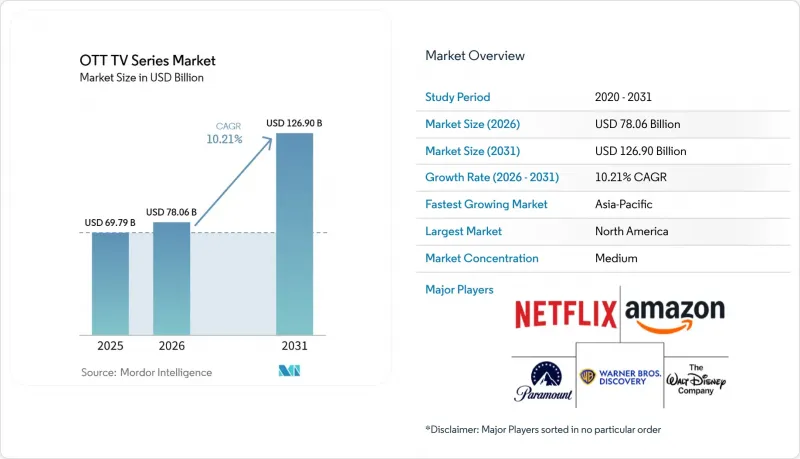
根據 Mordor Intelligence 預測,OTT 電視劇市場規模將從 2025 年的 697.9 億美元和 2026 年的 780.6 億美元成長到 2031 年的 1269 億美元,2026 年至 2031 年的年複合成長率(CAGR)為 10.21%。
本報告按獲利模式(SVOD、AVOD、TVOD、混合模式、免費增值模式)、類型(劇情、喜劇、動作/冒險、犯罪/驚悚等)、設備類型(智慧型手機/平板電腦、智慧電視等)、受眾年齡層(兒童/青少年、青年/老年人)和地區(北美、歐洲、亞太等)進行細分。市場預測以美元計價。
全球OTT電視劇市場趨勢及洞察
在全球範圍內,對原創劇集的需求日益成長。
OTT電視劇市場持續受益於成熟市場和新興市場對連續劇劇情的強勁需求。多集原創劇集如今已成為重要的用戶留存工具,因為觀眾在追看新劇集和長期劇情時,不太可能取消訂閱。為此,各大平台在維持對原創影集高額投資的同時,也收緊了每部劇集的獲利標準。 Netflix 報告稱,其 2025 年的內容投資額為 171 億美元,並計劃在 2026 年達到 180 億美元,這表明優質劇集仍然是主要服務提供商的主要成長動力。迪士尼也維持了 2026 會計年度 240 億美元的內容預算,延續了持續投資以豐富其優質節目陣容的趨勢。這將確保 OTT 電視劇市場繼續專注於數量較少但質量高的原創劇集,這些劇集能夠覆蓋不同地區的觀眾,並長期維持用戶的參與。
智慧電視的普及與「倚靠式觀看」的轉變
隨著智慧電視逐漸成為用戶長時間觀看的主要螢幕,OTT電視劇市場格局正在重塑。這一點意義重大,因為電視螢幕支持更傳統的「休閒」觀看環境,這往往能帶來更高的劇集觀看完成率、更高的重複觀看率以及更優質的廣告資源。到2025年第三季度,美國將有85%的電視可以存取串流內容,這表明串流媒體正在深入滲透到家庭的主要螢幕中。廣告成效同樣重要,預計2026年,聯網電視廣告支出將占美國電視廣告總支出的43%。隨著這一轉變的推進,OTT電視劇市場將進一步加強高階觀看行為與廣告收入之間的連結。最終,對於那些既需要高用戶參與度又需要廣泛獲利的平台而言,這將形成一種更平衡的經營模式。
成熟串流媒體市場中的“訂閱疲勞”
在家庭用戶通常已收費多種服務的成熟國家,OTT電視劇市場面臨明顯的限制。如果平台無法為新劇提供足夠的價值,或者價格上漲太快,消費者越來越傾向於更換、暫停或取消服務。這種壓力也引起了監管機構的關注,因為簡化取消流程是更廣泛的消費者保護議題的一部分。美國聯邦貿易委員會 (FTC) 正在推進「點擊取消」規則制定流程,一項兩黨共同提出的「取消訂閱法案」已於2026年1月提交眾議院審議。雖然這些發展並未降低串流媒體本身的需求,但對於依賴自動續訂的平台而言,客戶維繫將變得更加困難。在OTT電視劇市場,這種情況將迫使營運商推出捆綁套餐、擴大低價套餐範圍,並制定更精細的內容傳送方案。
細分市場分析
2025年,SVOD(訂閱視訊點播)營收佔42.48%,持續維持其在OTT電視劇市場最大收入來源的地位。這一地位反映了圍繞獨家內容和持續更新劇集構建的訂閱庫的持久價值,這些內容和劇集是觀眾難以輕易從其他管道取代的。然而,成長的重點正在轉移,AVOD(廣告支援視訊點播)預計將在2026年至2031年間以11.40%的複合年成長率成長。廣告支援訂閱方案現在已成為許多希望存取加值內容但又不想支付全額月費的用戶的主要入門選擇。淨成長數據已經顯示了這一趨勢,2025年第一季,廣告支援型訂閱計畫佔所有高級訂閱平台淨成長的57%。因此,與以往的串流媒體週期相比,OTT電視劇市場對純粹訂閱成長的依賴程度正在降低。
這種轉變並未削弱SVOD的地位;相反,它改變了SVOD在平台結構中的角色。高級訂閱計劃仍然與獨家旗艦劇集、提前觀看價值和高平均用戶收入(ARPU)緊密相關。同時,AVOD為營運商提供了更廣泛的用戶獲取管道,使其能夠從原本付費服務無法觸及的家庭用戶群中實現盈利。美國2026年819億美元的數位影片廣告支出也印證了這個趨勢,為各種獲利模式提供了巨大的成長空間。實際上,OTT電視劇產業正在向「多層盈利」模式轉型,其中SVOD保障了收入基礎,而AVOD則推動了更廣泛的用戶覆蓋。
到2025年,劇情類影集將佔OTT電視影集市場的27.32%,成為調查期間最大的類型。劇情類影集之所以維持核心地位,是因為長期的角色發展故事和季與季之間的連續性是留住觀眾最有效的手段之一。觀眾通常會續訂熱門影集的續集,因此,儘管製作成本高昂,劇情類影集的價值仍得以維持。同時,動作冒險類劇集預計到2031年將以11.80%的複合年成長率成長,在所有調查類型中成長率最高。這一成長趨勢反映出,動作類故事更容易被不同地區的觀眾所理解,因為它不像某些喜劇類型那樣依賴語言細微差別。在OTT電視連續劇市場,這一特點使得動作冒險類劇整合為跨國發行和系列擴張的可靠選擇。
劇情類節目仍然是內容庫深度的重要支柱,對本地和全球的製作外包策略都至關重要。歐洲的內容法規要求擁有歐盟用戶的平台,其節目庫中至少30%必須是歐洲製作的內容,這進一步鞏固了劇情類節目的地位。這項規定鼓勵對在地化劇情類節目和犯罪主題劇本的投資,以便在歐洲地區發行。動作和冒險類節目則具有不同的優勢:成熟的世界觀可以輕鬆地擴展到劇集之外,衍生出衍生劇和商品行銷產品項目。對於那些尋求低成本且對廣告商具有穩定吸引力的節目類型的平台而言,真人秀和生活風格類節目在OTT電視連續劇行業中仍然具有價值。最終形成了一種類型組合:劇情類節目有助於用戶留存,而動作和冒險類節目則推動了廣泛的跨國擴張。
區域分析
2025年,北美地區佔全球整體收入的30.34%,並持續維持在OTT電視劇市場最大區域市場的地位。該地區之所以如此重要,是因為其人均消費水準高、平台間競爭成熟,以及連網電視普及率高。 2025年第三季度,美國85%的電視用戶都曾造訪過串流內容,凸顯了電視劇觀看在串流環境中的滲透程度之深。該地區在獲利模式創新方面也扮演著核心角色,付費訂閱、廣告支援方案和捆綁銷售等模式在該地區都具有相當大的規模。 Netflix預計2026會計年度的營收將達到507億美元至517億美元,廣告收入將達到30億美元,顯示營收成長高度依賴雙重獲利模式。
預計亞太地區在2026年至2031年間將以11.45%的複合年成長率成長,成為OTT電視劇市場成長最快的地區。這一成長主要得益於數位存取的普及、智慧型手機的廣泛使用以及對在地化劇集的強勁需求。同時,與北美和西歐的家庭相比,亞太地區許多家庭仍處於串流服務引進週期的早期階段,這也反映出亞太地區的成長趨勢。該地區的競爭格局不僅取決於全球品牌知名度,也取決於其在本土市場的影響力。隨著印度、日本、中國及其周邊國家OTT電視劇市場的成長,那些投資於在地化語言內容和提供柔軟性定價策略的平台將在吸引新用戶方面佔據優勢。
歐洲在OTT電視劇市場依然佔據重要地位,付費串流媒體在其主要國家已相當普及。預計到2026年,法國將有74%的家庭至少使用一項付費串流服務,顯示其市場需求成熟且穩定。此外,歐洲的法規結構要求服務歐盟用戶的平台在其內容庫中至少保留30%的歐洲內容,這也促進了本土製作的發展。南美、中東和非洲仍是發展中市場,但隨著智慧型手機觀看和寬頻存取水準的提升,這些市場的重要性日益凸顯。 CANAL+於2026年7月完成了對MultiChoice的收購,這顯示其對非洲作為OTT電視劇市場長期成長區域的持續信心。在全部區域,成長的驅動力可能更多地來自本地化程度的提高和覆蓋範圍的擴大,而不僅僅是高價策略。
其他好處:
- Excel格式的市場預測(ME)表
- 3個月的分析師支持
目錄
第1章:引言
- 研究假設和市場定義
- 調查範圍
第2章:調查方法
第3章執行摘要
第4章 市場狀況
- 市場概覽
- 市場促進因素
- 全球對原創電視劇的需求日益成長
- 智慧電視的普及與「倚靠式觀看」的轉變
- 多層次的獲利模式正在擴大我們能夠觸及的受眾群體。
- 透過投資特許經營知識產權實現平台差異化
- 本地語言內容能夠加速用戶獲取。
- 人工智慧驅動的內容發現功能可提高閱讀完成率。
- 市場限制因素
- 成熟串流媒體市場中的“訂閱疲勞”
- 內容成本不斷上漲,給原創作品的獲利能力帶來了壓力。
- 權利的分散化限制了圖書館資源的再利用。
- 對廣告負載的高度敏感度會降低透過廣告收入實現獲利的效率。
- 產業價值鏈分析
- 產業供應鏈分析
- 宏觀經濟因素對市場的影響
- 監理情勢
- 技術展望
- 波特五力分析
第5章 市場規模與成長預測
- 透過貨幣化模式
- SVOD
- AVOD
- TVOD
- 混合
- 免費增值
- 按類型
- 戲劇
- 喜劇
- 動作冒險
- 犯罪/驚悚
- 真實生活方式
- 其他類型
- 依設備類型
- 智慧型手機和平板電腦
- 智慧電視
- 筆記型電腦和桌上型電腦
- 其他設備類型
- 按觀眾年齡層別分類
- 兒童/青少年
- 青壯年/老年人
- 按地區
- 北美洲
- 美國
- 加拿大
- 墨西哥
- 南美洲
- 巴西
- 阿根廷
- 智利
- 其他南美國家
- 歐洲
- 德國
- 英國
- 法國
- 義大利
- 西班牙
- 其他歐洲國家
- 亞太地區
- 中國
- 日本
- 印度
- 韓國
- 澳洲
- 其他亞太國家
- 中東
- 沙烏地阿拉伯
- 阿拉伯聯合大公國
- 卡達
- 其他中東國家
- 非洲
- 南非
- 埃及
- 奈及利亞
- 其他非洲國家
- 北美洲
第6章 競爭情勢
- 市場集中度
- 策略趨勢
- 市佔率分析
- 公司簡介
- Netflix, Inc.
- The Walt Disney Company
- Warner Bros. Discovery, Inc.
- Amazon.com, Inc.
- Apple Inc.
- Comcast Corporation
- Paramount Skydance Corporation
- Sony Group Corporation
- Tencent Holdings Limited
- iQIYI, Inc.
- Rakuten Group, Inc.
- Zee Entertainment Enterprises Limited
- Roku, Inc.
- JioStar India Private Limited
- PCCW Limited
- MBC Group
- CANAL+SA
- ITV plc
- ProSiebenSat.1 Media SE
- TelevisaUnivision, Inc.
第7章 市場機會與未來展望
According to Mordor Intelligence, the OTT TV series market size is projected to expand from USD 69.79 billion in 2025 and USD 78.06 billion in 2026 to USD 126.90 billion by 2031, registering a CAGR of 10.21% between 2026 to 2031.
This report is Segmented by Monetization Model (SVOD, AVOD, TVOD, Hybrid, and Freemium), Genre (Drama, Comedy, Action and Adventure, Crime and Thriller, and More), Device Type (Smartphones and Tablets, Smart TVs, and More), Viewer Age Group (Children/Teens and Young Adults/Seniors), and Geography (North America, Europe, Asia-Pacific, and More). The Market Forecasts are Provided in Terms of Value (USD).
Global OTT TV Series Market Trends and Insights
Rising Global Appetite for Serialized Original Content
The OTT TV series market continues to benefit from strong demand for serialized storytelling across both mature and emerging viewing regions. Multi-episode originals now work as a core retention tool because viewers are less likely to cancel when they are following returning seasons or longer story arcs. Platforms have responded by keeping original series spending high even as they tighten title-level return thresholds. Netflix reported USD 17.1 billion in content spend for 2025 and targeted USD 18 billion for 2026, which shows that large services still treat premium series as a primary growth lever. Disney also maintained a FY2026 content budget of USD 24 billion, which supports the same pattern of continued investment in premium programming depth. This keeps the OTT TV series market focused on fewer but more valuable originals that can travel across territories and hold subscriber attention for longer periods.
Smart TV Penetration and Lean-Back Viewing Shift
The OTT TV series market is being reshaped by the rise of smart TVs as the main screen for long-session viewing. This matters because a television screen supports a more traditional lean-back environment, and that tends to lift series completion, repeat viewing, and ad inventory quality. In the United States, 85% of television sets accessed streaming content in Q3 2025, which shows how deeply streaming has moved into the main household screen. The advertising effect is just as important because connected TV ad spend in the United States is expected to reach 43% of total TV ad spend in 2026. As that shift continues, the OTT TV series market gains a stronger bridge between premium viewing behavior and advertising revenue. The result is a more balanced business model for platforms that need both strong engagement and broader monetization.
Subscription Fatigue Across Mature Streaming Markets
The OTT TV series market faces a clear limit in mature countries where households already manage several recurring services. Consumers are more willing to switch, pause, or cancel when a platform does not provide enough fresh series value or when pricing changes arrive too quickly. That pressure has also drawn regulatory attention because easier cancellation standards are now part of the broader consumer protection discussion. The U.S. Federal Trade Commission pursued its click-to-cancel rulemaking process, and a bipartisan Unsubscribe Act was introduced in the House of Representatives in January 2026. These developments do not reduce demand for streaming itself, but they do make retention harder for platforms that depend on passive renewals. In the OTT TV series market, this pushes operators toward bundles, lower-priced tiers, and tighter content release planning.
Other drivers and restraints analyzed in the detailed report include:
- Multi-Tier Monetization Expands Audience Reach
- Platform Differentiation Through Franchise IP Investment
- Content Cost Inflation Compresses Return on Originals
For complete list of drivers and restraints, kindly check the Table Of Contents.
Segment Analysis
SVOD held 42.48% of revenue in 2025, which kept it as the largest monetization block in the OTT TV series market. That position reflects the lasting value of subscription libraries built around exclusive and recurring series that viewers cannot easily replace elsewhere. Even so, the center of growth has moved because AVOD is projected to expand at 11.40% CAGR during 2026-2031. Ad-supported plans now work as the main entry tier for many users who want premium catalog access without taking on the full subscription price. Gross additions data already points in that direction, with ad-supported tiers accounting for 57% of additions across premium subscription platforms in Q1 2025. The OTT TV series market is therefore becoming less dependent on pure subscription growth than it was in earlier streaming cycles.
The shift does not weaken SVOD. It changes what SVOD is expected to do inside the platform mix. Premium subscription tiers still carry the strongest link to exclusive tentpole series, early access value, and higher average revenue per user. At the same time, AVOD gives operators a larger funnel and helps them monetize households that would otherwise remain outside the paid stack. Digital video ad spending of USD 81.9 billion in the United States in 2026 supports that path and gives the monetization model real headroom. In practical terms, the OTT TV series industry is moving toward layered monetization where SVOD secures the revenue base and AVOD drives wider reach.
Drama captured 27.32% of the OTT TV series market size in 2025, which made it the largest genre in the period under review. Drama remains central because long-form character arcs and season continuity make it one of the strongest tools for retention. Viewers often stay subscribed to follow returning prestige titles, and that keeps drama valuable even when production costs are high. Action and adventure, however, is projected to expand at 11.80% CAGR through 2031, which gives it the strongest growth pace among the listed genres. This growth profile reflects the portability of action-led storytelling across regions because it depends less on language nuance than some comedy formats. In the OTT TV series market, that makes action and adventure a reliable choice for multi-country launches and franchise expansion.
Drama still anchors library depth because it serves both local and global commissioning strategies. European content rules also strengthen this segment because platforms with EU users must keep at least 30% European works in their catalogs. That requirement supports investment in local-language drama and in crime-related scripted formats that can travel within the region. Action and adventure gains from a different advantage because recognizable universes are easier to extend across seasons, spin-offs, and merchandising plans. Reality and lifestyle remains useful in the OTT TV series industry where platforms want a lower-cost category with steady advertiser appeal. The result is a genre mix where drama supports stickiness and action and adventure provides wider cross-border scaling.
Complete Report Scope:
- By Monetization Model
- SVOD
- AVOD
- TVOD
- Hybrid
- Freemium
- By Genre
- Drama
- Comedy
- Action and Adventure
- Crime and Thriller
- Reality and Lifestyle
- Other Genres
- By Device Type
- Smartphones and Tablets
- Smart TVs
- Laptops and Desktops
- Other Device Types
- By Viewer Age Group
- Children/ Teens
- Young Adults/ Seniors
- By Geography
- North America
- United States
- Canada
- Mexico
- South America
- Brazil
- Argentina
- Chile
- Rest of South America
- Europe
- Germany
- United Kingdom
- France
- Italy
- Spain
- Rest of Europe
- Asia-Pacific
- China
- Japan
- India
- South Korea
- Australia
- Rest of Asia-Pacific
- Middle East
- Saudi Arabia
- United Arab Emirates
- Qatar
- Rest of Middle East
- Africa
- South Africa
- Egypt
- Nigeria
- Rest of Africa
- North America
Geography Analysis
North America held 30.34% of global revenue in 2025, which kept it as the largest regional block in the OTT TV series market. The region remains important because it combines high spending per user, mature platform competition, and deep connected television usage. In the United States, 85% of television sets accessed streaming content in Q3 2025, which confirms how deeply series viewing has moved into the streaming environment. The region is also central to monetization innovation because premium subscriptions, ad-supported tiers, and bundle offers all have meaningful scale there. Netflix guided USD 50.7-51.7 billion in revenue for FY2026 and expected advertising revenue of USD 3 billion, which shows how strongly revenue expansion now depends on dual monetization.
Asia-Pacific is projected to expand at 11.45% CAGR during 2026-2031, which makes it the fastest-growing regional area in the OTT TV series market. The region is being lifted by a mix of rising digital access, broader smartphone usage, and strong demand for local-language series. Growth also reflects the fact that many households are still earlier in their streaming adoption cycle than those in North America and Western Europe. Competition in this region is shaped more by domestic relevance than by global brand recognition alone. Platforms that invest in regional language content and pricing flexibility are better positioned to capture new viewers as the OTT TV series market grows across India, Japan, China, and nearby countries.
Europe continues to hold a significant position in the OTT TV series market because paid streaming penetration is already well established in major countries. In France, 74% of households accessed at least one paid streaming service in 2026, which shows a mature and stable demand base. The European framework also favors local commissioning because platforms serving EU users must maintain a minimum 30% share of European works in their catalogs. South America, the Middle East, and Africa remain earlier-stage markets, but they matter because smartphone viewing and broadband access are improving from lower bases. CANAL+ completed its acquisition of MultiChoice in July 2026, which signals continued confidence in Africa as a longer-term expansion field for the OTT TV series market. Across these regions, growth is more likely to come from better local fit and wider access than from premium pricing alone.
- Netflix, Inc.
- The Walt Disney Company
- Warner Bros. Discovery, Inc.
- Amazon.com, Inc.
- Apple Inc.
- Comcast Corporation
- Paramount Skydance Corporation
- Sony Group Corporation
- Tencent Holdings Limited
- iQIYI, Inc.
- Rakuten Group, Inc.
- Zee Entertainment Enterprises Limited
- Roku, Inc.
- JioStar India Private Limited
- PCCW Limited
- MBC Group
- CANAL+ S.A.
- ITV plc
- ProSiebenSat.1 Media SE
- TelevisaUnivision, Inc.
Additional Benefits:
- The market estimate (ME) sheet in Excel format
- 3 months of analyst support
TABLE OF CONTENTS
1 INTRODUCTION
- 1.1 Study Assumptions and Market Definition
- 1.2 Scope of the Study
2 RESEARCH METHODOLOGY
3 EXECUTIVE SUMMARY
4 MARKET LANDSCAPE
- 4.1 Market Overview
- 4.2 Market Drivers
- 4.2.1 Rising Global Appetite for Serialized Original Content
- 4.2.2 Smart TV Penetration and Lean-Back Viewing Shift
- 4.2.3 Multi-Tier Monetization Expands Audience Reach
- 4.2.4 Platform Differentiation Through Franchise IP Investment
- 4.2.5 Local-Language Content Accelerates Subscriber Acquisition
- 4.2.6 AI-Assisted Content Discovery Improves Completion Rates
- 4.3 Market Restraints
- 4.3.1 Subscription Fatigue Across Mature Streaming Markets
- 4.3.2 Content Cost Inflation Compresses Return on Originals
- 4.3.3 Fragmented Rights Ownership Limits Library Reuse
- 4.3.4 Advertising Load Sensitivity Reduces Ad-Supported Monetization Efficiency
- 4.4 Industry Value Chain Analysis
- 4.5 Industry Supply Chain Analysis
- 4.6 Impact of Macroeconomic Factors on the Market
- 4.7 Regulatory Landscape
- 4.8 Technological Outlook
- 4.9 Porter's Five Forces Analysis
- 4.9.1 Bargaining Power of Buyers
- 4.9.2 Bargaining Power of Suppliers
- 4.9.3 Threat of New Entrants
- 4.9.4 Threat of Substitutes
- 4.9.5 Competitive Rivalry
5 MARKET SIZE AND GROWTH FORECASTS (VALUE)
- 5.1 By Monetization Model
- 5.1.1 SVOD
- 5.1.2 AVOD
- 5.1.3 TVOD
- 5.1.4 Hybrid
- 5.1.5 Freemium
- 5.2 By Genre
- 5.2.1 Drama
- 5.2.2 Comedy
- 5.2.3 Action and Adventure
- 5.2.4 Crime and Thriller
- 5.2.5 Reality and Lifestyle
- 5.2.6 Other Genres
- 5.3 By Device Type
- 5.3.1 Smartphones and Tablets
- 5.3.2 Smart TVs
- 5.3.3 Laptops and Desktops
- 5.3.4 Other Device Types
- 5.4 By Viewer Age Group
- 5.4.1 Children/ Teens
- 5.4.2 Young Adults/ Seniors
- 5.5 By Geography
- 5.5.1 North America
- 5.5.1.1 United States
- 5.5.1.2 Canada
- 5.5.1.3 Mexico
- 5.5.2 South America
- 5.5.2.1 Brazil
- 5.5.2.2 Argentina
- 5.5.2.3 Chile
- 5.5.2.4 Rest of South America
- 5.5.3 Europe
- 5.5.3.1 Germany
- 5.5.3.2 United Kingdom
- 5.5.3.3 France
- 5.5.3.4 Italy
- 5.5.3.5 Spain
- 5.5.3.6 Rest of Europe
- 5.5.4 Asia-Pacific
- 5.5.4.1 China
- 5.5.4.2 Japan
- 5.5.4.3 India
- 5.5.4.4 South Korea
- 5.5.4.5 Australia
- 5.5.4.6 Rest of Asia-Pacific
- 5.5.5 Middle East
- 5.5.5.1 Saudi Arabia
- 5.5.5.2 United Arab Emirates
- 5.5.5.3 Qatar
- 5.5.5.4 Rest of Middle East
- 5.5.6 Africa
- 5.5.6.1 South Africa
- 5.5.6.2 Egypt
- 5.5.6.3 Nigeria
- 5.5.6.4 Rest of Africa
- 5.5.1 North America
6 COMPETITIVE LANDSCAPE
- 6.1 Market Concentration
- 6.2 Strategic Moves
- 6.3 Market Share Analysis
- 6.4 Company Profiles (includes Global Level Overview, Market Level Overview, Core Segments, Financials as available, Strategic Information, Market Rank/Share, Products and Services, Recent Developments)
- 6.4.1 Netflix, Inc.
- 6.4.2 The Walt Disney Company
- 6.4.3 Warner Bros. Discovery, Inc.
- 6.4.4 Amazon.com, Inc.
- 6.4.5 Apple Inc.
- 6.4.6 Comcast Corporation
- 6.4.7 Paramount Skydance Corporation
- 6.4.8 Sony Group Corporation
- 6.4.9 Tencent Holdings Limited
- 6.4.10 iQIYI, Inc.
- 6.4.11 Rakuten Group, Inc.
- 6.4.12 Zee Entertainment Enterprises Limited
- 6.4.13 Roku, Inc.
- 6.4.14 JioStar India Private Limited
- 6.4.15 PCCW Limited
- 6.4.16 MBC Group
- 6.4.17 CANAL+ S.A.
- 6.4.18 ITV plc
- 6.4.19 ProSiebenSat.1 Media SE
- 6.4.20 TelevisaUnivision, Inc.
7 MARKET OPPORTUNITIES AND FUTURE OUTLOOK
- 7.1 White-Space and Unmet-Need Assessment

 美國直播基礎設施市場規模、佔有率和趨勢分析報告:按基礎設施組件、部署方式、最終用途和細分市場預測(2026-2033 年)
 OTT邊緣串流基礎設施:市場佔有率分析、產業趨勢與統計及成長預測(2026-2031年)
 影片串流媒體與廣播設備市場-2026-2032年全球市場預測線上電影市場-2026-2032年全球市場預測影片串流媒體市場-2026-2032年全球市場預測籃球直播:市場佔有率分析、產業趨勢與統計、成長預測(2026-2031)足球直播:市場佔有率分析、產業趨勢與統計、成長預測(2026-2031)視訊串流基礎設施:市場佔有率分析、產業趨勢與統計、成長預測(2026-2031)
 2026-2030年全球影像串流媒體及廣播設備市場影片串流:市場佔有率分析、產業趨勢與統計、成長預測(2026-2031)