


 |
市場調查報告書
商品編碼
2099180
視訊串流基礎設施:市場佔有率分析、產業趨勢與統計、成長預測(2026-2031)Video Streaming Infrastructure - Market Share Analysis, Industry Trends & Statistics, Growth Forecasts (2026 - 2031) |
||||||

※ 本網頁內容可能與最新版本有所差異。詳細情況請與我們聯繫。
據 Mordor Intelligence 稱,2025 年影片串流基礎設施市場價值為 433.2 億美元,預計到 2031 年將達到 916.6 億美元,而 2026 年為 488.6 億美元,預測期(2026-2031 年)的複合年成長率為 13.41%。
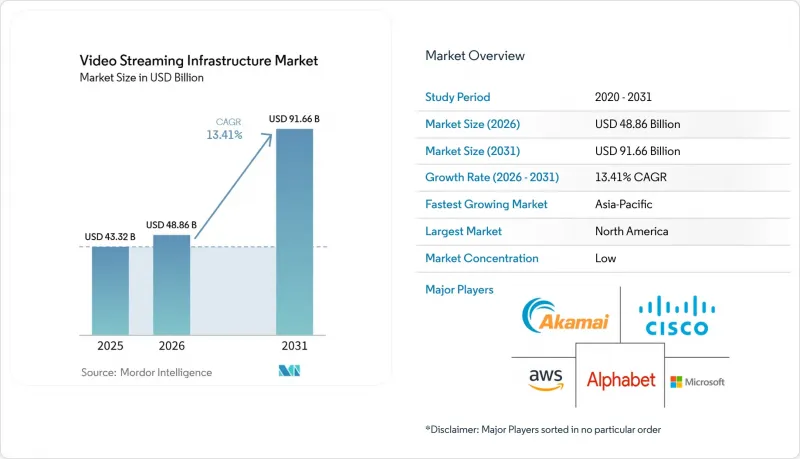
本報告按串流媒體類型(直播影片、非線性/點播)、組件(軟體[媒體工作流程編配等]、服務、硬體)、部署模式(雲端、本地部署、混合部署)、最終用戶(媒體和娛樂、體育和實況活動、電信、企業等)以及地區進行細分。市場預測以美元計價。
全球影片串流基礎設施市場趨勢及洞察
對低延遲實況活動的需求日益成長
體育賽事直播和高階賽事串流媒體仍然是視訊串流基礎設施市場進行新基礎設施投資的最迫切需求。版權擁有者現在需要能夠支援大規模並發觀眾、同時保持穩定畫質和嚴格延遲控制的系統。聯想表示,在2026年FIFA世界盃的部署中,僅依靠雲端傳輸無法滿足廣播級延遲要求,因此採用了近即時AI驅動的基礎設施和本地邊緣運算。 MainStreaming也在2025年FIFA俱樂部世界盃之前擴大了DAZN Edge的部署規模。這表明,各大體育平台正在投資自有邊緣運算能力,而不是僅依賴第三方CDN的覆蓋範圍。此外,Akamai Media Services Live 5將低延遲HLS傳輸的標準提高到了5-7秒。這使得未來體育賽事轉播權協議對更高性能的要求勢必會更高。
人工智慧驅動的影片工作流程自動化和本地化
人工智慧主導的自動化正在減少大規模影片準備、標註、本地化和發布所需的時間和精力,從而擴大影片串流基礎設施市場的營運範圍。這意義重大,因為內容擁有者現在需要同一資產的多個版本,涵蓋不同的語言、平台、格式和盈利模式。在2025年7月的平台更新中,Brightcove新增了自動元資料產生、字幕產生、人工智慧翻譯、語音配音和4K超高清直播功能,延遲僅8秒。 2026年4月,Wowza發布了其“視訊智慧框架”,該框架可在直播交付工作流程中產生即時元元資料、片段、警報和機器可讀事件訊號,從而減少交付後的處理延遲和人工交接。隨著這些工具的標準化,即使是小規模廣播公司也能更快地部署多語言目錄,因為本地化和元資料工作不再需要像過去那樣繁瑣的人工操作,從而大大減輕了國際業務擴張的壓力。
頻寬增加和轉碼成本上升
視訊串流基礎設施市場的成本負擔日益加重。這是因為壓縮技術的進步需要更強大的運算能力和更複雜的傳輸協定堆疊。營運商現在需要支援更多格式和更高解析度,並應對頻繁出現的並發連接高峰,同時他們的獲利模式也在不斷演變。 2026年6月,Meta Engineering指出,儘管AV1轉碼器提高了頻寬效率,但將AV1應用於大規模即時通訊仍需要對運算資源進行大量投資。 Bitmovin與MUBI的合作也反映了這種壓力,因為基於雲端的多轉碼器工作流程比升級本地編碼硬體以支援AVC、HEVC和AV1更容易擴展。這些成本壓力對中型業者的影響尤其嚴重,他們必須滿足與頂級平台相同的解析度和轉碼器要求,但卻缺乏在價格和現有規模方面與之匹敵的議價能力。
細分市場分析
到2025年,非線性串流媒體和視訊點播(VOD)串流媒體將佔據52.47%的市場佔有率,這證實了點播觀看仍然是視訊串流基礎設施市場中最大的應用場景。 VOD需求強調深度快取、高效編碼以及穩定且自適應的位元率傳輸,因為觀眾期望在龐大的內容庫和重複觀看過程中獲得一致的效能。在這個領域,擴展性更多地取決於平台向眾多設備和接取網路高效傳輸龐大內容庫的能力,而不是臨時的流量高峰。因此,在許多VOD密集型部署中,成本控制和播放穩定性比超低延遲更為重要。因此,儘管新的工作負載正在獲得成長的關注,VOD仍然是基礎設施投資的基石。
在這一領域,直播影片串流媒體是一個成長尤為迅速的細分市場,預計從2026年到2031年將以17.33%的複合年成長率成長。這一成長與體育賽事轉播權的轉變、虛擬活動的增加以及內容擁有者為尋求直接收費和廣告合作而加強的直接面對消費者(DTC)策略密切相關。與傳統的視訊點播(VOD)模式相比,直播視訊串流需要即時編碼、更嚴格的延遲控制、快速擴展的並發連接數以及更強的可觀測性。許多業者也在整合直播和點播工作流程,使錄製的視訊串流能夠在幾分鐘內重新播出,從而減少了對獨立管道設計的需求。這種格式的融合正促使影片串流基礎設施產業擴大建立整合營運模式,而不是將VOD和直播系統分開。
預計到2025年,軟體市佔率將達到51.87%,其中編碼和轉碼將佔軟體細分市場的31.13%,這表明計算密集型處理仍然是平台經濟的核心。這使得軟體成為影片串流基礎設施市場持續管理的基石,因為編碼邏輯、編配、播放智慧和監控都與日常營運密切相關。此外,隨著營運商從被動故障排除轉向預測性效能管理,預計到2031年,影片分析和體驗品質(QoE)監控的複合年成長率也將達到15.89%。這一轉變意義重大,因為用戶流失率的激增、廣告投放失敗和延遲等問題現在直接影響訂閱模式和廣告支援模式的收入。因此,擁有卓越可觀測性和工作流程自動化功能的軟體供應商正日益影響購買決策。
服務是成長最快的頂級組成部分,預計從2026年到2031年將以15.24%的複合年成長率成長。 2025年4月,康卡斯特技術解決方案公司推出了Comcast Media360,這是一項將影片管理、OTT分發和社群媒體分發整合到單一營運模式中的託管服務。這種以服務主導的趨勢反映了對營運柔軟性的日益重視,因為買家越來越傾向於將結果和運作置於增加本地硬體之上。雖然硬體在特定環境中仍然發揮作用,但隨著越來越多的功能轉移到軟體定義或託管環境中,其相對地位正在減弱。在整個影片串流基礎設施產業,價值的焦點正在轉向能夠維持媒體運作並減輕本地營運負擔的平台和服務層。
區域分析
到2025年,北美將佔據影片串流基礎設施市場36.63%的佔有率,並繼續保持其作為區域收入最大貢獻者的地位。該地區憑藉其成熟的訂閱習慣、強大的數位廣告市場、密集的資料中心網路以及優質的影片服務基礎,佔據了有利地位。美國仍是主要的需求中心,因為其市場集中了體育、媒體、企業和平台等各類規模的規模。加拿大和墨西哥也透過雙語支援和跨境內容需求推動了市場需求,凸顯了在地化和工作流程柔軟性的重要性。儘管北美影片串流基礎設施市場基礎成熟,但透過混合營運、事件串流媒體和由人工智慧驅動的更廣泛的媒體工作流程,該市場仍有成長空間。
歐洲仍然是影片串流媒體基礎設施市場的關鍵區域,因為向串流媒體的轉型受到內容經濟和監管合規的雙重影響。由於各國在廣播系統、版權結構和獲利模式方面存在顯著差異,全部區域的需求模式呈現出分散化的特徵。這使得跨國部署更加複雜,促使供應商提供更多模組化的部署和工作流程選項。資料居住和資料傳輸需求也會影響基礎設施拓撲結構,從而推動對特定區域處理節點和本地化交付方案的持續需求。在中東和非洲地區,儘管海灣國家正在積極投資數位媒體系統,但由於網路品質的限制,撒哈拉以南非洲部分市場的短期內普及速度可能會低於預期,儘管行動影片需求持續成長。
亞太地區預計將在2026年至2031年間以15.98%的複合年成長率成長,成為影片串流基礎設施市場成長最快的地區。該地區的成長動力主要來自於行動優先的觀看習慣、對本地加值內容的強勁需求以及大規模用戶群帶來的大量直播流量。根據AVIA預測,到2025年底,該地區的線上影片產業收入預計將達到700億美元,凸顯了其規模優勢,並推動了對新型傳輸基礎設施的投資。 AVIA也將印度定位為「行動優先」直播架構的全球標桿,強調了該地區為何正在為未來的發展樹立關鍵性能標準。
其他好處:
- Excel格式的市場預測(ME)表
- 3個月的分析師支持
目錄
第1章:引言
- 研究假設和市場定義
- 調查範圍
第2章:調查方法
第3章執行摘要
第4章 市場狀況
- 市場概覽
- 市場促進因素
- 對低延遲實況活動的需求日益成長
- 擴展CDN和邊緣運算能力,以應對尖峰時段流量傳輸。
- 透過雲端原生串流媒體營運降低資本投資負擔
- 人工智慧驅動的影片工作流程自動化和本地化
- 由於廣告獲利模式和混合獲利模式的出現,內容交付量正在增加。
- 5G多播與廣播串流的應用案例
- 市場限制因素
- 頻寬增加和轉碼成本上升
- 設備、轉碼器和播放器相容性碎片化
- 隱私權、權利和資料居住限制
- 新興網路尖峰時段服務品質不穩定
- 價值鏈分析
- 監理情勢
- 技術展望
- 波特五力分析
- 投資分析
- 評估宏觀經濟因素對市場的影響
第5章 市場規模與成長預測
- 按串流媒體類型
- 即時影片串流
- 非線性/視訊點播串流媒體
- 按組件
- 軟體
- 編碼和轉碼解決方案
- 視訊播放器解決方案
- 影像分析和品質體驗監測
- 媒體工作流程編配
- 其他軟體元件
- 服務
- 硬體
- 軟體
- 不同的發展
- 基於雲端的
- 現場
- 混合
- 最終用戶
- 媒體與娛樂
- 體育賽事和實況活動
- 電訊
- 公司
- 教育
- 政府/公共部門
- 其他最終用戶
- 按地區
- 北美洲
- 美國
- 加拿大
- 墨西哥
- 南美洲
- 巴西
- 阿根廷
- 其他南美國家
- 歐洲
- 英國
- 德國
- 法國
- 義大利
- 西班牙
- 其他歐洲國家
- 亞太地區
- 中國
- 印度
- 日本
- 韓國
- 澳洲和紐西蘭
- 其他亞太國家
- 中東和非洲
- 中東
- 沙烏地阿拉伯
- 阿拉伯聯合大公國
- 卡達
- 土耳其
- 其他中東國家
- 非洲
- 南非
- 奈及利亞
- 其他非洲國家
- 中東
- 北美洲
第6章 競爭情勢
- 市場集中度
- 策略性舉措(併購、合作、投資、物流網路擴張)
- Vendor Positioning Analysis
- 公司簡介
- Amazon Web Services, Inc.
- Akamai Technologies, Inc.
- Microsoft Corporation
- Alphabet Inc.
- Cisco Systems, Inc.
- International Business Machines Corporation
- Kaltura, Inc.
- Wowza Media Systems, LLC
- Brightcove Inc.
- Synamedia Limited
- Harmonic Inc.
- Haivision Inc.
- Bitmovin Inc.
- Comcast Technology Solutions, Inc.
- Vimeo.com, Inc.
- MediaKind
- Edgio, Inc.
- Dacast Inc.
- JWP, Inc.(JWX)
- Panopto, Inc.
第7章 市場機會與未來展望
According to Mordor Intelligence, the video streaming infrastructure market size was valued at USD 43.32 billion in 2025 and estimated to grow from USD 48.86 billion in 2026 to reach USD 91.66 billion by 2031, at a CAGR of 13.41% during the forecast period (2026-2031).
This report is Segmented by Streaming Type (Live Video, and Non-Linear / VOD), Component (Software [Media Workflow Orchestration, and More], Services, and Hardware), Deployment (Cloud-Based, On-Premises, and Hybrid), End User (Media and Entertainment, Sports and Live Events, Telecommunications, Enterprises, and More), and Geography. The Market Forecasts are Provided in Terms of Value (USD).
Global Video Streaming Infrastructure Market Trends and Insights
Rising Demand for Low-Latency Live Events
Live sports and premium event delivery remain the most immediate reason for new infrastructure spending across the Video streaming infrastructure market. Rights holders now need systems that can support very large concurrent audiences while keeping picture quality stable and delay tightly controlled. Lenovo said its FIFA World Cup 2026 deployment used near real-time AI-powered infrastructure and on-premise edge computing because cloud-only delivery did not meet broadcast-grade latency needs. MainStreaming also expanded the DAZN Edge footprint ahead of the FIFA Club World Cup 2025, showing that leading sports platforms are investing in private edge capacity rather than relying only on third-party CDN coverage. Akamai Media Services Live 5 then pushed low-latency HLS delivery toward a 5 to 7 second baseline, which makes higher performance expectations harder to avoid in future sports rights contracts.
AI-Based Video Workflow Automation and Localization
AI-led automation is lowering the time and labor needed to prepare, label, localize, and publish video at scale, which is raising the operating range of the Video streaming infrastructure market. That matters because content owners now need more versions of the same asset across languages, platforms, formats, and monetization models. Brightcove added automated metadata creation, caption generation, AI translation, audio dubbing, and 4K UHD live streaming with delays as low as 8 seconds in its July 2025 platform update. Wowza launched its Video Intelligence Framework in April 2026 to generate real-time metadata, clips, alerts, and machine-readable event signals inside live workflows, which reduces post-stream processing delays and manual handoffs. As these tools become standard, smaller broadcasters can expand into multi-language catalogues faster because localization and metadata work no longer require the same manual overhead that once limited international scaling.
Escalating Bandwidth and Transcoding Cost Burden
The cost side of the Video streaming infrastructure market is rising because better compression is coming with heavier compute requirements and more complex delivery stacks. Operators now need to support more formats, higher resolutions, and more frequent concurrency peaks at the same time that monetization models are still shifting. Meta Engineering said in June 2026 that adopting AV1 for real-time communication at scale required significant computational investment, even though the codec improved bandwidth efficiency. Bitmovin's work with MUBI also reflected this pressure, because a cloud-based multi-codec workflow can be easier to scale than refreshing owned encoding hardware for AVC, HEVC, and AV1 support. These cost pressures weigh most heavily on mid-tier operators, which face the same resolution and codec expectations as top-tier platforms but do not have the same pricing leverage or installed scale.
Other drivers and restraints analyzed in the detailed report include:
- Expanding CDN And Edge Compute Capacity for Peak Traffic Delivery
- Cloud-Native Streaming Operations Reducing Capex Burden
- Fragmented Device, Codec, And Player Compatibility
For complete list of drivers and restraints, kindly check the Table Of Contents.
Segment Analysis
Non-Linear and VOD streaming held 52.47% share in 2025, which confirms that on-demand viewing remained the largest current use case inside the Video streaming infrastructure market. VOD demand favors deep caching, efficient encoding, and stable adaptive bitrate delivery because viewers expect consistent performance across large catalogues and repeated sessions. In this segment, scale comes less from one-time traffic bursts and more from how efficiently platforms can serve a wide content library across many devices and access networks. That makes cost control and playback consistency more important than ultra-low delay in many VOD-heavy deployments. VOD therefore keeps anchoring baseline infrastructure spending even as newer workloads attract more growth attention.
Live video streaming was the faster-moving side of this segment and is projected to expand at 17.33% CAGR from 2026 to 2031. The growth is tied to sports rights migration, larger virtual event calendars, and stronger direct-to-consumer ambitions from content owners that want a direct billing and advertising relationship. Live delivery needs real-time encoding, tighter latency control, rapid concurrency scaling, and stronger observability than the VOD model usually requires. Many operators are also linking live and on-demand workflows so recorded streams become replay assets within minutes, which reduces the need for separate pipeline designs. That blending of formats means the video streaming infrastructure industry is increasingly building around unified operations rather than isolated VOD and live systems.
Software accounted for 51.87% share in 2025 and encoding and transcoding represented 31.13% of the software sub-segment, showing how central compute-heavy processing remained to platform economics. This made software the anchor of recurring control in the Video streaming infrastructure market because encoding logic, orchestration, playback intelligence, and monitoring all sites close to daily operations. Video analytics and quality-of-experience monitoring is also projected to grow at 15.89% CAGR by 2031, as operators move from reactive troubleshooting toward predictive performance management. That shift matters because viewer churn, ad delivery failure, and latency spikes now have direct revenue consequences in both subscription and ad-supported models. Software vendors with strong observability and workflow automation are therefore gaining more influence over buying decisions.
Services is the fastest-growing top-level component and is projected to expand at 15.24% CAGR from 2026 to 2031. Comcast Technology Solutions launched Comcast Media360 in April 2025 as a managed service that combines video management, OTT delivery, and social media distribution in one operating model. This service-led pattern reflects a broader preference for operating flexibility, because buyers increasingly want outcomes and uptime rather than more owned hardware. Hardware still has a role in specialized environments, but its relative position is weakening as more functions move into software-defined or managed environments. Across the video streaming infrastructure industry, the center of value is shifting toward platforms and service layers that can keep media operations running with less internal operational strain.
Complete Report Scope:
- By Streaming Type
- Live Video Streaming
- Non-Linear / VOD Streaming
- By Component
- Software
- Encoding and Transcoding Solutions
- Video Player Solutions
- Video Analytics and QoE Monitoring
- Media Workflow Orchestration
- Other Software Components
- Services
- Hardware
- Software
- By Deployment
- Cloud-based
- On-Premises
- Hybrid
- By End User
- Media and Entertainment
- Sports and Live Events
- Telecommunications
- Enterprises
- Education
- Government and Public Sector
- Other End Users
- By Geography
- North America
- United States
- Canada
- Mexico
- South America
- Brazil
- Argentina
- Rest of South America
- Europe
- United Kingdom
- Germany
- France
- Italy
- Spain
- Rest of Europe
- Asia-Pacific
- China
- India
- Japan
- South Korea
- Australia and New Zealand
- Rest of Asia-Pacific
- Middle East and Africa
- Middle East
- Saudi Arabia
- United Arab Emirates
- Qatar
- Turkey
- Rest of the Middle East
- Africa
- South Africa
- Nigeria
- Rest of Africa
- Middle East
- North America
Geography Analysis
North America held 36.63% of the video streaming infrastructure market share in 2025, maintaining its position as the largest regional revenue contributor. The region benefits from mature subscription habits, strong digital advertising depth, dense data center coverage, and a large base of premium video services. The United States remains the main demand center because it combines sports, media, enterprise, and platform scale in one market. Canada and Mexico also contribute demand through bilingual and cross-border content needs, which increase the importance of localization and workflow flexibility. Even with a mature base, the video streaming infrastructure market in North America still has room to expand through hybrid operations, event streaming, and broader AI-driven media workflows.
Europe remains an important region in the video streaming infrastructure market because its streaming transition is shaped by both content economics and regulatory compliance. Demand patterns are fragmented across the region because national broadcast systems, rights structures, and monetization models still vary widely by country. This makes multi-country rollout more complex and encourages vendors to offer more modular deployment and workflow options. Data residency and data transfer requirements also influence infrastructure topology, supporting continued demand for regional processing nodes and localized delivery design. In the Middle East and Africa, Gulf markets are investing more actively in digital media systems, while several Sub-Saharan markets still face network quality limitations that can slow near-term deployment, even as mobile video demand continues to rise.
Asia-Pacific is projected to expand at a 15.98% CAGR from 2026 to 2031, making it the fastest-growing geography in the video streaming infrastructure market. The region is being driven by mobile-first consumption habits, strong demand for local premium content, and heavy live-streaming traffic across large user bases. AVIA reports that the regional online video sector reached USD 70 billion in revenue by the end of 2025, highlighting the scale already supporting new delivery investments. AVIA also identifies India as a global reference point for mobile-first live delivery architecture, underscoring why the region is setting important performance benchmarks for future deployments.
- Amazon Web Services, Inc.
- Akamai Technologies, Inc.
- Microsoft Corporation
- Alphabet Inc.
- Cisco Systems, Inc.
- International Business Machines Corporation
- Kaltura, Inc.
- Wowza Media Systems, LLC
- Brightcove Inc.
- Synamedia Limited
- Harmonic Inc.
- Haivision Inc.
- Bitmovin Inc.
- Comcast Technology Solutions, Inc.
- Vimeo.com, Inc.
- MediaKind
- Edgio, Inc.
- Dacast Inc.
- JWP, Inc. (JWX)
- Panopto, Inc.
Additional Benefits:
- The market estimate (ME) sheet in Excel format
- 3 months of analyst support
TABLE OF CONTENTS
1 INTRODUCTION
- 1.1 Study Assumptions and Market Definition
- 1.2 Scope of the Study
2 RESEARCH METHODOLOGY
3 EXECUTIVE SUMMARY
4 MARKET LANDSCAPE
- 4.1 Market Overview
- 4.2 Market Drivers
- 4.2.1 Rising Demand for Low-Latency Live Events
- 4.2.2 Expanding CDN and Edge Compute Capacity for Peak Traffic Delivery
- 4.2.3 Cloud-Native Streaming Operations Reducing Capex Burden
- 4.2.4 AI-Based Video Workflow Automation and Localization
- 4.2.5 Ad-Supported and Hybrid Monetization Expanding Delivery Volumes
- 4.2.6 5G Multicast and Broadcast Streaming Use Cases
- 4.3 Market Restraints
- 4.3.1 Escalating Bandwidth and Transcoding Cost Burden
- 4.3.2 Fragmented Device, Codec, and Player Compatibility
- 4.3.3 Privacy, Rights, and Data Residency Constraints
- 4.3.4 Peak-Time Quality of Service Instability in Emerging Networks
- 4.4 Value Chain Analysis
- 4.5 Regulatory Landscape
- 4.6 Technological Outlook
- 4.7 Porter's Five Forces Analysis
- 4.7.1 Bargaining Power of Suppliers
- 4.7.2 Bargaining Power of Buyers/Consumers
- 4.7.3 Threat of New Entrants
- 4.7.4 Threat of Substitutes
- 4.7.5 Competitive Rivalry
- 4.8 Investment Analysis
- 4.9 Assessment of the Impact of Macroeconomic Factors on the Market
5 MARKET SIZE AND GROWTH FORECASTS (VALUE)
- 5.1 By Streaming Type
- 5.1.1 Live Video Streaming
- 5.1.2 Non-Linear / VOD Streaming
- 5.2 By Component
- 5.2.1 Software
- 5.2.1.1 Encoding and Transcoding Solutions
- 5.2.1.2 Video Player Solutions
- 5.2.1.3 Video Analytics and QoE Monitoring
- 5.2.1.4 Media Workflow Orchestration
- 5.2.1.5 Other Software Components
- 5.2.2 Services
- 5.2.3 Hardware
- 5.2.1 Software
- 5.3 By Deployment
- 5.3.1 Cloud-based
- 5.3.2 On-Premises
- 5.3.3 Hybrid
- 5.4 By End User
- 5.4.1 Media and Entertainment
- 5.4.2 Sports and Live Events
- 5.4.3 Telecommunications
- 5.4.4 Enterprises
- 5.4.5 Education
- 5.4.6 Government and Public Sector
- 5.4.7 Other End Users
- 5.5 By Geography
- 5.5.1 North America
- 5.5.1.1 United States
- 5.5.1.2 Canada
- 5.5.1.3 Mexico
- 5.5.2 South America
- 5.5.2.1 Brazil
- 5.5.2.2 Argentina
- 5.5.2.3 Rest of South America
- 5.5.3 Europe
- 5.5.3.1 United Kingdom
- 5.5.3.2 Germany
- 5.5.3.3 France
- 5.5.3.4 Italy
- 5.5.3.5 Spain
- 5.5.3.6 Rest of Europe
- 5.5.4 Asia-Pacific
- 5.5.4.1 China
- 5.5.4.2 India
- 5.5.4.3 Japan
- 5.5.4.4 South Korea
- 5.5.4.5 Australia and New Zealand
- 5.5.4.6 Rest of Asia-Pacific
- 5.5.5 Middle East and Africa
- 5.5.5.1 Middle East
- 5.5.5.1.1 Saudi Arabia
- 5.5.5.1.2 United Arab Emirates
- 5.5.5.1.3 Qatar
- 5.5.5.1.4 Turkey
- 5.5.5.1.5 Rest of the Middle East
- 5.5.5.2 Africa
- 5.5.5.2.1 South Africa
- 5.5.5.2.2 Nigeria
- 5.5.5.2.3 Rest of Africa
- 5.5.5.1 Middle East
- 5.5.1 North America
6 COMPETITIVE LANDSCAPE
- 6.1 Market Concentration
- 6.2 Strategic Moves (Merger and Acquisitions, Partnerships, Investment, Logistics Build-out)
- 6.3 Vendor Positioning Analysis
- 6.4 Company Profiles (includes Market level overview, Core Segments, Financials as available, Strategic Information, Products and Services, and Recent Developments)
- 6.4.1 Amazon Web Services, Inc.
- 6.4.2 Akamai Technologies, Inc.
- 6.4.3 Microsoft Corporation
- 6.4.4 Alphabet Inc.
- 6.4.5 Cisco Systems, Inc.
- 6.4.6 International Business Machines Corporation
- 6.4.7 Kaltura, Inc.
- 6.4.8 Wowza Media Systems, LLC
- 6.4.9 Brightcove Inc.
- 6.4.10 Synamedia Limited
- 6.4.11 Harmonic Inc.
- 6.4.12 Haivision Inc.
- 6.4.13 Bitmovin Inc.
- 6.4.14 Comcast Technology Solutions, Inc.
- 6.4.15 Vimeo.com, Inc.
- 6.4.16 MediaKind
- 6.4.17 Edgio, Inc.
- 6.4.18 Dacast Inc.
- 6.4.19 JWP, Inc. (JWX)
- 6.4.20 Panopto, Inc.
7 MARKET OPPORTUNITIES AND FUTURE OUTLOOK
- 7.1 White-space and Unmet-Need Assessment

 美國直播基礎設施市場規模、佔有率和趨勢分析報告:按基礎設施組件、部署方式、最終用途和細分市場預測(2026-2033 年)
 OTT邊緣串流基礎設施:市場佔有率分析、產業趨勢與統計及成長預測(2026-2031年)
 影片串流媒體與廣播設備市場-2026-2032年全球市場預測線上電影市場-2026-2032年全球市場預測OTT電視劇:市場佔有率分析、產業趨勢與統計、成長預測(2026-2031)影片串流媒體市場-2026-2032年全球市場預測籃球直播:市場佔有率分析、產業趨勢與統計、成長預測(2026-2031)足球直播:市場佔有率分析、產業趨勢與統計、成長預測(2026-2031)
 2026-2030年全球影像串流媒體及廣播設備市場影片串流:市場佔有率分析、產業趨勢與統計、成長預測(2026-2031)