


 |
市場調查報告書
商品編碼
2099899
足球直播:市場佔有率分析、產業趨勢與統計、成長預測(2026-2031)Football Streaming - Market Share Analysis, Industry Trends & Statistics, Growth Forecasts (2026 - 2031) |
||||||

※ 本網頁內容可能與最新版本有所差異。詳細情況請與我們聯繫。
根據 Mordor Intelligence 預測,足球串流媒體市場預計將從 2025 年的 101.1 億美元成長到 2026 年的 116.7 億美元,到 2031 年達到 216.5 億美元,2026 年至 2031 年的複合年預計成長率為 13.16%。
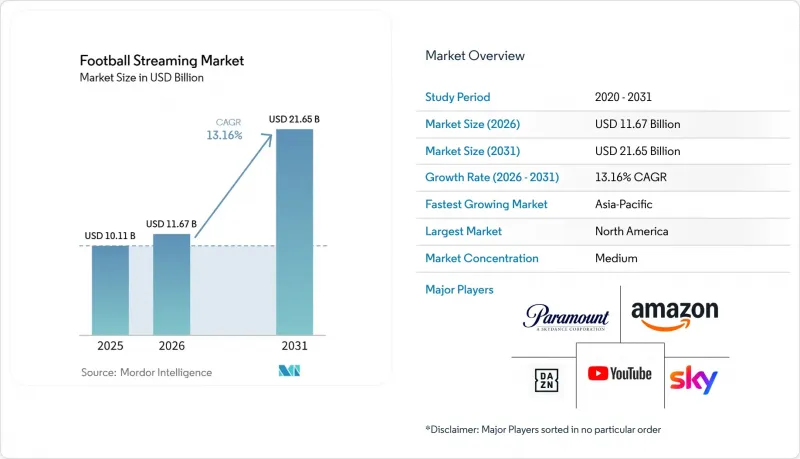
本報告按裝置類型(智慧型手機和平板電腦、智慧電視、筆記型電腦和桌上型電腦)、內容類型(國際賽事、國內賽事)、串流類型(直播、點播)以及地區(北美、南美、歐洲、亞太、中東和非洲)進行細分。市場預測以美元計價。
全球足球串流媒體市場的趨勢與洞察
串流媒體服務提供者增加了對優質足球轉播權的支出
足球串流媒體市場正日益轉向版權主導型模式。在這種模式下,掌控頂級賽事的轉播權正成為決定哪些平台能夠吸引用戶、留住用戶並塑造球迷全年觀賽習慣的關鍵因素。 DAZN 專注於加強其國內和國際轉播網路,就清楚地體現了這一趨勢。具體而言,DAZN 續簽了意甲聯賽、義大利盃和義大利超級盃在法國的獨家轉播權,並獲得了 2026 年義大利世界盃全部 104 場比賽的獨家轉播權。這些舉措之所以重要,是因為豐富的轉播權如今對平台價值的影響遠不止於直播。擁有更廣泛轉播權的服務可以降低用戶流失風險,讓球迷持續關注,從而在一年中更長的時間內觀看更多賽事。因此,小規模服務商進入足球串流媒體市場的難度也越來越大。轉播權價格的飆升不僅推高了收購成本,也提高了在主要足球市場維持營運所需的最低規模。此外,優質轉播權越來越集中在能夠整合聯賽、賽事直播和歷史內容的平台上,這使得每筆新交易都具有超越單純內容擴展的戰略意義。因此,在足球串流媒體市場,能夠跨多個平台和地區整合高價值足球內容的營運商將獲得豐厚回報,而競爭力較弱的營運商則只能提供更有限的套餐、特定地區或二線賽事。
從付費電視到直接面對消費者(DTC)的足球觀看方式的快速轉變。
足球串流媒體市場正穩步從傳統分銷模式轉型,並隨著直接數位接入的興起而加速發展。在這種模式下,平台對定價、套餐配置和球迷關係擁有更大的控制權。這項轉變體現在統籌機構和版權所有擁有者都在積極推動“串流媒體優先”協議,例如國際足總和DAZN聯合推出“FIFA+ on DAZN”,打造一個整合實況活動、歷史影像和原創節目的全球平台。足球串流媒體市場也正在透過區域性分銷策略不斷發展。例如,西甲聯賽與Begin在巴基斯坦、孟加拉和斯里蘭卡的獨家合作,旨在為盜版猖獗的地區提供合法且商業性可行的數位分銷管道。在北美,2026年世界盃已經展現了串流媒體在關鍵足球觀眾群體中與傳統電視轉播相媲美,甚至在某些方面超越傳統電視轉播的潛力。尤其值得一提的是,Peacock在西班牙語轉播領域首次超越了傳統電視的收視率。足球串流媒體市場正從這項轉型中受益。這是因為直接存取模式使平台能夠收集用戶數據、調整價格,並將足球賽事與其他數位服務捆綁銷售,其精細程度是傳統電視批發分銷模式無法企及的。預計這種直接接觸模式將在足球串流媒體市場進一步深化,尤其是在傳統付費電視系統價格昂貴、缺乏柔軟性或覆蓋年輕用戶群不足的國家。
廣播權成本飆升,導致版權所有擁有者和平檯面臨提高利潤率的壓力。
隨著優質轉播權成本持續上漲,足球串流媒體市場面臨持續的壓力,而許多服務商仍然嚴重依賴月度訂閱模式來收回投資。這一點在獨家多賽事套餐日益成長的重要性上體現得尤為明顯。對於營運商而言,即使這意味著成本增加和利潤率柔軟性降低,確保擁有足夠豐富的足球內容對於維持市場地位至關重要。 DAZN續簽了法國的轉播權,獲得了2026年義大利世界盃所有比賽的轉播權,並透過FIFA+不斷擴展足球內容,這些都表明競爭對手正在從單一賽事轉播轉向規模更大、更全面的轉播權組合。對於專業經營者而言,足球串流媒體市場是一個尤其具有挑戰性的環境,因為大規模生態系統可以透過廣告、電商、遊戲和其他配套服務來分攤足球相關成本,而這對於業務範圍較窄的營運商來說往往難以實現。這種不平衡意味著,不斷飆升的轉播權價格不僅會擠壓利潤空間,還會決定哪些公司能夠繼續參與未來合約週期的競標,哪些公司將被迫退守小規模或地理範圍較窄的市場。從長遠來看,足球串流媒體市場或許會繼續成長,但不斷上漲的轉播權成本仍然有可能削弱平台盈利,減少產品投資空間,並使平台難以保持競爭優勢。
細分市場分析
到2025年,智慧型手機和平板電腦將佔據足球串流媒體市場55.22%的佔有率,使其成為球迷的主要觀看方式。在行動連線優於固定寬頻、螢幕柔軟性比高階家庭硬體更為重要的市場環境下,行動裝置仍然是球迷的主要觀看管道。足球串流媒體市場仍然高度依賴行動設備,因為球迷觀看足球比賽往往首先考慮的是便攜性、即時通知和社交媒體的影響,尤其是在即時通訊應用和社交平臺上,比賽片段、說明和賽後反應不斷傳播的情況下。這一趨勢在南亞、東南亞、非洲和南美洲尤為顯著,這些地區的足球串流媒體產業持續擴張,這得益於價格實惠的行動資料通訊、智慧型手機普及率高以及新用戶進入門檻低。從實際角度來看,智慧型手機和平板電腦已經將足球串流融入了球迷的日常生活,讓他們可以在上班前、通勤途中或在其他活動間隙觀看比賽,而無需受限於特定地點。這種廣泛的普及性解釋了為什麼即使更高階的連網家庭體驗不斷發展,行動裝置仍然保持最大的市場佔有率。
預計從2026年到2031年,智慧電視的複合年成長率將達到13.42%,成為觀看高階足球賽事成長最快的大螢幕設備。越來越多的家庭選擇在客廳觀看比賽,而不是回歸傳統的付費電視套餐。智慧電視受益於這一轉變,提供更高的畫質、更沉浸式的比賽體驗,並方便球迷在觀看重要比賽時進行共享觀看——球迷們仍然更喜歡在大螢幕上觀看。 Fox、FS1和Tubi等平台世界盃收視率的激增進一步印證了這一觀點:觀看大規模足球賽事的管道正在從傳統電影片道擴展到整個現代互聯環境。在同一時期,Telemundo和Peacock也證明,串流媒體能夠滿足全國範圍內對足球賽事的大規模需求,這支持了高階數位觀看在家庭足球串流媒體市場中的長期潛力。雖然筆記型電腦和桌上型電腦在辦公室、學習和多任務處理環境中仍然很有用,遊戲機和第二螢幕格式也能增強參與度,但足球串流媒體市場的主要方向是建立穩固的行動基礎,以及聯網電視的快速成長。
區域分析
到2025年,歐洲將佔據全球足球串流媒體市場38.42%的佔有率,成為全球最大的市場。這主要得益於歐洲國內聯賽的商業性成熟以及主要足球區域的版權環境,使得多個競爭平台得以共存。歐洲足球串流媒體市場呈現出多層次的競爭格局,Sky、DAZN、Amazon Prime Video、Canal+和beIN Sports等公司並非採用簡單的「贏家通吃」模式,而是透過不同的轉播權組合、覆蓋不同國家以及在不同級別的競爭中展開競爭。 DAZN續簽了法甲聯賽的獨家轉播權至2028-29賽季,這表明各平台正尋求透過多聯賽的轉播權組合來建立長期的市場地位,從而透過單一訂閱延長用戶留存時間。在義大利,DAZN 獲得 2026 年 FIFA 世界盃全部 104 場比賽的獨家轉播權,這再次印證了足球串流媒體市場高階曝光度日益集中的趨勢,而這一趨勢的核心是那些能夠整合國內和國際資源的「數位優先」聚合平台。儘管歐洲仍然擁有強勁的獲利潛力,但由於版權分散、監管嚴格以及盜版問題等因素,該地區的足球串流媒體市場運作依然複雜,所有這些因素都會同時影響平台的經濟效益。
預計2026年至2031年間,北美地區的足球串流市場將以13.91%的複合年成長率成長,並有望成為成長最快的區域市場。這主要得益於2026年世界盃提升了觀眾認知度、平台滲透率和商業性信譽。福斯體育報告稱,2026年世界盃小組賽階段的收視率表現強勁。英語轉播的平均每場比賽觀眾人數為505萬,比2022年世界盃成長了92%,凸顯了該地區主流觀眾對足球日益成長的需求。康卡斯特也宣布,Telemundo和Peacock在世界盃期間的收視率均創下新高,其中Peacock的收視率首次超過了傳統電視轉播。這對於多語言環境和以串流媒體為主的家庭用戶而言,是一個重要的徵兆。北美足球串流媒體市場目前仍由多家訂閱服務商組成,較為分散。但隨著足球逐漸成為日常消費品,這種分散的格局也為商品搭售、聚合和跨平台提升銷售創造了空間。由於美國、加拿大和墨西哥都將參加2026年世界杯,與以往的世界杯週期相比,北美足球串流媒體市場擁有更堅實的持續成長基礎。
亞太、南美以及中東和非洲地區擁有足球串流媒體市場最長的成長潛力,但其獲利能力仍取決於廣播權的合理定價、本地分發模式的適用性、行動端的可及性以及透過合法途徑減少盜版的能力。在亞太地區,西甲聯賽與巴基斯坦、孟加拉和斯里蘭卡的Begin公司簽署的多年協議表明,足球串流媒體市場正在利用區域數位夥伴關係關係,改善價格敏感地區的合法觀看管道。這些地區對足球的需求旺盛,但傳統的付費分送系統卻不均衡。在南美,足球串流媒體市場持續受益於濃厚的足球文化和球迷的熱情,如果平台能夠根據當地實際情況調整定價和觀看方式,則擁有巨大的商業性成長潛力。在非洲和中東部分地區,足球串流媒體市場擁有龐大的受眾群體,但其成長仍然高度依賴「行動優先」的分發模式和真正實惠的價格。這是因為這些因素往往比世界頂級聯賽的理論人氣更為重要。
其他好處:
- Excel格式的市場預測(ME)表
- 3個月的分析師支持
目錄
第1章:引言
- 研究假設和市場定義
- 調查範圍
第2章:調查方法
第3章執行摘要
第4章 市場狀況
- 市場概覽
- 市場促進因素
- 串流媒體服務提供者增加了對優質足球轉播權的支出
- 足球內容從付費電視迅速轉向直接面對消費者的串流媒體播放。
- 對 5G、低延遲和多角度觀看的期待
- 透過第一方串流生態系統實現粉絲數據貨幣化
- 為服務不足的市場提供地區聯賽和俱樂部的直播服務。
- 足球串流媒體使用量的增加正在推動博彩、電商和會員服務的交叉銷售。
- 市場限制因素
- 版權費上漲,擁有者和平台利潤空間承壓
- 版權分配涵蓋各個聯盟、國家和設備。
- 盜版、非法再散佈和共用身分驗證訊息
- 尖峰時段交通事件規模延誤與可靠性風險
- 產業價值鏈分析
- 宏觀經濟因素對市場的影響
- 監理情勢
- 技術展望
- 波特五力分析
第5章 市場規模與成長預測
- 依設備類型
- 智慧型手機和平板電腦
- 智慧電視
- 筆記型電腦和桌上型電腦
- 其他設備類型
- 按內容類型
- 國際比賽
- 國內比賽
- 其他內容類型
- 按串流媒體類型
- 直播
- 點播串流媒體
- 其他串流媒體方法
- 按地區
- 北美洲
- 美國
- 加拿大
- 墨西哥
- 南美洲
- 巴西
- 阿根廷
- 智利
- 其他南美國家
- 歐洲
- 德國
- 英國
- 法國
- 義大利
- 西班牙
- 其他歐洲國家
- 亞太地區
- 中國
- 日本
- 印度
- 韓國
- 澳洲
- 其他亞太國家
- 中東
- 沙烏地阿拉伯
- 阿拉伯聯合大公國
- 卡達
- 其他中東國家
- 非洲
- 南非
- 埃及
- 奈及利亞
- 其他非洲國家
- 北美洲
第6章 競爭情勢
- 市場集中度
- 策略趨勢
- Vendor Positioning Analysis
- 公司簡介
- Amazon.com, Inc.
- Apple Inc.
- AT&T Inc.
- beIN Media Group LLC
- DAZN Group Limited
- DISH Network LLC
- Fox Corporation
- fuboTV Inc.
- Hulu, LLC
- NBCUniversal Media, LLC
- Paramount Global
- Peacock TV LLC
- Sky Limited
- Sony Pictures Networks India Private Limited
- Star India Private Limited
- Tencent Holdings Limited
- Viaplay Group AB
- Warner Bros. Discovery, Inc.
- YouTube LLC
- Zee Entertainment Enterprises Limited
第7章 市場機會與未來展望
According to Mordor Intelligence, the football streaming market size is expected to increase from USD 10.11 billion in 2025 to USD 11.67 billion in 2026 and reach USD 21.65 billion by 2031, growing at a CAGR of 13.16% over 2026-2031.
This report is Segmented by Device Type (Smartphones and Tablets, Smart TVs, and Laptops and Desktops), Content Type (International Matches, and Domestic Matches), Streaming Type (Live Streaming, and On-Demand Streaming), and Geography (North America, South America, Europe, Asia-Pacific, Middle East, and Africa). The Market Forecasts are Provided in Terms of Value (USD).
Global Football Streaming Market Trends and Insights
Rising Premium Football Rights Spending by Streamers
The football streaming market is moving deeper into a rights-led model, where control of premium competitions increasingly determines which platforms can win attention, hold subscribers, and shape wider fan habits across the year. The football streaming market is showing this pattern clearly through DAZN's push to strengthen both domestic and international coverage, including its renewal of exclusive Serie A, Coppa Italia, and Supercoppa Italiana rights in France and its position as the sole broadcaster of all 104 FIFA World Cup 2026 matches in Italy. These moves matter because rights depth now influences platform value beyond the live match itself, since a service with broader coverage can reduce cancellation risk and keep football fans inside one environment for more competitions and more months of the year. The football streaming market is therefore becoming harder for smaller services to navigate, because rights inflation does not only raise acquisition costs, it also raises the minimum scale needed to remain relevant in top football territories. Premium rights are also concentrating around platforms that can combine league access, tournament coverage, and archived content, which makes each new deal more strategically important than a simple inventory expansion. As a result, the football streaming market is rewarding players that can aggregate high-value football properties across multiple windows and geographies, while weaker operators are pushed toward narrower packages, selective territories, or secondary competitions.
Rapid Shift From Pay TV to Direct-to-Consumer Football Viewing
The football streaming market is gaining momentum from the steady move away from legacy distribution models and toward direct digital access that gives platforms fuller control over pricing, packaging, and the fan relationship. This shift is visible in the way governing bodies and rights holders are backing streaming-first arrangements, including FIFA and DAZN's launch of FIFA+ on DAZN as a consolidated global destination for live events, archive footage, and original programming. The football streaming market is also moving forward through region-specific distribution choices, such as LaLiga's exclusive partnership with Begin in Pakistan, Bangladesh, and Sri Lanka, which was designed to create a legal and more commercially workable digital option in a piracy-affected region. In North America, the 2026 World Cup has already shown that streaming can stand beside, and in some cases outperform, linear viewing for major football audiences, especially in Spanish-language coverage where Peacock passed linear delivery for the first time. The football streaming market benefits from this transition because direct access lets platforms collect user data, adjust price tiers, and bundle football with other digital services more precisely than traditional wholesale television distribution allowed. Over time, the football streaming market is likely to deepen this direct model further, especially in countries where old pay TV structures had limited affordability, weak flexibility, or poor reach among younger users.
Rights Inflation and Margin Pressure on Rights Holders and Platforms
The football streaming market faces persistent pressure because premium rights costs keep rising while many services still depend heavily on monthly subscription economics to recover those investments. The football streaming market shows this clearly in the growing importance of exclusive, multi-competition packages, where operators must secure enough football breadth to remain relevant, even when that breadth raises cost exposure and narrows margin flexibility. DAZN's rights renewals in France, its full World Cup 2026 position in Italy, and its continued expansion of football inventory through FIFA+ all show how competition is moving toward larger, more comprehensive rights stacks rather than isolated event coverage. The football streaming market is especially challenging for specialists because larger digital ecosystems can spread football costs across advertising, commerce, gaming, or other bundled services, while narrower operators often cannot. This imbalance means rights inflation does more than squeeze profits; it also shapes who can keep bidding in future cycles and who must step back into smaller or more local opportunities. Over time, the football streaming market may continue to grow, but rising rights costs can still weaken platform economics, reduce room for product investment, and make competitive positions harder to defend.
Other drivers and restraints analyzed in the detailed report include:
- Fan Data Monetization Through First-Party Streaming Ecosystems
- Rising Use of Football Streaming for Cross-Sell Into Betting, Commerce, and Memberships
- Piracy, Illegal Restreaming, and Credential Sharing
For complete list of drivers and restraints, kindly check the Table Of Contents.
Segment Analysis
Smartphones and tablets accounted for 55.22% of the football streaming market in 2025, which kept this category as the main access point for fans in markets where mobile connectivity is stronger than fixed broadband and where screen flexibility matters more than premium home hardware. The football streaming market still leans heavily on handheld devices because football consumption often starts with portability, instant notifications, and social spillover, especially when clips, commentary, and match reactions circulate continuously across messaging and social platforms. This pattern remains strong in South Asia, Southeast Asia, Africa, and South America, where the football streaming industry continues to expand through affordable mobile data, wide smartphone availability, and lower entry barriers for new users. In practical terms, smartphones and tablets keep the football streaming market close to day-to-day fan routines, because users can watch before work, during travel, and around fragmented schedules without depending on a fixed location. That broad accessibility helps explain why this device segment held the largest position even as more premium connected-home experiences continue to develop.
Smart TVs are projected to grow at a 13.42% CAGR from 2026 to 2031, which makes them the fastest-rising large-screen route for premium football access as households shift viewing back into the living room without returning to traditional pay TV bundles. The football streaming market is benefiting from that shift because smart TVs support better picture quality, more immersive match sessions, and stronger co-viewing behavior for marquee fixtures that fans still prefer to watch on a bigger screen. The World Cup audience surge across Fox, FS1, and Tubi also supports the idea that large-event football viewing is scaling across modern connected environments rather than only through legacy television channels. In the same period, Telemundo and Peacock showed that streaming can carry mass football demand at national-event level, which strengthens the long-term case for premium home-based digital viewing in the football streaming market. Laptops and desktops remain useful for office, study, and multitasking situations, while consoles and second-screen formats add incremental engagement value, but the core direction of the football streaming market points to a durable mobile base alongside faster connected-TV growth.
Complete Report Scope:
- By Device Type
- Smartphones and Tablets
- Smart TVs
- Laptops and Desktops
- Other Device Type
- By Content Type
- International Matches
- Domestic Matches
- Other Content Type
- By Streaming Type
- Live Streaming
- On-demand Streaming
- Other Streaming Type
- By Geography
- North America
- United States
- Canada
- Mexico
- South America
- Brazil
- Argentina
- Chile
- Rest of South America
- Europe
- Germany
- United Kingdom
- France
- Italy
- Spain
- Rest of Europe
- Asia-Pacific
- China
- Japan
- India
- South Korea
- Australia
- Rest of Asia-Pacific
- Middle East
- Saudi Arabia
- United Arab Emirates
- Qatar
- Rest of Middle East
- Africa
- South Africa
- Egypt
- Nigeria
- Rest of Africa
- North America
Geography Analysis
Europe accounted for 38.42% of the football streaming market in 2025, giving the region the largest position globally because its domestic leagues are commercially dense and its rights environment supports multiple competing platforms across major football territories. The football streaming market in Europe is defined by layered competition, where Sky, DAZN, Amazon Prime Video, Canal+, and beIN Sports operate through different rights bundles, different countries, and different competition tiers rather than through one simple winner-take-all model. DAZN's renewal of exclusive Serie A rights in France through the 2028-29 season shows how platforms are trying to build long-term relevance through multi-league portfolios that can hold fans inside one subscription for more of the calendar. In Italy, DAZN's exclusive control of all 104 FIFA World Cup 2026 matches adds another example of how the football streaming market is consolidating premium visibility around digital-first aggregators that can combine domestic and international reach. Europe still offers strong monetization potential, but the football streaming market here remains operationally complex because rights fragmentation, regulatory oversight, and piracy all affect platform economics at the same time.
North America is projected to grow at a 13.91% CAGR from 2026 to 2031, making it the fastest-growing regional bloc in the football streaming market as the 2026 World Cup expands audience familiarity, platform adoption, and commercial confidence. Fox Sports reported strong World Cup 2026 group-stage results, with average English-language viewership of 5.05 million viewers per match and a 92% increase versus the 2022 tournament, which highlights how mainstream football demand is broadening in the region. Comcast also stated that Telemundo and Peacock reached record viewership during the tournament, and that Peacock exceeded linear audience for the first time in this context, which is a major signal for the football streaming market in multilingual and streaming-first households. The football streaming market in North America is still fragmented across several subscription services, but that fragmentation also leaves room for bundling, aggregation, and cross-platform upsell as football becomes a more regular consumer category. With the United States, Canada, and Mexico all tied to the 2026 event cycle, the football streaming market in North America now has stronger foundations for sustained expansion than it had in earlier tournament periods.
Asia-Pacific, South America, the Middle East, and Africa together hold the longest runway for the football streaming market, although monetization still depends on rights affordability, local distribution fit, mobile access, and the ability to reduce piracy through legal convenience. In Asia-Pacific, LaLiga's multi-year Begin deal in Pakistan, Bangladesh, and Sri Lanka shows how the football streaming market is using regional digital partnerships to improve legal access in price-sensitive territories where football demand is high but traditional premium distribution has been uneven. In South America, the football streaming market continues to benefit from deep football culture and strong event intensity, which means the commercial upside is significant when platforms can match pricing and access with local realities. Across Africa and parts of the Middle East, the football streaming market has strong audience potential, but growth still depends heavily on mobile-first distribution models and practical affordability because those factors often matter more than the theoretical popularity of elite global leagues.
- Amazon.com, Inc.
- Apple Inc.
- AT&T Inc.
- beIN Media Group LLC
- DAZN Group Limited
- DISH Network L.L.C.
- Fox Corporation
- fuboTV Inc.
- Hulu, LLC
- NBCUniversal Media, LLC
- Paramount Global
- Peacock TV LLC
- Sky Limited
- Sony Pictures Networks India Private Limited
- Star India Private Limited
- Tencent Holdings Limited
- Viaplay Group AB
- Warner Bros. Discovery, Inc.
- YouTube LLC
- Zee Entertainment Enterprises Limited
Additional Benefits:
- The market estimate (ME) sheet in Excel format
- 3 months of analyst support
TABLE OF CONTENTS
1 INTRODUCTION
- 1.1 Study Assumptions and Market Definition
- 1.2 Scope of the Study
2 RESEARCH METHODOLOGY
3 EXECUTIVE SUMMARY
4 MARKET LANDSCAPE
- 4.1 Market Overview
- 4.2 Market Drivers
- 4.2.1 Rising Premium Football Rights Spending by Streamers
- 4.2.2 Rapid Shift From Pay TV to Direct-to-Consumer Football Viewing
- 4.2.3 5G, Low Latency, and Multi-Angle Viewing Expectations
- 4.2.4 Fan Data Monetization Through First-Party Streaming Ecosystems
- 4.2.5 Localized League and Club Streaming in Underserved Markets
- 4.2.6 Rising Use of Football Streaming for Cross-Sell Into Betting, Commerce, and Memberships
- 4.3 Market Restraints
- 4.3.1 Rights Inflation and Margin Pressure on Rights Holders and Platforms
- 4.3.2 Fragmented Rights Across Leagues, Countries, and Devices
- 4.3.3 Piracy, Illegal Restreaming, and Credential Sharing
- 4.3.4 Event-Scale Latency and Peak Traffic Reliability Risks
- 4.4 Industry Value Chain Analysis
- 4.5 Impact of Macroeconomic Factors on the Market
- 4.6 Regulatory Landscape
- 4.7 Technological Outlook
- 4.8 Porter's Five Forces Analysis
- 4.8.1 Bargaining Power of Suppliers
- 4.8.2 Bargaining Power of Buyers
- 4.8.3 Threat of New Entrants
- 4.8.4 Threat of Substitutes
- 4.8.5 Competitive Rivalry
5 MARKET SIZE AND GROWTH FORECASTS (VALUE)
- 5.1 By Device Type
- 5.1.1 Smartphones and Tablets
- 5.1.2 Smart TVs
- 5.1.3 Laptops and Desktops
- 5.1.4 Other Device Type
- 5.2 By Content Type
- 5.2.1 International Matches
- 5.2.2 Domestic Matches
- 5.2.3 Other Content Type
- 5.3 By Streaming Type
- 5.3.1 Live Streaming
- 5.3.2 On-demand Streaming
- 5.3.3 Other Streaming Type
- 5.4 By Geography
- 5.4.1 North America
- 5.4.1.1 United States
- 5.4.1.2 Canada
- 5.4.1.3 Mexico
- 5.4.2 South America
- 5.4.2.1 Brazil
- 5.4.2.2 Argentina
- 5.4.2.3 Chile
- 5.4.2.4 Rest of South America
- 5.4.3 Europe
- 5.4.3.1 Germany
- 5.4.3.2 United Kingdom
- 5.4.3.3 France
- 5.4.3.4 Italy
- 5.4.3.5 Spain
- 5.4.3.6 Rest of Europe
- 5.4.4 Asia-Pacific
- 5.4.4.1 China
- 5.4.4.2 Japan
- 5.4.4.3 India
- 5.4.4.4 South Korea
- 5.4.4.5 Australia
- 5.4.4.6 Rest of Asia-Pacific
- 5.4.5 Middle East
- 5.4.5.1 Saudi Arabia
- 5.4.5.2 United Arab Emirates
- 5.4.5.3 Qatar
- 5.4.5.4 Rest of Middle East
- 5.4.6 Africa
- 5.4.6.1 South Africa
- 5.4.6.2 Egypt
- 5.4.6.3 Nigeria
- 5.4.6.4 Rest of Africa
- 5.4.1 North America
6 COMPETITIVE LANDSCAPE
- 6.1 Market Concentration
- 6.2 Strategic Moves
- 6.3 Vendor Positioning Analysis
- 6.4 Company Profiles (includes Global Level Overview, Market Level Overview, Core Segments, Financials as available, Strategic Information, Market Rank/Share, Products and Services, Recent Developments)
- 6.4.1 Amazon.com, Inc.
- 6.4.2 Apple Inc.
- 6.4.3 AT&T Inc.
- 6.4.4 beIN Media Group LLC
- 6.4.5 DAZN Group Limited
- 6.4.6 DISH Network L.L.C.
- 6.4.7 Fox Corporation
- 6.4.8 fuboTV Inc.
- 6.4.9 Hulu, LLC
- 6.4.10 NBCUniversal Media, LLC
- 6.4.11 Paramount Global
- 6.4.12 Peacock TV LLC
- 6.4.13 Sky Limited
- 6.4.14 Sony Pictures Networks India Private Limited
- 6.4.15 Star India Private Limited
- 6.4.16 Tencent Holdings Limited
- 6.4.17 Viaplay Group AB
- 6.4.18 Warner Bros. Discovery, Inc.
- 6.4.19 YouTube LLC
- 6.4.20 Zee Entertainment Enterprises Limited
7 MARKET OPPORTUNITIES AND FUTURE OUTLOOK
- 7.1 White-Space and Unmet-Need Assessment

 美國直播基礎設施市場規模、佔有率和趨勢分析報告:按基礎設施組件、部署方式、最終用途和細分市場預測(2026-2033 年)
 OTT邊緣串流基礎設施:市場佔有率分析、產業趨勢與統計及成長預測(2026-2031年)
 影片串流媒體與廣播設備市場-2026-2032年全球市場預測線上電影市場-2026-2032年全球市場預測OTT電視劇:市場佔有率分析、產業趨勢與統計、成長預測(2026-2031)影片串流媒體市場-2026-2032年全球市場預測籃球直播:市場佔有率分析、產業趨勢與統計、成長預測(2026-2031)視訊串流基礎設施:市場佔有率分析、產業趨勢與統計、成長預測(2026-2031)
 2026-2030年全球影像串流媒體及廣播設備市場影片串流:市場佔有率分析、產業趨勢與統計、成長預測(2026-2031)