


 |
市場調查報告書
商品編碼
2097365
英國國內宅配( 小包裹):市場佔有率分析、產業趨勢與統計、成長預測(2026-2031)United Kingdom Domestic Courier, Express and Parcel (CEP) - Market Share Analysis, Industry Trends & Statistics, Growth Forecasts (2026 - 2031) |
||||||

※ 本網頁內容可能與最新版本有所差異。詳細情況請與我們聯繫。
根據 Mordor Intelligence 預測,英國國內宅配、快遞和小包裹(CEP) 市場規模預計將從 2025 年的 120.5 億美元成長到 2026 年的 124.6 億美元,到 2031 年達到 151.3 億美元,2026 年至 2031 年的複合年成長率為 3.96%。
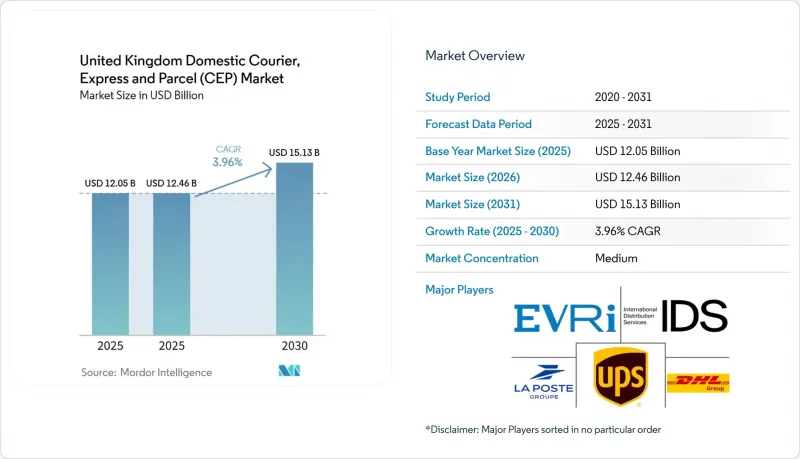
本報告按配送速度(快遞、非快遞)、貨物重量(輕型、中型等)、最終用戶行業(電子商務、製造業等)、經營模式(B2B等)和運輸方式(公路、航空、其他)進行分類。市場預測以美元計價。
英國國內宅配( 小包裹)市場趨勢與分析
中小企業採用全通路履約推動電子商務小包裹量成長
中小型零售商正在整合線上和線下庫存,導致小包裹密度增加,國內宅配網路的訂單量也隨之上升。英國脫歐後供應鏈的本土化趨勢意味著,57%的物流經理現在從國內採購商品,進一步加劇了英國國內宅配市場的貨物流向。政府平均為每家物流公司提供38,315美元的人工智慧津貼,幫助中小企業準確預測需求,並緩解先前導致運力緊張的高峰期。更高的可視性使承運商能夠動態分配配送車輛,從而支援中重型貨物的持續成長,並增強收入的穩定性。
城市微型倉配中心縮短了倫敦和其他主要城市的最後一公里配送。
Accenture的一項分析顯示,選址合適的微型倉配中心(MFC)預計可將人口密集城市的貨車行駛里程減少高達26%,同時降低排放和最後一公里配送成本。倫敦交通局(TfL)預測,一旦建成一定數量的微型配送中心,配送交通量將減少13%,這項結果符合嚴格的超低排放區(ULEZ)法規,目前已有96.7%的車輛符合該法規。亞馬遜與鐵路相連的配送中心是微型配送中心如何與國家基礎設施整合的絕佳範例,使電動卡車能夠完成最後一公里配送,而無需擔心續航里程。地理位置的接近性是一項顯著優勢,尤其是在低溫運輸藥品運輸中,溫度波動是不可接受的。
嚴重的司機短缺正在加速最後一公里配送服務的薪資上漲。
根據英國物流協會(Logistics UK)的數據,由於運輸公司競相爭奪稀缺人才,重型貨運司機的薪水在最近的報告期間上漲了12%。目前駕駛者的平均年齡已超過50歲,隨著英國脫歐後來自歐洲的新進員工人數減少,尋找替代者的難度也日益增加。政府已累計1600萬美元用於維修卡車停靠站,但職位空缺仍然居高不下,尤其是在最後一公里配送領域,由於直接與客戶的接觸限制了自動化程度。薪資上漲給利潤率帶來了壓力,迫使營運商轉向自動駕駛解決方案和電氣化技術以抵消人事費用。
基於細分市場的分析
2025年,電子商務佔英國國內宅配市場佔有率的30.17%,但服裝等關鍵品類的滲透率趨於平緩,成長速度也維持在市場平均水準。相較之下,醫療保健配送預計將以6.37%的複合年成長率(2026-2031年)成長,這主要得益於藥房直接向患者配送藥品以及支撐高價位的嚴格低溫運輸標準。英國國內宅配業越來越依賴保溫電動貨車和資料登錄設備,以確保生技藥品的溫度維持在8°C以下。
在製造業領域,由於國內供應商採用準時制(JIT)系統應對邊境中斷,需求保持穩定。同時,在金融服務領域,即使在數位化程度不斷提高的背景下,安全的文件遞送仍然至關重要。可再生能源組件和電動車零件屬於「其他」類別,它們對超大小包裹的需求雖然不時出現,但盈利,擁有專業處理認證的承運商可以從中獲利。
快遞服務是成長最快的細分市場,年複合成長率(CAGR)為5.98%(2026-2031年)。同時,截至2025年,非快遞服務佔英國國內宅配市場的73.03%。 DPD的自主機器人目前在30個配送中心運作,是快遞公司如何在控制不斷上漲的人事費用的同時,確保當日送達時段的滿載運轉的絕佳例證。零售商對可靠配送的日益重視導致了更高的定價,從而抵消了高昂的技術投資成本。非快遞公司正專注於路線整合以實現成本優勢,這使得英國國內宅配市場能夠同時滿足注重成本和速度的客戶的需求。
DPD、Evri-DHL 和英國皇家郵政現在透過 API 發布取件截止時間,讓經銷商在不影響隔天送達的前提下設定更晚的訂單截止時間。同時,英國皇家郵政已將國內貨運量減少了一半,每年減少 3 萬噸二氧化碳排放,同時維持了隔日送達服務。這種成本和二氧化碳排放的雙重最佳化確保了快遞服務仍然是英國國內宅配市場的重要支柱,而標準服務則為大量的電子商務物流奠定了基礎。
其他好處:
- Excel格式的市場預測(ME)表
- 3個月的分析師支持
目錄
第1章:引言
- 市場分析與定義的前提條件
- 分析範圍
第2章 分析方法
第3章執行摘要
第4章 市場狀況
- 市場概覽
- 人口統計數據
- GDP細分:依經濟活動分類
- 國內生產毛額成長率:依經濟活動分類
- 通貨膨脹率
- 經濟表現及概覽
- 電子商務產業趨勢
- 製造業的發展趨勢
- 運輸和倉儲部門的GDP
- 出口趨勢
- 進口趨勢
- 燃油價格
- 基礎設施
- 法律規範
- 價值鍊和通路分析
- 價值鍊和通路分析
- 市場促進因素
- 中小企業採用全通路履約推動電子商務小包裹量成長
- 城市微型倉配中心縮短了倫敦和其他主要城市的最後一公里配送。
- 透過擴大異地配送網路(宅配櫃和門市)來減少配送失敗
- 利用數位化工具的隨選配送司機現在可以在 30 分鐘內滿足配送需求。
- 零售商整合配送合作夥伴關係,推動了高階當日達服務的成長。
- 政府的淨零排放獎勵正在加速電動外送車的推廣應用。
- 市場限制因素
- 最後一公里配送服務中嚴重的司機短缺正在加速薪資上漲。
- 堵塞費和清潔空氣區收費給以柴油動力為主的車隊的利潤率帶來了壓力。
- 顧客對免費退貨的期望日益提高,這對逆向物流帶來了更大的成本壓力。
- 針對宅配櫃的破壞行為激增,增加了快遞網路基礎設施投資的風險。
- 市場上的技術創新
- 波特五力分析
第5章 市場規模與成長預測
- 運輸速度
- 快遞
- 除了快遞之外
- 運輸重量
- 重型貨物
- 輕型貨物
- 中等重量貨物
- 終端用戶產業
- 電子商務
- 金融服務(BFSI)
- 醫療保健
- 製造業
- 一級產業
- 批發和零售貿易(線下)
- 其他
- 模型
- B2B (Business-to-Business)
- B2C (Business-to-Consumer)
- C2C(消費者對消費者交易)
- 交通工具
- 路
- 航空
- 其他
第6章 競爭情勢
- 市場集中度
- 關鍵策略趨勢
- 市佔率分析
- 公司簡介
- AnyVan, Ltd.(Owned by Vitruvian Partners LLP)
- ArrowXL, Ltd.
- ComfortDelGro(Including Addison Lee, Ltd.)
- DHL Group
- DX Group(Owned by HIG Capital, LLC)
- Evri, Ltd.(Acquired by Apollo Global Management)
- FedEx
- Freedom Couriers, Ltd.
- InPost(Including Yodel Delivery Network Ltd./Judge Logistics, Ltd.)
- International Distribution Services PLC(Including Royal Mail)
- Kuehne+Nagel(Including QUICK UP)
- LaPoste Group(Including DPD Group and CitySprint(UK), Ltd.)
- Menzies Distribution, Ltd.(Including Gnewt Cargo, Ltd.)
- Parker Couriers(Part of Parker Car Service)
- Quickshift UK, Ltd.
- Rapid Fleet, Ltd.
- Redhead Couriers, Ltd.
- Speedy Fleet, Ltd.
- TVS SCS Courier Services(Part of TVS Group)
- United Parcel Service of America, Inc.(UPS)
- Whistl UK, Ltd.
第7章 市場機會與未來展望
According to Mordor Intelligence, the United Kingdom domestic courier, express and parcel market size is expected to increase from USD 12.05 billion in 2025 to USD 12.46 billion in 2026 and reach USD 15.13 billion by 2031, growing at a CAGR of 3.96% over 2026-2031.
This report is Segmented by Speed of Delivery (Express and Non-Express), by Shipment Weight (Light Weight Shipments, Medium Weight Shipments and More), by End User Industry (E-Commerce, Manufacturing and More), by Model (Business-To-Business (B2B) and More) and by Mode of Transport (Road, Air, and Others). The Market Forecasts are Provided in Terms of Value (USD).
United Kingdom Domestic Courier, Express and Parcel (CEP) Market Trends and Insights
Growth in E-commerce Parcel Volumes Driven by SMEs Adopting Omnichannel Fulfillment
Small and medium-sized retailers are integrating online and store inventory, which lifts parcel density and pushes more orders into domestic courier networks. Post-Brexit localization of supply chains means 57% of logistics managers now source goods domestically, further concentrating shipment flows inside the United Kingdom domestic courier market. Government AI grants averaging USD 38,315 per logistics firm help SMEs forecast demand accurately, smoothing peaks that once strained capacity. Higher visibility encourages carriers to allocate vans dynamically, supporting sustained medium-weight growth and underpinning revenue resilience.
Urban Micro-Fulfillment Centers Shortening Last-Mile Distances in London and Major Cities
Accenture analysis estimates that well-placed Micro-fulfillment centers (MFCs) can reduce parcel-van km by up to 26% in dense cities, cutting emissions and last-mile costs simultaneously. Transport for London projects a 13% drop in delivery traffic once a critical MFC mass is reached, an outcome that dovetails with strict Ultra Low Emission Zone (ULEZ) rules already met by 96.7% of vehicles. Amazon's rail-connected depots exemplify how MFCs integrate with national infrastructure, enabling electric trucks to complete the final leg of delivery without range anxiety. Closer proximity especially benefits cold-chain pharmaceutical shipments that cannot tolerate temperature excursions.
Acute Driver Shortages Amplifying Wage Inflation in Last-Mile Operations
Logistics UK data show heavy-goods-vehicle driver pay increased 12% in the most recent reporting window as haulers bid for scarce talent. Average driver age now exceeds 50, intensifying replacement challenges as European recruits decline post-Brexit. Although the government earmarked USD 16 million for truck-stop upgrades, vacancy rates remain high, particularly in last-mile roles where direct customer contact limits automation. Elevated wages compress margins and push operators toward autonomous solutions and electrification to offset personnel costs.
Other drivers and restraints analyzed in the detailed report include:
- Expansion of Out-of-Home Delivery Networks Reducing Failed Deliveries
- On-Demand Gig Couriers Catering to less than 30-Minute Delivery Market
- High Customer Expectation for Free Returns Increasing Reverse Logistics Cost Pressure
For complete list of drivers and restraints, kindly check the Table Of Contents.
Segment Analysis
E-commerce commanded 30.17% of the United Kingdom domestic courier market share in 2025, however, penetration levels in core categories such as apparel are flattening, moderating growth to the overall market rate. In contrast, Healthcare deliveries are forecast to expand at 6.37% CAGR (2026-2031), propelled by direct-to-patient pharmacy services and stringent cold-chain standards that favor premium pricing. The United Kingdom domestic courier industry increasingly relies on insulated EV vans and data-logging devices that ensure temperatures of 8 °C or lower for biologics.
Manufacturing maintains consistent demand as domestic suppliers adopt just-in-time flows to guard against border disruption, while Financial Services continue to require secure document transfer despite digitalization. Renewable-energy components and EV parts enter the Others bucket, creating sporadic but lucrative oversized-parcel demand that carriers with specialist handling endorsements can capture.
Express services represented the faster-expanding tier, growing at a 5.98% CAGR (2026-2031), while non-express accounted for 73.03% of the United Kingdom domestic courier market size in 2025. DPD's autonomous robots, now active at 30 depots, illustrate how Express players can contain rising labor costs while still meeting same-day windows. Retailer preference for guaranteed delivery drives premium rates that offset higher technological outlays. Non-Express operators emphasize route consolidation to achieve cost advantages, positioning the United Kingdom domestic courier market to serve both value-driven and speed-sensitive customer segments.
DPD, Evri-DHL, and Royal Mail now publish late-collection cut-off times via API, permitting merchants to offer later order deadlines without jeopardizing next-day arrival. At the same time, Royal Mail's halving of domestic flights removes 30,000 tons of CO2 annually while safeguarding next-day performance. This dual optimization of cost and carbon ensures Express remains a key contributor to the United Kingdom domestic courier market while standard services anchor high-volume e-commerce flows.
Complete Report Scope:
- Speed of Delivery
- Express
- Non-Express
- Shipment Weight
- Heavy Weight Shipments
- Light Weight Shipments
- Medium Weight Shipments
- End User Industry
- E-Commerce
- Financial Services (BFSI)
- Healthcare
- Manufacturing
- Primary Industry
- Wholesale and Retail Trade (Offline)
- Others
- Model
- Business-to-Business (B2B)
- Business-to-Consumer (B2C)
- Consumer-to-Consumer (C2C)
- Mode of Transport
- Road
- Air
- Others
List of Companies Covered in this Report:
- AnyVan, Ltd. (Owned by Vitruvian Partners LLP)
- ArrowXL, Ltd.
- ComfortDelGro (Including Addison Lee, Ltd.)
- DHL Group
- DX Group (Owned by H.I.G. Capital, LLC)
- Evri, Ltd. (Acquired by Apollo Global Management)
- FedEx
- Freedom Couriers, Ltd.
- InPost (Including Yodel Delivery Network Ltd./Judge Logistics, Ltd.)
- International Distribution Services PLC (Including Royal Mail)
- Kuehne+Nagel (Including QUICK UP)
- LaPoste Group (Including DPD Group, and CitySprint (UK), Ltd.)
- Menzies Distribution, Ltd. (Including Gnewt Cargo, Ltd.)
- Parker Couriers (Part of Parker Car Service)
- Quickshift UK, Ltd.
- Rapid Fleet, Ltd.
- Redhead Couriers, Ltd.
- Speedy Fleet, Ltd.
- TVS SCS Courier Services (Part of TVS Group)
- United Parcel Service of America, Inc. (UPS)
- Whistl UK, Ltd.
Additional Benefits:
- The market estimate (ME) sheet in Excel format
- 3 months of analyst support
TABLE OF CONTENTS
1 Introduction
- 1.1 Study Assumptions and Market Definition
- 1.2 Scope of the Study
2 Research Methodology
3 Executive Summary
4 Market Landscape
- 4.1 Market Overview
- 4.2 Demographics
- 4.3 GDP Distribution by Economic Activity
- 4.4 GDP Growth by Economic Activity
- 4.5 Inflation
- 4.6 Economic Performance and Profile
- 4.6.1 Trends in E-Commerce Industry
- 4.6.2 Trends in Manufacturing Industry
- 4.7 Transport and Storage Sector GDP
- 4.8 Export Trends
- 4.9 Import Trends
- 4.10 Fuel Price
- 4.11 Infrastructure
- 4.12 Regulatory Framework
- 4.13 Value Chain and Distribution Channel Analysis
- 4.14 Value Chain and Distribution Channel Analysis
- 4.15 Market Drivers
- 4.15.1 Growth in E-Commerce Parcel Volumes Driven by SMEs Adopting Omnichannel Fulfilment
- 4.15.2 Urban Micro-Fulfilment Centers Shortening Last-Mile Distances in London and Major Cities
- 4.15.3 Expansion of Out-of-Home Delivery Networks (Parcel Lockers and Shops) Reducing Failed Deliveries
- 4.15.4 On-Demand Gig Couriers, Empowered by Digital Tools, are Now Catering to the Sub-30-Minute Delivery Market
- 4.15.5 Retailer Consolidation of Delivery Partnerships Boosting Premium Same-Day Growth
- 4.15.6 Government Net-Zero Incentives Accelerating Electric Delivery-Van Fleet Adoption
- 4.16 Market Restraints
- 4.16.1 Acute Driver Shortages Amplifying Wage Inflation in Last-Mile Operations
- 4.16.2 Congestion and Clean Air Zone Charges Eroding Margins for Diesel-Heavy Fleets
- 4.16.3 High Customer Expectation for Free Returns Increasing Reverse Logistics Cost Pressure
- 4.16.4 Surge in Parcel Locker Vandalism Heightens Capital Expenditure Risks for Delivery Networks
- 4.17 Technology Innovations in the Market
- 4.18 Porter's Five Forces Analysis
- 4.18.1 Competitive Rivalry
- 4.18.2 Bargaining Power of Buyers
- 4.18.3 Bargaining Power of Suppliers
- 4.18.4 Threat of New Entrants
- 4.18.5 Threat of Substitutes
5 Market Size and Growth Forecasts (Value, USD)
- 5.1 Speed of Delivery
- 5.1.1 Express
- 5.1.2 Non-Express
- 5.2 Shipment Weight
- 5.2.1 Heavy Weight Shipments
- 5.2.2 Light Weight Shipments
- 5.2.3 Medium Weight Shipments
- 5.3 End User Industry
- 5.3.1 E-Commerce
- 5.3.2 Financial Services (BFSI)
- 5.3.3 Healthcare
- 5.3.4 Manufacturing
- 5.3.5 Primary Industry
- 5.3.6 Wholesale and Retail Trade (Offline)
- 5.3.7 Others
- 5.4 Model
- 5.4.1 Business-to-Business (B2B)
- 5.4.2 Business-to-Consumer (B2C)
- 5.4.3 Consumer-to-Consumer (C2C)
- 5.5 Mode of Transport
- 5.5.1 Road
- 5.5.2 Air
- 5.5.3 Others
6 Competitive Landscape
- 6.1 Market Concentration
- 6.2 Key Strategic Moves
- 6.3 Market Share Analysis
- 6.4 Company Profiles (Includes Global Level Overview, Market Level Overview, Core Segments, Financials as Available, Strategic Information, Market Rank/Share for Key Companies, Products and Services, and Recent Developments)
- 6.4.1 AnyVan, Ltd. (Owned by Vitruvian Partners LLP)
- 6.4.2 ArrowXL, Ltd.
- 6.4.3 ComfortDelGro (Including Addison Lee, Ltd.)
- 6.4.4 DHL Group
- 6.4.5 DX Group (Owned by H.I.G. Capital, LLC)
- 6.4.6 Evri, Ltd. (Acquired by Apollo Global Management)
- 6.4.7 FedEx
- 6.4.8 Freedom Couriers, Ltd.
- 6.4.9 InPost (Including Yodel Delivery Network Ltd./Judge Logistics, Ltd.)
- 6.4.10 International Distribution Services PLC (Including Royal Mail)
- 6.4.11 Kuehne+Nagel (Including QUICK UP)
- 6.4.12 LaPoste Group (Including DPD Group, and CitySprint (UK), Ltd.)
- 6.4.13 Menzies Distribution, Ltd. (Including Gnewt Cargo, Ltd.)
- 6.4.14 Parker Couriers (Part of Parker Car Service)
- 6.4.15 Quickshift UK, Ltd.
- 6.4.16 Rapid Fleet, Ltd.
- 6.4.17 Redhead Couriers, Ltd.
- 6.4.18 Speedy Fleet, Ltd.
- 6.4.19 TVS SCS Courier Services (Part of TVS Group)
- 6.4.20 United Parcel Service of America, Inc. (UPS)
- 6.4.21 Whistl UK, Ltd.
7 Market Opportunities and Future Outlook
- 7.1 White-Space and Unmet-Need Assessment

 美國國際快遞小包裹宅配(CEP):市場佔有率分析、行業趨勢和統計數據以及成長預測(2026-2031 年)印度國內宅配和小包裹(CEP):市場佔有率分析、行業趨勢和統計數據以及成長預測(2026-2031 年)日本國內宅配、快捷郵件和小包裹:市場佔有率分析、行業趨勢和統計數據以及成長預測(2026-2031 年)
 小包裹遞送市場規模、佔有率和成長分析:按服務類型、遞送速度、小包裹重量、最終用戶、運輸方式和地區分類-2026-2033年產業預測宅配、速遞和小包裹遞送 (CEP):市場佔有率分析、行業趨勢和統計數據以及成長預測 (2026-2031)
 全球宅配、包裹及小包裹市場-2026-2032年市場預測視訊串流平台:市場佔有率分析、產業趨勢與統計、成長預測(2026-2031)
 代出貨市場規模、佔有率和成長分析:按產品類型、經營模式、平台類型、供應商類型、公司規模、銷售管道、最終用戶和地區分類-2026-2033年產業預測
 快遞小包裹宅配(CEP) 市場規模、佔有率和成長分析:按服務類型、目的地、運輸方式、遞送速度、包裹重量和地區分類-2026-2033 年產業預測
 生鮮食品在地化配送市場:預測至 2034 年 -產品類型、配送模式、平台類型、訂單規模、支付方式、最終用戶和地區分類的全球分析